
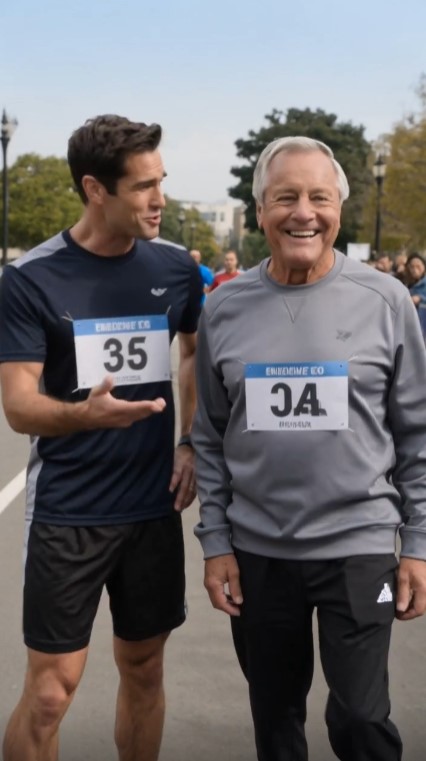
Everyone laughed when the 76-year-old man stepped onto the starting line.
He wasn’t wearing expensive running shoes.
He wasn’t stretching.
He wasn’t even there to win.
A younger runner looked at him.
“Sir… are you sure about this?”
The old man smiled.
“I only need to reach one place.”
The race started.
Hundreds ran past him.
Within minutes…
He was almost last.
But he kept going.
One mile.
Then two.
Then three.
Spectators began cheering for him.
But near the halfway point…
He suddenly stopped.
He walked through the crowd…
And stood in front of a young woman in a wheelchair.
She looked up at him.
Then burst into tears.
The old man removed his race number…
And handed it to her.
“I made it.”
The woman hugged him.
Nobody understood why.
Then she showed him something on her phone.
A photograph of another runner…
Wearing the exact same number.
The old man stared at it.
“That was my son.”
The young woman nodded.
“He saved my life.”
Then she handed the old man a sealed note.
“Your son asked me to give you this…”
“If you ever came back to this race.”
The old man’s hands began shaking.
Because his son had been gone for years.
And nobody had told him this letter existed.
His name was Henry Carter.
His son’s name was Daniel.
And seven years earlier, Daniel had stood on that exact starting line wearing race number 418.
Henry looked down at the number pinned to his own shirt.
He hadn’t requested it.
When he registered, he’d simply told the organizers that his son had run the race years earlier.
A volunteer disappeared for several minutes.
Then returned carrying an old race number.
“We found this in storage,” she said.
“You should wear it.”
Henry had no idea it was Daniel’s actual number.
Now he understood.
The young woman wiped tears from her face.
“My name is Rachel.”
Henry looked at the envelope.
“How did you know I’d be here?”
“I didn’t.”
“Then why bring this?”
Rachel looked toward the racecourse.
“Because I’ve brought it every year.”
Henry froze.
“Every year?”
“For six years.”
She had attended the race every spring.
Same location.
Same spot near the halfway point.
And every year, the sealed envelope sat inside her bag.
Waiting.
Henry slowly sat on the curb beside her wheelchair.
The race continued around them.
Runners passed.
People cheered.
Music played from speakers.
But Henry heard almost none of it.
“Tell me what happened.”
Rachel nodded.
Seven years earlier, she had been twenty-four.
She had recently moved to the city.
She knew almost nobody.
Running was the one thing that made the unfamiliar place feel manageable.
So she registered for her first half-marathon.
Daniel was thirty-six.
He was an experienced runner.
He wasn’t competing seriously that day either.
He was pacing a friend.
Rachel had never met him.
They wouldn’t have spoken at all if Rachel hadn’t collapsed near mile six.
She remembered feeling dizzy.
Then everything went dark.
The next thing she remembered was waking in the hospital.
Daniel had been running several yards behind her.
He saw her fall.
He stopped immediately.
While other runners called emergency services, Daniel stayed beside her.
He kept talking to her.
He helped responders locate her emergency information.
Then he rode to the hospital because Rachel had nobody nearby.
Henry looked confused.
“He went with you?”
Rachel nodded.
“He stayed until almost midnight.”
“That sounds like Daniel.”
“He missed the rest of the race.”
Henry smiled sadly.
“He wouldn’t have cared.”
Rachel’s collapse revealed a previously undiagnosed heart condition.
Doctors told her that getting medical attention quickly had mattered enormously.
Daniel didn’t perform some impossible miracle.
He simply stopped.
He noticed someone needed help and refused to continue until she was safely in the hands of medical professionals.
The next morning, he returned to the hospital.
He brought coffee.
And the medal organizers had given him despite not finishing.
“He gave it to me,” Rachel said.
“Why?”
“He said I had the harder race.”
Henry laughed.
“That definitely sounds like him.”
Rachel and Daniel remained friends.
At first, it was occasional messages.
Then coffee.
Birthdays.
Holiday cards.
Daniel met Rachel’s parents when they visited.
Rachel met Daniel’s wife, Laura, and their young daughter, Sophie.
Eventually, Rachel stopped thinking of Daniel as the stranger who’d helped her during a race.
He became family.
Three years later, Rachel was involved in a serious car accident.
Her spinal injuries left her unable to walk.
Henry looked toward her wheelchair.
Rachel nodded.
“That was four years after the race.”
Daniel visited her rehabilitation center constantly.
He refused to let her disappear into herself.
When Rachel said she’d never return to the race, Daniel disagreed.
“You don’t have to run it.”
“I can’t run.”
“I didn’t say run.”
“What am I supposed to do?”
“Come back.”
Daniel promised that one day they would return together.
He would run.
Rachel would wait near the halfway point.
When Daniel reached her, he’d stop.
Just as he’d stopped the first time they met.
Rachel smiled as she remembered it.
“He said mile six belonged to us.”
Henry looked at the spot where they were sitting.
“This is it?”
Rachel nodded.
“Almost exactly.”
But Daniel never got the chance.
Two years later, he became seriously ill.
His condition progressed quickly.
Henry had been beside him during those final months.
So had Laura and Sophie.
But Daniel never told Henry about the letter.
“Why?” Henry asked.
Rachel looked at the envelope.
“I think you need to read it.”
Henry examined the handwriting.
It was Daniel’s.
Across the front:
DAD
Underneath, smaller:
ONLY IF HE COMES BACK TO MILE SIX.
Henry opened it.
The first line made him smile.
Dad, if you’re reading this, then you’ve finally done something I’ve been asking you to do for twenty years. You showed up to one of my races.
Henry laughed.
Then covered his mouth.
Daniel had always asked him to come.
Henry always had an excuse.
Work.
Bad knees.
Crowds.
Parking.
Too early.
Too far.
“I’ll come to the next one,” Henry would say.
There was always supposed to be a next one.
Until there wasn’t.
Henry continued reading.
Don’t feel guilty. I knew you were proud of me. You didn’t have to stand behind a barrier holding a ridiculous sign for me to know that.
Henry wiped his eyes.
Then the letter changed.
Daniel explained Rachel.
Not the medical details.
Not the accident.
He wrote about what she’d taught him.
The day Rachel collapsed, I thought I stopped my race to help her.
Years later, I realized she stopped me.
I was running through everything back then. Work. Marriage. Fatherhood. Life. I was always trying to reach the next thing.
Rachel taught me that sometimes the important part isn’t the finish line.
It’s noticing who is beside the road.
Henry stopped reading.
Rachel was crying again.
“So he gave this to you?”
“Three weeks before he died.”
“And told you to wait?”
“Yes.”
“For me?”
Rachel nodded.
“He said you’d eventually come.”
Henry shook his head.
“Daniel knew I hated running.”
“He said you were stubborn.”
“He was right.”
“He said that too.”
Henry laughed.
Then he returned to the letter.
Near the bottom was one final request.
Dad, if you ever come to this race, don’t finish it for me.
Stop at mile six.
Give Rachel my number.
Then look inside the back pocket.
Henry frowned.
“Back pocket?”
Rachel looked confused too.
Henry turned his race bib over.
Nothing.
Then he remembered the small belt organizers had given him with Daniel’s archived race materials.
He opened its tiny rear compartment.
Inside was a folded piece of paper sealed in plastic.
Henry stared at Rachel.
“Did you know about this?”
“No.”
He opened it.
It wasn’t another letter.
It was a child’s drawing.
A little girl had drawn three people.
One was running.
One sat in what looked like a wheelchair.
And one older man stood between them.
Across the top, in a child’s handwriting, were the words:
GRANDPA’S TURN.
Henry recognized the handwriting.
“Sophie.”
Daniel’s daughter.
Rachel nodded.
“She was nine when Daniel died.”
Henry turned the drawing over.
Daniel had written:
Sophie thinks you’ll eventually do the race. I told her she’s overly optimistic. Please prove me wrong.
Henry laughed so loudly that several spectators looked over.
Then he cried harder than he had since his son’s funeral.
Rachel reached for his hand.
“He wasn’t asking you to become a runner.”
Henry nodded.
“He was asking me to show up.”
Exactly.
For most of Henry’s life, showing love meant providing.
He worked overtime.
Paid bills.
Fixed things.
Drove Daniel to school.
Helped him buy his first car.
When Daniel became an adult, Henry assumed his son understood.
And Daniel did.
But Henry had missed things.
Races.
Weekend gatherings.
Small moments he believed could always happen later.
Daniel’s letter wasn’t an accusation.
That somehow made it hurt more.
It was permission.
Permission to stop regretting what he’d missed and start showing up for what remained.
Henry looked toward the course.
“Rachel.”
“Yes?”
“I think I’m supposed to give you this.”
He removed number 418.
He handed it to her.
Rachel pressed the bib against her chest.
For several seconds, she couldn’t speak.
“I’ve waited six years for this.”
Henry smiled.
“Sorry I’m slow.”
Rachel laughed.
“You’re seventy-six.”
“I meant in general.”
A race volunteer approached.
“Sir, are you okay?”
Henry nodded.
“I think I’m finished.”
Rachel looked at him.
“No.”
Henry raised an eyebrow.
She pointed toward the course.
“You’re halfway.”
“Daniel specifically told me not to finish.”
“He told you not to finish it for him.”
Henry stared at her.
Rachel smiled.
“Finish it for yourself.”
Henry looked toward the distant road.
Six more miles.
His legs already hurt.
His back was stiff.
He had trained for months just to reach this point.
“I can’t.”
Rachel shook her head.
“That’s not what your son would’ve said.”
Henry laughed.
“You didn’t know him long enough. He absolutely would’ve said that.”
Then a voice came from behind them.
“Grandpa.”
Henry turned.
A young woman stood in the crowd.
Sophie.
Now sixteen.
Henry’s granddaughter was holding a sign.
It read:
I KNEW YOU’D SHOW UP.
Henry stared at her.
“You knew?”
Sophie smiled.
“Rachel called me when you registered.”
“You two planned this?”
Rachel shrugged.
“Only the cheering part.”
Henry shook his head.
Then Sophie stepped forward.
“Dad would be proud.”
Henry’s face softened.
“He’d make fun of my shoes.”
“He definitely would.”
Henry looked down at his ordinary gray sneakers.
Then toward the road.
Finally, he stood.
“All right.”
Rachel smiled.
“One step at a time.”
Henry returned to the course.
By then, almost every competitive runner was far ahead.
He didn’t care.
People who had watched the scene began applauding as he stepped back onto the road.
Henry walked.
Then jogged.
Then walked again.
Mile seven.
Mile eight.
His legs became heavy.
At mile nine, he considered stopping.
Then he imagined Daniel beside him.
Not young.
Not sick.
Just Daniel.
Smiling.
Probably saying something annoying.
Henry continued.
At mile eleven, Sophie appeared behind the barrier.
“Two more!”
Henry pointed at her.
“You lied! You said one step at a time!”
She laughed.
At mile twelve, several runners who had already finished walked back along the sidewalk to cheer him.
Henry couldn’t understand why strangers cared.
Then he realized that wasn’t the point.
They didn’t need to know him.
They simply saw someone still moving.
So they encouraged him.
Exactly the kind of thing Daniel would have done.
When Henry finally saw the finish line, the official clock hardly mattered.
Most runners were already eating, stretching or leaving.
But a crowd remained.
Rachel was there.
Sophie was there.
Laura was there.
Daniel’s old running friends were there.
Henry slowed.
For a moment, he couldn’t move.
Then Sophie shouted:
“Come on, Grandpa!”
Henry crossed the finish line.
He didn’t raise his arms.
He didn’t celebrate.
He simply bent forward and cried.
A volunteer placed a medal around his neck.
Henry immediately removed it.
He walked toward Rachel.
“No,” she said.
Henry held it out.
“Daniel gave you his first one.”
Rachel shook her head.
“This one is yours.”
Henry looked at the medal.
Then at Sophie.
Finally, he kept it.
Weeks later, Henry visited Rachel at home.
On her wall was Daniel’s old medal.
Beside it was race number 418.
And beside that was the photograph she’d shown Henry at mile six.
Daniel running.
Young.
Healthy.
Smiling.
Henry placed another photograph beside it.
It had been taken during his own race.
Henry was standing beside Rachel’s wheelchair.
His race number was halfway removed.
Both were crying.
Rachel looked at the two photographs.
“Same place.”
Henry nodded.
“Same number.”
“Different runner.”
Henry smiled.
“Same reason to stop.”
The following year, Henry returned to the race.
He didn’t run.
He volunteered at mile six.
His job was simple.
Hand out water.
Watch the runners.
Help anyone who needed it.
Rachel sat nearby.
Sophie volunteered too.
At one point, a young runner stopped, breathing heavily.
“I don’t think I can finish.”
Henry handed him water.
The runner looked at the old man.
“Did you ever run this race?”
Henry smiled.
“Once.”
“Were you fast?”
“Absolutely not.”
“Did you finish?”
Henry looked toward Rachel.
Then toward the spot where Daniel had stopped years earlier.
“Yes.”
The runner nodded.
Then started moving again.
Henry watched him disappear into the crowd.
For years, Henry had thought races were about finishing faster than everyone else.
Daniel had understood something different.
Sometimes the most important person in a race was the one willing to stop.
And sometimes the person who seemed almost last…
was exactly where he needed to be.
At mile six.
Beside a young woman in a wheelchair.
Holding an old race number.
And finally receiving a letter his son had left behind years earlier…
waiting for the day his father decided to show up.