
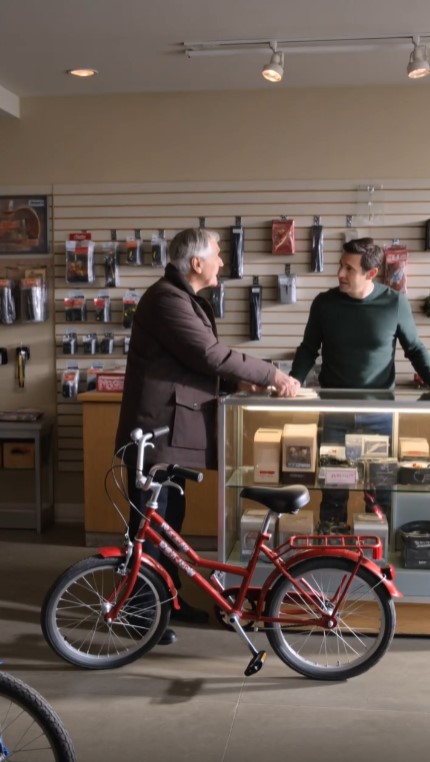
Every December…
An elderly man walked into the same bicycle shop.
He bought one small red children’s bicycle.
Paid cash.
And left without it.
“Donate it to a child who needs one.”
He did this for 18 years.
Never gave his name.
Never asked who received them.
Then one Christmas…
The shop owner finally asked:
“Why a red bicycle?”
The old man smiled sadly.
“My son wanted one.”
“But I couldn’t afford it.”
The owner didn’t ask anything else.
Years passed.
Then one December…
The old man didn’t come.
For the first time in 18 years.
Instead…
A young father entered the shop holding his little boy’s hand.
He pointed toward a red bicycle.
“My first bike came from this store.”
The owner smiled.
“Maybe it came from someone very special.”
The young father looked confused.
Then the door opened.
The elderly man walked in.
Much slower now.
The young father saw him…
And suddenly pulled something from his wallet.
An old card that had been attached to his childhood bicycle.
The elderly man read it.
His hands began shaking.
Because he recognized the handwriting.
But it wasn’t his.
Then the young father said:
“My mother told me to give this to you if I ever found you.”
And what he handed him next explained why that first red bicycle had never reached his own son.
The elderly man’s name was Henry Carter.
The young father was Daniel Brooks.
And the handwriting on the card belonged to Henry’s late wife, Margaret.
Henry lowered himself into a chair.
“Where did you get this?”
Daniel looked confused.
“It came with my bicycle.”
“No.”
Henry shook his head.
“I mean this card.”
“It was tied to the handlebars.”
Henry read the words again.
Every child deserves one Christmas morning they’ll remember forever.
Underneath was a small handwritten M.
Henry knew that M.
He’d seen it on grocery lists.
Birthday cards.
Notes tucked into his lunchbox.
Forty years of marriage.
Margaret.
But she had never told him she’d written anything for the bicycles.
Henry looked at Daniel.
“What did your mother give you?”
Daniel reached into his coat.
He removed an old photograph.
The moment Henry saw it, he stopped breathing.
A boy stood beside a red bicycle.
He was about eight years old.
His hair was messy.
His grin enormous.
Henry whispered:
“Michael.”
The shop owner looked at him.
“Who?”
“My son.”
Henry took the photograph with trembling hands.
His son Michael was standing beside the exact bicycle Henry had wanted to give him for Christmas almost forty years earlier.
The bicycle Henry believed Michael had never received.
On the back, Margaret had written:
Christmas, 1986. He thought it was the greatest bicycle in the world.
Henry looked up.
“I don’t understand.”
Daniel sat beside him.
“My mother said you’d need the letter.”
He handed Henry a sealed envelope.
Across the front, in Margaret’s handwriting:
FOR HENRY — IF ONE OF THE RED BIKES EVER FINDS ITS WAY HOME
Henry closed his eyes.
Margaret had died five years earlier.
He still kept her slippers beside their bed.
He still occasionally reached for two coffee mugs in the morning.
And now she was speaking to him through an envelope carried by a stranger.
Henry opened it.
My dear Henry,
There’s something I should have told you many years ago.
Henry continued reading.
In December 1986, Henry and Margaret were struggling badly.
Henry had been laid off from the factory.
Bills were overdue.
Their old car needed repairs.
Michael was eight.
For months, he had talked about only one thing.
A red bicycle he’d seen in the window of a neighborhood bike shop.
Henry promised himself he’d find a way.
He took temporary jobs.
Shoveled snow.
Fixed a neighbor’s fence.
Sold an old radio.
By Christmas week, he’d almost saved enough.
Then the furnace broke.
Their house was freezing.
The repair took nearly every dollar Henry had saved.
He came home devastated.
Margaret found him sitting at the kitchen table with his face in his hands.
“I promised him,” Henry said.
“He’ll understand.”
“He’s eight.”
“He’ll still understand.”
But Henry couldn’t forgive himself.
Christmas Eve came.
There was no bicycle beneath the tree.
Or so Henry believed.
Margaret’s letter revealed what happened after Henry fell asleep that night.
She called her older sister, Evelyn.
Evelyn knew about the bicycle.
Without telling Henry, she’d already bought it.
Red.
Chrome handlebars.
White grips.
Exactly the one Michael wanted.
Just before midnight, Evelyn’s husband delivered it to the house.
Margaret hid it in the shed.
Early Christmas morning, while Henry was still sleeping, she rolled it outside and tied a ribbon around the handlebars.
Michael found it after breakfast.
Henry stared at the letter.
“No.”
He remembered that Christmas.
Michael had disappeared outside after opening presents.
When he returned, he was excited.
He told Henry that a friend down the street had gotten a bicycle.
Henry assumed Michael had spent the morning riding someone else’s.
“But why didn’t I see it?”
The letter answered.
Michael knew his father couldn’t afford the bicycle.
Margaret had told him it was from Santa.
But Michael was old enough to understand.
He believed Henry would feel ashamed if he saw it.
So Margaret arranged to keep the bicycle in Evelyn’s garage a few houses away.
Michael rode it there.
For almost three months.
Then something happened.
Michael came home one afternoon and told Margaret about a boy named Tommy.
Tommy lived nearby with his mother.
They had very little.
Tommy would stand at the edge of the park watching other children ride bicycles.
One afternoon Michael let him try his.
Tommy rode in circles until it was almost dark.
When Michael returned home, he said:
“Mom, I think he likes it more than I do.”
Margaret laughed.
But Michael was serious.
A week later, he gave Tommy the red bicycle.
Henry stopped reading.
He remembered Tommy.
A quiet boy who sometimes came to their house.
“Michael gave it away?”
Daniel nodded.
Henry returned to the letter.
Margaret had been shocked.
She asked Michael whether he was certain.
Michael said something she’d never forgotten.
Dad couldn’t buy me one, but somebody helped us. Maybe now it’s our turn.
Margaret never told Henry.
At first, she thought she’d explain after Christmas.
Then she saw how ashamed Henry still felt about not buying the bicycle himself.
She feared telling him someone else had bought it would make him feel worse.
So she stayed silent.
Years passed.
The bicycle became a family secret between Margaret and Michael.
Then, when Michael was nineteen, tragedy struck.
He died after a sudden illness.
Henry was devastated.
For years afterward, Christmas became difficult.
The red bicycle he’d failed to buy became symbolic of everything he wished he’d done differently.
Margaret tried to tell him several times.
But each time, she stopped.
Henry wiped his eyes.
“Why?”
Daniel pointed toward the letter.
“Keep reading.”
After Michael died, Margaret finally went looking for Tommy.
She found his mother.
Tommy still had the red bicycle.
He’d outgrown it, but his mother had kept it.
When Margaret explained what had happened, Tommy’s mother cried.
She told Margaret that bicycle had changed more than one Christmas.
Tommy had ridden it to school.
To the library.
To his first after-school job.
When he became too large for it, his younger brother used it.
Then a cousin.
One bicycle had passed through four children.
Margaret came home that night with an idea.
She told Henry:
“Maybe this year we should buy a bicycle for a child.”
Henry agreed immediately.
He chose a small red one.
That was the first bicycle he donated.
He believed he was doing it because of the bicycle he hadn’t been able to give Michael.
But Margaret knew the truth.
Henry was continuing something Michael had already started.
The first donated red bicycle wasn’t the beginning.
It was the second link in the chain.
Henry lowered the letter.
His face was wet with tears.
“All these years…”
The shop owner quietly said:
“You’ve donated twenty-three bicycles here.”
Henry nodded.
“Eighteen anonymously. Then after my wife died, I kept coming.”
He’d never counted them.
Daniel looked at his son.
Then back at Henry.
“My bike was one of them.”
“What year?”
“2004.”
Henry thought for a moment.
“That would’ve been…”
“The sixth,” the shop owner said.
Daniel smiled.
“My mother was raising me alone. She couldn’t afford a bicycle.”
A local holiday charity selected Daniel.
On Christmas morning, he woke to find a red bicycle outside their apartment.
Attached to the handlebars was Margaret’s card.
Henry looked confused.
“Why was Margaret writing cards?”
The shop owner answered.
“Your wife came here separately.”
Henry stared.
“What?”
“Every year.”
After Henry purchased the bicycle and left, Margaret would return.
She never interfered with who received it.
She only brought a small handwritten card to attach to the handlebars.
The same sentence every year.
Every child deserves one Christmas morning they’ll remember forever.
Henry laughed through his tears.
“That woman.”
The shop owner smiled.
“She made me promise not to tell you.”
Daniel reached into his wallet again.
“I’ve carried mine since I was eight.”
Henry touched the old card.
“But you said your mother told you to give me something.”
Daniel nodded.
“My mother knew Margaret.”
Henry looked up.
“How?”
Years after Daniel received the bicycle, his mother wanted to thank whoever had donated it.
The shop refused to reveal Henry’s identity.
But Margaret happened to be there dropping off the card for the next year’s bicycle.
The two women began talking.
Margaret never revealed Henry’s name.
She only explained the story of Michael.
Over time, Daniel’s mother and Margaret became friends.
Daniel grew up knowing that his bicycle had come from an anonymous man who donated one every Christmas in memory of his son.
Then, shortly before Margaret died, she contacted Daniel’s mother.
She gave her the photograph of Michael with his red bicycle.
And the sealed letter for Henry.
She said:
“If Daniel ever happens to meet Henry, he’ll know when to give these to him.”
Henry looked at Daniel.
“So your mother waited all these years?”
“She promised Margaret.”
“Why didn’t she just find me?”
“She thought Margaret wanted it to happen naturally.”
Henry laughed.
“That sounds like Margaret.”
Then Daniel’s little boy tugged his sleeve.
“Dad?”
“Yes, Ethan?”
“Are we getting the red one?”
Everyone looked toward the bicycle Daniel had pointed to when he entered.
Daniel smiled.
“We came to buy your first bike.”
Henry stood slowly.
“No.”
Daniel looked at him.
Henry walked toward the red bicycle.
“I’ll buy it.”
Daniel immediately shook his head.
“Absolutely not.”
“It’s tradition.”
“You’ve done enough.”
Henry looked at Ethan.
“Do you want that bicycle?”
The boy nodded enthusiastically.
Henry smiled.
“Then I’ll make you a deal.”
“What?”
“You ride it until you’re too big.”
Ethan nodded.
“And then?”
Henry pointed toward the old photograph of Michael.
“You find somebody smaller who needs it.”
Ethan thought about this seriously.
“Do I have to give it away?”
“One day.”
The boy looked at the bicycle.
Then at Henry.
“Okay.”
Daniel crouched beside his son.
“You sure?”
Ethan nodded.
“Then somebody else gets a Christmas bike.”
Henry turned away to hide his tears.
The shop owner didn’t.
He was openly crying.
That Christmas, Ethan received the red bicycle.
Attached to the handlebars was a card.
But this time, Henry wrote it himself.
This bicycle doesn’t belong to one child forever.
It belongs to whoever needs their turn.
Underneath he added:
Michael started it. Keep it moving.
Daniel kept Margaret’s old card.
Henry kept the photograph of Michael.
For the first time in nearly forty years, he no longer looked at that Christmas as the year he’d failed his son.
Michael had gotten the bicycle.
More importantly, he’d given it away.
The boy Henry thought he’d disappointed had quietly learned the exact lesson Henry spent the rest of his life trying to teach.
Kindness wasn’t about what you could afford.
It was about what you were willing to pass on.
The following December, Henry returned to the shop.
He was even slower.
He used a cane.
But he carried cash.
“One red bicycle,” he said.
The owner smiled.
“Same as always?”
Henry nodded.
“Same as always.”
Before Henry could leave, the door opened.
Daniel entered.
Then another person.
A woman in her thirties.
Then a man with two teenagers.
Then a mother holding the hand of a little girl.
Henry looked around.
“What is this?”
The shop owner smiled.
“Some people wanted to meet you.”
They were recipients.
Children—now adults—who had received Henry’s bicycles over the years.
The owner had never given them Henry’s identity.
But after Daniel’s story, several had come forward through the charities that had originally distributed the bicycles.
One woman said her bicycle had allowed her to ride to school after her family moved.
One man said he taught his younger brother to ride on his.
Another still had his in his parents’ garage.
Henry listened quietly.
Then he said:
“I didn’t come here for this.”
Daniel smiled.
“We know.”
“That was the whole point.”
“We know that too.”
A little girl approached him.
She held a handmade card.
Henry opened it.
Inside was a drawing of dozens of red bicycles.
At the bottom she’d written:
THANK YOU FOR STARTING IT.
Henry stared at the words.
Then shook his head.
“I didn’t start it.”
He reached into his wallet.
He carried Michael’s photograph now.
He showed it to the girl.
“This boy did.”
Years later, after Henry was gone, the bicycle shop continued the tradition.
Every December, one small red bicycle appeared in the front window.
But it was no longer purchased by one anonymous elderly man.
Former recipients contributed.
Customers added a few dollars.
Local families joined.
Sometimes they bought one bicycle.
Sometimes ten.
The shop called it Michael’s Red Bicycle.
No child receiving one was told a sad story.
No family was asked to publicly say thank you.
They simply received a bicycle.
And one small card.
Every child deserves one Christmas morning they’ll remember forever.
Decades after Michael gave his first red bicycle to another boy, nobody knew exactly how many children had eventually ridden because of that one decision.
Henry never learned the number.
He didn’t need to.
He finally understood something much more important.
For years, he had walked into that bicycle shop believing he was trying to make up for the Christmas when he couldn’t give his son what he wanted.
But there had never been anything to make up for.
Michael had received his red bicycle.
He’d loved it.
And then, while still just a child, he’d looked at another boy who had less…
And decided the bicycle had somewhere else to go.
Henry spent the rest of his life doing exactly the same thing.
One red bicycle.
One child.
One Christmas at a time.