
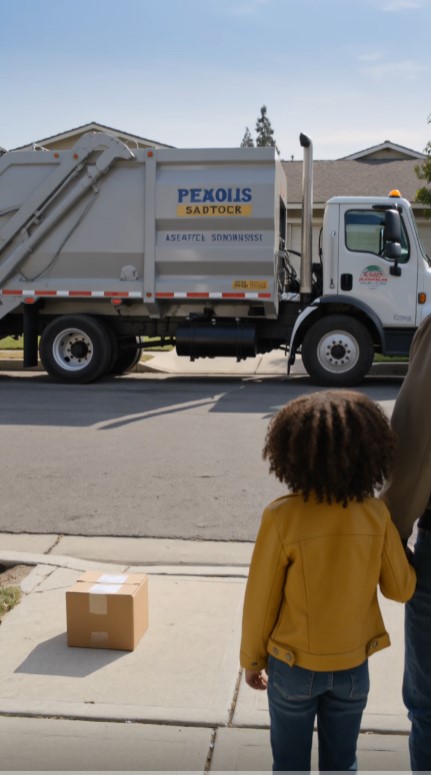
The garbage truck was about to crush everything…
When a little girl screamed:
“STOP!”
Her father grabbed her hand.
“Lucy, what’s wrong?”
She pointed toward one cardboard box beside the curb.
“That box is crying.”
The workers looked at each other.
Nobody heard anything.
Then…
A tiny sound came from inside.
Not crying.
Music.
A soft melody.
The sanitation worker carefully opened the box.
Inside was an old music player…
Still running.
And dozens of sealed envelopes.
Every envelope had a different person’s name.
Except one.
That one simply said:
For the girl who heard the music.
Everyone went silent.
Lucy’s father looked at the sanitation worker.
“How could anyone know she’d be here?”
They called the address on an old label attached to the box.
An elderly man answered.
When they explained what they’d found…
He stopped speaking.
Then whispered:
“Don’t open the girl’s envelope.”
“I’m coming.”
Twenty minutes later…
A car stopped across the street.
The elderly man stepped out.
Saw Lucy…
And dropped what he was carrying.
Because he recognized her immediately.
But Lucy had never seen him before.
The object hit the pavement.
It was a framed photograph.
The glass cracked.
Lucy’s father, Daniel Carter, instinctively pulled his daughter closer.
“Sir?”
The elderly man didn’t answer.
He was staring at Lucy.
Not at her clothes.
Not at the box.
At her face.
“What’s your name?” he whispered.
“Lucy.”
The man’s eyes filled.
“Lucy what?”
“Lucy Carter.”
He covered his mouth.
Daniel stepped forward.
“Who are you?”
The man looked at him.
“My name is Henry Miller.”
That meant nothing to Daniel.
Then Henry bent down and picked up the broken frame.
He turned it around.
Daniel froze.
The photograph showed a little girl.
She couldn’t have been older than seven.
Same dark curls as Lucy.
Same wide smile.
Even the same small dimple in her left cheek.
For a moment Daniel thought he was looking at an old photograph of his daughter.
Then he noticed the date written at the bottom.
1972.
Lucy pointed at the photograph.
“Is that me?”
Henry shook his head.
“No, sweetheart.”
His voice broke.
“That’s your grandmother.”
Daniel’s face changed.
“My mother?”
Henry nodded.
“Rachel.”
Daniel took the photograph.
He’d seen childhood pictures of his mother before.
But never this one.
“Where did you get this?”
Henry looked toward the cardboard box.
“Because that box belonged to my wife.”
“Who was your wife?”
Henry answered quietly.
“Margaret Miller.”
Daniel went completely still.
He knew that name.
His mother had mentioned Margaret only a handful of times.
Margaret had been Rachel’s childhood best friend.
They grew up on the same street.
Went to the same school.
Then something happened when they were teenagers.
The families moved apart.
The girls lost contact.
At least that was the story Daniel had always heard.
“My mother knew your wife.”
Henry gave a sad smile.
“Your mother was the most important person in Margaret’s childhood.”
Daniel looked at the envelopes.
“What is all this?”
Henry sat on the curb.
For a moment, he seemed too overwhelmed to answer.
Then he looked at Lucy.
“The music player. Can I see it?”
The sanitation worker handed it to him.
Henry turned it over.
His thumb found a small scratch near the battery cover.
“M.M.”
Margaret Miller.
Henry closed his eyes.
“I thought this was gone.”
“Where did the box come from?” Daniel asked.
Henry pointed toward a house three doors away.
It had been emptied after its elderly owner died.
A cleanup company had placed boxes of unwanted belongings at the curb.
Henry explained that the house had belonged to Margaret’s older sister, Evelyn.
Margaret died six years earlier.
Some of her belongings had gone to Evelyn.
When Evelyn died recently, relatives cleared the house.
Apparently nobody realized what this particular box contained.
Daniel pointed toward the envelope.
“Then explain that.”
For the girl who heard the music.
Henry stared at it.
“I can.”
He carefully opened the box farther.
Beneath the envelopes was a notebook.
On the first page Margaret had written:
THE SONG PROJECT
Henry smiled.
“She started this before she got sick.”
Margaret had spent much of her adult life teaching music at an elementary school.
She believed people remembered songs differently from almost anything else.
A melody could bring back a classroom.
A wedding.
A parent.
A childhood home.
So when Margaret learned she was seriously ill, she started recording messages for people she’d known.
Each message began with a piece of music connected to that person.
The envelopes contained letters explaining which recording belonged to whom.
Former students.
Old neighbors.
Relatives.
Friends.
Even the nurse who’d cared for Margaret during treatment.
“She didn’t want a funeral full of speeches,” Henry said.
“She wanted people to hear something that made them remember a good day.”
Daniel looked at the music player.
“Why weren’t these delivered?”
Henry lowered his head.
“Because I couldn’t do it.”
After Margaret died, Henry opened the box once.
He listened to the first recording.
He couldn’t continue.
So he gave the box to Evelyn for safekeeping.
He told himself he’d retrieve it later.
Months became years.
Then Evelyn’s health declined.
The box was forgotten.
Until Lucy heard it playing beside the garbage truck.
Daniel pointed toward the strange envelope.
“But Margaret couldn’t possibly know Lucy.”
“She didn’t.”
“Then who is ‘the girl who heard the music’?”
Henry smiled faintly.
“That wasn’t a name.”
He opened Margaret’s notebook.
Near the back was a page marked:
LAST LETTER
Underneath Margaret had written:
If this box ever gets separated from Henry, play Track 27 before opening anything else.
If somebody finds it because they hear the music, give that person the envelope marked FOR THE GIRL WHO HEARD THE MUSIC.
Daniel stared at him.
“So it could’ve been anyone?”
“Anyone.”
Lucy had simply been the person who heard it.
Nothing supernatural.
Nothing predicted.
Margaret had prepared a thank-you letter for whoever eventually rescued the box if it was ever lost.
But that still didn’t explain Henry’s reaction when he saw Lucy.
Henry picked up the photograph again.
“The strange part isn’t the envelope.”
He handed the picture to Daniel.
“The strange part is her.”
Lucy looked almost exactly like Rachel had at the same age.
That was why Henry recognized her.
He hadn’t known Daniel had a daughter.
He hadn’t even known Rachel’s family still lived nearby.
“Is my mother one of the names?” Daniel asked.
Henry looked at the envelopes.
Then stopped.
There it was.
RACHEL CARTER
Daniel swallowed.
“My mother died three years ago.”
Henry closed his eyes.
“I didn’t know.”
Daniel picked up the envelope.
“Can I open it?”
Henry nodded.
Inside was a handwritten letter and a number.
TRACK 4
Henry pressed the buttons on the old player.
A melody began.
Daniel recognized it almost immediately.
His mother used to hum it while cooking.
Lucy recognized it too.
“Grandma’s song.”
Daniel looked at her.
“Yes.”
Then Margaret’s recorded voice began.
Rachel, if you’re hearing this, either Henry finally became brave enough to deliver these letters, or somebody rescued my box from wherever he managed to lose it.
Henry laughed through his tears.
“She knew me too well.”
The recording continued.
Margaret spoke about two little girls who had grown up almost like sisters.
She remembered bicycles left in front yards.
Sleepovers.
School plays.
A secret place beneath an old maple tree.
Then her voice became quieter.
Rachel, there’s something I should’ve told you a long time ago.
Daniel looked at Henry.
Henry appeared surprised too.
Margaret explained that the girls hadn’t simply drifted apart.
At sixteen, Rachel’s family went through a difficult period.
Her father lost his job.
Her parents separated temporarily.
Rachel became embarrassed and withdrew from friends.
Then Margaret made things worse.
During an argument, she repeated something private Rachel had told her.
Another student overheard.
Within days, people at school knew.
Rachel felt betrayed.
She stopped speaking to Margaret.
Soon afterward, Rachel moved away with her mother.
Margaret wrote letters.
Rachel never answered.
Eventually Margaret stopped writing.
Daniel had never heard this.
His mother had always described Margaret as “a friend I lost.”
She’d never said why.
Margaret’s recording continued.
I spent years telling myself we were children and children make mistakes.
But being young explains what I did. It doesn’t erase it.
Then Margaret said something that made Daniel sit down.
I saw you once after we were grown.
It happened nearly thirty years later.
Margaret had been in a grocery store when she saw Rachel in another aisle.
Rachel was holding the hand of a young boy.
Daniel.
Margaret wanted to approach.
She couldn’t.
“I remember that store,” Daniel whispered.
He had been about six.
Margaret followed them outside.
She almost called Rachel’s name.
Then Rachel knelt to tie Daniel’s shoe.
She was laughing.
Margaret lost her nerve.
She went home and wrote another letter.
But she never mailed it.
That letter was inside the envelope.
Daniel unfolded it.
The paper had yellowed.
Rachel,
I saw you today.
You looked happy.
Your little boy has your smile.
I wanted to say I’m sorry.
Instead, I stood behind a row of shopping carts like a coward.
Daniel stopped reading.
Henry touched his shoulder.
“There are more.”
Beneath the letter were photographs.
Rachel and Margaret at eight.
At twelve.
At fifteen.
And the photograph Henry had dropped when he arrived.
Seven-year-old Rachel sitting at a piano.
On the back Margaret had written:
Rachel heard the melody before anyone else did.
Daniel frowned.
“What does that mean?”
Henry explained.
The song playing from the old device wasn’t random.
Margaret had written the melody as a child.
Nothing complicated.
Just a few notes.
Rachel had been the first person Margaret ever played it for.
She learned it immediately.
Years later, Rachel apparently still remembered it.
She had hummed it around Daniel.
Daniel had hummed it around Lucy.
A tiny melody had passed through three generations without Daniel ever knowing where it began.
Lucy looked at the player.
“That’s why Grandma knew it?”
Daniel nodded.
“Looks like it.”
Henry turned to the envelope addressed to Lucy.
“You found the box. That means this belongs to you.”
Lucy opened it.
Inside was a small card.
Margaret had written:
To the girl who heard the music,
Thank you for stopping.
Most people become very good at walking past small things.
A song. A photograph. A person who needs someone to notice.
Whatever you heard that made you stop, don’t lose that part of yourself.
There was something else inside.
A tiny brass key.
Daniel looked at Henry.
“What’s that for?”
Henry laughed.
“I have absolutely no idea.”
The notebook provided the answer.
The key opened a small wooden cabinet in Evelyn’s house.
Before the cleanup crew removed anything else, Henry contacted the family handling the estate and explained what they’d discovered.
With permission, they checked.
Inside the cabinet were more of Margaret’s recordings.
Photographs.
And a thick bundle of letters tied with blue ribbon.
Every letter was addressed to Rachel.
Most had never been mailed.
But at the bottom was something unexpected.
Letters from Rachel.
Margaret hadn’t known about them when she made her final recording.
Rachel had written back.
Years later.
She’d apparently found an old address for Evelyn and sent several letters hoping they might reach Margaret.
For reasons nobody could fully reconstruct, they ended up stored in Evelyn’s cabinet and were never forwarded.
Daniel opened the first.
His mother’s handwriting was unmistakable.
Dear Margaret,
I don’t know whether this will reach you.
I’ve spent too many years being angry about something that happened when we were sixteen.
The truth is, I missed you longer than I was angry with you.
Henry began crying.
Daniel continued.
Rachel wrote about Daniel.
About becoming a grandmother.
About Lucy.
And about the melody.
I still remember your little song.
My granddaughter hums it now.
Daniel looked at Lucy.
There was the final connection.
Margaret hadn’t predicted Lucy.
She hadn’t known which child would find the box.
But Rachel had told her about Lucy in a letter that never reached her.
Two women had spent decades believing the other had chosen silence.
Both had eventually tried to reconnect.
Neither knew the other had done the same.
Henry sat on the curb holding Rachel’s letter.
“We were all so close.”
Daniel nodded.
“And nobody knew.”
Over the next several weeks, Henry delivered Margaret’s envelopes.
Daniel helped.
Some recipients had moved.
Several had died.
Their letters went to family members.
A retired teacher received one.
So did a former student who had become a music teacher herself.
Every envelope contained a memory.
Not money.
Not a secret inheritance.
Just proof that someone had remembered them.
Daniel kept Rachel’s envelope.
Lucy kept hers.
The sanitation worker who’d stopped the truck received something too.
Henry asked for his name.
“Marcus.”
A week later, Marcus found an envelope at the sanitation office.
Inside was a thank-you card from Henry.
And one sentence copied from Margaret’s letter:
Thank you for stopping.
Months later, Daniel and Lucy visited Henry.
The old music player sat on his table.
He’d had it repaired.
“Want to hear Track 27?” he asked.
Lucy nodded.
The familiar melody played.
Lucy began humming.
Daniel joined.
Henry didn’t know the words because there weren’t any.
There never had been.
It was simply a childhood tune written by one little girl and remembered by another.
Henry looked at Lucy.
“You know something?”
“What?”
“If you hadn’t heard that music, all of this would’ve disappeared.”
Lucy thought for a moment.
Then shook her head.
“No.”
Henry smiled.
“No?”
“The music was loud enough.”
Daniel laughed.
But Henry understood what she meant.
The box hadn’t needed someone extraordinary.
It only needed someone willing to notice.
Years later, Lucy still kept Margaret’s card.
She also kept the photograph of her grandmother at seven.
People often assumed it was Lucy herself until they saw the date.
And whenever Daniel told the story, he corrected one detail.
His daughter hadn’t heard a box “crying.”
She had heard a melody.
A melody her grandmother had carried for most of her life.
A melody written by a friend she thought she’d lost forever.
And because one little girl asked a garbage truck to stop…
Two apologies written decades earlier finally reached the people they were meant for.
The women who wrote them were gone.
But the forgiveness wasn’t.
It had simply been waiting inside a box…
For someone to hear the music.