
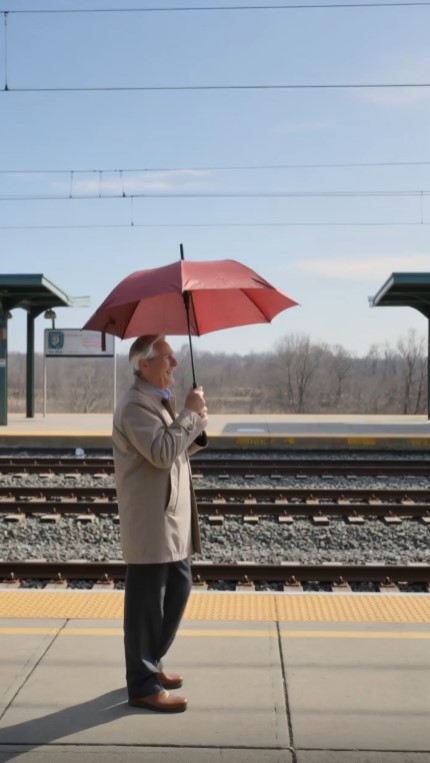
It wasn’t raining.
But every morning…
The elderly man stood on the train platform holding an open red umbrella.
People stared.
Some laughed.
For three months…
He did exactly the same thing.
Then one morning…
A woman approached him.
“Sir… why the umbrella?”
He smiled.
“So she’ll know where to find me.”
“Who?”
“My daughter.”
“She loved red umbrellas when she was little.”
The woman went quiet.
“How long has it been?”
“Thirty-four years.”
Before she could ask anything else…
A train arrived.
Passengers poured onto the platform.
The old man lifted the red umbrella higher.
Nobody came toward him.
His smile slowly disappeared.
Then the train doors began closing.
A hand suddenly appeared between them.
The doors reopened safely.
A woman around sixty stepped onto the platform.
She was holding something.
A tiny red umbrella.
The old man’s knees nearly gave way.
The woman walked toward him.
But instead of saying “Dad”…
She asked him one question.
“What did you call the place under the kitchen table?”
The old man dropped his umbrella.
His face went completely pale.
For several seconds, he couldn’t speak.
Then he whispered:
“The Red Castle.”
The woman covered her mouth.
The elderly man began crying.
Because only three people had ever known those words.
Him.
His late wife.
And their daughter.
The woman stared at him.
“Dad?”
Henry Carter nodded.
“Emily.”
Thirty-four years disappeared in a single word.
Emily stepped forward.
Henry reached for her, then stopped.
He seemed afraid to touch her.
Emily closed the distance herself.
She wrapped her arms around him.
Henry broke down.
People on the platform stopped walking.
Some had seen the old man with the umbrella every morning for months.
Now they understood.
He wasn’t confused.
He wasn’t performing some strange ritual.
He had been waiting.
Henry held his daughter as if he were terrified she might disappear again.
“I thought I’d never see you.”
Emily whispered:
“I thought you stopped looking.”
Henry pulled away.
“Stopped?”
His expression changed.
“Emily, I never stopped.”
She stared at him.
“But Mom said—”
Henry closed his eyes.
And Emily stopped speaking.
The reunion they’d both imagined suddenly became complicated.
Henry picked up his umbrella.
“Can we sit somewhere?”
They went to the small station café.
Emily placed the tiny umbrella on the table.
It was a child’s umbrella.
Faded red fabric.
One bent spoke.
A wooden handle covered in scratches.
Henry recognized it immediately.
“You kept it.”
Emily nodded.
“All these years.”
When Emily was little, she had been obsessed with red umbrellas.
Her mother, Margaret, bought her that tiny one for her sixth birthday.
Emily carried it everywhere.
Even when there wasn’t a cloud in the sky.
She’d open it inside the house despite being told not to.
Then she’d crawl beneath the kitchen table with it and announce:
“Welcome to the Red Castle.”
Henry would crawl underneath too.
Margaret would bring cookies.
It became their family game.
The question Emily had asked on the platform wasn’t random.
It was something she had decided years ago.
If she ever found a man claiming to be her father, she’d ask about the Red Castle.
No newspaper.
No official document.
No distant relative would know the answer.
Only her father would.
Henry touched the little umbrella.
“Where did you get this?”
Emily frowned.
“You gave it to me.”
“No.”
“Yes. It was in my suitcase.”
Henry shook his head.
“The day you left, your umbrella was hanging beside the kitchen door.”
Emily stared at him.
“That’s impossible.”
Henry leaned forward.
“Tell me what you remember.”
Emily was twenty-six when she disappeared from Henry’s life.
Not six.
That was important.
She hadn’t been abducted.
She hadn’t simply vanished.
She had left.
But she’d left believing something that wasn’t true.
At twenty-six, Emily was engaged to a man named Robert.
Henry didn’t like him.
He thought Robert was controlling.
Emily believed her father simply couldn’t accept that she was an adult.
Their arguments became worse.
Margaret constantly tried to keep peace between them.
Then one evening, everything exploded.
Henry and Robert argued in the driveway.
Emily stepped between them.
Henry told Robert to leave.
Emily said if Robert left, she was going with him.
Henry, angry and frightened, said something he’d regretted every day since.
“If you walk away with him, don’t expect me to chase you.”
Emily left.
Henry expected her back the next morning.
She didn’t return.
Three days passed.
Then a letter arrived.
It was supposedly from Emily.
Dad,
Please don’t contact me.
I’ve made my choice.
Let me live my life.
Henry obeyed at first.
Then Margaret became desperate.
She called every number they had.
Robert’s number was disconnected.
Emily’s workplace said she’d resigned.
Their apartment had been emptied.
Henry contacted relatives.
Friends.
Anyone who might know where they’d gone.
Nothing.
Weeks became months.
Then Henry received another letter.
Please stop looking.
It appeared to be signed by Emily.
Henry showed it to Margaret.
She cried for hours.
Eventually they convinced themselves their daughter truly wanted nothing to do with them.
But Henry still sent birthday cards to the last address he had.
Every one came back.
Then Emily told her side.
She had never written either letter.
Henry stared at her.
“Never?”
“Never.”
Emily and Robert had moved almost immediately after the argument.
Robert said Henry had threatened him.
He told Emily her parents had demanded she stay away.
At first Emily didn’t believe him.
Then Robert showed her a letter.
Supposedly from Henry.
It said:
You chose him. Don’t come back when it goes wrong.
Henry’s hands began shaking.
“I never wrote that.”
“I know that now.”
Robert gradually isolated Emily from nearly everyone she knew.
Whenever she talked about contacting her parents, he told her they had rejected her.
He claimed Henry had returned her letters unopened.
He claimed Margaret had said it was better if everyone moved on.
For years, Emily believed him.
Eventually the marriage ended.
But by then almost a decade had passed.
Emily was ashamed.
She didn’t know whether her parents would want to hear from her.
So she searched quietly.
The old family house had been sold.
Their phone number had changed.
Henry and Margaret had moved.
And then Emily made a discovery that devastated her.
Her mother had died.
Margaret passed away eleven years after Emily left.
“I found the obituary six years too late,” Emily said.
Henry looked down.
“She waited for you.”
Emily began crying.
“I didn’t know.”
“She never blamed you.”
Henry reached across the table.
“She kept your room almost exactly the same until we moved.”
Emily wiped her face.
“Did she think I hated her?”
“No.”
“Are you sure?”
Henry nodded.
“She thought you were alive. That’s what mattered to her.”
Henry had eventually discovered the letters were false.
Not all at once.
After Margaret died, he cleaned out an old filing cabinet.
Behind one drawer, he found an envelope Margaret had hidden.
Inside were photocopies of the two letters supposedly written by Emily.
Margaret had noticed something Henry hadn’t.
The handwriting looked right.
But one detail was wrong.
Emily always wrote the number seven with a line through it.
The letters didn’t.
Margaret had apparently begun questioning whether Emily had written them.
She’d hired a private investigator.
The investigator found that Robert had used multiple addresses after leaving town.
Then the trail ended.
Margaret became ill before she could continue.
Henry resumed the search.
Years passed.
No result.
Then three months earlier, everything changed.
Henry received a letter.
No return address.
Inside was a photocopy of an old photograph.
Seven-year-old Emily stood beneath her tiny red umbrella.
On the back was written:
If you’re still looking for me, stand at Central Station with a red umbrella.
Weekdays. 8:15 a.m.
Henry thought it might be a cruel joke.
He went anyway.
The first morning, nobody came.
He returned the second.
Then the third.
A week.
A month.
Two months.
Every weekday at 8:15, Henry stood on the platform.
People began recognizing him.
The station employees called him “Umbrella Henry.”
Some assumed he was waiting for a wife.
Others thought he was eccentric.
Henry didn’t care.
“If there was even a one percent chance it was her,” he told the woman who’d first asked him about the umbrella, “I was going to be here.”
Emily looked confused.
“But I sent that letter only three weeks ago.”
Henry stopped.
“What?”
“I found your address three weeks ago.”
“Emily, I’ve been standing there for three months.”
Neither spoke.
Someone else had sent the first message.
“Who had that photograph?” Henry asked.
Emily looked at the tiny umbrella.
“Robert.”
Henry’s expression hardened.
Emily explained.
Robert had died four months earlier.
They’d been divorced for many years.
After his death, his sister Anna contacted Emily.
Robert had left several boxes in storage.
Anna found old photographs.
Letters.
Documents.
And the little red umbrella.
Then she discovered something worse.
Copies of letters Robert had intercepted.
Letters Henry and Margaret had sent Emily over the years.
Robert had kept them.
One was from Margaret.
It had never been opened.
Emily reached into her bag.
She placed it on the table.
Henry recognized his wife’s handwriting immediately.
For Emily
His eyes filled.
Emily whispered:
“I haven’t opened it yet.”
“Why?”
“I wanted to find you first.”
Henry stared at the envelope.
Then pushed it toward her.
“Open it.”
Inside were four pages.
Margaret had written the letter sixteen years earlier.
She told Emily about ordinary things.
The garden.
Neighbors.
Henry complaining about his knees.
Then:
Your father still checks the mailbox like you’re going to write tomorrow.
Henry looked away.
Margaret continued:
Whatever happened between you two, don’t mistake his pride for lack of love.
He’s angry because he misses you.
And you’re probably angry because you miss him too.
Emily stopped reading.
Then came the line that broke them both.
If you ever come home and don’t know how to begin, bring the little red umbrella.
Your father will understand.
Emily pressed the letter to her chest.
“That was Mom’s idea.”
Henry nodded.
“The umbrella.”
Suddenly they understood why someone had sent Henry that first anonymous instruction.
Anna.
Robert’s sister.
Emily called her.
Anna admitted it immediately.
After finding the hidden letters, she felt sick.
She knew her brother had manipulated both sides.
She wasn’t sure Emily was emotionally ready to contact Henry.
So she sent Henry the photograph and instructions first.
“I wanted to know whether he’d actually show up,” Anna said.
Henry almost laughed.
“For three months?”
“I didn’t think you’d start the next morning.”
“Of course I started the next morning.”
Anna then gave Emily the stored belongings and told her what she’d done.
Emily had spent weeks deciding whether she could face her father.
Finally, she sent her own letter confirming the same place and time.
Then she boarded the train carrying the umbrella.
Henry asked:
“Why didn’t you come sooner?”
Emily looked down.
“I was scared.”
“Of me?”
“Of finding out you’d stopped loving me.”
Henry reached across the table.
“Emily, I stood on a train platform holding a red umbrella for ninety-two mornings.”
She laughed through her tears.
“Eighty-nine.”
“What?”
“Weekdays.”
Henry smiled.
“I came Saturdays too.”
“You did?”
“I wasn’t taking chances.”
For the first time in thirty-four years, father and daughter laughed together.
Their reunion didn’t erase everything.
There were difficult conversations.
Henry had to acknowledge the words he’d said the night Emily left.
Emily had to accept that years of silence had been built from anger, manipulation, shame and missed opportunities.
Neither could recover the time with Margaret.
That remained the hardest part.
But they could stop losing more.
Emily began visiting every month.
Then every two weeks.
Henry showed her Margaret’s photographs.
Emily brought the letters Robert had hidden.
Together they read them.
Some were painful.
Others were surprisingly ordinary.
One complained about a broken washing machine.
Another contained a recipe.
One simply said:
Your father saw a red umbrella today and followed the poor woman halfway through the grocery store.
Emily laughed so hard she had to put the letter down.
Henry muttered:
“It looked like yours.”
A year after their reunion, they returned to Central Station.
This time Henry didn’t carry the large red umbrella.
Emily brought the tiny one.
They sat on the same platform bench.
A little girl nearby noticed it.
“That’s too small for you,” she told Emily.
Emily smiled.
“I know.”
“Why do you have it?”
Emily looked at Henry.
“Because someone used it to find me.”
The child looked confused.
Henry smiled.
“It’s a long story.”
Years later, after Henry died, Emily kept both umbrellas.
The large one he had carried on the platform.
And the tiny one from her childhood.
She placed Margaret’s final letter between them.
But what she remembered most wasn’t the moment she stepped from the train.
It was the question she’d asked.
“What did you call the place under the kitchen table?”
Thirty-four years of separation.
False letters.
Lost addresses.
Anger.
Regret.
None of that had erased the answer.
Henry had remembered immediately.
The Red Castle.
Because sometimes the smallest memory survives everything.
And sometimes all it takes to find your way back to someone…
Is one person willing to stand in the same place every morning…
Holding a red umbrella high enough to be seen.