
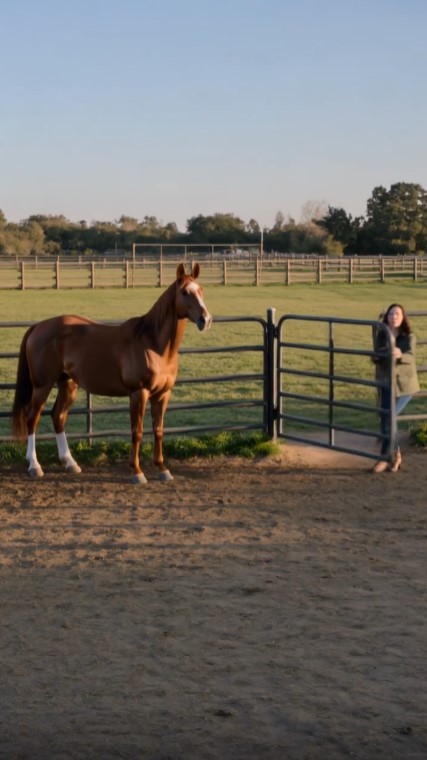
The rescued horse had been calm for weeks.
Then one morning…
The gate opened for training.
And the horse suddenly ran.
“Ruby!”
Her new owner followed from a safe distance.
But Ruby wasn’t escaping.
She ran across the pasture…
Straight toward the far fence.
Then stopped.
On the other side…
An elderly man was standing completely still.
Ruby stared at him.
The man stared back.
Then he whispered:
“No way…”
Ruby began making a sound her owner had never heard before.
The elderly man slowly approached the fence.
“Ruby?”
The horse immediately pushed her nose toward him.
The owner froze.
“You know her?”
The man’s eyes filled with tears.
“I raised her.”
He explained that years earlier…
Circumstances had forced them apart.
He had searched for her…
But eventually believed he’d never see her again.
Then Ruby suddenly noticed what he was carrying.
The horse’s reaction made both of them realize she remembered far more than just his face.
In the man’s hand was an old brass bell.
The moment it moved, it made a soft sound.
Clink.
Ruby’s head shot upward.
The elderly man stopped.
“Do you remember this?”
He gently rang it again.
Clink. Clink.
Ruby began pacing along the fence.
Then she made the same low, excited call.
Her new owner, Rachel Carter, stared.
“What is that bell?”
The man wiped his eyes.
“My wife used it every evening.”
His name was Henry Wilson.
Twenty years earlier, Henry and his wife Margaret had owned a small farm several miles away.
Ruby had been born there.
Henry still remembered the night.
A spring storm had knocked out the electricity.
Margaret held a flashlight while Henry stayed with Ruby’s mother, Belle.
Just before sunrise, the foal finally arrived.
Margaret chose her name.
“Look at that reddish coat,” she’d said.
“Ruby.”
For the next fourteen years, Ruby lived on their farm.
She was never a competition horse.
Never famous.
Never especially valuable.
To Henry and Margaret, none of that mattered.
She was family.
Margaret developed a routine.
Every evening around six, she’d walk from the farmhouse carrying a small brass handbell.
She rang it twice.
Ruby and Belle would come from the pasture.
Sometimes slowly.
Sometimes at a gallop.
There were usually carrots waiting.
Ruby learned the routine quickly.
Henry smiled as he explained it.
“She could be at the farthest corner of the pasture. Margaret rang that bell and she’d come running.”
Rachel looked at Ruby.
The horse was still staring at the bell.
“What happened?”
Henry’s smile disappeared.
“Margaret got sick.”
Cancer.
At first, they believed treatment would work.
Then the bills began.
Henry sold equipment.
Then part of the land.
Eventually, he sold most of the horses.
He kept Ruby longer than any of the others.
“She was Margaret’s favorite.”
Henry paused.
“But eventually I couldn’t afford the farm.”
Margaret died shortly afterward.
Henry moved into a small apartment.
Ruby went to a family who promised to keep her permanently.
For a while, Henry received photographs.
Then the family moved.
Their phone number changed.
Henry lost contact.
He tried tracing Ruby through old records, but ownership changed again.
Then again.
At some point, the paperwork became incomplete.
Henry never found her.
“I assumed she’d died years ago.”
Rachel looked toward Ruby.
“How did you end up here today?”
Henry lifted the bell.
“Because of this.”
He had recently moved into a smaller senior apartment.
While clearing his storage unit, he’d found a box of Margaret’s belongings.
Inside was the bell.
Henry couldn’t bring himself to throw it away.
So that morning he’d gone for a drive through the countryside.
He eventually stopped beside Rachel’s property because he remembered that the land had once belonged to a friend.
He had no idea it was now an equine rescue and rehabilitation farm.
Then he saw a chestnut horse in the distance.
“I thought she looked familiar.”
“But you couldn’t know from that far away.”
“I couldn’t.”
Henry nodded toward Ruby.
“Then she saw me.”
Rachel had rescued Ruby only six weeks earlier.
The mare had arrived through a regional horse welfare organization after her previous owner could no longer care for several animals.
Ruby was older.
Underweight.
Her hooves needed attention.
But she was gentle.
Her paperwork listed an approximate age and several recent owners.
Her early history was almost blank.
Rachel knew only one important detail from an old veterinary record.
Ruby had a small white mark beneath her lower lip.
Henry suddenly mentioned it.
“She has a little white spot under here.”
Rachel’s expression changed.
“How did you know that?”
“She’s had it since she was born.”
Rachel walked closer.
There it was.
A small irregular patch almost invisible unless Ruby raised her head.
Henry described another marking.
A tiny scar above Ruby’s left knee.
She had gotten it as a young horse after catching herself on an old gate.
Rachel checked.
The scar was there too.
But the strongest evidence came from the records.
Rachel retrieved Ruby’s paperwork.
Henry gave her the name of the veterinarian who had treated Ruby when she was young.
The clinic still existed.
Its archived records went back decades.
Later that afternoon, they received confirmation.
A chestnut mare named Ruby.
Same approximate birth year.
Same markings.
Registered to Henry and Margaret Wilson.
There was no longer any doubt.
This was Henry’s Ruby.
Rachel found him sitting outside the pasture.
He was holding the brass bell.
“It’s her.”
Henry closed his eyes.
For several seconds, he said nothing.
Then Ruby walked toward him.
Rachel opened the inner gate and, following the farm’s safety procedures, allowed Henry to enter the small paddock with her.
He didn’t rush toward Ruby.
He simply stood.
Ruby approached him.
She smelled his jacket.
His hands.
His shoulders.
Then Henry lifted the bell.
He rang it twice.
Ruby immediately turned her head toward the barn.
Henry laughed through his tears.
“That’s what she used to do.”
Rachel smiled.
“She expected dinner?”
“Carrots.”
Henry reached into his coat pocket.
Rachel laughed.
“You brought carrots?”
“I didn’t know she was here.”
“Then why are you carrying carrots?”
Henry looked slightly embarrassed.
“I feed them to my neighbor’s donkey.”
Rachel wasn’t sure she believed him.
But Ruby clearly approved.
Henry held out a carrot.
Ruby took it gently.
Then she remained beside him.
Rachel didn’t claim Ruby was remembering every detail of her early life.
Nobody could know exactly what memories or associations were driving her behavior.
But the familiar voice, the bell, the routine and Henry’s presence clearly meant something to her.
Henry began visiting twice a week.
He never asked Rachel to give Ruby back.
In fact, Rachel eventually brought up the possibility herself.
“If you want her…”
Henry interrupted.
“I can’t.”
His apartment didn’t allow horses, obviously.
Rachel smiled.
“I mean we could work something out.”
Henry shook his head.
“Ruby needs stability. She has that here.”
He looked across the pasture.
“I spent years wishing I could find her. I don’t need to own her again.”
“What do you need?”
Henry smiled.
“To know she’s okay.”
So that became the arrangement.
Ruby remained with Rachel.
Henry became part of her life again.
Every Tuesday and Saturday, he arrived with carrots.
And the bell.
Eventually Rachel asked about Margaret.
“Did she ring it right until the end?”
Henry became quiet.
“No.”
During Margaret’s final months, she became too weak to walk to the pasture.
But Ruby would often stand near the farmhouse in the evenings.
One day, Henry carried the bell into Margaret’s bedroom.
He opened the window.
Margaret rang it.
Twice.
Ruby came running from the pasture.
“She stood outside that window for almost an hour.”
Henry looked down.
“That was the last time Margaret saw her.”
After Margaret died, Henry couldn’t ring the bell anymore.
He placed it in a box.
Until the morning he found Ruby.
Several months after the reunion, Rachel noticed Henry hadn’t visited.
Tuesday passed.
Then Saturday.
She called.
No answer.
Finally, Henry’s daughter, Anna, returned the call.
Henry had been hospitalized with pneumonia.
“He’s going to recover,” Anna said, “but it may take a while.”
Rachel told her not to worry about Ruby.
Then Anna said something unexpected.
“My dad talks about that horse constantly.”
Rachel smiled.
“So do we.”
Two weeks later, Henry was still in rehabilitation.
Rachel couldn’t bring Ruby to him.
So she recorded a short video.
Ruby stood near the pasture gate.
Rachel rang Henry’s brass bell twice.
Ruby immediately walked toward the sound.
Rachel sent the video.
Anna later said Henry watched it six times.
When Henry finally returned to the farm, he was using a walker.
Rachel expected Ruby to approach cautiously.
Instead, the mare lifted her head the moment she heard his voice.
“Ruby.”
She walked directly toward him.
Henry stood outside the fence.
This time he didn’t ring the bell.
He didn’t need to.
The visits continued.
Ruby gained weight.
Her coat improved.
She became stronger.
Henry became stronger too.
One afternoon, Rachel found him repairing the leather strap attached to the old bell.
“What are you doing?”
“It’s falling apart.”
“That thing belongs in a museum.”
Henry smiled.
“It belongs near Ruby.”
But eventually Henry made a decision.
He handed the bell to Rachel.
“You keep it.”
She immediately refused.
“No.”
“Rachel.”
“That was Margaret’s.”
“Exactly.”
He looked toward Ruby.
“If anything happens to me, I don’t want it disappearing into another box for twenty years.”
Rachel reluctantly accepted it.
Henry asked for one promise.
“Don’t ring it every day.”
“Why?”
“She’ll get spoiled.”
Rachel laughed.
“She’s already spoiled.”
Henry nodded.
“Margaret’s fault.”
Years passed.
Henry’s visits became less frequent as walking grew more difficult.
But whenever he came, Ruby still approached the fence.
And occasionally, he rang the bell.
Twice.
Never more.
Then one winter morning, Anna called Rachel.
Henry had died peacefully during the night.
He was eighty-four.
Rachel sat in her kitchen holding the phone.
Afterward, she walked toward Ruby’s pasture.
The brass bell hung beside the barn door.
Rachel took it down.
She hesitated.
Then rang it.
Once.
Twice.
Ruby lifted her head from the far end of the field.
For several seconds, she stood still.
Then she began walking.
Not running.
Just walking steadily toward Rachel.
When she reached the gate, Rachel gave her a carrot.
“That’s from Henry.”
Ruby ate it.
Rachel stood beside her for a long time.
Several days later, Anna visited.
She brought an old photograph.
Margaret stood beside Ruby as a young horse.
Henry was behind them.
In Margaret’s hand was the brass bell.
On the back, Henry had written:
Some sounds mean home.
Rachel framed the photograph inside the barn.
The bell remained beneath it.
Ruby lived out the rest of her years at the rescue farm.
She was never sold again.
And whenever visitors heard her story, they often focused on the dramatic morning when she suddenly ran across the pasture toward an elderly stranger.
But Rachel always told them that wasn’t the part she remembered most.
It was what happened when Ruby noticed the object in Henry’s hand.
The old brass bell.
The same bell Margaret had rung every evening decades earlier.
Henry moved it once.
Clink.
Ruby lifted her head.
He rang it twice.
And the old horse turned toward the barn as though an evening routine interrupted by nearly twenty years had simply begun again.
Nobody could ask Ruby exactly what she remembered.
Maybe the sound.
Maybe Henry’s voice.
Maybe the carrots that once followed those two familiar rings.
Maybe all of it together.
But Henry never needed a perfect explanation.
He had spent years believing Ruby was gone forever.
Then one ordinary morning, she saw him standing beyond a fence.
And ran straight toward him.
The bell only confirmed what Henry already felt when Ruby pushed her nose into his hands.
After all those years apart…
Something familiar was still there.