
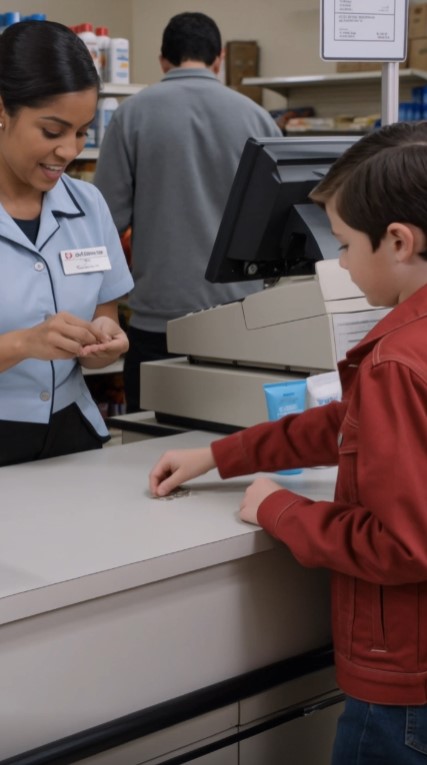
The boy emptied a handful of coins onto the pharmacy counter.
“Is this enough?”
The cashier counted them.
Then gently shook her head.
The boy looked down.
He quietly started putting the coins back into his pocket.
A construction worker waiting behind him asked:
“What were you buying?”
The boy pointed toward a small bag of ordinary personal-care supplies.
“They’re for my grandma.”
The worker looked at the cashier.
“I’ll pay.”
The boy immediately shook his head.
“No. Grandma says we don’t take things from strangers.”
The worker smiled.
“Then don’t.”
He held out his hand.
“I’m Marcus.”
The boy hesitated…
Then shook it.
“Eli.”
Marcus smiled.
“Now we’re not strangers.”
The cashier laughed.
Marcus paid…
And the boy ran outside carrying the bag.
Everyone thought it was over.
But three days later…
Marcus returned.
The cashier immediately pointed toward the door.
“Someone has been waiting for you.”
Marcus turned.
An elderly woman was standing there.
She wasn’t holding money.
She was holding something Marcus hadn’t seen since he was a child.
His smile disappeared.
“Where did you get that?”
The woman answered:
“From your mother.”
Marcus stared at the object in her hands.
It was a small red metal lunchbox.
The paint was chipped along the edges.
One corner was dented.
Across the front, written in faded black marker, were the letters:
M.R.
Marcus hadn’t seen it in almost thirty years.
He stepped closer.
“That was mine.”
The elderly woman nodded.
“I know.”
Her name was Evelyn Carter.
She was Eli’s grandmother.
Marcus looked from Evelyn to the lunchbox.
“My mother gave you this?”
“A long time ago.”
“When?”
Evelyn’s expression softened.
“When you were about Eli’s age.”
Marcus couldn’t speak.
His mother, Anna Reed, had died eleven years earlier.
After her death, Marcus had cleaned out her apartment with his sister.
They’d found photographs.
Old birthday cards.
School papers.
His father’s watch.
But never the red lunchbox.
Marcus assumed it had disappeared during one of their childhood moves.
Now it was sitting in the hands of a woman he’d never met.
“Can we sit somewhere?”
Evelyn asked.
Marcus nodded.
The pharmacy had a small waiting area near the back.
They sat opposite each other.
The cashier, Rachel, remained at the counter, pretending not to listen.
Marcus placed his work gloves beside him.
“Please tell me how you knew my mother.”
Evelyn looked down at the lunchbox.
“Because she helped me once.”
Nearly thirty years earlier, Evelyn had been raising her daughter Laura alone.
Money was scarce.
Evelyn worked mornings in a school cafeteria and evenings cleaning offices.
Anna Reed worked in the same school cafeteria.
Marcus was eight.
Laura was seven.
The two women weren’t close friends at first.
They simply worked beside each other.
But Anna noticed things.
She noticed when Evelyn stopped buying lunch for herself.
She noticed the same worn coat every winter.
And one December afternoon, she noticed Evelyn crying inside the staff storage room.
Evelyn’s electricity had been disconnected.
Her paycheck was still four days away.
Laura was staying with a neighbor because their apartment had become too cold.
“I was ashamed,” Evelyn told Marcus.
“I didn’t want anyone to know.”
Marcus listened silently.
“Your mother found me.”
“What did she do?”
“She sat beside me.”
Marcus smiled faintly.
“That sounds like her.”
Evelyn nodded.
Anna didn’t offer a speech.
She didn’t ask embarrassing questions.
She simply said:
What do you need until Friday?
Evelyn initially refused help.
Anna understood.
So she tried something else.
The next morning, Anna brought the red lunchbox.
Marcus recognized it immediately.
“He used to carry that everywhere.”
Evelyn smiled.
“She told me.”
Inside were sandwiches.
Fruit.
A few groceries.
And an envelope.
Evelyn opened it later.
There was enough money to reconnect the electricity and buy basic necessities until payday.
Marcus frowned.
“My mom didn’t have much money either.”
“I know.”
That was what Evelyn never forgot.
Anna wasn’t wealthy.
Marcus’s father had left years earlier.
Anna was raising Marcus and his younger sister herself.
“She couldn’t afford to rescue people,” Evelyn said.
“But she helped me anyway.”
Marcus looked at the lunchbox.
“Why give you mine?”
Evelyn smiled.
“Because I wouldn’t accept an envelope.”
Marcus laughed softly.
“Mom knew that?”
“She figured it out.”
Anna told Evelyn the lunchbox contained leftovers that would otherwise be wasted.
Only after Evelyn returned home did she discover the money beneath the food.
The following week, Evelyn tried to return everything.
Anna refused the money.
So Evelyn asked:
“How do I repay you?”
Anna gave her an answer Evelyn remembered word for word.
You don’t repay kindness backward. You pass it forward.
Marcus lowered his head.
He’d heard that sentence before.
His mother used to say it whenever he complained about helping neighbors.
Evelyn continued.
She eventually repaid the money anyway.
Anna protested.
But Evelyn insisted.
The lunchbox was different.
“I tried returning it.”
“And Mom wouldn’t take it?”
“She told me you’d outgrown it.”
Marcus laughed.
“I definitely hadn’t.”
Evelyn looked embarrassed.
“I suspected that later.”
Anna asked her to keep it.
So Evelyn did.
For years, the lunchbox sat inside a kitchen cabinet.
Eventually it moved into a storage box.
Then, three days earlier, Eli returned from the pharmacy carrying a bag.
Evelyn immediately asked where he’d gotten it.
Eli explained everything.
The coins.
The construction worker.
The handshake.
Marcus paying the difference.
Evelyn became concerned.
“You accepted money from someone?”
Eli defended himself.
“He wasn’t a stranger anymore.”
Marcus laughed.
“I may have stretched that rule a little.”
Evelyn smiled.
“Just slightly.”
Then Eli told her the man’s name.
Marcus.
He described the construction vest.
The work boots.
The scar above his left eyebrow.
Evelyn stopped him.
“Scar?”
Eli pointed to the same place on his own forehead.
“Right here.”
Evelyn remembered Anna talking about Marcus falling from his bicycle when he was eight.
He’d needed stitches above his eyebrow.
Still, Marcus was a common name.
It could have been coincidence.
Then Eli remembered something else.
The cashier had called the man Mr. Reed when handing him his receipt.
Marcus Reed.
Evelyn went directly to her storage closet.
She opened an old box.
And found the lunchbox.
Inside was something Marcus didn’t know about.
Evelyn opened it.
Taped beneath the lid was a tiny photograph.
Marcus leaned closer.
It showed his mother.
Anna was much younger.
Standing in the school cafeteria.
Beside her was Evelyn.
Marcus touched the photograph.
“I’ve never seen this.”
Evelyn removed it carefully.
“Take it.”
Marcus shook his head.
“No.”
“It belongs with you.”
“What about the lunchbox?”
“That too.”
Marcus stared at her.
For several seconds, he was eight years old again.
Sitting at the kitchen table.
Watching his mother pack sandwiches.
Complaining because she’d cut his apple the wrong way.
Anna laughing.
The red lunchbox beside him.
He hadn’t thought about those mornings in years.
Then something occurred to him.
“Why were you waiting here instead of calling me?”
Evelyn smiled.
“I didn’t have your number.”
“You could’ve asked Rachel.”
“The cashier wouldn’t give out a customer’s information.”
Marcus glanced toward the counter.
Rachel raised both hands.
“Privacy.”
“So you waited?”
“Eli remembered you said you stopped here after work sometimes.”
Marcus shook his head.
“How long?”
“Today?”
“Yes.”
“About forty minutes.”
Marcus looked at the lunchbox.
“All because I paid for a few things?”
Evelyn’s smile disappeared.
“No.”
She leaned forward.
“Because thirty years ago, your mother helped me when she didn’t have much herself.”
Evelyn touched the lunchbox.
“And three days ago, her son helped my grandson without knowing who he was.”
Marcus looked away.
His eyes were filling.
Evelyn continued.
“I thought you deserved to know that some part of her made it all the way around.”
Marcus covered his mouth.
For years after Anna died, he’d worried he’d forgotten pieces of her.
Her voice.
The exact way she laughed.
The songs she played while cooking.
Small memories disappeared first.
That frightened him.
But sitting inside a pharmacy beside a woman he’d never met, Marcus realized something.
Other people carried pieces of Anna too.
People he’d never known existed.
Evelyn had remembered her kindness for nearly three decades.
And somehow, without knowing any of it, Marcus had repeated the same gesture.
Not the same amount.
Not the same circumstances.
But the same instinct.
Someone was short.
He could help.
So he did.
A few minutes later, the pharmacy door opened.
Eli walked in with his mother, Laura.
He immediately spotted Marcus.
“You found him!”
Evelyn smiled.
“I found him.”
Eli saw the lunchbox.
“What’s that?”
Marcus looked at Evelyn.
“You tell him.”
Evelyn patted the chair beside her.
Eli sat.
She told him about Anna.
About the cold apartment.
About the lunchbox.
About a woman who’d hidden help beneath sandwiches because Evelyn was too proud to accept it directly.
When Evelyn finished, Eli looked at Marcus.
“So your mom helped Grandma?”
“Yes.”
“And then you helped me?”
Marcus nodded.
Eli thought carefully.
“So we’re even?”
Evelyn immediately shook her head.
“No.”
Eli looked confused.
“Why not?”
Marcus smiled.
Because he knew the answer.
“My mom didn’t want anybody keeping score.”
Evelyn looked at him.
“You remember.”
“I remember.”
Marcus turned toward Eli.
“She said you don’t repay kindness backward.”
Eli waited.
“You pass it forward.”
Eli looked at the pharmacy bag his mother was carrying.
Then at Marcus.
“Okay.”
Nobody knew what he meant.
Two weeks later, they found out.
Marcus stopped at the pharmacy after work.
Rachel pointed toward the counter.
“There.”
A glass jar had appeared beside the register.
A handwritten note was taped to it:
SHORT A FEW DOLLARS? TAKE WHAT YOU NEED.
Marcus stared.
“What’s this?”
Rachel smiled.
“Eli.”
The boy had emptied his piggy bank.
Not much.
Mostly coins.
His mother added a little.
Evelyn added more.
Rachel asked the pharmacy manager whether they could create a small, properly managed community assistance fund for eligible basic items instead of leaving loose cash at the counter.
The manager agreed to help set up a simple store-approved program.
The handwritten jar itself was eventually replaced.
But Rachel kept Eli’s original note behind the register.
Marcus added money whenever he could.
Other customers began contributing too.
Nobody called it charity.
Eli named it:
THE NOT-STRANGERS FUND
Marcus laughed when he heard.
“That’s terrible.”
Eli crossed his arms.
“You started it.”
He had a point.
The red lunchbox went home with Marcus.
He cleaned it carefully.
He didn’t repaint it.
The scratches belonged there.
So did the dent.
He placed the photograph of Anna and Evelyn inside.
But there was still an empty space beneath it.
Several months later, Marcus filled that space with another picture.
Evelyn.
Laura.
Eli.
Marcus.
All standing outside the pharmacy.
Years passed.
Eli grew older.
Marcus stayed in touch with the family.
Not because he felt obligated.
Because they stopped feeling like strangers.
When Evelyn eventually moved into a smaller apartment, Marcus and several coworkers helped with the furniture.
When Marcus’s construction company needed summer help, Eli applied years later.
Marcus made him go through the same hiring process as everyone else.
Eli complained.
“You’ve known me since I was ten.”
Marcus shrugged.
“Exactly. I know what you’re like.”
Evelyn laughed for five minutes when she heard.
The lunchbox remained on a shelf in Marcus’s home.
Visitors occasionally asked about it.
He always told the story.
But he never began with his mother.
He began with a boy standing at a pharmacy counter.
A handful of coins.
A bag he couldn’t quite afford.
And a rule from his grandmother:
Don’t take things from strangers.
Then Marcus would smile.
Because he’d discovered that afternoon how quickly a stranger could become something else.
A name.
A handshake.
A story.
A connection nobody knew existed.
And sometimes, a kindness could travel for thirty years before finding its way back to the family where it started.