
The checkout line was getting longer.
And people were becoming impatient.
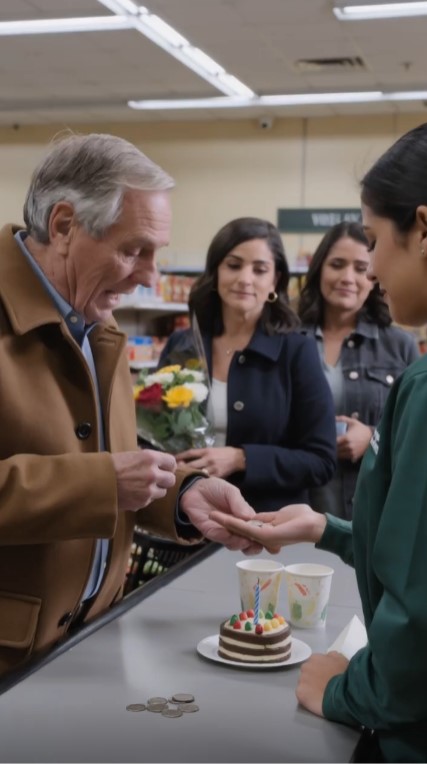
An elderly man stood at the register…
Counting coins one by one.
His hands were shaking.
“I’m sorry,” he whispered.
The cashier smiled.
“Take your time.”
Someone behind him sighed.
Another customer checked their watch.
But the cashier didn’t rush him.
Finally, the man counted the last coin.
Then quietly asked:
“Is it enough?”
The cashier looked at what he was buying.
A tiny birthday cake.
One candle.
And two cups.
She looked back at him.
“Who’s the cake for?”
The elderly man smiled.
“My wife.”
“Birthday?”
He nodded.
“Her first one in the care home.”
The entire line went silent.
Then the woman who had been checking her watch stepped forward.
“Sir…”
She placed flowers from her own basket beside his cake.
“Please take these too.”
Another customer added chocolates.
Then another added a birthday card.
Within seconds…
The man who couldn’t afford anything extra was standing beside a counter full of gifts.
But then the cashier noticed what he’d written on the birthday card.
She read the first line…
And immediately started crying.
Dear Margaret,
If you don’t remember that I’m your husband today, that’s okay. I’ll remember for both of us.
The cashier, Emily Carter, quickly covered her mouth.
The elderly man looked embarrassed.
“Oh.”
He reached for the card.
“I wasn’t finished.”
“I’m sorry,” Emily whispered.
She handed it back.
Nobody in the line complained anymore.
The woman who’d donated the flowers looked down.
The man behind her quietly put his phone away.
The elderly customer’s name was Henry Wilson.
He was eighty-one.
His wife, Margaret, was turning seventy-nine.
They had been married for fifty-six years.
For most of those years, Margaret remembered everything.
Every birthday.
Every anniversary.
Every neighbor’s name.
Every appointment Henry forgot.
She remembered which grandchild hated tomatoes.
She remembered exactly where she’d hidden Christmas presents months earlier.
She remembered that Henry took his coffee black but secretly preferred it with sugar.
Then small things began disappearing.
A doctor’s appointment.
A familiar street.
A recipe she’d cooked for forty years.
One afternoon, Margaret called Henry from the grocery store.
“I can’t find my husband.”
Henry’s heart stopped.
“Margaret, it’s me.”
There was silence.
Then she laughed.
“Of course it is.”
But Henry didn’t laugh.
A year later, Margaret’s care needs became more than Henry could safely manage alone.
He resisted outside help for months.
Their daughter Rachel tried to reason with him.
“Dad, you barely sleep.”
“I’m fine.”
“You fell last week.”
“I tripped.”
“You left the stove on because Mom wandered outside.”
Henry became angry.
“She belongs at home.”
Rachel took his hand.
“She belongs somewhere safe.”
Henry knew she was right.
Knowing didn’t make it easier.
The day Margaret moved into the care home, Henry packed her clothes.
Her favorite blanket.
Their wedding photograph.
A small radio.
And a blue ceramic bird she’d kept beside their bed for decades.
Margaret watched him.
“Are you coming too?”
Henry forced a smile.
“Not today.”
Her expression changed.
“Why?”
Henry turned away so she wouldn’t see him cry.
That evening, he returned to their house alone.
He made two cups of tea out of habit.
Then stood staring at the second one.
For fifty-six years, almost every important moment in Henry’s life had included Margaret.
Now her first birthday in the care home was approaching.
Henry wanted it to feel normal.
At least for an hour.
But money had become tight.
Transportation.
Household bills.
Prescription costs.
Expenses connected with Margaret’s care.
Henry had enough for the basics, but very little extra that week.
So he emptied an old jar of coins.
He counted them at the kitchen table.
Then walked to the grocery store.
He bought the smallest cake he could find.
One candle.
Two disposable cups.
He planned to ask the care home for coffee.
That was enough.
It had to be.
At the register, however, Henry realized he’d miscounted.
He was short.
Only by a little.
But enough.
Emily quietly removed a small store item he’d added at the last minute so the total would fit what he had.
Henry counted again.
His fingers shook.
People waited.
Then strangers began adding things.
Flowers.
Chocolates.
A birthday card.
A woman named Laura even offered to pay for the cake.
Henry immediately shook his head.
“No, thank you.”
“Please.”
“I can pay for the cake.”
Laura smiled.
“Then let us help with the birthday.”
Henry looked at the gifts.
“I don’t know any of you.”
The man behind her laughed softly.
“Apparently that’s not stopping anybody.”
Henry smiled.
Then he began writing in the card.
That was when Emily accidentally saw the first line.
Now everyone understood something else.
This wasn’t simply an elderly husband buying a birthday cake.
Henry didn’t even know whether Margaret would understand why he was bringing it.
Emily gently asked:
“Does she recognize you?”
Henry looked at the card.
“Sometimes.”
The answer hurt more than anything dramatic could have.
“Some days she calls me Henry.”
He smiled faintly.
“Those are good days.”
“And the others?”
“Sometimes she thinks I’m her brother.”
“Sometimes a neighbor.”
“Last week she asked if I’d met her husband.”
Emily’s eyes filled again.
“What did you say?”
Henry laughed softly.
“I told her he sounded like a very lucky man.”
Laura turned away, wiping her face.
Henry continued writing.
When he finished, he placed the card inside its envelope.
Emily packed everything carefully.
The flowers didn’t fit in the grocery bag, so Laura tied them together.
The man who’d added chocolates carried the cake to the door.
Henry looked around at everyone.
“I don’t know how to thank you.”
Laura smiled.
“Go see your wife.”
Henry nodded.
“I can do that.”
He left.
But Emily couldn’t stop thinking about him.
Neither could Laura.
The following morning, Emily arrived for work and found Laura waiting near the register.
“I have a strange question.”
Emily smiled.
“About Henry?”
Laura nodded.
“Do you know which care home?”
Emily shook her head.
Even if she had known from store records, she wouldn’t have shared private customer information.
Laura understood.
“I just wanted to know how the birthday went.”
So did Emily.
They assumed they’d never find out.
Three days later, Henry returned.
He was carrying the same birthday card.
Emily immediately walked over.
“How was it?”
Henry smiled.
“Interesting.”
That wasn’t the answer she’d expected.
“Did Margaret like the flowers?”
“She loved them.”
“The chocolates?”
“She tried giving them to a nurse.”
Emily laughed.
“And the cake?”
Henry became quiet.
“At first, she wouldn’t eat it.”
“Why?”
“She said she was waiting for her husband.”
Emily’s smile disappeared.
Henry had arrived at the care home shortly before lunch.
Margaret was sitting near a window.
She didn’t recognize him.
Not that day.
Henry sat beside her.
“Happy birthday.”
Margaret looked at the cake.
“Thank you.”
“Do you know who I am?”
A caregiver glanced toward Henry.
He usually avoided asking that question.
But emotion got the better of him.
Margaret studied his face.
Then shook her head.
“No.”
Henry’s heart broke quietly.
He smiled anyway.
“That’s okay.”
He placed the flowers beside her.
“These are for you.”
“They’re beautiful.”
“A woman named Laura gave them to you.”
“Do I know Laura?”
“No.”
Margaret looked confused.
“Why would she give me flowers?”
Henry thought about it.
“Because she was having a busy day and then decided your birthday was more important for a minute.”
Margaret smiled.
“That was nice.”
Henry placed two cups on the table.
Then the little cake.
He put the single candle in the center.
A caregiver lit it.
Everyone sang.
Margaret laughed.
For a moment, Henry didn’t care whether she knew his name.
She was happy.
That was enough.
Then Margaret looked at the second cup.
“Is somebody else coming?”
Henry swallowed.
“I’m here.”
“No.”
She shook her head.
“My husband.”
Henry looked down.
“What is his name?”
“Henry.”
His eyes filled.
“What is he like?”
Margaret smiled.
“Annoying.”
The caregivers laughed.
Henry did too.
“Anything else?”
“He snores.”
“Terrible man.”
“He is.”
Then Margaret’s expression softened.
“But he’s good.”
Henry couldn’t answer.
Margaret looked toward the door.
“He’ll come.”
Henry whispered:
“Yes.”
“He always does.”
For several minutes, they ate cake together.
Margaret still didn’t recognize him.
Then Henry remembered the card.
He took it from the envelope.
“I wrote you something.”
Margaret nodded.
Henry began reading.
Dear Margaret,
If you don’t remember that I’m your husband today, that’s okay. I’ll remember for both of us.
He stopped.
Margaret was staring at him.
Henry continued.
You have remembered enough for both of us for fifty-six years.
You remembered birthdays I forgot.
You remembered where I left my keys.
You remembered our children’s appointments, our grandchildren’s favorite foods, and every anniversary even when I pretended I hadn’t forgotten.
Margaret’s eyes moved toward his hands.
So if some of those memories are becoming harder to carry, you can give them to me.
I’ll carry them now.
Henry’s voice broke.
The room was silent.
He reached the final line.
And if tomorrow you ask me who I am, I’ll introduce myself again.
Love, Henry.
Margaret stared at him.
Then at the card.
Then back at his face.
For several seconds, nothing happened.
Henry folded the paper.
“Happy birthday.”
Margaret suddenly reached across the table.
She touched his wedding ring.
Then looked at her own.
“Henry?”
He froze.
“Yes.”
Her eyes filled.
“You came.”
Henry began crying.
“Of course I came.”
Margaret squeezed his hand.
“I knew you would.”
The moment lasted less than five minutes.
Later, Margaret became confused again.
She asked why there were flowers in her room.
She asked whether Rachel was coming.
Then she asked Henry where her husband was.
But Henry didn’t consider the afternoon ruined.
Not anymore.
He had gotten five minutes.
Five minutes in which Margaret knew exactly who he was.
Five minutes in which fifty-six years seemed to return.
Emily listened silently as Henry finished the story.
Then she asked:
“Why did you bring the card back?”
Henry placed it on the counter.
“Margaret gave it to me.”
Emily looked confused.
“She said it belonged to my wife.”
Emily covered her mouth again.
Henry smiled.
“So I’m keeping it safe until she wants it back.”
A few weeks later, Henry returned to the store.
Then again.
Eventually, he became familiar to everyone working mornings.
Sometimes he bought flowers.
Sometimes cookies.
Sometimes nothing more than two cups of coffee.
Laura occasionally saw him too.
The first time they met again, Henry pointed at her.
“You’re the flower woman.”
Laura laughed.
“How’s Margaret?”
Henry smiled.
“Today?”
“Yes.”
“Today she knew me.”
Laura’s face lit up.
“That’s wonderful.”
Henry nodded.
“Yesterday she didn’t.”
He said it without bitterness.
He was learning to live inside both realities.
Months later, Emily asked whether he still read Margaret the birthday card.
“Sometimes.”
“Does it help her remember?”
Henry thought about the question.
“That’s not why I read it.”
“Then why?”
He smiled.
“Because even when she doesn’t remember me, I remember what I promised her.”
Years passed.
Emily eventually became the store’s assistant manager.
She saw countless customers.
Most disappeared from memory.
But she never forgot Henry counting coins.
Or the impatient line that suddenly became generous.
She especially remembered the sentence she’d accidentally read:
If you don’t remember that I’m your husband today, that’s okay. I’ll remember for both of us.
It taught her something she hadn’t understood before.
Sometimes love isn’t being remembered.
Sometimes it’s showing up even when you might not be.
It’s bringing two cups when only one person knows why.
It’s buying the smallest cake you can afford.
It’s introducing yourself again.
And again.
And again.
Because somewhere beneath everything illness can change…
There are fifty-six years worth remembering.
And Henry had decided that if Margaret could no longer carry all of them herself…
He would carry enough for both of them.