
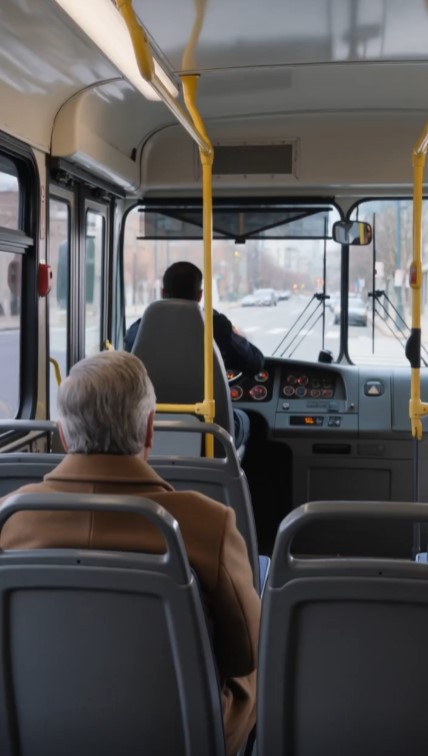
The elderly man reached his stop…
But when the doors opened, he didn’t move.
The driver looked back.
“Sir, this is your stop.”
The man stared outside.
Then quietly said:
“I know.”
His hands were trembling.
A passenger asked:
“Are you okay?”
The elderly man looked at the empty seat beside him.
“My wife and I got off at this stop together every Friday for 52 years.”
The bus became completely silent.
“Today is my first time doing it alone.”
Then a young man suddenly stood.
“I’ll walk with you.”
A woman stood too.
“So will I.”
Then another passenger got up.
And another.
Within seconds…
Almost the entire bus was standing.
The elderly man stared at them.
But just as he stepped onto the sidewalk…
The driver did something nobody on that bus expected.
He switched off the engine.
Then he stood up.
“Give me one minute.”
The passengers looked confused.
The driver, Marcus Reed, stepped off the bus and walked toward the elderly man.
“What’s your name, sir?”
“Henry.”
“Henry, where were you and your wife going every Friday?”
Henry pointed across the street.
A small café stood on the corner.
Its faded blue sign read:
MILLER’S CAFÉ
“There.”
Marcus looked at the passengers standing behind him.
“You all really planning to walk him?”
The young man who had first volunteered nodded.
Marcus smiled.
“Then we’re going to do this properly.”
He contacted dispatch, explained the brief situation, and followed the instructions he was given.
Then he turned toward Henry.
“I’m walking you across.”
Henry shook his head immediately.
“You have a bus full of people.”
Marcus looked behind him.
Nobody was complaining.
For perhaps the first time that morning, nobody seemed concerned about being a few minutes late.
Henry looked at the café again.
“I don’t know if I can go inside.”
Marcus didn’t ask why.
He simply said:
“Then we’ll get you to the door.”
Henry nodded.
The young passenger joined them.
So did the woman.
The rest stayed near the bus.
Slowly, Henry crossed the street.
Every few steps, he glanced toward the empty space beside him.
For fifty-two years, that space had belonged to Margaret.
They met when Henry was twenty-three.
Margaret was twenty-one.
Their first date had been a disaster.
Henry chose a restaurant he couldn’t really afford.
Margaret spilled coffee on her dress.
Then Henry missed the last bus home.
A month later, they tried again.
This time, Margaret chose.
“No expensive restaurant.”
She took him to Miller’s Café.
They ordered two coffees and split a piece of pie.
That became their place.
After they married, they returned on Fridays.
When their children were young, sometimes the children came too.
When money was tight, they ordered only coffee.
When Henry received a promotion, they celebrated there.
When Margaret’s mother died, they sat in the corner booth for nearly two hours without speaking.
When their first grandchild was born, Henry brought a photograph and showed it to everyone working there.
Years became decades.
The original owner retired.
The menu changed.
Prices changed.
The neighborhood changed.
But Friday remained.
They took the same bus.
Got off at the same stop.
Crossed the same street.
And sat in the same booth whenever it was available.
Then, six months earlier, Margaret became ill.
Henry cared for her at home as long as he could.
She died three weeks before that bus ride.
For the first two Fridays afterward, Henry didn’t leave his house.
On the third Friday, he put on his coat.
He walked to the bus stop.
He told himself he needed to go back.
But he hadn’t understood how difficult the journey would be.
Every part of it contained Margaret.
The bus shelter where she complained about the cold.
The seat where she always sat by the window.
The corner where she reminded Henry to press the stop button because he was forever forgetting.
And finally, the open bus doors.
For fifty-two years, Margaret had stood beside him there.
That morning, the seat was empty.
Henry simply couldn’t make his legs move.
Now he stood outside Miller’s Café with Marcus and two strangers.
Through the window, he could see the corner booth.
Empty.
Henry stopped.
“I made a mistake.”
Marcus looked at him.
“What do you mean?”
“I shouldn’t have come.”
“You don’t have to go inside.”
Henry nodded.
But he didn’t leave.
Then the café door opened.
An elderly woman wearing an apron stepped outside.
She stared at Henry.
“Henry?”
His face crumpled.
“Hello, Evelyn.”
Evelyn Miller had worked at the café for more than forty years.
She had served Henry and Margaret hundreds of times.
She looked behind him.
Then her expression changed.
“Oh, Henry.”
He nodded.
“Margaret died.”
Evelyn closed her eyes.
“I heard she was sick.”
“Three weeks ago.”
Evelyn hugged him.
Henry finally cried.
Not quietly.
Not politely.
He buried his face against the shoulder of a woman he’d known for decades and cried on the sidewalk.
Marcus stepped back.
The young man looked away.
A few passengers near the bus wiped their eyes.
When Henry composed himself, Evelyn asked:
“Are you coming in?”
Henry looked through the window.
“I don’t know.”
Evelyn understood.
Then she said:
“Your table is still there.”
Henry stared at her.
Evelyn opened the door.
He took one step.
Then stopped again.
Marcus touched his shoulder.
“Want company?”
Henry looked at the bus.
“You have a route.”
“Yes.”
“People have places to be.”
Marcus smiled.
“So do you.”
Henry laughed faintly.
“I don’t even know you.”
“Marcus.”
The young passenger raised his hand.
“Daniel.”
The woman beside him smiled.
“Rachel.”
Henry looked at all three.
Then toward the passengers.
“Why are you doing this?”
Daniel answered first.
“Because someday one of us might need somebody to get off the bus with us.”
Nobody had anything better to say than that.
Henry entered the café.
Evelyn led him toward the corner.
Two cups were already sitting on the table.
Henry stopped.
His eyes went immediately to the second cup.
Evelyn noticed.
“Oh.”
She started to remove it.
Henry reached out.
“No.”
Evelyn stopped.
“Leave it.”
Henry sat in his usual seat.
The chair across from him remained empty.
Marcus checked the time.
He needed to return to the bus.
But before leaving, he asked:
“Henry, what time do you normally go home?”
“About ten.”
Marcus nodded.
Then he walked away.
Henry assumed that was the end of it.
It wasn’t.
At 9:55, Henry paid his bill.
He stood outside the café.
He expected to wait for the next scheduled bus.
Instead, when his regular route arrived at the stop, Marcus was driving again.
The doors opened.
Marcus looked at him.
“Ready?”
Henry smiled.
“This part’s easier.”
“Good.”
Henry climbed aboard.
He sat in the same seat.
The one beside him remained empty.
Marcus watched him in the mirror.
Then Henry noticed something tucked beside the window.
A small folded piece of paper.
He opened it.
Several names were written inside.
Daniel.
Rachel.
Thomas.
Emily.
Michael.
Names of passengers from that morning.
At the top, someone had written:
FRIDAY WALKING CLUB
Underneath:
If you need someone next Friday, 8:15. Same bus.
Henry stared at it.
He looked toward Marcus.
“Did you do this?”
Marcus shook his head.
“The passengers.”
Henry laughed.
“They’re ridiculous.”
“Probably.”
The following Friday, Henry boarded again.
He expected the whole thing to have been a kind gesture everyone had forgotten.
At the third stop, Daniel boarded.
“Morning, Henry.”
At the next stop, Rachel got on.
Then Emily.
Then Thomas.
Not everyone from the previous week could come.
They had jobs.
Families.
Appointments.
But five people had rearranged their morning.
When Henry’s stop arrived, Marcus opened the doors.
This time, Henry stood immediately.
Daniel looked at him.
“Need us?”
Henry looked across the street.
Then at the group.
“Yes.”
They walked together.
At the café, Evelyn had prepared the corner booth.
Henry ordered coffee.
Daniel ordered breakfast.
Rachel ordered pie despite it being barely nine in the morning.
“Margaret would’ve liked you,” Henry told her.
Rachel smiled.
“How do you know?”
“She believed pie was acceptable at any hour.”
Henry told them stories.
How Margaret once missed their bus because she stopped to rescue a kitten.
How she always carried peppermints.
How she cheated at cards and denied it even when caught.
For the first time since Margaret died, Henry discovered something unexpected.
Talking about her didn’t make her disappear more.
It brought pieces of her back.
The Friday visits continued.
Not every passenger came every week.
Sometimes Henry went with only Daniel.
Sometimes Rachel.
Sometimes nobody was available, and Henry went alone.
That mattered too.
Because slowly, the stop stopped frightening him.
He could stand when the doors opened.
He could cross the street.
He could enter the café.
He could sit opposite the empty chair.
Months later, Marcus pulled up to Henry’s stop.
The doors opened.
Henry stood.
A new passenger noticed the empty seat beside him.
“Someone sitting there?”
Henry looked at it.
For a second, the old sadness returned.
Then he smiled.
“Someone used to.”
The passenger apologized.
Henry shook his head.
“No need.”
He stepped off the bus without hesitation.
Marcus watched through the mirror.
Henry crossed the street alone.
He reached the café.
Then stopped.
A woman stood near the bus shelter looking confused.
She was perhaps seventy.
She checked a piece of paper.
Then looked at the street signs.
Henry approached.
“Are you lost?”
“A little.”
“Where are you trying to go?”
She showed him the address.
Henry recognized it.
“Two blocks past the café.”
The woman sighed.
“I haven’t been here since my husband died.”
Henry looked at her.
“First time coming alone?”
She nodded.
Henry understood immediately.
He glanced toward Miller’s Café.
Then toward her destination.
“I’ll walk with you.”
The woman smiled.
“You don’t have to.”
Henry thought about a bus full of strangers standing up.
A young man saying, I’ll walk with you.
A driver switching off the engine.
And the first terrible Friday when he thought he couldn’t take another step without Margaret beside him.
“Yes,” Henry said.
“I know.”
He offered his arm.
“But sometimes the first walk is easier with somebody.”
Together, they continued down the sidewalk.
Behind them, Marcus watched from the bus.
Then he smiled and pulled away.
Years later, Henry still took that route on Fridays.
The empty seat never stopped meaning something.
It shouldn’t have.
Fifty-two years don’t disappear because a person learns how to ride a bus alone.
But Henry eventually understood what those strangers had given him.
They hadn’t replaced Margaret.
Nobody could.
They simply stood beside him at the exact moment grief convinced him he couldn’t take the next step.
And then, when he was ready…
They let him take it himself.