
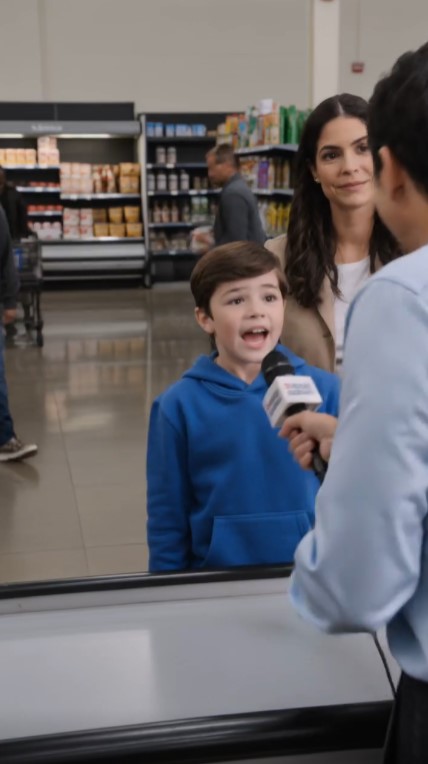
A little boy suddenly grabbed the store microphone.
His mother froze.
“Evan! Put that down!”
But before an employee could reach him…
The boy spoke.
“Excuse me… can everyone please listen?”
Shoppers stopped.
The cashier looked confused.
His mother rushed toward him.
But Evan continued:
“There’s a man here who needs help.”
Everyone started looking around.
Then the boy pointed toward an elderly man standing near the checkout.
The man immediately shook his head.
“No, no… I’m fine.”
Evan looked at him.
“You told me you haven’t eaten today.”
The entire checkout area went silent.
The elderly man lowered his head.
Then something unexpected happened.
A woman placed a loaf of bread on the counter.
Another shopper added milk.
Someone else brought fruit.
Within seconds…
People from different aisles started walking toward the checkout carrying groceries.
The elderly man covered his face.
But then the store manager came running toward them.
Everyone thought the boy was in trouble.
Instead, the manager looked at Evan and made an announcement that changed everything.
“My name is Thomas Miller, and I’m the manager here.”
He took the microphone gently from Evan.
“First, young man, you’re definitely not supposed to use this without permission.”
Evan’s mother, Rachel Carter, closed her eyes.
“I’m so sorry.”
But Thomas wasn’t angry.
He looked toward the elderly man.
Then back at the growing pile of groceries.
“And second…”
He paused.
“Whatever these customers put on that counter, the store is matching.”
For a moment, nobody moved.
Then someone applauded.
Within seconds, the checkout area erupted.
Evan smiled.
The elderly man didn’t.
He looked overwhelmed.
“Please,” he said. “I don’t need all this.”
Thomas approached him carefully.
“What’s your name, sir?”
“Henry.”
“Henry, nobody’s trying to embarrass you.”
Henry looked at the groceries.
“I can pay for my own things.”
Evan spoke again.
“But you put them back.”
Rachel looked at her son.
“What do you mean?”
Evan pointed toward a nearby shelf.
That was when the story began to make sense.
Ten minutes earlier, Rachel and Evan had been shopping for groceries.
Rachel was comparing prices while Evan wandered a few feet away to look at cereal.
He noticed Henry standing beside a small basket.
Inside were only four things.
Bread.
Soup.
Bananas.
Milk.
Henry looked at the prices.
Then he opened his wallet.
He counted the bills inside.
After a moment, he returned the milk.
Then the bananas.
Then the soup.
Eventually, only the bread remained.
Evan watched him.
“Don’t you like bananas?”
Henry looked down.
“What?”
“You put them back.”
Henry smiled.
“I like them.”
“Then why aren’t you buying them?”
Rachel had taught Evan not to question strangers, but nine-year-olds don’t always understand which questions adults have decided are uncomfortable.
Henry hesitated.
“I have to make my money last until Monday.”
Evan looked at the bread.
“Is that your dinner?”
Henry smiled again.
“I’ll be fine.”
“Did you eat lunch?”
Henry didn’t answer.
Evan asked:
“Breakfast?”
Henry sighed.
“No.”
That answer stayed with the boy.
A few minutes later, he saw the store’s unattended customer-service microphone.
And before Rachel understood what he was doing, Evan was speaking to the entire supermarket.
Now Henry stood surrounded by strangers carrying groceries toward him.
A woman placed eggs on the counter.
A teenager added pasta.
Someone brought vegetables.
Another person added coffee.
Henry shook his head.
“That’s enough.”
Nobody seemed to hear him.
“Really. That’s enough.”
Thomas raised his hand.
“All right, everyone.”
The crowd quieted.
“We’re going to slow down.”
He turned toward Henry.
“What would actually help you?”
Henry looked surprised by the question.
Thomas didn’t assume.
He didn’t want the moment to become a spectacle where strangers filled carts simply because it made them feel generous.
Henry looked down.
“Just enough food for a few days.”
Thomas nodded.
“Then that’s what we’ll do.”
Rachel approached Henry.
“I’m sorry about Evan. He meant well.”
Henry looked at the boy.
“He did.”
Evan frowned.
“Are you mad?”
Henry shook his head.
“No.”
“Embarrassed?”
Henry laughed softly.
“A little.”
Evan thought about that.
“Sorry.”
Henry looked at him for several seconds.
“Don’t be sorry for noticing.”
That sentence made Thomas turn around.
“Say that again.”
Henry smiled.
“Don’t be sorry for noticing.”
Thomas stared at him.
Something about those words seemed familiar.
Then he noticed Henry’s jacket.
Pinned near the collar was a small metal badge.
Most of the lettering had faded.
Thomas leaned closer.
“Where did you get that?”
Henry touched it.
“This?”
Thomas nodded.
“It’s from the old Miller’s Market.”
Henry looked surprised.
“You remember Miller’s?”
Thomas smiled.
“My father owned it.”
Henry stared at him.
“Arthur Miller?”
Thomas’s expression changed.
“You knew my father?”
Henry looked toward the supermarket around them.
“I worked for him.”
Thomas froze.
“When?”
“1978 until about 1986.”
Thomas stepped closer.
“Henry what?”
“Henry Walker.”
Thomas’s mouth opened.
“Henry Walker?”
Henry nodded.
Thomas stared at him.
Then suddenly laughed.
“You’re Henry?”
Now everyone was confused.
Thomas handed the microphone to an employee.
“Wait here.”
He ran toward the back office.
Henry looked at Rachel.
“What is happening?”
“I have no idea.”
Several minutes later, Thomas returned carrying an old framed photograph.
He handed it to Henry.
The picture showed a small neighborhood grocery store.
Five employees stood outside.
One was a young Henry.
Another was Thomas’s father, Arthur.
Henry stared at it.
“I haven’t seen this picture in forty years.”
Thomas pointed toward young Henry.
“My father talked about you.”
Henry looked surprised.
“Why?”
Thomas laughed.
“Because of the winter of 1982.”
Henry’s eyes widened.
“Oh.”
“What happened?” Evan asked.
Thomas looked at him.
“My father almost lost his store.”
A severe winter and several unexpected expenses had left Arthur’s small grocery business struggling.
He had employees to pay.
Bills piling up.
And a family at home.
One Friday, Arthur gathered his workers.
He told them he might have to close.
Henry had a wife and two children.
He needed every paycheck.
But he did something Arthur never forgot.
Henry told him:
“Pay the others first.”
Arthur refused.
Henry insisted.
For several weeks, Henry accepted fewer hours and picked up evening work elsewhere.
Other employees followed his example.
One repaired a broken freezer instead of charging for the work.
Another helped renegotiate a supplier bill.
Customers organized a neighborhood shopping day.
The store survived.
Thomas looked at Henry.
“My father said you were the first person who stepped forward.”
Henry shook his head.
“A lot of people helped.”
“That’s exactly what Dad said you’d say.”
Thomas turned the photograph around.
Something was written on the back in faded ink.
He handed it to Evan.
“Read that.”
Evan carefully sounded out the handwriting.
Henry notices who needs help before they ask. Never lose people like that.
Underneath was Arthur Miller’s signature.
Henry looked away.
For the first time, tears filled his eyes.
Thomas asked:
“What happened to you?”
Henry sighed.
Life had been ordinary for many years.
He married his wife, Margaret.
Raised two children.
Worked maintenance jobs.
Eventually retired.
Margaret died four years earlier.
Then came medical bills.
Home repairs.
A few unexpected expenses.
Henry’s savings gradually shrank.
His pension covered the basics, but that month several bills arrived together.
Henry expected a small payment on Monday.
Until then, he had decided he could stretch what remained.
“I wasn’t starving,” he insisted.
Thomas looked at the single loaf of bread.
“You hadn’t eaten today.”
Henry smiled.
“I’ve had worse days.”
Thomas shook his head.
“My father would come out of his grave and fire me if I let you leave with one loaf of bread.”
Henry laughed.
“He threatened to fire me at least once a week.”
Thomas looked toward the groceries customers had donated.
Then toward the supermarket around him.
The old Miller’s Market was long gone.
Thomas had spent years working for larger grocery chains.
But one thing his father taught him remained.
A grocery store saw people at their most ordinary.
And sometimes, if employees paid attention, at their most vulnerable.
Thomas took the microphone again.
“I want everyone to hear something.”
Henry immediately protested.
“Oh, no.”
Thomas smiled.
“Too late.”
He told the customers about the photograph.
About Arthur Miller.
About the struggling store.
And about the young employee who had once stepped forward when Thomas’s father needed help.
Then Thomas looked toward Evan.
“Today, somebody else noticed.”
Evan became shy.
Thomas continued.
“This store already has a small community assistance budget.”
He paused.
“Starting today, we’re expanding it.”
Customers listened.
Thomas explained that the store would establish a simple, discreet program for customers experiencing temporary hardship.
No public announcements.
No embarrassing scenes.
No one being forced to explain their life in front of strangers.
Staff could connect customers with approved assistance according to the store’s procedures.
Then Thomas pointed toward Evan.
“And we’re calling it the Notice Someone Fund.”
Rachel laughed.
Evan’s eyes widened.
“Because of me?”
Thomas nodded.
“And Henry.”
Henry shook his head.
“You don’t need my name on anything.”
“We aren’t putting your name on it.”
“Good.”
Thomas smiled.
“But I am stealing your words.”
Henry knew exactly which ones.
Don’t be sorry for noticing.
Over the following weeks, customers who had witnessed the moment asked whether they could contribute.
The store developed the idea into a properly managed community program with local partners rather than leaving random cash at the checkout.
The purpose remained simple.
Help someone through a difficult week without turning their hardship into entertainment.
Henry became the program’s first recipient.
He hated that description.
So Thomas stopped using it.
Instead, he called Henry its first adviser.
Henry liked that even less.
But he kept coming back.
Every Wednesday, he met Thomas for coffee.
Evan occasionally visited too.
One afternoon, Evan asked Henry:
“Why didn’t you ask somebody for help?”
Henry thought about it.
“When you’ve spent your whole life helping yourself, asking can feel difficult.”
“But you helped Mr. Thomas’s dad.”
“That was different.”
“How?”
Henry opened his mouth.
Then stopped.
Evan smiled.
“See?”
Henry laughed.
“You’re annoying.”
“My mom says I’m curious.”
“Your mother is being polite.”
Months later, Henry was shopping when he noticed a young father at another checkout.
The man had a little girl beside him.
The cashier gave him the total.
He checked his wallet.
Then quietly removed several items.
Henry watched.
For a second, he saw himself.
He approached Thomas.
“I think somebody needs your fund.”
Thomas looked toward the checkout.
“How do you know?”
Henry smiled.
“I noticed.”
Thomas arranged the assistance discreetly.
The young father never had to stand in front of a crowd.
There was no microphone.
No applause.
Just a cashier quietly telling him that a store assistance credit had covered the remaining groceries.
The father looked stunned.
“Why?”
The cashier gave him a small card.
On it were six words:
DON’T BE SORRY FOR NEEDING HELP.
On the other side:
DON’T BE SORRY FOR NOTICING.
A year after the day Evan grabbed the microphone, Thomas invited him back to the store.
There was no big ceremony.
Henry insisted on that.
Thomas simply showed Evan a small sign near customer service.
It explained that customers facing temporary hardship could privately ask an employee about available community assistance.
Evan read it.
“Did I do this?”
Thomas shook his head.
“No.”
Evan looked disappointed.
Thomas smiled.
“You started something.”
Then he pointed toward Henry.
“He started something forty-four years before you did.”
Henry laughed.
“And Arthur started things before me.”
Evan thought about it.
“So who gets the credit?”
Henry placed a hand on his shoulder.
“That’s the nice thing about helping people.”
“What?”
“You don’t have to know.”
Years later, Evan barely remembered what groceries people placed on that counter.
He couldn’t remember how many shoppers applauded.
He couldn’t even remember exactly what he’d said into the microphone.
But he remembered the elderly man lowering his head because he was embarrassed.
And he remembered what Henry told him afterward.
Don’t be sorry for noticing.
Because that was what had really changed everything.
Not the microphone.
Not the groceries.
Not even the manager’s announcement.
A nine-year-old boy simply noticed that someone beside him was having a difficult day.
And instead of assuming somebody else would help…
He decided to say something.