
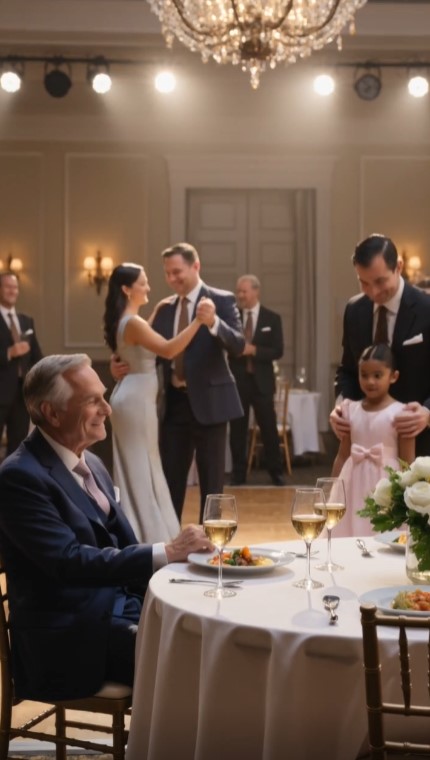
Everyone was dancing…
Except one elderly man sitting alone.
Then a little girl noticed him.
She walked across the room and asked:
“Why aren’t you dancing?”
The man smiled.
“My legs aren’t as quick as they used to be.”
The girl thought for a moment.
Then held out her hand.
“Mine aren’t very good either.”
The elderly man laughed.
Then something nobody expected happened.
He took her hand.
They slowly walked onto the dance floor.
One tiny step.
Then another.
The girl copied every move he made.
People around them began noticing.
One couple suddenly changed the way they were dancing.
Then another couple followed.
Within seconds…
Something was happening across the entire dance floor.
Everyone had slowed down.
The fast turns stopped.
The energetic steps disappeared.
Couples moved gently from side to side.
Nobody announced it.
Nobody asked the DJ to stop the music.
One person simply noticed what the little girl was doing.
Then another.
And another.
Within seconds, an entire room had quietly adjusted its pace to match one elderly man.
His name was Henry Wilson.
And when he finally realized what everyone was doing, he stopped dancing.
He looked around.
Dozens of people were moving at his speed.
Henry covered his mouth.
The little girl squeezed his hand.
“Are you okay?”
Henry looked down at her.
“What’s your name?”
“Lily.”
“How old are you, Lily?”
“Eight.”
Henry smiled.
“My granddaughter would’ve been about your age when she first learned this dance.”
Lily’s mother, Rachel Carter, had been watching from across the room.
She approached slowly.
“Lily, sweetheart, don’t tire him out.”
Henry shook his head.
“She isn’t.”
Then he looked toward the bride and groom.
It was their wedding reception.
Emily Carter and Daniel Reed had been married only a few hours earlier.
Henry was sitting alone because the person he’d spent fifty-four years dancing with was no longer beside him.
His wife, Margaret, had died eleven months earlier.
They had met at a community dance in 1969.
Henry was twenty-one.
Margaret was nineteen.
Henry later admitted he attended only because his brother promised there would be free food.
Margaret was standing beside the wall.
Henry noticed her immediately.
It took him almost an hour to find enough courage to approach.
“Would you like to dance?”
Margaret looked at him.
“Can you dance?”
Henry lied.
“Yes.”
He could not.
Within thirty seconds, he stepped on her foot.
Margaret burst out laughing.
“You’re terrible.”
“I can improve.”
“You’d better.”
She taught him.
One step.
Then another.
Nothing complicated.
Henry never became a particularly good dancer.
But Margaret didn’t care.
They married four years later.
And they danced everywhere.
In their kitchen.
At family weddings.
In the living room on anniversaries.
Sometimes there wasn’t even music.
As they aged, their dancing changed.
The turns became smaller.
The steps became slower.
After Henry developed arthritis, Margaret would tease him.
“Keep up.”
When Margaret’s own health began declining, Henry returned the joke.
“Keep up.”
Eventually, neither could.
So they developed their own dance.
One step left.
Pause.
One step right.
Pause.
A tiny turn if they felt adventurous.
Margaret called it “the old people shuffle.”
Henry called it perfect.
At their fiftieth anniversary, their children asked them to dance.
Henry worried they would look ridiculous.
Margaret grabbed his hand.
“We’ve earned the right to look ridiculous.”
They danced for almost four minutes.
It became Henry’s favorite memory of their final years together.
Then Margaret died.
Afterward, Henry stopped dancing completely.
He still attended family events.
He smiled.
He applauded.
But whenever music started, he sat down.
That was what he’d been doing at Emily’s wedding.
Until Lily noticed.
Now Henry stood in the middle of the dance floor while an entire room moved at the same slow rhythm Margaret had taught him.
One step.
Pause.
One step.
Pause.
Henry’s eyes filled with tears.
He looked toward the DJ.
“Can you stop the music for a moment?”
The music faded.
Everyone became quiet.
Henry still held Lily’s hand.
“I need to tell you people something.”
Guests gathered closer.
Henry pointed toward the floor.
“This dance you’re all doing…”
He laughed.
“My wife invented it.”
People smiled.
“At least that’s what she claimed.”
Then his voice changed.
“Margaret and I danced together for fifty-four years.”
The room became completely still.
“She died last year.”
Emily, the bride, wiped her eyes.
Henry continued.
“I haven’t danced since.”
He looked down at Lily.
“Until this young lady decided I didn’t have a good enough excuse.”
Lily smiled proudly.
People laughed.
Henry turned toward the guests.
“When I realized all of you had slowed down…”
He paused.
“I thought you were feeling sorry for me.”
Several people shook their heads.
“But then I remembered something Margaret used to say.”
Henry looked toward the empty chair where he’d been sitting.
“She always said the best dancers aren’t the people who know the most steps.”
He smiled.
“They’re the people who notice their partner.”
Rachel looked at Lily.
Henry continued.
“And that’s what all of you just did.”
He squeezed Lily’s hand.
“You noticed somebody.”
Then something unexpected happened.
Henry started walking away from the dance floor.
Lily followed him.
“Where are we going?”
“To get something.”
Henry returned to his table.
Hanging over the back of his chair was his jacket.
He reached into the inside pocket and removed a small velvet pouch.
From it, he took an old silver bracelet.
Rachel immediately stepped forward.
“Henry…”
“Don’t worry.”
He smiled.
“I’m not giving away the family fortune.”
He knelt carefully in front of Lily.
“My wife wore this to almost every wedding we attended.”
Lily stared at the bracelet.
A tiny silver shoe hung from it.
“She called this her dancing shoe.”
Henry explained that Margaret bought the charm after their first anniversary.
Every time Henry complained about dancing, Margaret touched it and said:
“No excuses.”
Lily smiled.
“That sounds like my mom.”
Rachel laughed.
“She’s right.”
Henry held the bracelet toward Lily.
“I’d like you to have the little charm.”
Rachel shook her head.
“Oh, Henry, we couldn’t—”
“I didn’t say the bracelet.”
He smiled.
“Margaret would haunt me.”
Everyone laughed.
Henry carefully removed the tiny dancing-shoe charm.
He placed it in Lily’s hand.
“Why me?” she asked.
“Because you got an old man dancing again.”
Lily stared at it.
Then closed her fingers around the charm.
But suddenly she reopened her hand.
“No.”
Henry looked surprised.
“You don’t want it?”
“I want it.”
“Then what’s wrong?”
Lily pointed toward the dance floor.
“You said it was your wife’s.”
“Yes.”
“Then you should keep it.”
Henry stared at her.
Lily thought for a moment.
“Can I borrow it?”
“For how long?”
“Until the next dance.”
Henry smiled.
“What happens then?”
“I give it back.”
Henry’s eyes filled again.
“All right.”
Lily held the charm tightly.
Then the DJ spoke.
“Mr. Wilson?”
Henry looked up.
“Would Margaret have had a favorite song?”
Henry laughed.
“She had about fifty.”
“Pick one.”
Henry named an old song they had danced to for decades.
The DJ found it.
The first notes began.
Henry looked at Lily.
“One more?”
She held out her hand.
“One more.”
They returned to the floor.
This time, everyone waited.
Henry took the first step.
Lily copied him.
One step.
Pause.
One step.
Pause.
Then Emily and Daniel joined.
Rachel joined with Lily’s father.
Other couples followed.
But this time, Henry didn’t stop when he noticed.
He simply smiled.
Halfway through the song, he looked toward the empty space beside him.
For a moment, he imagined Margaret there.
Not as something supernatural.
Not as though she had somehow returned.
Just a memory so familiar that Henry could almost predict exactly what she would’ve said.
Keep up, Henry.
He laughed.
Lily looked at him.
“What?”
“Nothing.”
“Tell me.”
Henry smiled.
“My wife would’ve said we’re dancing too slowly.”
Lily became serious.
“Then we should go faster.”
“Absolutely not.”
She laughed.
At the end of the song, the room applauded.
Henry bowed dramatically.
Lily copied him.
Then she handed him the silver charm.
Henry looked at it.
“I thought you wanted to borrow it.”
“The dance is over.”
Henry closed her fingers around it again.
“Keep it until the next one.”
“When’s that?”
Henry looked toward the bride.
Emily heard him.
“My anniversary party.”
Henry nodded.
“There you go.”
A year later, Emily and Daniel held a small anniversary gathering.
Henry came.
So did Lily.
She was nine now.
The first thing she did was walk toward him.
She opened her hand.
The tiny silver dancing shoe was inside.
“You remembered.”
“You said until the next dance.”
Henry attached it to Margaret’s bracelet.
Then Lily held out her hand.
“Ready?”
Henry looked at her.
“My legs are even slower now.”
Lily shrugged.
“Then everybody else will have to slow down again.”
Henry laughed.
They danced.
Over the following years, it became a family tradition.
Whenever Henry attended a wedding, anniversary or birthday celebration, somebody asked him to dance.
Sometimes Lily.
Sometimes Emily.
Sometimes one of Henry’s grandchildren.
Nobody treated him like he was fragile.
Nobody forced him.
They simply adjusted.
One step.
Pause.
One step.
Pause.
When Henry eventually needed a cane, he danced with it.
When standing became difficult, Lily sat beside him and moved her feet to the music.
“Still dancing,” she said.
Henry smiled.
“Margaret would’ve approved.”
Years later, Lily kept the tiny silver shoe.
Henry eventually gave it to her permanently.
With it came a note.
She opened it after he died.
His handwriting was shaky.
Dear Lily,
The night we met, you thought you were asking an old man to dance.
You weren’t.
You were reminding him that losing his dance partner didn’t mean he had to spend the rest of his life sitting beside the dance floor.
Then came one final sentence:
Never be so busy dancing that you forget to notice who is sitting alone.
Lily kept the note.
She kept the charm.
And at her own wedding many years later, something unusual happened.
Halfway through the reception, the music slowed.
Lily looked around the room.
Then she noticed an elderly guest sitting alone.
She walked toward him.
Held out her hand.
And asked:
“Why aren’t you dancing?”
The man smiled.
“My legs aren’t as quick as they used to be.”
Lily touched the tiny silver shoe hanging from her bracelet.
Then she smiled.
“That’s okay.”
She held out her hand.
“Neither are mine.”
And one by one, across the dance floor…
Everyone slowed down.