
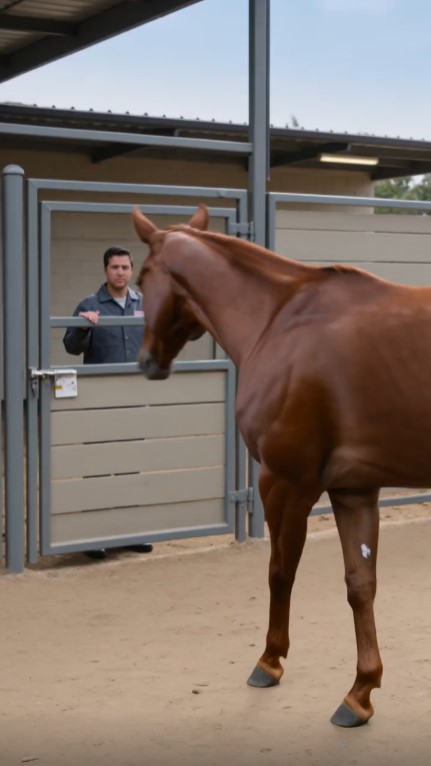
The rescued horse had finally found a home.
His new owner opened the paddock gate.
Everyone expected the horse to walk toward her.
But he didn’t.
Instead…
He turned around.
Walked past everyone…
And headed straight toward an elderly volunteer sweeping near the fence.
The man stopped.
“Buddy?”
The horse immediately walked faster.
Then gently pressed his head against the man’s chest.
The broom fell from his hand.
The elderly man wrapped his arms around the horse…
And started crying.
For eight months…
He had arrived before sunrise to feed Buddy.
Sat nearby when the horse was frightened.
And never forced him to trust.
The new owner watched quietly.
Then she walked toward them.
The volunteer wiped his eyes.
“I’m sorry. He’s yours now.”
The woman looked at him.
Then at Buddy.
And said six words the elderly man never expected to hear.
“Then you should come with him.”
The man’s name was Henry Wilson.
He stared at her.
“What?”
The woman smiled.
“You heard me.”
Her name was Rachel Carter.
She had spent nearly two months preparing to adopt Buddy from the rescue sanctuary.
Her property had been inspected.
The fencing had been checked.
A veterinarian had reviewed Buddy’s needs.
Rachel had even visited him several times so he could become familiar with her before moving.
Everything had been planned carefully.
But there was something Rachel hadn’t understood until that morning.
Buddy wasn’t leaving only a place.
He was leaving a person.
Henry looked down at the horse.
“No, ma’am.”
“Rachel.”
“Rachel, I can’t come with your horse.”
“Why not?”
Henry laughed.
“Because that’s not generally how horse adoption works.”
Rachel smiled.
“I don’t mean move into my house.”
A few volunteers laughed.
Henry wiped his eyes.
Rachel continued.
“I live twenty minutes away.”
Henry looked at her.
“I have a small farm. Buddy will have his own paddock, shelter and another calm horse nearby once the introduction is done properly.”
“I know.”
“You read the adoption file?”
“I helped write half of it.”
“Then you also know he’s going to need time.”
Henry nodded.
Rachel pointed toward Buddy.
“And apparently he thinks you’re part of the transition plan.”
Henry looked away.
Buddy remained beside him.
Eight months earlier, that would’ve been almost impossible.
When Buddy first arrived at the rescue, he trusted very little.
He was underweight and tense.
Sudden movement frightened him.
A bucket being dropped could send him to the far side of the paddock.
He didn’t like people approaching quickly.
Nobody at the rescue knew every detail of what had happened before he arrived, so they were careful not to invent a story for him.
They knew only what they could observe.
Buddy needed patience.
Henry understood patience.
He was seventy-two and had started volunteering at the sanctuary after his wife, Margaret, died.
For forty-six years, Henry and Margaret had built their mornings around each other.
Coffee at six.
Breakfast at six-thirty.
Henry complaining about the weather.
Margaret telling him he complained about the weather regardless of what it was.
Then one winter, Margaret was gone.
Suddenly, Henry’s mornings became unbearably long.
His daughter suggested volunteering.
Henry hated the idea.
“I don’t need something to keep me busy.”
“You’re reorganizing the garage for the fourth time.”
“It needs organizing.”
“You labeled a drawer ‘miscellaneous screws by emotional importance.’”
Henry stared at her.
“That was a joke.”
“Dad.”
A week later, he arrived at the horse rescue.
He told the coordinator:
“I don’t know much about horses.”
She handed him a broom.
“You know how to sweep?”
“I’ve been married.”
She laughed.
“You’ll do fine.”
Henry swept aisles.
Cleaned water buckets.
Moved hay.
Repaired gates.
He rarely handled horses directly at first.
Then Buddy arrived.
On Buddy’s second morning, Henry was sweeping near his paddock.
The horse stood at the far end.
Henry didn’t approach.
He kept sweeping.
The next morning, same thing.
On the fourth morning, Henry sat outside the fence while drinking coffee.
Buddy watched him.
Henry watched Buddy.
Neither moved closer.
“This is ridiculous,” Henry said.
Buddy flicked an ear.
“My wife would’ve liked you.”
The horse stared.
“She would’ve said you’re handsome.”
Henry took another sip.
“Don’t let it go to your head.”
That became their routine.
Henry arrived before sunrise.
He helped prepare Buddy’s feed according to the rescue’s plan.
Then he sat nearby.
Sometimes he talked.
Sometimes he didn’t.
Weeks passed.
Buddy gradually became more comfortable with the rescue staff.
One morning, Henry was repairing a latch when he felt warm breath against his shoulder.
He froze.
Buddy had approached the fence behind him.
Henry didn’t turn quickly.
“Morning.”
Buddy stayed.
Henry slowly lifted his hand.
The horse sniffed it.
Then walked away.
Henry smiled for the rest of the day.
The next week, Buddy approached again.
Eventually, Henry could stand near him without Buddy moving away.
Later, under the staff’s guidance, he could gently touch his neck.
Nothing was rushed.
No dramatic breakthrough happened overnight.
Trust arrived in inches.
That was what Henry liked about Buddy.
The horse didn’t care about speeches.
He didn’t care that Henry had spent months feeling lost.
He didn’t ask Henry to explain why some mornings were harder than others.
Henry simply showed up.
And eventually, Buddy started showing up too.
One morning, another volunteer noticed Henry sitting beside the paddock.
“Buddy’s helping you, isn’t he?”
Henry shook his head.
“I’m helping him.”
The volunteer smiled.
“Sure.”
By the fourth month, everyone at the sanctuary knew Buddy watched for Henry in the mornings.
If Henry was late, the horse often stood near the section of fence closest to the service entrance.
The staff didn’t claim Buddy understood schedules like a person.
But the pattern was obvious enough to make them smile.
Henry pretended not to notice.
Then Rachel appeared.
She had owned horses for years.
After losing her older gelding, she eventually decided she was ready to offer another horse a home.
She didn’t choose Buddy because of a dramatic photograph.
She spent time with the rescue staff.
Asked about his behavior.
His veterinary needs.
His training.
His comfort around other horses.
And she listened when they explained that Buddy might need a long adjustment period.
On Rachel’s third visit, she noticed Henry.
He was sitting outside Buddy’s paddock reading a newspaper.
“Does he like the news?” Rachel asked.
Henry looked up.
“No.”
“Then why are you reading to him?”
“Because my wife used to complain that I read the paper instead of talking to her.”
Rachel smiled.
“And?”
“I’m continuing the tradition.”
Buddy stood a few feet away.
Rachel watched.
“He trusts you.”
Henry folded the newspaper.
“He tolerates me.”
Buddy immediately walked closer and nudged Henry’s shoulder.
Rachel laughed.
“Very convincing.”
Henry scratched Buddy gently.
“He’ll trust you too.”
Rachel became serious.
“You think?”
“I do.”
“How do you know?”
“Because you don’t keep trying to prove you’re trustworthy.”
Rachel remembered that sentence.
During every visit, she followed Henry’s example.
She didn’t demand affection.
She allowed Buddy to approach.
Sometimes he did.
Sometimes he didn’t.
Gradually, Buddy became comfortable around her.
The adoption was approved.
Then moving day arrived.
Henry told himself he wouldn’t be emotional.
He failed immediately.
He arrived before everyone else.
He cleaned Buddy’s water bucket even though it didn’t need cleaning.
He checked the gate twice.
Then three times.
He brushed dust from the same section of fence for nearly ten minutes.
When Rachel arrived with the transport arranged according to the rescue’s procedures, Henry stayed busy.
He didn’t want anyone making a fuss.
Buddy was going somewhere good.
That was the point.
Rachel opened the paddock gate with the rescue staff.
Buddy looked toward her.
Then turned around.
He walked past everyone.
Straight toward Henry.
“Buddy?”
The horse approached.
Then gently pressed his head against Henry’s chest.
Henry’s broom fell.
Eight months of pretending collapsed with it.
He wrapped his arms around Buddy’s neck.
“You’re all right.”
His voice shook.
“You’re going somewhere good.”
Buddy stayed against him.
“You don’t need me anymore.”
Rachel heard that.
She walked closer.
Henry released Buddy and wiped his face.
“I’m sorry.”
“For what?”
“Making this difficult.”
Rachel shook her head.
“Henry.”
“He’s yours now.”
Then she said the six words:
“Then you should come with him.”
Henry laughed.
But Rachel wasn’t joking.
“You don’t have to decide today.”
“Rachel—”
“Come visit.”
Henry looked at Buddy.
“As often as you want.”
“You’ll get tired of me.”
“I’ve met you six times and I’m already tired of you.”
Henry stared.
Then laughed.
Rachel continued.
“Wednesday mornings?”
Henry hesitated.
“That’s not often.”
“Fine. Wednesdays and Saturdays.”
“Still not often.”
“Henry.”
He smiled.
“All right.”
Buddy eventually left the sanctuary that morning.
Henry stood beside the fence as the transport pulled away.
For the first time in eight months, the paddock was empty.
He picked up his broom.
Then put it down again.
“I think I’m going home.”
Nobody tried to stop him.
The next morning, Henry woke before sunrise automatically.
He made coffee.
Then stared at the clock.
There was no Buddy to feed.
For the first time since joining the rescue, Henry understood something uncomfortable.
He had told everyone he’d been helping a frightened horse.
That was true.
But it wasn’t the whole truth.
Buddy had given Henry somewhere to be each morning.
A reason to put on his boots.
A reason to complain about the cold.
A living creature expecting nothing from him except consistency.
Henry sat alone at his kitchen table.
Then his telephone rang.
Rachel.
“Is everything okay?”
“Yes.”
“Buddy ate breakfast.”
Henry smiled.
“Good.”
“He spent half an hour investigating the paddock.”
“Good.”
“He has decided one fence post is suspicious.”
“Very sensible.”
“And he keeps looking toward the driveway.”
Henry became quiet.
Rachel continued.
“I know we said Wednesday.”
“It is Monday.”
“I can read a calendar.”
“So?”
“So I thought you might want to come tell him the fence post isn’t dangerous.”
Henry looked at his boots beside the door.
“I suppose someone should.”
Twenty-five minutes later, Henry arrived.
Buddy saw his car.
By the time Henry walked toward the paddock, the horse was standing near the gate.
Henry stopped.
“Well.”
Buddy approached.
Henry smiled.
“You lasted one day without me.”
Rachel stood behind him.
“I think that applies to both of you.”
Henry pretended not to hear her.
The Wednesday-and-Saturday arrangement didn’t last.
Henry started visiting three days a week.
Then Rachel asked whether he’d help repair a section of fencing.
Then a gate needed adjustment.
Then she needed someone present for a farrier appointment when she couldn’t leave work.
Within months, Henry had become part of Buddy’s new life.
But something else happened.
Buddy gradually stopped depending so heavily on Henry’s presence.
He began approaching Rachel eagerly.
He settled into his new routine.
He became comfortable with his surroundings.
Henry noticed.
One afternoon, he arrived and Buddy didn’t immediately walk toward him.
The horse was grazing calmly on the far side of the paddock.
Henry stood at the gate.
Rachel approached.
“He hasn’t seen you.”
“Yes, he has.”
Henry smiled.
“He’s busy.”
Rachel looked concerned.
“You okay?”
Henry nodded.
“More than okay.”
Buddy eventually lifted his head.
Then walked toward them at an unhurried pace.
Henry rubbed his neck.
“That was the whole point, wasn’t it?”
“What?”
“For him not to need me so much.”
Rachel smiled.
“Maybe.”
Henry looked at Buddy.
“Doesn’t mean I have to like it.”
Months later, the rescue held an open day.
Rachel brought Buddy back for a short, carefully managed visit.
Former volunteers gathered around.
Everyone remembered the nervous horse who once stayed at the far end of his paddock.
Now he stood calmly beside Rachel.
Henry watched from several feet away.
A new volunteer approached him.
“That’s Buddy?”
Henry nodded.
“I heard you were the one who got him to trust people.”
Henry immediately shook his head.
“No.”
“But everyone says—”
“Don’t listen to everyone.”
He pointed toward Buddy.
“He did the difficult part.”
The volunteer looked confused.
Henry explained.
“You can’t force trust into an animal.”
“You can give them predictable days.”
“Food.”
“Space.”
“Proper care.”
“People who don’t punish fear.”
“And time.”
He watched Buddy lower his head while Rachel gently touched his neck.
“Then sometimes they decide you’re safe.”
The volunteer smiled.
“You must’ve been pretty important to him.”
Henry looked toward Rachel.
“I think we were important to each other for a while.”
Rachel heard him.
“For a while?”
Henry looked at her.
She raised an eyebrow.
“You’re fixing my barn door tomorrow.”
Henry laughed.
“Fine. Apparently forever.”
Two years passed.
Henry continued volunteering at the rescue.
But his role changed.
Whenever a frightened or uncertain horse arrived, Henry was often the person willing to sit quietly nearby.
New volunteers sometimes became impatient.
“Shouldn’t we be doing something?”
Henry would point toward the horse.
“We are.”
“What?”
“Not asking for anything.”
At Rachel’s farm, Buddy became a steady, content horse.
Henry visited constantly.
Eventually Rachel placed a small wooden bench beside Buddy’s paddock.
One morning Henry noticed a brass plaque attached to it.
He read:
HENRY’S SEAT
Underneath were smaller words:
For the man who understood that trust doesn’t have a deadline.
Henry stared at Rachel.
“You put my name on a bench?”
“You’re old.”
“I am not that old.”
“You need somewhere to sit.”
“I can stand.”
“You complain when you stand.”
“I complain when I sit too.”
“Exactly. Now you have an official location.”
Henry laughed.
Then sat down.
Buddy wandered over.
Henry rubbed his forehead.
“You know she thinks she’s funny.”
Buddy stayed beside him.
Years later, when Henry’s health made early-morning volunteering difficult, he finally stopped working regular shifts at the rescue.
His final morning was quiet.
No gymnasium full of people.
No ceremony.
Exactly how Henry wanted it.
But before he left, the rescue coordinator handed him an envelope.
Inside were photographs of horses he’d helped care for over the years.
Buddy was on top.
On the back Rachel had written:
You once told Buddy he didn’t need you anymore.
You were wrong.
Needing someone isn’t always about being unable to live without them.
Sometimes it just means life is better when they show up.
Henry read it twice.
Then put the photograph in his jacket.
He continued visiting Buddy whenever he could.
Sometimes he sat on the bench.
Sometimes he talked about Margaret.
Sometimes he said nothing.
Buddy would graze nearby.
And every so often, the horse would walk over and rest his head close to the elderly man’s chest.
Just as he had on adoption day.
Henry no longer cried every time.
Usually.
Because the day Buddy found his permanent home, everyone had assumed one chapter was ending.
A rescued horse was leaving.
An elderly volunteer was saying goodbye.
A new owner was taking responsibility.
But Rachel had understood something the others hadn’t.
Giving Buddy a new home didn’t require erasing the person who had helped him feel safe enough to reach it.
So when Henry wiped his eyes and whispered:
“I’m sorry. He’s yours now.”
Rachel didn’t tell him to say goodbye.
She looked at the horse pressed against his chest and said:
“Then you should come with him.”
And somehow…
That became a new beginning for all three of them.