
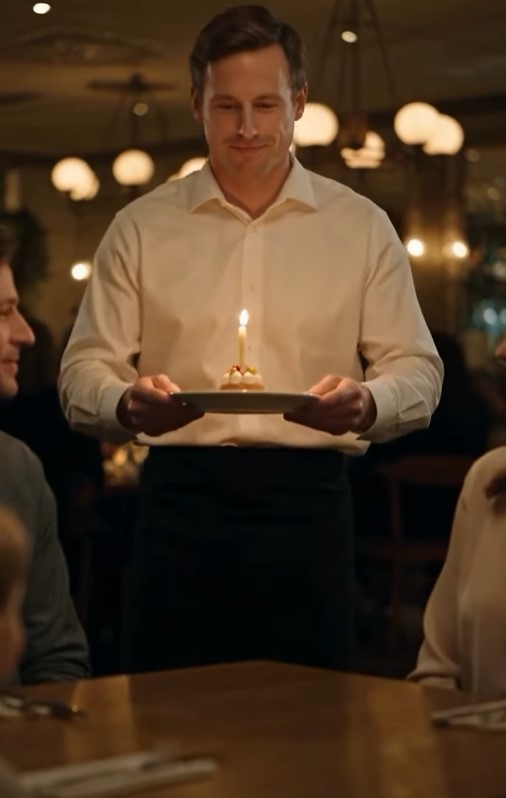
Everyone in the restaurant thought the waiter was acting strangely.
He was walking toward a family table carrying their meals when he suddenly stopped.
Instead of serving them, he carefully placed the entire tray on a nearby empty table.
The father looked confused.
“What happened?”
But the waiter wasn’t looking at the food.
He was staring at something behind them.
Then he calmly said:
“Please step back with me.”
The family hesitated.
Nobody understood why he wanted them to leave the table.
Then the waiter pointed toward the wall.
A large framed decoration behind their seats had started slowly slipping downward.
The family stepped away.
Moments later, the frame slid down the wall and came to rest against the padded bench beneath it.
The restaurant went quiet.
The father looked at the frame.
Then at the waiter.
“You saw that?”
The waiter nodded.
The father placed a hand on his shoulder.
“Thank you.”
What looked like a strange interruption turned out to be a moment of quick thinking nobody at that table would forget.
The waiter’s name was Marcus Reed.
He was twenty-four years old.
He’d worked at the restaurant for only three weeks.
And until that evening, most customers barely noticed him.
Marcus liked it that way.
He was quiet.
Careful.
The kind of waiter who remembered who ordered water without ice and which child wanted sauce on the side.
The family at table twelve consisted of Daniel Carter, his wife Rachel, their ten-year-old daughter Sophie and Daniel’s seventy-eight-year-old father, Henry.
They were celebrating Henry’s birthday.
Nothing elaborate.
Henry had specifically requested that.
“No balloons.”
Daniel had ignored him.
“No singing.”
Rachel had already told the staff it was his birthday.
“And absolutely no embarrassing cake.”
Sophie had personally selected the most embarrassing cake she could find.
Henry looked around the table.
“I have raised terrible people.”
Sophie smiled.
“Happy birthday, Grandpa.”
Marcus had heard the conversation while taking their order.
He liked Henry immediately.
When Marcus returned carrying the family’s meals, he was only a few steps away when something caught his attention.
The large framed decoration behind Henry and Sophie looked different.
Marcus had wiped that exact section of wall earlier.
He remembered the frame sitting level.
Now one side was lower.
He stopped.
At first, he wondered whether he’d imagined it.
Then the frame shifted again.
Barely.
But enough.
Marcus didn’t shout.
He didn’t drop the tray.
He placed it safely on an empty table.
Then asked the family to move.
Seconds later, the decoration slid downward and came to rest against the bench.
Nobody was hurt.
The manager immediately closed off the seating area and arranged for the wall fixtures and similar decorations to be inspected before the tables were used again.
Daniel looked at Marcus.
“How did you even notice that?”
Marcus shrugged.
“It looked different.”
“That’s it?”
Marcus nodded.
Henry studied him.
“You notice a lot, don’t you?”
Marcus smiled.
“My dad taught me to.”
Something in his voice made Henry curious.
“What did your father do?”
Marcus hesitated.
“He was a waiter.”
Henry smiled.
“Good man?”
“The best.”
Marcus collected himself.
“He worked in restaurants for almost thirty years.”
Daniel looked around.
“So this is the family business?”
Marcus laughed.
“Not exactly.”
“What do you mean?”
“My dad didn’t want me working in restaurants.”
Henry raised an eyebrow.
“Why?”
“He said the hours were terrible.”
Henry nodded.
“Sensible man.”
“He also said customers could be difficult.”
Daniel looked offended.
“We’ve been delightful.”
Marcus smiled.
“So far.”
The family laughed.
The manager approached and apologized for the incident.
He offered to move them to another table and replace anything that had cooled while they waited.
Henry waved him off.
“Nobody’s hurt. That’s what matters.”
The family relocated.
Marcus continued serving them.
But Daniel noticed something.
Every time Marcus entered the dining room, he looked around.
Not nervously.
Deliberately.
A chair blocking the aisle?
He moved it.
A spilled drink near the entrance?
He cleaned it immediately.
A child wandering too close to a server carrying hot dishes?
Marcus slowed down and gave the family space.
He seemed to notice the room before he noticed himself.
At the end of dinner, Henry asked:
“What did your father teach you?”
Marcus smiled.
“About what?”
“Noticing.”
Marcus became quiet.
Then he pulled out the empty chair beside Henry.
“My dad’s name was Thomas.”
Thomas Reed started working in restaurants at eighteen.
He never became a famous chef.
Never owned a restaurant.
Never made much money.
But Marcus remembered that whenever his father entered a room, he automatically noticed small things.
A wet floor.
A chair sticking into a walkway.
An elderly customer struggling with a coat.
A child standing alone.
A coworker becoming overwhelmed.
When Marcus was little, he thought his father had some unusual ability.
“How did you see that?” Marcus would ask.
Thomas always gave the same answer.
“Because I was looking.”
As Marcus grew older, Thomas taught him something else.
Most preventable problems didn’t begin as emergencies.
They began as something small.
Something loose.
Something misplaced.
Something different from yesterday.
“You don’t need to panic about everything,” Thomas told him.
“You just shouldn’t train yourself to ignore everything.”
Henry nodded slowly.
“I like that.”
Marcus smiled.
“So did I.”
“Did?”
Marcus looked down.
“My father died two years ago.”
The table became quiet.
“I’m sorry,” Rachel said.
“Thank you.”
Marcus explained that after Thomas died, he’d found one of his father’s old notebooks.
Thomas used it for work.
Schedules.
Phone numbers.
Supply lists.
But on the last few pages were little reminders he’d written to himself over the years.
Check the back exit before opening.
Don’t carry more than you can safely handle.
If somebody looks lost, ask.
If something looks wrong, don’t assume someone else has noticed.
Marcus kept the notebook.
When he began working at the restaurant, he read those pages again.
Henry smiled.
“So your father noticed that frame.”
Marcus laughed.
“I think that’s giving him too much credit.”
“No.”
Henry pointed toward Marcus.
“He taught you to notice it.”
Marcus didn’t answer.
Later, the birthday cake arrived.
Despite Henry’s objections, several employees sang.
Marcus joined them.
Henry covered his face.
“I specifically requested dignity.”
Sophie hugged him.
“You’re seventy-eight. It’s too late.”
Everyone laughed.
Before leaving, Daniel shook Marcus’s hand.
“Thank you again.”
Marcus nodded.
“I’m glad I saw it.”
Daniel handed him the bill folder.
Marcus opened it after the family left.
The tip was generous.
But there was something else inside.
A note.
Marcus,
Thank you for paying attention when the rest of us weren’t.
Your father taught you well.
— Table 12
Marcus folded the note and placed it in his pocket.
He thought that was the end of the story.
It wasn’t.
Three weeks later, Daniel returned.
Alone.
Marcus recognized him immediately.
“Everything okay?”
“Fine.”
Daniel handed him an envelope.
“What is this?”
“A question.”
Marcus opened it.
Inside was a business card.
Daniel Carter owned a regional property-management company responsible for several office buildings, retail spaces and apartment complexes.
On the back, Daniel had written:
Safety & Facilities Trainee Program
Marcus looked confused.
“You’re offering me a job because I saw a crooked picture?”
Daniel shook his head.
“No.”
“Then why?”
“Because after that night, I watched you.”
Marcus laughed.
“That sounds disturbing.”
Daniel smiled.
“I watched how you worked.”
He’d noticed Marcus checking pathways.
Helping coworkers.
Moving obstacles before someone tripped over them.
Paying attention without turning everything into a performance.
Daniel’s company had an entry-level facilities position open.
The role involved inspections, documentation and learning from experienced maintenance staff.
“You’d have to interview like everyone else,” Daniel said.
“No promises.”
Marcus looked at the card.
“I don’t have experience.”
“You have some.”
“Not in buildings.”
“That’s what training is for.”
Marcus hesitated.
“My dad would’ve loved this.”
“Then apply.”
Marcus did.
The interview wasn’t easy.
The hiring team asked technical questions he couldn’t answer.
Marcus admitted when he didn’t know.
But he understood something they valued.
Observation wasn’t a replacement for proper training.
It was what made training useful.
Marcus got the position.
He kept working weekend restaurant shifts for several months while learning his new job.
His supervisor, Evelyn Miller, taught him building inspections.
Fire-exit requirements.
Maintenance reporting.
How to document hazards properly instead of simply fixing something and forgetting about it.
On his first day, Evelyn asked:
“Why do you want to do this?”
Marcus thought about his father.
Then the restaurant.
“Because I like finding small problems before they become big ones.”
Evelyn smiled.
“You’ll fit in.”
A year later, Marcus had completed additional training and moved into a permanent facilities role.
He didn’t become some magical person who spotted every danger.
Nobody could.
Sometimes he missed things.
Sometimes other employees noticed them first.
That was exactly how the system was supposed to work.
Everyone paid attention.
Everyone reported concerns.
Nobody relied on one person.
Marcus liked that.
Then one afternoon, Daniel visited one of the properties.
He found Marcus crouched beside a doorway making notes.
Daniel smiled.
“What did you find?”
“Nothing exciting.”
“Good.”
Marcus pointed toward the door.
“It’s starting to drag. Probably needs adjustment before it gets worse.”
Daniel laughed.
“You know, every time I see you, you’re staring at something nobody else cares about.”
Marcus stood.
“My father would call that a compliment.”
“It is.”
Several years passed.
Marcus eventually became a facilities supervisor.
One day, a new employee named Ethan joined his team.
Ethan was nineteen.
Eager.
And constantly afraid of looking inexperienced.
During his first week, Ethan noticed a small water stain on a ceiling tile.
He almost ignored it.
Then he mentioned it to Marcus.
They investigated through the proper maintenance process.
A plumbing connection above the ceiling had developed a slow leak.
Nothing dramatic had happened.
Nobody had been in immediate danger.
It was simply a problem caught early.
Ethan apologized.
“Sorry. I thought it might be nothing.”
Marcus looked at him.
“Never apologize for reporting something because you’re worried it might be nothing.”
Ethan nodded.
Marcus paused.
Then smiled.
“My dad used to say something.”
“What?”
“Most problems don’t introduce themselves as emergencies.”
Ethan thought about it.
“I like that.”
“So did I.”
That evening, Marcus went home and opened the old notebook.
Thomas’s handwriting had faded slightly.
Marcus turned to the final page.
Then he added something beneath his father’s notes.
Teach the next person to look too.
Years later, Marcus still occasionally visited the restaurant.
The large framed decoration was gone.
After the original incident, management had reviewed how wall decorations were secured and inspected the others.
Table twelve was still there.
One evening, Marcus brought his own young son, Noah.
They sat in the same booth.
Noah looked around.
“Dad?”
“Yeah?”
“Why do you keep looking at the wall?”
Marcus laughed.
“Old habit.”
He told his son the story.
About the family.
The slipping frame.
The tray of food.
And the grandfather celebrating his seventy-eighth birthday.
When he finished, Noah asked:
“Were you scared?”
“Not until afterward.”
“Did you save them?”
Marcus shook his head.
“I asked them to move.”
“That’s kind of saving them.”
Marcus smiled.
“We don’t know what would’ve happened.”
The frame had slid onto the padded bench rather than crashing violently.
Maybe nobody would’ve been seriously hurt.
Marcus never claimed otherwise.
What mattered was simpler.
He saw something that didn’t look right.
And he acted before waiting to find out whether it would become dangerous.
Then Noah asked:
“How did you notice?”
Marcus stopped.
For a second, he could hear Thomas answering the same question decades earlier.
He smiled.
“Because I was looking.”
Noah nodded as though this were obvious.
Then he pointed behind Marcus.
“Dad.”
“What?”
“Your jacket is falling off the chair.”
Marcus turned.
It was.
Noah grinned.
“You weren’t looking.”
Marcus laughed.
“Apparently not.”
His son picked up the jacket.
Marcus looked around the restaurant.
Servers moved between tables.
Families talked.
Glasses clinked.
Nobody there knew that years earlier, a young waiter had stopped in the middle of that dining room carrying a tray of food.
For a few confusing seconds, everyone thought he was acting strangely.
He put the food down.
Asked a family to move.
And stared at the wall behind them.
Then the frame slipped.
Only afterward did everyone understand what Marcus’s father had spent years teaching him:
Paying attention rarely looks important before something happens.
Usually, it just looks like someone stopping for no reason.
Looking twice.
Asking a question.
Moving something out of the way.
Until the moment comes when everyone else finally sees what they saw.
And by then…
Sometimes the small decision to pay attention has already made all the difference.