
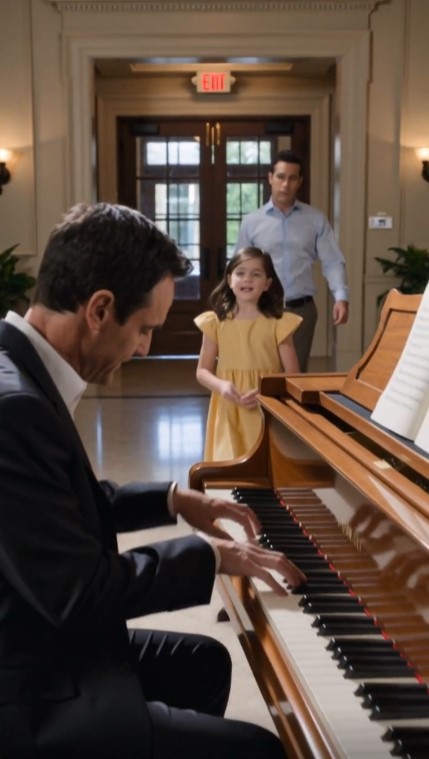
The pianist was performing for a packed room…
When a little girl walked toward him holding three crumpled dollars.
Her father followed closely behind.
She placed the money beside the piano.
The pianist stopped.
“What’s this for?”
The girl whispered:
“Can you play something for my mom?”
The pianist smiled.
“What’s her favorite song?”
The girl shook her head.
“She doesn’t have one.”
Then she hummed a tiny melody.
Just four notes.
The pianist’s smile disappeared.
“Do that again.”
She hummed it again.
The pianist slowly stood.
“Who taught you that?”
“My mom.”
The girl’s father suddenly looked uncomfortable.
The pianist stared at him.
Then toward the back of the room.
A woman had just entered.
She heard the four notes…
And immediately stopped walking.
The pianist whispered:
“That melody hasn’t been played here in 24 years.”
Then the woman said his name.
“Daniel?”
The pianist gripped the edge of the piano.
The room became completely silent.
The woman standing near the entrance was Rachel Carter.
She looked as though she’d forgotten how to breathe.
Daniel stared at her.
“Rachel?”
The little girl looked from one adult to the other.
“Mom?”
Rachel didn’t answer.
Her husband, Michael, walked toward her.
“You know him?”
Rachel nodded slowly.
“Yes.”
Daniel looked down at the child.
Then back at Rachel.
“She’s your daughter?”
“Yes.”
The girl’s name was Emma.
She was eight years old.
And she had absolutely no idea why four notes she’d heard her mother hum hundreds of times had suddenly silenced an entire room.
Daniel sat back down at the piano.
His hands trembled above the keys.
He played the four notes.
Emma’s face lit up.
“That’s it!”
Daniel added four more.
Rachel covered her mouth.
Emma turned.
“Mom, that’s your song!”
Rachel’s eyes filled with tears.
“No, sweetheart.”
She looked at Daniel.
“It was ours.”
Twenty-four years earlier, Daniel Carter was twenty-six years old.
He played piano five nights a week in that same restaurant.
Back then, it was smaller.
The walls were darker.
The tables were cheaper.
And the piano sat near a window instead of the center of the room.
Daniel wasn’t famous.
He wasn’t even sure he wanted to be a professional musician.
He played because he loved music and because the restaurant paid enough to cover part of his rent.
Rachel was twenty-four.
She worked at a bookstore two blocks away.
Every Thursday evening, she stopped at the restaurant after work.
At first, she came for coffee.
Then she came for the piano.
Eventually, she came for Daniel.
He noticed that she always chose the same table.
Table twelve.
Close enough to hear the piano clearly.
Far enough away that she could pretend she wasn’t watching him.
One rainy Thursday, the restaurant was almost empty.
Daniel finished a song.
Rachel clapped.
She was the only person who did.
Daniel laughed.
“Thank you, table twelve.”
Rachel raised her coffee.
“You’re welcome.”
“What do you want to hear?”
“I don’t know.”
“Everyone knows one song.”
“I don’t.”
Daniel played four random notes.
“What about that?”
Rachel laughed.
“That’s not a song.”
“It could be.”
He played the four notes again.
Then added four more.
Rachel listened.
Daniel improvised for several minutes.
When he finished, she asked:
“What was that?”
He smiled.
“Your song.”
“I told you I don’t have one.”
“You do now.”
From that night forward, those four opening notes became theirs.
Sometimes Rachel walked into the restaurant and Daniel played them without looking up.
Sometimes he slipped them into another piece just to see if she’d notice.
She always did.
A year later, Daniel proposed.
Not with a huge speech.
Not in front of a crowd.
He waited until the restaurant closed.
Rachel sat at table twelve.
Daniel played those four notes.
Then he walked over and asked:
“Do you want to hear the rest of this for the next fifty years?”
Rachel laughed.
Then cried.
Then said yes.
But they never reached the wedding.
Three months before the ceremony, Daniel received an opportunity to tour with a small music group.
It wasn’t glamorous.
But to Daniel, it felt like the first real chance he’d ever had.
Six months on the road.
Possibly longer.
Rachel supported him at first.
Then the dates kept changing.
Six months became nine.
Wedding plans were postponed.
Calls became less frequent.
Daniel believed Rachel wanted him to give up the biggest opportunity he’d ever received.
Rachel believed Daniel had already chosen music over the life they’d planned.
Neither was entirely right.
Neither was entirely wrong.
They were young.
Proud.
And terrible at saying what they were actually afraid of.
Their final argument happened over the telephone.
“If you want to go, go,” Rachel said.
Daniel replied:
“Maybe I will.”
Rachel waited for him to say more.
He didn’t.
Daniel waited for her to ask him to come home.
She didn’t.
The call ended.
Weeks passed.
Then months.
The engagement quietly disappeared.
Daniel returned to the restaurant nearly a year later.
Table twelve was empty.
Rachel had moved.
Daniel asked the bookstore owner where she’d gone.
Another city, he was told.
That was all.
For a while, Daniel continued playing their melody.
Then one night he stopped.
It hurt too much.
Years passed.
The restaurant changed owners.
Daniel left.
He worked as a studio musician.
Taught piano.
Performed at hotels and events.
Eventually, after nearly two decades away, he returned to the restaurant for occasional weekend performances.
But he never played those four notes.
Not once.
Until Emma hummed them.
Daniel looked at Rachel across the room.
“You taught her?”
Rachel nodded.
“I didn’t mean to.”
Emma frowned.
“What does that mean?”
Rachel smiled at her daughter.
“I hum it when I’m cooking.”
Michael looked at his wife.
“You hum it all the time.”
Rachel seemed embarrassed.
“I know.”
Daniel looked at Michael.
There was an uncomfortable silence.
Then Michael did something neither expected.
He held out his hand.
“I’m Michael.”
Daniel stood.
“Daniel.”
They shook hands.
Michael smiled faintly.
“I’ve apparently been listening to your melody for fifteen years without knowing it.”
Daniel looked horrified.
Rachel laughed through her tears.
“Michael.”
“What? It’s true.”
That broke the tension.
Several people in the restaurant laughed.
Emma pointed toward the piano.
“Can you play the whole song?”
Daniel looked at Rachel.
“I don’t know if I remember it.”
Rachel stared at him.
“Yes, you do.”
Daniel sat.
He played the four notes.
Then the next four.
Then another phrase.
Slowly, the melody returned.
It wasn’t technically impressive.
It wasn’t a famous composition.
Nobody in the room had ever heard it before.
But Rachel remembered every part.
Halfway through, she closed her eyes.
She was twenty-four again.
Sitting at table twelve.
Listening to a young pianist invent a song because she’d told him she didn’t have a favorite.
Daniel reached the ending.
Then stopped.
Emma clapped first.
Everyone else followed.
Daniel looked at Rachel.
“I never finished it.”
Rachel nodded.
“I know.”
Emma immediately asked:
“Why?”
Daniel smiled.
“Because sometimes people stop writing something before they know how it ends.”
Emma considered that.
“Then finish it now.”
Adults sometimes make simple things complicated.
Children often do the opposite.
Daniel looked at Rachel.
Rachel looked at Michael.
Michael smiled.
“She’s going to keep asking until you do.”
Rachel laughed.
“She absolutely will.”
Daniel returned his hands to the keys.
He played the melody again.
But when he reached the place where he’d always stopped…
he continued.
A new section.
Then another.
The music changed.
The original melody had been written by a twenty-six-year-old man falling in love.
The ending was being written by a fifty-year-old man who understood that not every love story was supposed to end the way it began.
Some people don’t return to become your future.
They return to help you understand your past.
When Daniel finished, Rachel was crying.
So was Emma.
Even Michael wiped one eye.
“Dust,” he said.
Rachel laughed.
“Inside a restaurant?”
“Very aggressive dust.”
After the performance, Daniel joined them at their table.
Emma pushed the three dollars toward him.
“You forgot your money.”
Daniel smiled.
“You keep it.”
“No. I paid for a song.”
“You got your song.”
“So you get the money.”
Daniel looked at Rachel.
“She always like this?”
“Constantly.”
Daniel accepted the three dollars.
“Then thank you.”
Emma smiled.
Rachel asked the question she’d been avoiding.
“Did you ever get married?”
Daniel shook his head.
“No.”
Her face changed.
“Because of me?”
Daniel immediately answered.
“No.”
Rachel looked relieved.
Daniel explained.
He’d had relationships.
A long one in his thirties.
Another later.
Life simply hadn’t taken him toward marriage.
“And you?” he asked, though the answer was sitting beside her.
Rachel looked at Michael.
“Seventeen years.”
Michael smiled.
“She still won’t let me load the dishwasher.”
“Because you do it incorrectly.”
“There are no rules.”
“There are absolutely rules.”
Daniel laughed.
Something inside him relaxed.
For years, he’d imagined Rachel’s life after him.
In some versions, she regretted leaving.
In others, she forgot him completely.
Reality was healthier than either fantasy.
She’d built a life.
A good one.
And Daniel was genuinely glad.
Rachel seemed to understand.
“You were important to me,” she said quietly.
Daniel nodded.
“You were important to me too.”
Michael didn’t look threatened.
He simply listened.
Rachel continued.
“But I think for years I confused something ending with something being a mistake.”
Daniel looked at her.
“Me too.”
They talked for nearly an hour.
Rachel explained how she’d moved for work.
How she met Michael years later.
How Emma was born after they’d nearly given up hope of having a child.
Daniel told them about touring.
Teaching.
His students.
His return to the restaurant.
Then Rachel asked:
“Why did you say the melody hadn’t been played here in twenty-four years?”
Daniel looked toward the piano.
“Because the last time I played it was the night before I left.”
Rachel remembered.
She’d been sitting at table twelve.
Daniel had played their melody.
Neither knew it would be the last time.
“I thought you forgot it,” she said.
Daniel smiled.
“No.”
Rachel nodded.
“Neither did I.”
Emma was listening carefully.
“So you loved Mom?”
Michael nearly choked on his water.
Rachel closed her eyes.
“Emma.”
“What?”
Daniel laughed.
“Yes.”
Emma turned toward Michael.
“Dad, are you mad?”
Michael looked at Daniel.
Then Rachel.
“No.”
“Why?”
“Because your mother had a whole life before she met me.”
Emma thought about this.
Then turned to Rachel.
“Did you love him?”
Rachel looked at Daniel.
“Yes.”
Emma seemed satisfied.
“Okay.”
And just like that, the interrogation ended.
Before they left, Daniel asked Emma something.
“Do you take piano lessons?”
“No.”
“Want to?”
Emma shrugged.
“Maybe.”
Rachel smiled.
“She has a keyboard at home.”
Daniel wrote something on a napkin.
Eight notes.
The opening melody.
He handed it to Emma.
“Start with those.”
Emma studied them.
“I can’t read music.”
“Then hum them until you can.”
She carefully folded the napkin and placed it in her pocket.
Over the following months, something unexpected happened.
Rachel and Daniel didn’t suddenly become inseparable.
They didn’t rewrite their lives.
They didn’t pretend the previous twenty-four years hadn’t happened.
Instead, they became friends.
Michael occasionally came to Daniel’s performances.
Emma started piano lessons with a teacher near their home.
Whenever she struggled, she’d play the four notes.
Daniel eventually met some of Emma’s extended family.
Rachel attended one of his student recitals.
The past stopped being a wound they avoided touching.
It became simply part of their story.
Then, on Daniel’s fifty-second birthday, a package arrived at the restaurant.
Inside was a small frame.
Mounted behind the glass were three crumpled one-dollar bills.
Below them was a handwritten note:
FOR THE SONG YOU FINALLY FINISHED.
— EMMA
Daniel laughed.
He hung it beside his piano.
Five years later, Emma performed in her first serious student recital.
Rachel and Michael sat in the front row.
Daniel sat several seats away.
Emma walked onto the stage.
She sat at the piano.
Then spoke into the microphone.
“This piece started before I was born.”
Rachel immediately looked at Daniel.
Emma continued.
“My mom says it isn’t really her song anymore.”
Daniel smiled.
Emma placed her hands on the keys.
“She says it’s ours.”
Then she played four notes.
Rachel began crying before the fifth.
Emma had expanded the melody with her teacher.
She kept Daniel’s original opening.
She kept the ending he’d written the night they reunited.
But in the middle, she’d added something of her own.
When she finished, Daniel stood first.
Then Rachel.
Then Michael.
The audience followed.
Afterward, Emma ran toward them.
“Well?”
Michael hugged her.
“Amazing.”
Rachel could barely speak.
Daniel smiled.
“You changed my song.”
Emma shook her head.
“Our song.”
Years later, Daniel still kept those three dollars framed beside his piano.
People often asked why.
He never gave the entire explanation.
Usually, he simply said:
“A little girl paid me to finish something I’d left unfinished for twenty-four years.”
Most people assumed he meant the music.
Daniel knew it was more than that.
For twenty-four years, he had remembered the ending of his relationship with Rachel as a failure.
Two people loved each other.
Then lost each other.
Therefore, he’d thought, something must have gone wrong.
But that little girl taught him something different.
Not every meaningful relationship has to last forever in the same form to have mattered.
Rachel had loved Daniel.
Daniel had loved Rachel.
Their lives separated.
Rachel eventually loved Michael.
They built a family.
And without even realizing it, Rachel carried four little notes from her old life into her new one.
She hummed them while cooking.
While folding laundry.
While driving.
Her daughter heard them.
Remembered them.
And one evening, in a crowded restaurant, Emma walked toward a pianist carrying three crumpled dollars.
She didn’t know the man.
She didn’t know the history.
She only wanted a song for her mother.
So she hummed four notes.
Daniel stopped playing.
A woman entered at the back of the room.
And twenty-four years after their melody had gone silent…
she said his name.