
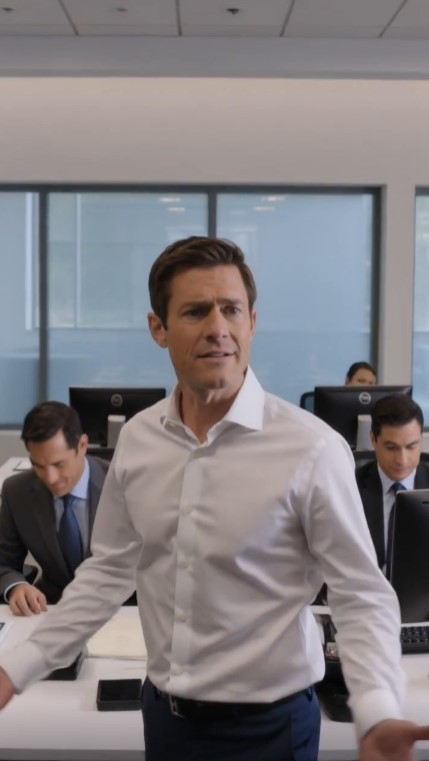
At exactly 3:00 PM…
Every employee stood up.
At the same time.
The new manager froze.
“Where is everyone going?”
Nobody answered.
They simply started walking toward the elevators.
The manager followed them.
“Guys?”
Still nothing.
Then he noticed something stranger.
The receptionist was leaving too.
So was security.
Even the company director stepped out of his office.
Within seconds…
The entire floor was empty.
The manager followed everyone downstairs.
Outside…
Nearly 100 employees were standing silently on the sidewalk.
Nobody was looking at him.
They were looking across the street.
At one elderly man.
The man was wearing ordinary work clothes…
And holding a small lunch bag.
The new manager whispered:
“Who is that?”
The company director smiled.
“You really don’t know?”
Then the elderly man looked up at the building.
And every employee began applauding.
When the manager finally learned who he was…
He understood why the entire company had stopped working for him.
His name was Henry Walker.
And for thirty-seven years, Henry had cleaned that building.
The new manager, Marcus Reed, stared across the street.
“A janitor?”
Company director Daniel Carter looked at him.
“Not just a janitor.”
Marcus immediately regretted how the question sounded.
“I didn’t mean—”
“I know.”
Daniel smiled.
“You’ve been here nine days. You don’t know the story.”
Across the street, Henry looked overwhelmed.
He was seventy-two years old.
Gray hair.
Faded blue work shirt.
Old black shoes.
In one hand was the same brown lunch bag he’d apparently carried to work for years.
Henry looked at the crowd.
Then pointed toward himself as if asking:
Me?
The applause became louder.
Someone shouted:
“WE LOVE YOU, HENRY!”
Henry laughed.
Then covered his face.
Marcus looked around.
Receptionists.
Accountants.
Engineers.
Assistants.
Supervisors.
Security officers.
Senior executives.
People who normally struggled to agree on what temperature the office should be were standing together in the middle of a workday applauding one maintenance employee.
“What did he do?” Marcus asked.
Daniel looked at him.
“Depends who you ask.”
A woman near them overheard.
Her name was Rachel Miller.
She’d worked in accounting for fourteen years.
She turned toward Marcus.
“He stopped me from quitting.”
Another employee spoke.
“He found my wedding ring.”
Someone else said:
“He taught me how to change a tire.”
A young man near the back laughed.
“He gave me half his lunch every Tuesday for three months.”
Marcus stared at him.
“Why?”
The young man shrugged.
“Because he knew I couldn’t afford one.”
Then the receptionist raised her hand.
“He sat with me for two hours after my mother died.”
A security officer added:
“He came to my daughter’s graduation.”
Marcus looked back toward Henry.
“What exactly was his job here?”
Daniel smiled.
“Officially?”
“Yes.”
“Facilities attendant.”
“And unofficially?”
Daniel looked at the employees.
“Apparently everything else.”
Henry crossed the street.
The applause continued until he reached the entrance.
He looked embarrassed.
“Can everybody please stop?”
Nobody did.
Henry pointed toward Daniel.
“You’re responsible for this.”
Daniel laughed.
“Partly.”
“I told you I didn’t want anything.”
“You’re not getting anything.”
Henry looked around suspiciously.
“Then why are a hundred people standing outside?”
Daniel checked his watch.
“Because at three o’clock today, you finished your final shift.”
Marcus finally understood.
Henry was retiring.
But that still didn’t explain why the entire company had stopped.
People retired all the time.
There were cards.
Cake.
Maybe a speech.
This was different.
Daniel walked toward Henry.
“You spent thirty-seven years making sure this building was ready for us every morning.”
Henry shook his head.
“I cleaned things.”
“You did more than that.”
“No.”
Daniel smiled.
“We took a vote.”
Henry groaned.
“That sounds dangerous.”
People laughed.
Daniel turned toward the crowd.
“Who wants to go first?”
Rachel from accounting stepped forward.
She held an old envelope.
“Me.”
Henry recognized her immediately.
“Oh, no.”
Rachel smiled.
“Oh, yes.”
She opened it.
“Fourteen years ago, I was twenty-three.”
It had been Rachel’s first office job.
She was overwhelmed.
Her father had recently died.
Her mother was struggling financially.
Rachel was commuting nearly two hours each way and constantly terrified she would make a mistake and be fired.
One evening, she stayed late.
Everyone else left.
At 8:30, Henry found her sitting alone at her desk.
Crying.
He didn’t ask what was wrong immediately.
He placed a box of tissues on the desk.
Then continued emptying the trash cans.
Rachel laughed as she remembered.
“I was crying so hard, and he was just cleaning around me.”
Henry shrugged.
“I didn’t want to make it weird.”
“You absolutely made it weird.”
The crowd laughed.
Eventually, Rachel told him she planned to quit the next morning.
She believed she wasn’t good enough for the job.
Henry listened.
Then asked one question.
“Did they tell you that?”
“No.”
“Did you get fired?”
“No.”
“Then why are you doing their job for them?”
Rachel looked confused.
Henry explained.
“If somebody decides you’re not good enough, make them tell you.”
He pointed toward her desk.
“Don’t reject yourself before they get a chance to see what you can do.”
Rachel came to work the next morning.
Fourteen years later, she was the company’s senior accounting manager.
She held up the envelope.
“This was my resignation letter.”
Henry stared at it.
“You kept that?”
“For fourteen years.”
“That’s strange.”
“Probably.”
She hugged him.
Then another employee stepped forward.
Thomas Wilson.
He was now a project supervisor.
But eighteen years earlier, he’d been a temporary warehouse worker in another division of the company.
One winter morning, Thomas arrived wearing shoes with a hole in the sole.
Henry noticed.
Thomas tried to hide it.
At lunch, Henry left.
Twenty minutes later, he returned with a pair of work shoes.
Thomas refused them.
Henry placed the receipt inside the box.
“You can pay me back when you’re rich.”
Thomas smiled.
“I never got rich.”
Henry nodded.
“I noticed.”
The crowd laughed.
Thomas continued.
“But I did pay him back.”
Henry frowned.
“No, you didn’t.”
“Yes, I did.”
Thomas pointed toward a young employee standing nearby.
“Marcus.”
Not the new manager.
Another Marcus—a twenty-year-old warehouse assistant.
The young man stepped forward.
Thomas explained that six months earlier, he’d noticed the young employee wearing a damaged winter coat.
Thomas bought him another one.
Henry looked at Thomas.
“You remembered.”
Thomas nodded.
“Of course I remembered.”
Then came Emily from reception.
Seven years earlier, Emily received a phone call at work.
Her mother had died unexpectedly.
Emily couldn’t drive.
Couldn’t think.
Couldn’t even remember where she’d parked her car.
Henry had already finished his shift.
But he sat with her until her brother arrived.
Two hours.
He said almost nothing.
“I kept apologizing for making him stay,” Emily said.
“And do you know what he told me?”
Henry looked at the ground.
Emily smiled.
“He said, ‘You’re not making me do anything. I’m sitting in a chair.’”
People laughed softly.
Emily’s eyes filled.
“But I remember that chair.”
She hugged him.
Story after story followed.
Henry found a lost wedding ring inside a vacuum canister because he refused to empty it after hearing someone was searching for the ring.
He walked a nervous intern to the train station after a late shift.
He kept spare umbrellas in a closet.
He knew which employees took their coffee black.
He noticed when someone who normally arrived at eight hadn’t appeared by ten.
He learned the names of people’s children.
He attended funerals.
Graduations.
Retirement parties.
One employee remembered Henry repairing the broken wheel on her son’s toy truck because she’d brought the child to the office during an emergency.
Another remembered Henry leaving a sandwich beside his desk during a difficult month.
Someone else remembered a handwritten note:
Bad days are allowed. Going home and trying again tomorrow is allowed too.
Marcus, the new manager, listened.
Then Daniel finally spoke.
“My turn.”
Henry shook his head.
“Absolutely not.”
Daniel ignored him.
Twenty-nine years earlier, Daniel Carter wasn’t the company director.
He wasn’t even management.
He was nineteen.
And he was the owner’s nephew.
“I was unbearable,” Daniel said.
Henry laughed.
“You improved slightly.”
The crowd laughed.
Daniel continued.
At nineteen, he believed his family connection made him important.
He arrived late.
Spoke rudely.
Left messes.
Treated support staff as if they were invisible.
One evening, Daniel left an empty coffee cup on the floor beside a trash can.
Not inside.
Beside it.
Henry was cleaning nearby.
Daniel started walking away.
Henry called after him.
“Daniel.”
Daniel turned.
Henry pointed toward the cup.
“You dropped something.”
Daniel replied:
“That’s your job.”
The crowd groaned.
Daniel raised his hands.
“I told you I was unbearable.”
Henry walked toward him.
He didn’t yell.
He didn’t insult him.
He simply said:
“My job is cleaning the building.”
Then he pointed at the cup.
“Your job is deciding what kind of man makes another person bend down because he couldn’t be bothered.”
Daniel picked up the cup.
He never forgot it.
Years later, when Daniel eventually became director, Henry was still there.
Daniel offered him promotions.
Henry refused most of them.
“Too many meetings,” Henry explained.
Daniel tried to give him an office.
Henry laughed for a week.
But there was one thing Henry accepted.
Responsibility for training new facilities employees.
His first rule wasn’t about cleaning.
It was:
Learn people’s names.
His second:
If you see something small becoming a big problem, don’t walk past it.
His third:
Nobody working in this building is beneath you.
Daniel looked at Marcus.
“That’s why we’re outside.”
Marcus nodded slowly.
Now he understood.
Henry hadn’t built the company.
He didn’t own shares.
He hadn’t negotiated its biggest contracts.
His name wasn’t on the building.
But for thirty-seven years, he’d influenced the culture inside it in hundreds of tiny ways.
Then Daniel turned toward Henry.
“One last thing.”
Henry groaned.
“You promised no gifts.”
“This isn’t a gift.”
The doors opened.
Two employees rolled out a large wooden box.
Henry looked suspicious.
“What is that?”
“Thirty-seven years of evidence.”
Daniel opened it.
Inside were hundreds of envelopes.
Henry stared.
“What…”
“Letters.”
Employees had been quietly collecting them for months.
Current staff.
Former staff.
People who had moved away.
People who had retired.
People Henry hadn’t seen in twenty years.
Each had written something they remembered.
Henry picked up the first envelope.
The handwriting was shaky.
He opened it.
Dear Henry,
You probably don’t remember me.
Henry laughed.
“Everybody starts like that.”
Daniel smiled.
“Keep reading.”
The letter was from a former employee named Susan.
Twenty-six years earlier, Susan had been going through a divorce.
She often stayed late because she didn’t want to return to an empty apartment.
Henry noticed.
One night, while cleaning, he said:
“You know staying at work doesn’t make home disappear.”
Susan had started crying.
Henry sat beside her.
The next day, she called her sister.
Her sister invited her to stay for a few weeks.
Susan wrote:
You didn’t fix my life. You just said the sentence that made me stop hiding from it.
Henry lowered the letter.
He couldn’t continue.
Daniel put a hand on his shoulder.
“You don’t have to read them now.”
Henry looked inside the box.
Hundreds of envelopes.
Thirty-seven years.
He whispered:
“I didn’t know.”
Rachel asked:
“Didn’t know what?”
“That people remembered.”
The crowd became quiet.
Henry looked around.
“I thought most of this stuff was just…”
He shrugged.
“Tuesday.”
Rachel smiled.
“That’s the point.”
“What is?”
“You were kind on ordinary Tuesdays.”
Henry looked down.
That sentence affected him more than any applause.
Then Marcus noticed the lunch bag.
Henry had been carrying it the entire time.
“What do you have in there?”
Henry looked surprised.
“My lunch.”
“You’re retiring and you still brought lunch?”
“I got hungry.”
People laughed.
Daniel pointed toward it.
“Show him.”
Henry rolled his eyes.
Inside was a sandwich.
An apple.
A small packet of cookies.
And one extra sandwich.
Marcus frowned.
“Why two?”
Henry looked confused by the question.
“One’s extra.”
“For who?”
“Whoever forgot lunch.”
Marcus stared at him.
Even on his last day…
Henry had brought an extra sandwich for somebody else.
The applause started again.
Henry immediately looked annoyed.
“Oh, come on.”
But this time, Marcus joined them.
Afterward, everyone returned upstairs.
Not immediately.
The company had deliberately scheduled the event and paused work safely so employees could attend.
Henry stayed downstairs with Daniel and Marcus.
Marcus introduced himself properly.
“Marcus Reed.”
Henry shook his hand.
“New operations manager.”
“Nine days.”
Henry smiled.
“Still time to escape.”
Marcus laughed.
“Can I ask you something?”
“Sure.”
“How do you get a hundred people to care this much about you?”
Henry’s expression changed.
“I didn’t.”
Marcus waited.
Henry pointed toward the building.
“You’re thinking about it backward.”
“How?”
“I didn’t spend thirty-seven years trying to make people care about me.”
He picked up his lunch bag.
“I spent thirty-seven years trying to care about them.”
Then he walked away.
Marcus never forgot that.
Over the next several years, he became known as one of the better managers in the company.
Not because he copied Henry.
He couldn’t.
But he changed small things.
He learned every employee’s name.
He stopped scheduling meetings through lunch unless absolutely necessary.
He started asking quiet employees what they thought before the loudest person in the room answered everything.
When someone made a mistake, he asked what happened before asking who was responsible.
He learned that culture wasn’t something written on a poster.
It was what people repeatedly watched their coworkers and managers do.
Henry returned occasionally.
Christmas lunches.
Company anniversaries.
Daniel’s retirement.
Every time he entered the building, somebody shouted:
“Henry!”
And within minutes, people gathered around him.
Five years after his retirement, Henry attended the company’s fiftieth anniversary celebration.
Marcus was now a director.
A young intern stood beside him.
“Who’s that old man everyone keeps hugging?”
Marcus smiled.
“You really don’t know?”
The intern shook his head.
Marcus looked toward Henry.
He was eighty now.
Walking more slowly.
Still carrying a lunch bag.
Marcus laughed when he saw it.
“Come with me.”
He introduced them.
Henry shook the intern’s hand.
“First week?”
“Third day.”
“What’s your name?”
“Ethan.”
Henry repeated it once.
“Ethan.”
The intern looked surprised.
Years later, Ethan would remember that.
Not the anniversary speeches.
Not the expensive decorations.
Not the executives.
He remembered an eighty-year-old retired facilities worker asking his name…
and actually listening to the answer.
When Henry died several years later, the company lowered its flag.
Employees gathered again at 3:00 PM.
This time, there was no man across the street.
Instead, Daniel brought out Henry’s old lunch bag.
Inside was a note Henry had written years earlier.
It contained only two sentences:
Most people don’t need you to change their whole life.
They just need you not to walk past the part where you can help.
The company framed it.
But Marcus insisted it not be placed in the executive boardroom.
He put it beside the employee entrance.
Where everyone would pass it.
Underneath was a small plaque:
HENRY WALKER
37 YEARS
HE LEARNED OUR NAMES.
New employees sometimes asked who he was.
The older ones would smile.
Then they’d tell the story.
About the man who cleaned the building.
The man who carried an extra sandwich.
The man who found rings, repaired toys, sat beside grieving coworkers and noticed when someone was having a terrible Tuesday.
And about the afternoon when a new manager watched an entire floor suddenly stand up at exactly 3:00 PM.
Reception.
Security.
Executives.
Nearly one hundred employees.
All walking outside for one elderly man carrying an ordinary lunch bag.
The new manager had whispered:
“Who is that?”
Years later, Marcus understood the answer.
Henry Walker’s job had been taking care of a building.
But somewhere during those thirty-seven years…
he’d quietly started taking care of the people inside it too.