
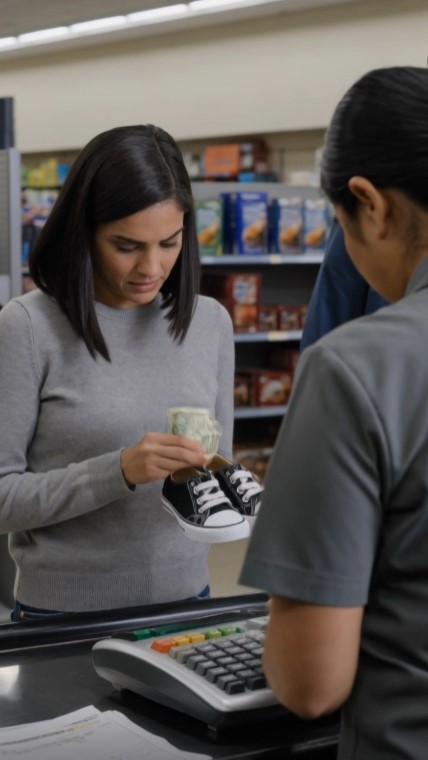
The woman stood in line holding just one thing.
A pair of tiny children’s shoes.
When the cashier told her the price…
She quietly counted her money.
Then counted it again.
She was short.
“I’m sorry,” she whispered.
“I’ll put them back.”
Before she could move…
A man behind her said:
“No. I’ll pay.”
The woman immediately shook her head.
“You don’t have to.”
“I know.”
He paid for the shoes.
She stared at him.
“Why?”
The stranger smiled.
“Because someone once did it for me.”
The woman thanked him…
Took the shoes…
And walked away.
The cashier smiled.
“That was kind.”
But the man wasn’t smiling anymore.
He was staring at the woman as she left.
Then he suddenly asked:
“Did you hear what she called her son?”
The cashier nodded.
The man went completely still.
He ran toward the door…
Because that name meant something nobody in the store could have known.
“Ma’am!”
The woman stopped.
She had already reached the sidewalk.
Her little boy stood beside her, holding the shopping bag with both hands.
The man hurried toward them.
“I’m sorry. I don’t mean to frighten you.”
The woman looked nervous.
“What is it?”
He glanced at the boy.
A moment earlier, as they’d left the checkout, she’d bent down and said:
“Come on, Henry. Let’s get home.”
Henry.
The man swallowed.
“Your son’s name is Henry?”
The woman nodded.
“Yes.”
“Henry what?”
She hesitated.
“Henry Walker.”
The man’s face lost its color.
The woman pulled her son slightly closer.
“Why?”
The stranger stared at the boy.
Then he asked:
“Who named him?”
“I did.”
“Why Henry?”
Now she looked completely confused.
“My grandfather.”
The man stepped backward.
“What was your grandfather’s full name?”
She answered slowly.
“Henry Thomas Walker.”
The stranger grabbed the metal railing beside the store entrance.
For several seconds, he couldn’t speak.
The woman stared at him.
“Did you know him?”
The man’s name was Daniel Carter.
He was fifty-two years old.
And he hadn’t heard the name Henry Thomas Walker spoken aloud in nearly thirty years.
“Yes,” Daniel whispered.
“I knew him.”
The woman’s expression changed.
“My grandfather died before I was born.”
Daniel shook his head.
“No.”
“What?”
“I mean… I knew someone with that name.”
He struggled to explain.
“Maybe it’s a coincidence.”
The woman waited.
Daniel reached into his wallet.
Behind his driver’s license was an old photograph.
Its edges were soft from decades of being handled.
He pulled it out.
The photograph showed two boys.
One was about eleven.
The other looked sixteen or seventeen.
They were sitting on the steps outside a grocery store.
The younger boy was Daniel.
The teenager beside him was Henry Walker.
The woman stared.
“Where did you get this?”
Daniel’s voice cracked.
“I’ve carried it for thirty-one years.”
She took the photograph.
On the back were four handwritten words:
Daniel + Henry — 1995
The woman covered her mouth.
“That’s him.”
Daniel looked at her.
“You’re sure?”
“My mother has this exact photograph.”
Now it was Daniel’s turn to stare.
“What?”
“She has a copy.”
The little boy tugged his mother’s coat.
“Mommy, who is that?”
She crouched.
“That’s your great-grandfather.”
The boy pointed at young Daniel.
“Who’s he?”
Neither adult answered immediately.
Finally Daniel said:
“Someone your great-grandfather helped.”
The woman’s name was Rachel Walker.
And the story began thirty-one years earlier.
Daniel was eleven.
His father had recently disappeared from his life.
His mother, Evelyn, was doing everything she could to keep them afloat.
She worked mornings at a laundry.
Evenings cleaning offices.
Some weeks there was enough money.
Some weeks there wasn’t.
One afternoon, Daniel’s shoes split across the front.
His toes were nearly exposed.
His mother tried repairing them.
Glue.
Tape.
Even stitching.
Nothing lasted.
Daniel stopped playing outside because he was embarrassed.
At school, he curled his toes inside the shoes so other children wouldn’t notice the hole.
Then one Saturday, Evelyn took him to a discount store.
She had saved enough—or thought she had.
Daniel found a pair of sneakers.
Nothing expensive.
Plain black.
He loved them.
At the register, Evelyn counted her money.
Then counted it again.
She was short.
Not by much.
But enough.
Daniel remembered her face more clearly than anything else about that day.
Embarrassment.
Exhaustion.
And the awful look of a parent who wanted to give her child something ordinary but couldn’t.
“I’m sorry,” Evelyn whispered.
“We’ll come back next week.”
Daniel tried pretending he didn’t care.
“It’s okay.”
Then someone behind them spoke.
“I’ve got it.”
A teenage boy.
Sixteen years old.
Wearing a grocery-store apron.
His name tag said:
HENRY
Evelyn immediately refused.
“No, sweetheart.”
Henry shrugged.
“I just got paid.”
“You don’t even know us.”
“I know.”
“Then why?”
Henry smiled.
“Because somebody helped my mom last month.”
He paid the difference.
It wasn’t a fortune.
To Henry, it probably seemed like a small amount.
To eleven-year-old Daniel, it felt enormous.
Outside the store, Daniel asked him:
“Why did you really do that?”
Henry thought for a moment.
Then said something Daniel never forgot.
“Because being short on money shouldn’t make somebody feel small.”
Daniel remembered those words for the rest of his life.
A few weeks later, Daniel saw Henry again.
Henry worked at a grocery store near their apartment.
Daniel began stopping there after school.
Sometimes Henry gave him small jobs with the manager’s permission.
Flattening empty boxes.
Sweeping near the loading area.
Returning carts.
Nothing improper.
Nothing secret.
Henry simply treated Daniel like he mattered.
Over time, he became the closest thing Daniel had to an older brother.
Henry taught him how to throw a baseball.
How to change a bicycle tire.
How to tie a proper necktie.
When Daniel’s mother worked late, Henry occasionally sat with him on the grocery-store steps until she arrived.
One evening, Daniel asked:
“Why are you always helping people?”
Henry laughed.
“I’m not.”
“You helped me.”
“That’s one person.”
“You helped that lady carry groceries yesterday.”
“Two.”
“And Mr. Lewis.”
“Okay, maybe three.”
Daniel smiled.
Henry became serious.
“My mom says if somebody helps you, you don’t spend your whole life trying to repay that exact person.”
“What do you do?”
“You help the next one.”
Daniel remembered that too.
Then, when Daniel was fourteen, everything changed.
Evelyn found better work in another city.
They had to move quickly.
Daniel went to the grocery store to tell Henry.
Henry wasn’t working.
Daniel left a note with another employee.
He never knew whether Henry received it.
He wrote twice afterward.
Both letters came back.
The grocery store eventually closed.
Years passed.
Daniel finished school.
Went to college.
Built a career in logistics.
Married.
Had a daughter.
Divorced amicably years later.
Lost his mother.
Changed cities twice.
But he never forgot Henry.
Especially when he bought shoes.
For years, whenever Daniel saw someone struggling at a checkout, he remembered that Saturday.
Sometimes he helped.
Not always.
He wasn’t wealthy enough to solve every problem he encountered.
But when he reasonably could, he did.
And if anyone asked why, Daniel always gave the same answer:
“Because someone once did it for me.”
Exactly what he’d told Rachel.
Now, thirty-one years later, he was standing outside another store.
Another parent had been short.
Another child needed shoes.
And that child was named Henry Walker.
Rachel looked at Daniel.
“My mother needs to meet you.”
Daniel’s heart began pounding.
“Your mother?”
“She was Henry’s daughter.”
Daniel stared.
“Henry had a daughter?”
Rachel nodded.
“Laura.”
Daniel repeated the name.
“Laura.”
Rachel smiled.
“You really didn’t know.”
“No.”
She pulled out her phone.
Daniel became nervous.
“Is your grandfather…”
He stopped.
Rachel understood.
“He died twenty-seven years ago.”
Daniel lowered his head.
He had expected that possibility.
Still, hearing it hurt.
“How old?”
“Twenty.”
Daniel looked up sharply.
“What happened?”
“A car accident.”
Daniel closed his eyes.
Henry had died only a few years after Daniel moved away.
Suddenly all those unanswered letters made sense.
Daniel had spent decades occasionally wondering whether Henry simply forgot him.
He hadn’t.
He never got the chance.
Rachel called her mother.
“Mom?”
She paused.
“Something strange just happened.”
Daniel listened.
Rachel explained the shoes.
The man.
The photograph.
Then there was silence on the other end.
Rachel looked at Daniel.
“She wants to talk to you.”
Daniel took the phone.
“Hello?”
A woman’s voice answered.
“Is this Daniel Carter?”
He nearly dropped the phone.
“Yes.”
The woman began crying.
“My father talked about you.”
Daniel couldn’t speak.
“He did?”
“All the time.”
Daniel sat on the bench outside the store.
“What did he say?”
Laura laughed through tears.
“He called you Little D.”
Daniel covered his face.
Nobody had called him that since childhood.
Laura continued.
“I have something that belongs to you.”
They met the following afternoon.
Laura Walker was forty-eight.
She arrived carrying a small cardboard box.
The moment Daniel saw her, he recognized Henry in her face.
“You have his eyes.”
Laura smiled.
“Everybody says that.”
Rachel and little Henry came too.
They sat around Laura’s kitchen table.
On the wall was the same photograph Daniel carried.
The two boys on the grocery-store steps.
Laura placed the box in front of Daniel.
“My grandmother gave me this after Dad died.”
Inside were several photographs.
A baseball.
An old grocery-store name tag.
HENRY
And an envelope.
Written across it:
FOR LITTLE D
Daniel stopped breathing for a moment.
“He wrote this?”
Laura nodded.
“We didn’t know where to send it.”
Daniel opened the envelope.
The paper inside was yellowed.
Little D,
Your note finally got to me. I’m sorry I missed you before you moved.
Daniel pressed a hand against his mouth.
Henry had received the note.
He kept reading.
Don’t worry about paying me back for the shoes. You already tried three times and I’m not taking your money.
Daniel laughed through tears.
He remembered.
After moving, he’d placed five dollars inside each of his first three letters.
His mother kept finding the returned envelopes.
Henry’s letter continued:
If you really want to pay me back, wait until you’re older.
Someday you’ll be standing somewhere and you’ll see somebody counting money twice.
Daniel stopped.
Rachel looked at him.
“What?”
He handed her the letter.
She read the next line aloud.
When you see that, pay attention.
Everyone became silent.
Daniel looked toward the tiny pair of children’s shoes sitting beside Rachel’s chair.
Laura continued reading:
Maybe they’ll need help. Maybe they won’t. Don’t embarrass them. Don’t assume anything. But if you can help and they want you to, that’s enough.
Then the final lines:
You don’t owe me, Little D.
Just don’t forget what it feels like when somebody notices.
— Henry
Daniel lowered his head and cried.
For thirty-one years, he’d believed he was repeating Henry’s lesson from memory.
He had no idea Henry had written it down.
And he certainly couldn’t have known that the next person he’d help would be Henry’s own granddaughter.
Rachel looked at her son’s new shoes.
“This is unbelievable.”
Daniel shook his head.
“The timing is unbelievable.”
He didn’t call it fate.
He didn’t pretend there was some invisible force arranging checkout lines.
It was a coincidence.
A remarkable one.
A city with thousands of people.
A random afternoon.
A woman a few dollars short.
A stranger standing behind her.
A child’s name spoken at exactly the right moment.
But what happened next wasn’t coincidence.
That part was a choice.
Daniel stayed in contact with the Walker family.
He learned more about Henry.
After Daniel moved away, Henry had become a father at nineteen.
He worked hard.
Eventually became a mechanic.
He adored Laura.
He had been saving to open a small repair shop when he died.
Laura was only three.
Most of what she knew about her father came from her grandmother.
Stories.
Photographs.
Letters.
Daniel suddenly possessed something Laura didn’t.
Memories of Henry alive.
Not as a father.
Not as a photograph.
As a teenager.
He told her everything.
How Henry laughed.
How he hated tomatoes.
How he couldn’t sing.
How he used to spin a baseball in his hand when thinking.
How he’d deliberately lose races to Daniel until Daniel figured it out and became furious.
Laura laughed harder than she’d laughed in years.
“My mother told me Dad did that.”
“He was terrible at pretending.”
Daniel brought out his old photograph.
Laura held it beside hers.
Identical copies.
On Daniel’s copy:
Daniel + Henry — 1995
On Henry’s copy, something else had been written.
Daniel had never seen it.
LITTLE BROTHER I NEVER HAD.
Daniel stared at those words for a long time.
Months passed.
Little Henry grew out of the shoes.
Rachel was about to donate them.
Then she stopped.
Instead, she cleaned them carefully.
Placed them inside a box.
And wrote the date on top.
Years later, when Henry was old enough to understand, Rachel showed him the shoes.
She told him about the checkout.
About Daniel.
About his great-grandfather.
And about the letter.
Henry looked at the tiny shoes.
“So Mr. Daniel bought these because Great-Grandpa bought his?”
“Basically.”
“Did he know?”
“No.”
“That makes it better.”
Rachel smiled.
“Why?”
“Because he would’ve done it anyway.”
She stared at her son.
That was exactly right.
Daniel hadn’t helped because Rachel was connected to Henry.
He didn’t know she was.
He helped because thirty-one years earlier, a teenage grocery-store worker had taught an embarrassed eleven-year-old boy what kindness felt like.
That kindness survived longer than Henry did.
It traveled quietly through Daniel’s life.
Until one afternoon, it returned to Henry’s family without Daniel even knowing where it was going.
On what would have been Henry Walker’s sixty-eighth birthday, Laura invited Daniel to dinner.
At the table sat Rachel.
Little Henry, now a teenager.
Daniel’s daughter.
And several members of both families.
Laura placed the old grocery-store name tag in the center of the table.
Beside it were the tiny shoes.
Then teenage Henry brought out another box.
“What is that?” Daniel asked.
Henry smiled.
“Something Mom and I started.”
Inside were gift cards for children’s shoes.
Nothing huge.
They had worked with a local family-support organization so assistance could be offered privately and responsibly to parents who needed it.
On the box were six words:
BECAUSE SOMEONE ONCE DID IT FOR ME.
Daniel stared at them.
“You used my line.”
Henry shook his head.
“No.”
He placed his great-grandfather’s letter beside the box.
“It was his line first.”
Daniel smiled.
“Fair enough.”
Over time, the small effort grew.
Friends contributed.
Then coworkers.
Then other families.
Nobody attached Henry’s photograph to every donation.
Nobody demanded public gratitude.
That would have defeated the point.
The help was meant to feel like help.
Not humiliation.
Years later, Daniel was shopping when he noticed a young father at the register ahead of him.
The man was buying children’s clothes.
He counted his money.
Paused.
Then quietly removed one item.
Daniel noticed.
For a moment, he thought about stepping forward.
Before he could…
a young man from the next checkout line approached.
“Excuse me.”
It was Henry.
Rachel’s son.
Now twenty-one.
He spoke quietly to the father.
Daniel couldn’t hear everything.
He didn’t need to.
The father hesitated.
Then nodded.
Henry paid for the item.
Daniel waited near the exit.
When Henry saw him, he smiled.
“You were watching?”
Daniel nodded.
“Couldn’t help it.”
Henry shrugged.
“It wasn’t much.”
Daniel laughed.
“Your great-grandfather said the same thing.”
They walked outside together.
Henry asked:
“Do you still carry the picture?”
Daniel pulled out his wallet.
“Always.”
Henry examined the old photograph.
His great-grandfather at sixteen.
Daniel at eleven.
Two boys sitting on grocery-store steps.
“It’s weird,” Henry said.
“What?”
“If he hadn’t bought your shoes…”
Daniel shook his head.
“Don’t do that.”
“Why?”
“Because we can’t know what would’ve happened.”
He put the photograph away.
“But we know what did happen.”
A teenager saw a mother counting her money.
He helped.
The boy she was raising remembered.
Thirty-one years later, that boy had become a man standing in another checkout line.
He saw another mother counting her money.
So he helped too.
He didn’t know her name.
Didn’t know her family.
Didn’t know the little boy beside her was named after the teenager who had once helped him.
Daniel only discovered that after she’d begun walking away.
One word stopped him.
“Henry.”
He ran toward the door.
And eventually learned something the teenager from the grocery store had understood long before Daniel did.
Kindness doesn’t always return to the person who gave it.
Sometimes it travels for years.
Through strangers.
Through families.
Through tiny moments nobody thinks will matter.
Until one afternoon, someone finds themselves standing behind a parent counting money twice.
And remembers to notice.