
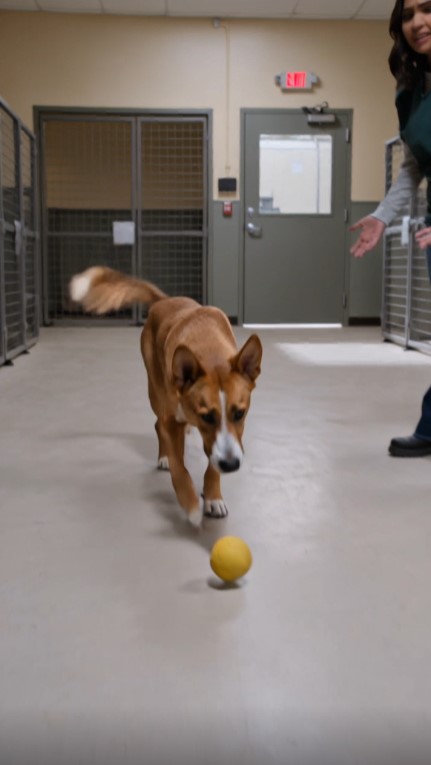
Every morning, the shelter dog did the same strange thing.
He picked up his favorite yellow ball…
Walked past every other dog…
And dropped it in front of one empty kennel.
A volunteer returned the ball.
“Buddy, nobody’s in there.”
Buddy picked it up again.
And carried it straight back.
Day after day.
Finally, the shelter manager asked:
“Why that kennel?”
They checked the records.
The manager suddenly stopped scrolling.
“Wait…”
Buddy hadn’t always been alone.
Months earlier…
Another dog had shared that exact kennel with him.
The volunteer whispered:
“Where is the other dog now?”
The manager looked at the screen.
Then immediately grabbed her phone.
Hours later…
A car pulled into the shelter parking lot.
Buddy heard it before anyone else.
He dropped the yellow ball.
Ran safely toward the inside viewing gate…
And froze.
Because someone had just stepped out of that car.
It was an elderly woman.
And beside her…
was a dog.
A black-and-white mixed breed with one white front paw.
Buddy stared through the secure gate.
The other dog stopped too.
For several seconds, neither moved.
Then Buddy made a sound volunteer Rachel Miller had never heard from him before.
Not a bark.
Not quite a whine.
Something softer.
The black-and-white dog pulled gently toward the entrance.
The elderly woman looked down.
“Easy, Daisy.”
Buddy’s entire body began moving.
His tail.
His shoulders.
Even his back legs seemed unable to stay still.
Rachel turned toward shelter manager Emily Carter.
“That’s her?”
Emily nodded.
“That’s Daisy.”
Buddy suddenly spun around.
He ran back toward his kennel.
Rachel frowned.
“Where’s he going?”
Seconds later, Buddy returned.
The yellow ball was in his mouth.
He carried it to the viewing gate.
Then dropped it.
Daisy stared at the ball.
Emily covered her mouth.
“Oh my God.”
But she didn’t open the gate.
Nobody rushed the dogs together.
The shelter had procedures for reunions and introductions, especially after animals had been separated for months.
Instead, the team confirmed Daisy’s records and spoke with her current caregiver.
The elderly woman’s name was Margaret Wilson.
She’d adopted Daisy nearly five months earlier.
“I had no idea there was another dog,” Margaret said.
Emily looked embarrassed.
“We didn’t either. Not at first.”
That required an explanation.
Buddy had arrived at the shelter seven months earlier.
He and Daisy had been found together near an abandoned rental property.
Neither dog had identification that immediately led to an owner.
They appeared comfortable around each other, so after health assessments, the shelter temporarily housed them in connected spaces and gave them supervised time together.
Daisy was outgoing.
Buddy wasn’t.
Daisy approached staff first.
Buddy watched her.
If Daisy accepted food from someone, Buddy often followed.
If Daisy rested, Buddy settled nearby.
And there was one object they constantly shared.
A yellow rubber ball.
Daisy would chase it.
Buddy would take it.
Daisy would steal it back.
Shelter staff joked that the ball belonged to whichever dog could keep it for more than thirty seconds.
Then Daisy was adopted.
At the time, the shelter didn’t have enough evidence to classify them as a bonded pair that had to remain together.
Both could eat, rest and interact independently.
Buddy showed no obvious crisis after Daisy left.
He continued playing.
He ate normally.
He interacted with staff.
So everyone believed he’d adjusted.
A few weeks later, the shelter reorganized several kennels.
Buddy was moved.
The kennel Daisy had occupied remained empty while maintenance work was completed.
That was when Buddy’s strange routine began.
Every morning, he picked up the yellow ball.
Walked down the row.
Stopped at the empty kennel.
And left it there.
The first time, Rachel assumed he’d dropped it accidentally.
She threw it back.
Buddy retrieved it.
Then returned it to the empty kennel.
“Okay, weird.”
The next morning, he did it again.
And the next.
At first, nobody connected the behavior with Daisy.
Several dogs had moved through that section.
Months had passed.
And Rachel hadn’t been working at the shelter when Daisy was adopted.
Then Emily finally checked Buddy’s earliest intake records.
There was Daisy.
Same intake date.
Same property.
Same section.
Several photographs showed the two dogs together.
One picture stopped everyone.
Daisy was lying on a blanket.
Buddy was beside her.
Between their paws…
was the yellow ball.
Rachel whispered:
“He’s been bringing it back to her kennel.”
Emily was careful.
“That’s what it looks like.”
They couldn’t know exactly what Buddy was thinking.
But the pattern was specific enough to investigate.
Emily checked Daisy’s adoption record.
Then she called Margaret.
“Is Daisy okay?”
Margaret immediately became nervous.
“Yes. Why?”
“Nothing is wrong.”
Emily explained Buddy.
The yellow ball.
The empty kennel.
The old photographs.
Margaret became silent.
Then she said:
“Daisy does something too.”
Emily sat straighter.
“What?”
Margaret explained.
Every evening, Daisy carried one particular toy to the front door.
A small blue rope.
She would place it on the rug.
Then lie beside it.
Margaret had always assumed Daisy simply liked sleeping near the entrance.
“But that rope came from your shelter,” Margaret said.
Emily checked the photographs.
There it was.
In another intake picture, Buddy was chewing the same blue rope while Daisy lay beside him.
Margaret’s voice softened.
“Do you think she misses him?”
Emily didn’t pretend to know.
“I think they clearly had a relationship. I’d like to see how they respond to each other now, if you’re comfortable bringing Daisy in.”
Margaret didn’t hesitate.
“When?”
That afternoon.
Now Daisy stood on one side of the secure introduction area.
Buddy waited on the other.
The shelter’s behavior staff watched both dogs carefully.
Their bodies appeared loose.
Their interest was strong.
No one forced contact.
When the team judged it appropriate, they moved through the shelter’s normal controlled introduction process.
Buddy approached.
Daisy approached.
They sniffed.
Moved apart.
Then came back.
Buddy grabbed the yellow ball.
Daisy immediately took the other side.
Rachel laughed.
“There it is.”
For several minutes, they played the same game recorded in the old shelter photographs.
Buddy took the ball.
Daisy chased him.
Daisy got it.
Buddy followed.
Then both dogs lay down.
Side by side.
The yellow ball rested between them.
Margaret watched silently.
Then she asked the question everyone had been thinking.
“Why wasn’t Buddy adopted with her?”
Emily explained honestly.
At the time Daisy left, Buddy was not yet ready for adoption.
He was still completing behavioral and medical evaluations.
The shelter also hadn’t concluded that separating them would compromise either dog’s welfare.
By the time Buddy became available, Daisy had already been living successfully with Margaret.
Margaret nodded.
“So what happens now?”
“Nothing has to happen today.”
Margaret looked toward the dogs.
“I mean with Buddy.”
Emily hesitated.
“Buddy is still looking for a home.”
Margaret became quiet.
Rachel knew what everyone was hoping.
But nobody pressured her.
Adopting another dog was a major commitment.
Margaret was seventy-one.
She lived alone.
She had a fenced yard, but Daisy was already a significant responsibility.
Emotion wasn’t enough.
The shelter wanted any placement to be sustainable.
Margaret eventually stood.
“I need to think.”
Emily nodded.
“Absolutely.”
When it was time for Daisy to leave, Buddy watched from inside.
Margaret looked back at him.
“I feel terrible.”
“Don’t,” Emily said. “You gave Daisy a good home. You didn’t know Buddy existed.”
Margaret took Daisy home.
That evening, Buddy carried the yellow ball back to the empty kennel.
Rachel found it there the next morning.
But something had changed.
Now she knew why that kennel mattered.
She sat outside Buddy’s enclosure.
“You saw her.”
Buddy picked up the ball.
Rachel smiled.
“Yes. She was real.”
Three days passed.
Then Margaret called.
“I want to talk about Buddy.”
Emily’s heart jumped.
But Margaret wasn’t calling to impulsively adopt him.
She’d done something smarter.
She’d spoken with her veterinarian.
Her daughter.
Her neighbor.
She reviewed the costs of caring for two dogs.
Food.
Routine veterinary care.
Emergencies.
Transportation.
Exercise.
She even arranged a backup caregiver.
Then she asked whether the shelter could conduct additional meetings between Buddy and Daisy.
“That’s exactly what we’d want,” Emily said.
The visits continued.
The dogs appeared comfortable together.
Buddy also became increasingly comfortable with Margaret.
But the shelter still wanted to know whether Margaret and Buddy were a good match independent of Daisy.
So they took their time.
Margaret walked him.
Fed him.
Practiced simple routines with staff guidance.
Spent quiet time sitting near him.
Buddy initially paid more attention to Daisy.
Gradually, he began approaching Margaret too.
One afternoon, Margaret sat on a bench while Daisy explored nearby.
Buddy walked toward her carrying the yellow ball.
He stopped.
Margaret held out her hand.
Buddy placed the ball at her feet.
She looked at Emily.
“Does that mean what I think it means?”
Emily smiled.
“It means he put a ball at your feet.”
Margaret laughed.
“You people never let me make anything dramatic.”
“We try not to speak for dogs.”
“Fine.”
Margaret picked up the ball.
“But I’m throwing it.”
She did.
Buddy and Daisy ran after it together.
Several weeks after the first reunion, Margaret completed Buddy’s adoption.
Rachel packed his belongings.
Blanket.
Food.
Medical information.
Favorite treats.
And, of course…
the yellow ball.
Before leaving, Buddy walked down the shelter corridor one final time.
He passed the other kennels.
Then stopped at the empty one.
Rachel watched.
Buddy looked inside.
He still had the yellow ball in his mouth.
For a moment, Rachel wondered if he would drop it there again.
He didn’t.
He turned.
Walked back toward Margaret.
And carried it outside.
Rachel wiped her eyes.
Emily noticed.
“You okay?”
“Dust.”
“Inside a shelter?”
“Terrible dust problem.”
They laughed.
Margaret opened the back door of her car.
Daisy was already secured in her travel setup.
Buddy climbed into his designated space beside her.
Margaret drove home.
The shelter expected an adjustment period.
They got one.
The first week wasn’t magically perfect.
Buddy was uncertain about household noises.
He followed Daisy constantly.
He needed help learning the routine.
Margaret worked with the shelter and her veterinarian.
Slowly, Buddy settled.
He discovered the couch.
Then Margaret’s garden.
Then the patch of afternoon sunlight beside the kitchen door.
Daisy taught him something else.
Every evening at approximately six, Margaret prepared their dinner.
Daisy waited politely.
Buddy did not.
“Buddy.”
He bounced.
“Sit.”
He sat for approximately half a second.
Margaret laughed.
“You’re seventy pounds of bad manners.”
Daisy looked at him.
Buddy sat again.
This time he waited.
“Thank you, Daisy.”
Margaret put down the bowls.
Within months, Buddy’s behavior became part of the household.
The yellow ball usually lived beneath Margaret’s kitchen table.
The blue rope stayed near the front door.
Sometimes Daisy carried the yellow ball.
Sometimes Buddy stole the blue rope.
Neither object belonged to only one dog anymore.
One year after Buddy’s adoption, Margaret brought both dogs back to the shelter for a community event.
Rachel was waiting.
“Buddy!”
Buddy recognized her voice and hurried over.
Rachel crouched.
“You look good.”
Margaret smiled.
“He’s doing very well.”
Daisy wandered toward the old kennel row during their supervised visit.
Buddy followed.
Rachel watched carefully.
The kennel that had once been empty now housed another dog awaiting adoption.
Buddy stopped several feet away.
He looked.
Then turned back toward Daisy.
The yellow ball was in Margaret’s bag.
Rachel smiled.
Later, the shelter used Buddy and Daisy’s story during volunteer training.
Not as proof that dogs experience memory exactly like humans.
Not as evidence that every pair of dogs who enjoy each other’s company must always be adopted together.
Instead, Emily used it to teach something simpler.
“Behavior has history.”
She showed new volunteers the old photographs.
Buddy.
Daisy.
The yellow ball.
“Sometimes something that looks strange makes more sense once you know what happened before.”
One volunteer asked:
“Do you think Buddy was leaving the ball there because he expected Daisy to come back?”
Emily smiled.
“We’ll never know exactly why he did it.”
“But he stopped after they were reunited?”
“He eventually stopped carrying it to that kennel, yes.”
“So he remembered her.”
Emily looked toward a photograph Margaret had recently sent.
Buddy and Daisy asleep on the same rug.
The yellow ball between them.
“They had clearly known each other before. Their reunion showed strong familiarity and interest. Beyond that, I try not to put human sentences into a dog’s head.”
The volunteer nodded.
Emily smiled.
“The real story is good enough.”
Years later, Margaret grew older.
Her daughter Laura became more involved in caring for the dogs.
That had always been part of Margaret’s backup plan.
When Margaret eventually moved into a smaller home near Laura, Buddy and Daisy went with her.
The yellow ball went too.
It was badly worn by then.
One afternoon, Laura suggested replacing it.
Margaret immediately refused.
“That ugly thing?”
“Yes.”
“It barely bounces.”
“I don’t care.”
Laura laughed.
“Why?”
Margaret picked up the faded ball.
“Because this is why Buddy came home.”
Technically, she knew that wasn’t true.
A ball hadn’t made the phone call.
A ball hadn’t reviewed the records.
A ball hadn’t arranged the introduction.
People had.
But the little yellow toy had been the clue that made them look.
Years later, Rachel still remembered the morning everything changed.
Buddy had walked down the kennel row as usual.
Yellow ball in his mouth.
He stopped at the empty kennel.
Dropped it.
Rachel returned it.
Buddy carried it straight back.
She finally asked:
“Why that kennel?”
Nobody expected an answer.
Dogs couldn’t explain their histories.
So the shelter checked for him.
They opened his old records.
Found another dog’s name.
Found photographs.
Made a phone call.
And hours later, a car pulled into the parking lot.
Buddy heard it.
Dropped his ball.
Ran toward the inside viewing gate.
And froze.
Because stepping out of that car was Daisy.
The dog who had once shared his kennel.
The dog who had once shared his blue rope.
And the dog who, before leaving the shelter months earlier…
had shared that same yellow ball.