
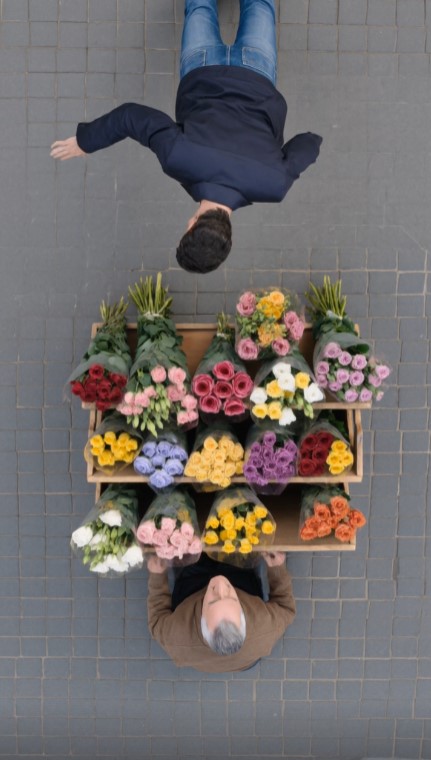
The stranger pointed at the flower stand.
“How much for all of them?”
The elderly vendor laughed.
“All of them?”
“Every flower.”
The vendor named the price.
The man paid.
People nearby started watching.
The vendor began gathering the bouquets.
But the stranger stopped him.
“No. Keep them.”
The elderly man looked confused.
“You just bought them.”
“I know.”
“Then why give them back?”
The stranger smiled.
“Sell them again.”
The vendor stared at him.
“Why would you do that?”
The man asked one strange question:
“Were you selling flowers here nineteen years ago?”
The vendor’s smile disappeared.
“Yes…”
The stranger reached into his pocket.
Then placed a tiny object on the counter.
The vendor stared at it.
His hands began trembling.
“I remember this.”
The stranger nodded.
“You should. You gave it to me.”
On the counter was a tiny wooden flower.
No bigger than a coin.
Hand-carved.
One petal was slightly shorter than the others.
On the back were two faded letters.
H.W.
The elderly vendor picked it up.
“I made these.”
“I know.”
“I haven’t made one in years.”
The stranger smiled.
“My name is Daniel Carter.”
The old man’s eyes narrowed as he searched Daniel’s face.
Daniel waited.
Then he said:
“I was fourteen.”
The vendor’s expression changed.
“Daniel?”
Daniel nodded.
The elderly man gripped the edge of his flower stand.
“Oh my God.”
His name was Henry Wilson.
He had sold flowers from that same corner for almost thirty years.
And nineteen years earlier, on a cold November afternoon, he’d noticed a fourteen-year-old boy standing across the street.
Daniel wasn’t buying flowers.
He was watching them.
For nearly an hour.
Eventually Henry called out:
“You planning to stare them into growing?”
Daniel looked embarrassed.
“No, sir.”
“Then come over here before you freeze.”
Daniel crossed the street.
His clothes were clean but worn.
His backpack had one broken strap.
Henry noticed the boy kept looking at a small bouquet of white daisies.
“Those for somebody?”
Daniel nodded.
“My mom.”
“Birthday?”
“No.”
Henry waited.
Daniel finally whispered:
“She’s in the hospital.”
Henry’s expression softened.
“What happened?”
“She’s sick.”
Daniel didn’t say more.
He didn’t need to.
“How much are the daisies?” he asked.
Henry told him.
Daniel reached into his pocket.
Coins.
A few crumpled bills.
He counted everything twice.
Then his shoulders dropped.
He was short.
Not by much.
But enough.
“I’ll come back.”
Henry stopped him.
“Where are you going?”
“To get more money.”
“How?”
Daniel shrugged.
“I’ll figure it out.”
Henry looked at the coins.
Then at the boy.
“How much do you have?”
Daniel told him.
Henry took exactly that amount.
Then handed him the bouquet.
Daniel shook his head.
“That’s not enough.”
“It is today.”
“No, sir.”
Henry pushed the flowers toward him.
“Take them to your mother.”
Daniel hesitated.
Then accepted them.
“Thank you.”
As he turned away, Henry called:
“Wait.”
Henry had recently started carving tiny wooden flowers from scraps left over from repairing his stand.
He kept a handful beside the register.
He picked one up.
A little wooden daisy.
“This one’s free.”
Daniel stared.
“Why?”
“Because real flowers don’t last forever.”
Henry placed the wooden flower in Daniel’s hand.
“This one might.”
Daniel smiled.
Then ran toward the bus stop.
Henry assumed that was the end of the story.
It wasn’t.
Daniel’s mother, Evelyn Carter, had been hospitalized for complications from a serious illness.
She had already been sick for months.
Daniel’s father wasn’t in the picture.
Money was disappearing quickly.
Daniel had started working small weekend jobs.
Carrying groceries.
Cleaning yards.
Helping a neighbor at his garage.
Anything legal he could find.
The daisies were supposed to be something normal in a life that had stopped feeling normal.
When Daniel entered his mother’s hospital room, Evelyn saw the bouquet.
“You bought flowers?”
Daniel nodded.
“With what money?”
“My money.”
“Daniel.”
“Mom.”
She smiled.
Then noticed the wooden flower.
“What’s that?”
Daniel told her about Henry.
The flower vendor.
The missing money.
The discount.
The wooden daisy.
Evelyn held it between her fingers.
“He sounds like a good man.”
Daniel nodded.
Then Evelyn said something he never forgot.
“Make sure you remember people who are kind to you when they don’t have to be.”
Daniel thought she’d meant to say thank you.
Years later, he realized she meant much more.
Evelyn’s health improved temporarily.
She came home.
For nearly two years, she and Daniel rebuilt something resembling ordinary life.
Then her illness returned.
This time, treatment didn’t work.
Daniel was sixteen when his mother died.
At the funeral, he placed white daisies beside her photograph.
But he kept the wooden flower.
He carried it in his pocket through high school.
Then through community college.
Then his first job.
When he worried about losing it, he put it inside his wallet.
Years passed.
Daniel became an electrician.
Then a project supervisor.
Eventually, he and a friend started a small electrical contracting company.
The first year nearly destroyed them.
Daniel worked six days a week.
Sometimes seven.
But the company survived.
Then grew.
At thirty-one, Daniel employed twenty-three people.
He married.
Had a daughter.
Bought a house.
But the wooden flower remained in his desk.
One afternoon, his eight-year-old daughter Sophie found it.
“What’s this?”
Daniel took it from her carefully.
“A flower.”
“It doesn’t look very good.”
Daniel laughed.
“No, it doesn’t.”
“Did you make it?”
“No.”
“Who did?”
Daniel paused.
“A man who helped me when I was your age.”
“I thought you said you were fourteen.”
Daniel stared.
“How do you know that?”
“You told Mom the story.”
Daniel laughed.
“Then why’d you ask?”
“I wanted to see if you’d change it.”
That sounded exactly like her mother.
Sophie turned the wooden flower over.
“Who’s H.W.?”
Daniel froze.
He had looked at those initials hundreds of times.
But for some reason, he’d never seriously tried to find the man behind them.
He remembered Henry’s first name.
But not the surname.
He only knew the flower stand had been near the old hospital.
The following weekend, Daniel drove there.
The hospital had expanded.
Several stores were gone.
The corner where the flower stand once stood now held a coffee kiosk.
Daniel asked around.
Nobody knew Henry.
He returned home disappointed.
Over the following years, he checked occasionally.
Nothing.
Then one Tuesday morning, nineteen years after receiving the daisies, Daniel was driving to a meeting when traffic forced him onto a different street.
He stopped at a red light.
And saw flowers.
Hundreds of them.
Roses.
Daisies.
Tulips.
Sunflowers.
Behind them stood an elderly man arranging bouquets.
Daniel stared.
The man was older.
Much older.
White hair now.
Glasses.
Slightly stooped.
Daniel almost kept driving.
Then he noticed the wooden sign above the stand.
WILSON’S FLOWERS
Daniel’s heart started pounding.
H.W.
Henry Wilson.
He parked.
Walked toward the stand.
And asked:
“How much for all of them?”
Now Henry stood on the other side of the counter holding the tiny wooden flower he’d carved nineteen years earlier.
“You kept this?”
Daniel smiled.
“For nineteen years.”
Henry looked at the flowers Daniel had just purchased.
“You didn’t need to buy my entire stand.”
“I know.”
“Then why?”
Daniel took a breath.
“Because the daisies weren’t what you really gave me.”
Henry frowned.
Daniel explained.
After Evelyn died, Daniel went through a difficult period.
He was angry.
At doctors.
At his absent father.
At classmates who still had mothers waiting at home.
At anyone whose life seemed easier.
One afternoon, he nearly dropped out of school.
His counselor, Mrs. Miller, found him packing his locker.
“What are you doing?”
“Leaving.”
“To go where?”
“Work.”
“You’re sixteen.”
“I need money.”
She convinced him to finish the day before making a permanent decision.
Daniel went home.
He opened his wallet.
The wooden flower fell onto the table.
He remembered Henry.
A man who hadn’t known him.
Hadn’t known his mother.
Hadn’t asked Daniel to prove he deserved anything.
Henry had simply noticed a kid counting coins.
Daniel went back to school the next morning.
“I’m not saying that wooden flower magically changed my life,” Daniel told Henry.
Henry smiled.
“Good. That would be a lot of pressure for a bad piece of carving.”
Daniel laughed.
“But it reminded me that the world wasn’t entirely against me.”
Henry stopped smiling.
Daniel continued.
“When you’re sixteen and angry, sometimes one piece of evidence is enough.”
Henry looked down at the little flower.
Daniel finished school.
His counselor helped him find an apprenticeship program.
He worked.
Studied.
Failed an exam.
Took it again.
Passed.
Built a career.
There was no miracle.
Just years of ordinary decisions.
But Daniel never forgot the afternoon someone chose kindness when embarrassment would have been easier.
Henry looked around.
Several customers had gathered.
The people who initially stopped because a stranger bought an entire flower stand were now listening quietly.
Daniel pointed toward the bouquets.
“You sold me flowers when I couldn’t afford them.”
“I gave you a discount.”
“You gave me dignity.”
Henry shook his head.
“I sold you some daisies.”
“You didn’t make me feel poor.”
Henry became quiet.
“That mattered.”
Daniel looked toward a young woman standing nearby with her phone lowered.
“People remember how you make them feel when they’re already embarrassed.”
Henry wiped his eyes.
Then he asked:
“What happened to your mother?”
Daniel swallowed.
“She died two years later.”
Henry closed his eyes.
“I’m sorry.”
“She got to come home for a while.”
Daniel smiled.
“And she remembered the daisies.”
Henry looked surprised.
“She did?”
“She remembered you too.”
Daniel reached into his jacket.
“I brought something else.”
He placed a folded piece of paper on the counter.
Henry opened it.
It was a photocopy of an old photograph.
Evelyn sitting in her hospital bed.
Fourteen-year-old Daniel beside her.
On the table…
white daisies.
Henry touched the photograph.
“She was young.”
“Thirty-eight.”
Henry stared at it for several seconds.
Then Daniel turned the copy over.
On the back was something Evelyn had written before she died.
Daniel had found it years later in a box of family photographs.
Daniel spent his last dollars on these flowers. A stranger made sure he had enough. Remind him someday that there were good people around us even during the bad years.
Henry stopped reading.
His shoulders began shaking.
Daniel walked around the stand.
The two men hugged.
One of the customers wiped her eyes.
Another man looked away.
Henry eventually stepped back.
“You really bought all these flowers because of something I did nineteen years ago?”
Daniel shook his head.
“No.”
Henry looked confused.
Daniel smiled.
“I bought them because of what happened afterward.”
Then Daniel told him.
The first time was six years after his mother died.
Daniel was working as an apprentice.
He stopped at a convenience store after a twelve-hour shift.
Ahead of him, a woman with two children was removing groceries from the counter.
Bread.
Milk.
Eggs.
Then diapers.
Her card had declined.
She tried again.
Declined.
She began putting things back.
Daniel remembered coins on a flower stand.
He paid the difference.
The woman tried to get his information so she could repay him.
Daniel said:
“Help somebody else someday.”
Henry stared.
“You said that?”
“Yes.”
“Because of me?”
“Because of you and my mother.”
Then came another.
An apprentice on Daniel’s crew couldn’t afford replacement work boots immediately.
Daniel bought them through the company’s employee-support program.
Another employee needed transportation after his car broke down.
Daniel helped arrange it.
When his company became profitable, Daniel created a small emergency assistance fund for employees facing temporary crises.
Not free money handed out carelessly.
A structured program.
Confidential.
Managed properly.
No public embarrassment.
Henry listened.
“You did all that?”
Daniel shook his head.
“A lot of people did.”
He refused to take credit for every outcome.
Just as Henry had once sold him discounted flowers, Daniel had learned that small assistance worked best when it connected people to something stable.
Then Daniel told Henry about Sophie.
His daughter had started a tradition at school.
Every birthday, instead of receiving one extra present, she chose school supplies to donate through an approved community program.
The first year, Daniel asked why.
Sophie had answered:
“Because Grandma Evelyn said there were good people during the bad years.”
Henry covered his mouth.
The story had traveled through a woman Sophie had never met.
A flower Daniel had never thrown away.
And a vendor who believed he’d simply helped one teenager buy daisies.
Henry looked at the money Daniel had paid for the flowers.
“This is too much.”
“No.”
“Daniel—”
“You’re going to sell them again.”
Henry laughed.
“So I get paid twice?”
“That’s the idea.”
“I can’t do that.”
“Why?”
“It feels wrong.”
Daniel leaned closer.
“Then do what you told me without saying it.”
Henry raised an eyebrow.
“Which was?”
“When you’ve got enough, make sure somebody else does too.”
Henry stared at him.
Then slowly smiled.
“All right.”
That afternoon, Henry sold the flowers again.
But he did something Daniel didn’t expect.
He put part of the second day’s proceeds aside.
At the end of the week, he called Daniel.
“I have an idea.”
Daniel returned to the stand.
Henry had placed a small wooden box beside the register.
A handwritten sign said:
THE DAISY BOX
Daniel frowned.
“What is this?”
Henry explained.
Customers could contribute if they wanted.
The money would be used through a local community partner to provide flowers for people in hospitals, nursing homes and hospice care who might otherwise receive none.
Daniel immediately liked the idea.
But he made one request.
“No story about me on the sign.”
Henry smiled.
“I wasn’t going to put your name.”
“Good.”
“I was going to put mine.”
Daniel laughed.
Instead, the sign remained simple:
Sometimes flowers matter most when someone thinks nobody remembered them.
The program began small.
A few bouquets a week.
Then customers started contributing.
A local florist joined.
Then another.
A hospital volunteer coordinator helped ensure deliveries followed facility rules.
White daisies became the unofficial symbol.
Henry kept selling flowers.
Daniel visited whenever he could.
Sometimes he brought Sophie.
Henry eventually taught her how to carve a tiny wooden flower.
Her first attempt was terrible.
She looked at it.
“This is ugly.”
Henry pointed toward Daniel.
“So was his.”
Daniel protested.
“Mine is historic.”
Henry laughed.
“Yours has one short petal because I sneezed while carving it.”
Daniel stared.
“You never told me that.”
“You never asked.”
Years later, Henry retired.
On his final day at the flower stand, Daniel arrived early.
This time, he didn’t buy every flower.
He bought one bouquet.
White daisies.
“How much?”
Henry told him.
Daniel paid exactly the amount.
No extra.
Henry noticed.
“You’re not going to make a big dramatic gesture?”
“No.”
“I’m disappointed.”
Daniel handed him the daisies.
“These are for you.”
Henry looked confused.
“Why would a flower seller need flowers?”
“Because nobody ever buys flowers for the man selling them.”
Henry stared at the bouquet.
Then laughed.
“That sounds like something your mother would’ve said.”
Daniel nodded.
“Probably.”
Before Henry left, he gave Daniel one final object.
Another tiny wooden flower.
This one was better carved.
Five even petals.
Smooth edges.
On the back:
D.C.
Daniel smiled.
“What do I do with this?”
Henry pointed toward Sophie.
“Nothing.”
“Then why give it to me?”
“You don’t keep this one.”
Daniel understood.
He handed it to his daughter.
Years later, Sophie kept both wooden flowers in a small glass case.
Henry’s imperfect original.
And the second one he made decades later.
Beneath them was Evelyn’s photograph with the daisies.
Sophie eventually told the story to her own children.
Not as a story about a rich man buying an elderly vendor’s entire flower stand.
That was only the part strangers had witnessed.
The real story had begun nineteen years earlier.
With a fourteen-year-old boy.
A handful of coins.
A mother in a hospital.
And a bouquet he couldn’t quite afford.
Henry Wilson could have simply told him:
“Sorry.”
Instead, he looked at the coins.
Looked at the boy.
And said:
“That’s enough.”
Then he added a tiny wooden flower.
Henry probably forgot about the moment within days.
Daniel carried it for nineteen years.
And when he finally found the old flower vendor again, Daniel didn’t return because he believed kindness created a debt.
He returned because his mother had taught him something before she died.
Remember the people who are kind to you when they don’t have to be.
So Daniel bought every flower on Henry’s stand.
Then gave every one of them back.
Not because he needed the flowers.
But because nineteen years earlier, when Daniel had almost nothing…
Henry had made sure he could still walk into his mother’s hospital room carrying something beautiful.