
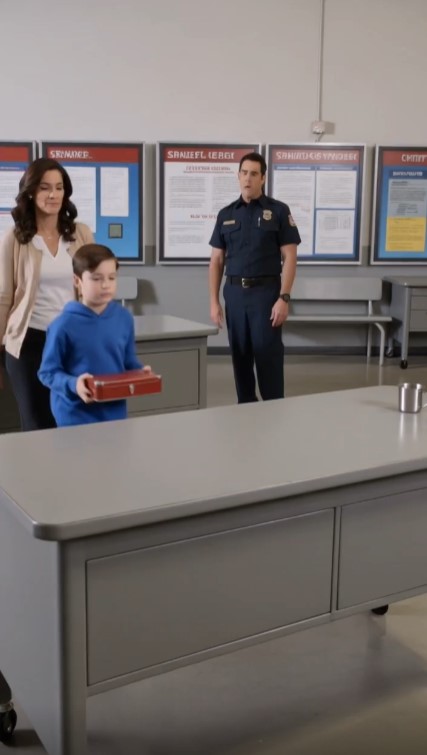
The firefighter suddenly shouted:
“EVERYONE STOP.”
Twenty children froze.
They were halfway through a routine fire-station tour.
Nothing was wrong.
No alarm.
No emergency.
Then the firefighter pointed at one little boy.
More specifically…
At the old red lunchbox he was carrying.
“Where did you get that?”
The boy looked confused.
“My grandpa gave it to me.”
The firefighter’s face changed.
“What’s your grandpa’s name?”
Before the boy could answer…
An older firefighter across the room dropped what he was holding.
CLANG.
Everyone turned.
He was staring at the lunchbox too.
The teacher pulled the boy closer.
“What is happening?”
The older firefighter slowly walked forward.
“Can I see the bottom?”
The boy turned the lunchbox over.
Three tiny scratches were carved into the metal.
The older firefighter went completely still.
“No way…”
The first firefighter whispered:
“You recognize them?”
The older man nodded.
Then said something nobody expected:
“I made those marks.”
The boy stared at him.
“But this belonged to my grandpa.”
The firefighter looked directly at him.
“I know.”
Silence.
Then he asked:
“Did your grandfather ever tell you where he got it?”
The boy shook his head.
The firefighter carefully opened the lunchbox.
It looked empty.
Until he pressed beneath the loose inner lining.
Something dropped into his hand.
The firefighter stared at it…
Then immediately closed his fist.
“Call his grandfather.”
The boy looked frightened.
“Why?”
The firefighter looked at him.
Because after thirty-two years…
something hidden inside that lunchbox had finally come back to the one place nobody expected.
And the boy’s grandfather had apparently known about it the entire time.
The older firefighter’s name was Michael Harris.
He was sixty-one years old.
He’d worked at Station 14 for thirty-five years.
The little boy was nine-year-old Ethan Carter.
His class had come to the station that morning to learn about fire safety.
Each child had been allowed to bring a small lunch.
Most carried colorful insulated bags.
Ethan brought an old metal lunchbox.
Red paint.
Silver latch.
Dented corner.
The teacher had even asked about it earlier.
“That’s an antique.”
Ethan had smiled proudly.
“My grandpa says old things work if you take care of them.”
Now Michael was holding that same lunchbox as though it were priceless.
The teacher, Mrs. Miller, stepped forward.
“Mr. Harris, you’re frightening him.”
Michael immediately realized how the situation looked.
He crouched several feet away.
“I’m sorry, Ethan.”
“You’re not in trouble.”
Ethan looked at Michael’s closed hand.
“What did you find?”
Michael hesitated.
Then opened it.
A small brass key rested in his palm.
Attached to it was a faded metal tag.
14-B
The first firefighter, Daniel Reed, stared.
“What’s 14-B?”
Michael didn’t answer.
Instead, he looked toward the back of the station.
At a row of old lockers that hadn’t been used in years.
Daniel followed his gaze.
“No.”
Michael nodded.
“Locker B.”
The station had been renovated twice since the early 1990s.
Most of the old lockers were removed.
But several remained in a storage room because they’d been built directly into the original wall.
Michael looked at the key again.
“I thought this was gone.”
Ethan frowned.
“Why was Grandpa hiding your key?”
Michael looked at him.
“That’s what I’d like to know.”
Mrs. Miller called the number Ethan provided.
His grandfather answered.
“Hello?”
“Mr. Carter? This is your grandson’s teacher.”
There was an immediate pause.
“Is Ethan okay?”
“He’s perfectly safe.”
“What happened?”
Mrs. Miller looked at Michael.
“One of the firefighters recognized Ethan’s lunchbox.”
Silence.
Then:
“Which firefighter?”
Michael took the phone.
“Henry?”
Nothing.
Michael tried again.
“Henry Carter?”
A shaky voice answered.
“Michael?”
Michael closed his eyes.
“You knew.”
Henry didn’t deny it.
“You found the key.”
Michael stared at the lunchbox.
“Yes.”
Another pause.
Then Henry said:
“I wondered how long it would take.”
Michael almost laughed.
“Thirty-two years, apparently.”
Henry became quiet.
Then he asked:
“Is the locker still there?”
Michael turned toward the storage corridor.
“Yes.”
“Don’t open it without me.”
Michael’s expression changed.
“Henry, what’s inside?”
“I’ll tell you when I get there.”
“You live forty minutes away.”
“Then you’ll have forty minutes to practice patience.”
Michael laughed despite himself.
“That sounds exactly like you.”
The children continued their tour with other firefighters.
Ethan kept the lunchbox beside him.
But every few minutes, he looked toward Michael.
Finally he asked:
“How do you know Grandpa?”
Michael smiled.
“Your grandfather saved my career.”
Ethan’s eyes widened.
“From a fire?”
“No.”
“Did he rescue you?”
“Not exactly.”
“Then how?”
Michael looked at the red lunchbox.
“He gave me lunch.”
Ethan stared.
“That’s it?”
Michael laughed.
“That was the beginning.”
Thirty-two years earlier, Michael had been twenty-nine.
He was already a firefighter.
Henry Carter was thirty-one.
They worked the same shift at Station 14.
Michael was confident.
Sometimes too confident.
Henry was the opposite.
Quiet.
Methodical.
The kind of firefighter who checked equipment twice even when someone else had already checked it.
The two men became close friends.
And every shift, Henry carried the same red lunchbox.
His wife, Margaret, had bought it for him when he started working a factory job as a teenager.
He refused to replace it.
The younger firefighters teased him.
Michael teased him most.
“One day that thing’s going to rust shut.”
Henry always answered:
“Then I’ll finally stop sharing my food with you.”
Michael laughed.
“Your wife packs enough for four people.”
“Because she knows you steal half of it.”
Then came the call that changed everything.
It was a residential fire.
The crew responded.
The situation was chaotic.
Michael made a judgment error.
Not a reckless stunt.
Not a dramatic act of disobedience.
But a mistake.
He moved too quickly before receiving confirmation he needed from another team member.
Henry stopped him.
Physically.
He grabbed Michael’s coat and pulled him back.
Seconds later, part of the interior structure shifted.
Nobody was seriously injured.
The crew adjusted.
The incident was handled.
But afterward, Michael was shaken.
He knew what could have happened.
The department reviewed the call.
Michael wasn’t fired.
But he was furious with himself.
He began questioning whether he belonged in the job.
For several shifts, he barely spoke.
Then one afternoon, Henry sat beside him.
Red lunchbox between them.
He opened it.
Two sandwiches.
An apple.
Cookies.
Michael stared.
“I’m not hungry.”
Henry handed him a sandwich.
“I didn’t ask.”
Michael refused.
Henry placed it beside him anyway.
They sat silently.
Eventually Michael said:
“I almost got someone hurt.”
Henry answered:
“Yes.”
Michael looked at him.
He’d expected reassurance.
Henry didn’t give it.
“I made a mistake.”
“Yes.”
“I could’ve—”
“But you didn’t.”
“Because you stopped me.”
Henry shook his head.
“Because we’re a team.”
Michael stared at the floor.
“I should quit.”
Henry opened the lunchbox again.
“No.”
“You don’t know that.”
“Yes, I do.”
“How?”
Henry pointed at him.
“Because you’re treating one mistake like proof that you’re incapable of learning.”
Michael became quiet.
Henry continued.
“If you don’t learn from it, then maybe you shouldn’t be here.”
“But if you learn…”
He tapped the lunchbox.
“…then tomorrow you come back with lunch.”
Michael laughed.
“What does lunch have to do with anything?”
“Nothing.”
“Then why’d you say it?”
“Because Margaret packed two sandwiches.”
That ridiculous conversation kept Michael from making a permanent decision during one terrible week.
He stayed.
He trained harder.
Became more careful.
Years later, he became an instructor.
Then captain.
And whenever a younger firefighter made a correctable mistake and immediately decided they were a failure, Michael remembered Henry.
A mistake mattered.
Accountability mattered.
Learning mattered too.
Ethan listened carefully.
“So Grandpa was a firefighter?”
Michael looked surprised.
“You didn’t know?”
Ethan shook his head.
“He says he worked for the city.”
Michael laughed.
“That sounds like Henry.”
Then the station doors opened.
An elderly man walked inside.
Ethan ran toward him.
“Grandpa!”
Henry Carter was sixty-three now.
He had retired years earlier.
His hair was white.
He walked with a slight limp.
But Michael recognized him immediately.
For a moment, neither man spoke.
Then Michael held up the brass key.
“You’ve got some explaining to do.”
Henry looked at it.
“Still works?”
“I don’t know.”
“Let’s find out.”
They walked toward the old storage room.
Ethan followed with his teacher.
Daniel came too.
Locker B stood in the corner.
Faded green paint.
Rust around the hinges.
A small lock.
Michael inserted the key.
It turned.
Inside was almost nothing.
An old folded station T-shirt.
A photograph.
And a sealed envelope.
Michael removed the photograph first.
Five firefighters stood outside Station 14.
Young.
Smiling.
Michael recognized himself immediately.
Henry stood beside him holding the red lunchbox.
On the back:
SHIFT B — 1994
Michael smiled.
Then he noticed the envelope.
His name was written across it.
MICHAEL HARRIS
Underneath:
OPEN WHEN YOU THINK ONE BAD DAY DEFINES YOU.
Michael looked at Henry.
“What is this?”
Henry shrugged.
“Open it.”
Michael tore the old envelope carefully.
Inside was a letter.
Michael,
If you’re reading this, you’re probably angry with yourself again.
Michael stopped.
Henry looked away.
Michael continued.
You made a mistake.
That doesn’t mean the mistake doesn’t matter.
It means what you do afterward matters too.
Take responsibility.
Learn.
Train.
Then come back tomorrow.
If you ever become the senior man in the room, remember how it felt when you were the one wondering whether you belonged there.
Don’t excuse dangerous mistakes.
But don’t confuse accountability with humiliation either.
Michael’s voice broke.
The final line read:
And bring lunch.
— Henry
Michael laughed through his tears.
“You wrote this thirty-two years ago?”
Henry nodded.
“Why didn’t you give it to me?”
“I was going to.”
“What happened?”
Henry smiled.
“You got better.”
Michael stared.
“That is the stupidest answer I’ve ever heard.”
“Probably.”
“Then why hide it?”
Henry pointed toward the lunchbox.
“I didn’t hide it there originally.”
Michael frowned.
Henry explained.
The key had once been Michael’s spare locker key.
After the difficult call, Michael gave Henry the key.
“Why?”
Michael couldn’t remember.
Henry did.
“You told me if you came in the next morning trying to quit, I should lock your resignation letter inside the locker until you’d eaten breakfast.”
Michael started laughing.
“I said that?”
“You were dramatic at twenty-nine.”
“I still am.”
Daniel nodded.
“Confirmed.”
Everyone laughed.
Henry kept the spare key.
Years later, when Henry retired, he accidentally took it home.
He intended to return it.
Instead, he placed it beneath the loose lining of his red lunchbox so he wouldn’t lose it.
Then life moved on.
Margaret became ill.
Henry’s attention shifted to caring for her.
The lunchbox went into a closet.
The key remained hidden.
Years later, after Margaret died, Henry found it again.
He considered mailing it to Michael.
But then he found the old letter too.
He’d kept a copy at home because he’d never given Michael the original.
So Henry drove back to Station 14 one afternoon.
Michael wasn’t working.
Henry used the spare key to place the letter inside the old locker.
Then he returned the key to the lunchbox.
“You came here?”
Michael asked.
“About eleven years ago.”
“Why didn’t you call me?”
Henry shrugged.
“I didn’t know what I’d say.”
“How about hello?”
“That would’ve worked.”
Michael shook his head.
“Stubborn old man.”
Henry smiled.
“Correct.”
Then Michael asked the obvious question.
“Why give the lunchbox to Ethan?”
Henry looked at his grandson.
Because a week earlier, Ethan had told him his class was visiting a fire station.
“Which station?” Henry asked.
“Fourteen.”
Henry froze.
He hadn’t planned it.
But suddenly the old lunchbox seemed like the perfect thing to send.
Henry cleaned it.
Packed Ethan’s sandwich inside.
Then checked beneath the lining.
The key was still there.
He left it.
“You knew somebody might recognize it,” Michael said.
“I hoped.”
“Why not just come yourself?”
Henry became quiet.
“Because I wasn’t sure you were still here.”
Michael stared.
“You could’ve called.”
“I know.”
“Look up the station online?”
“I know.”
“Ask literally anyone?”
“I know, Michael.”
Michael finally laughed.
“You haven’t changed.”
“Neither have you.”
Ethan looked between them.
“Wait.”
Everyone turned.
“You put the key there on purpose?”
Henry nodded.
“So you wanted me to bring it?”
“Yes.”
“Why didn’t you tell me?”
Henry smiled.
“Would you have been this excited if I had?”
Ethan considered it.
“No.”
“Exactly.”
Michael shook his head.
“You turned your grandson into a thirty-two-year delivery service.”
Henry laughed.
“He was already coming.”
Michael folded the letter carefully.
Then he looked at Ethan.
“Your grandfather did something for me I spent years trying to do for other firefighters.”
“What?”
“He let me make a mistake without letting me become the mistake.”
Ethan frowned.
“What does that mean?”
Michael thought.
“It means when someone does something wrong, you don’t pretend it was right.”
“You help them take responsibility.”
“But if they can learn and improve, you don’t spend the rest of their life telling them they’re only the worst thing they ever did.”
Ethan nodded slowly.
Then he opened his lunchbox.
“Do you want half my sandwich?”
The room exploded with laughter.
Henry looked at Michael.
“See?”
“Your family hasn’t changed either.”
Michael accepted half.
They ate together at the same station table where Henry had shared lunch with him thirty-two years earlier.
Before the class left, Michael asked Ethan if he could photograph the lunchbox.
Ethan frowned.
“Why?”
“Because nobody will believe this.”
Henry immediately said:
“Don’t encourage him. He loves telling stories.”
Michael looked offended.
“I am a respected captain.”
“You once locked yourself in the supply room.”
“That door was defective.”
“You pulled instead of pushed.”
“Details.”
Ethan laughed.
Then something unexpected happened.
He held the lunchbox toward Michael.
“You can keep it.”
Henry looked surprised.
“Ethan.”
The boy shrugged.
“It was yours before it was mine.”
Michael shook his head.
“No.”
“Why?”
“Because it was never mine.”
He pointed toward Henry.
“It was his.”
Then Michael touched the three scratches on the bottom.
“And those?”
Ethan asked.
Michael smiled.
“That part was me.”
Thirty-two years earlier, Michael had borrowed Henry’s lunchbox.
Henry warned him not to damage it.
Michael dropped it within ten minutes.
The fall left three scratches.
Henry complained about them for years.
Ethan laughed.
“So that’s why you recognized it?”
“That and the dent.”
“You made the dent too?”
Michael became quiet.
Henry smiled.
“Yes.”
Everyone laughed again.
Ethan took the lunchbox home.
But the story changed how he saw it.
It was no longer just something old Grandpa Henry had given him.
It had been carried through hundreds of shifts.
It had sat beside two young firefighters during one of the hardest conversations of Michael’s career.
It had survived retirement.
A closet.
A loose inner lining.
And a hidden key.
The following month, Henry returned to Station 14.
This time, he didn’t need Ethan to deliver anything.
Michael had invited him.
Several younger firefighters sat around the station table.
Michael placed the old letter in a protective sleeve.
Then he told them the story.
Not to glorify mistakes.
Not to suggest serious errors should be ignored.
The opposite.
He wanted them to understand why honest review and learning mattered.
At the end, Henry said:
“Accountability asks what happened and what you’ll do differently.”
“Humiliation just asks how long we can make somebody feel ashamed.”
The room became quiet.
Michael pointed toward him.
“That’s why I kept him around.”
Henry laughed.
“You didn’t keep me anywhere.”
Years later, when Michael finally retired, Henry attended.
Ethan was there too.
He was seventeen now.
And he carried the red lunchbox.
Michael saw it immediately.
“You still have that thing?”
Ethan smiled.
“It still works if you take care of it.”
Michael looked at Henry.
“You taught him that?”
Henry nodded.
Michael laughed.
At the retirement dinner, Ethan handed Michael a small package.
Inside was a new metal lunchbox.
Bright red.
On the bottom were three tiny scratches.
Michael stared.
“You didn’t.”
Ethan smiled.
“I did.”
Inside was a note:
FOR TOMORROW.
Michael looked at Henry.
Henry’s eyes filled.
Thirty-two years earlier, Michael had nearly allowed one bad day to convince him he didn’t belong in the career he’d chosen.
Henry hadn’t told him the mistake didn’t matter.
He hadn’t told him everything would magically be fine.
He gave him lunch.
Made him face what happened.
And reminded him that the next decision mattered too.
Then Henry wrote a letter Michael never received.
He placed it inside an old locker.
The key eventually disappeared beneath the lining of a battered red lunchbox.
For decades, neither man mentioned it.
Until a nine-year-old boy walked into Station 14 carrying his grandfather’s lunch.
Michael saw three scratches.
Three marks he’d made with his own hands thirty-two years earlier.
The hidden key opened an old locker.
The locker held a letter.
And the letter contained the words Michael had spent most of his career trying to give to others:
Take responsibility.
Learn.
Then come back tomorrow.
And, because Henry Carter was still Henry Carter, one final instruction:
Bring lunch.