
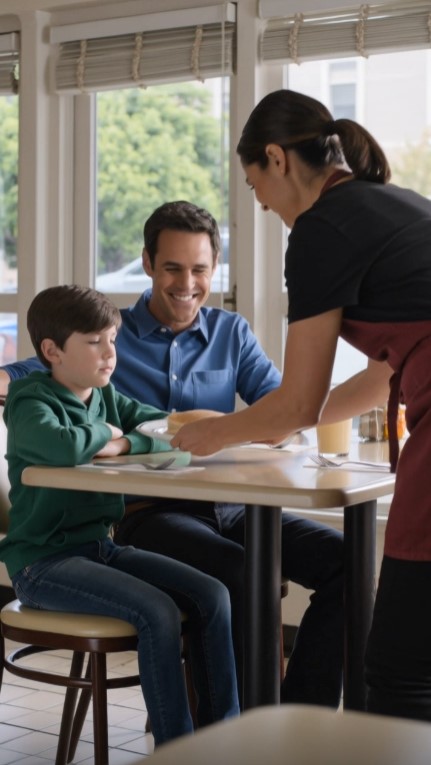
The waitress was placing pancakes on the table…
When the father said:
“Thank you. Noah’s been waiting all morning for these.”
The plate slipped from her hands.
Everyone turned.
The waitress stared at the 8-year-old boy.
“What did you call him?”
The father looked confused.
“Noah.”
The waitress went completely pale.
“What’s his last name?”
Now the father stopped smiling.
“Why?”
She apologized.
“I’m sorry. I just…”
Then she looked at Noah again.
“What’s your birthday?”
The father stood.
“Okay. What’s going on?”
The restaurant manager rushed over.
But the waitress wasn’t looking at him.
She was staring at a tiny mark on Noah’s wrist.
Then she whispered:
“No way.”
Noah pulled his sleeve down.
The father stepped between them.
“How do you know my son?”
The waitress shook her head.
“I don’t.”
Then she said something even stranger:
“But I know someone with the same name…”
“The same birthday…”
“And the exact same mark.”
Silence.
The father stared at her.
“Who?”
The waitress reached into her apron…
Pulled out her phone…
And turned the screen toward him.
His face changed instantly.
“Where did you get that?”
The waitress whispered:
“I think you need to call your wife.”
The father’s name was Daniel Carter.
He had stopped at the small roadside restaurant with Noah on their way home from a weekend soccer tournament.
Daniel’s wife, Rachel, hadn’t traveled with them.
She was home with their younger daughter.
Until that moment, the morning had been completely ordinary.
Noah was tired.
Daniel needed coffee.
They’d argued for ten minutes about whether Noah was allowed chocolate chips in his pancakes.
Then a waitress named Emily Miller heard Noah’s name.
And everything changed.
Daniel looked at the photograph on Emily’s phone.
It showed another boy.
Approximately eight years old.
Dark hair.
Brown eyes.
Blue sweatshirt.
The boy was standing beside an elderly woman.
Daniel’s stomach tightened.
The resemblance to Noah was impossible to ignore.
But that wasn’t what frightened him.
On the boy’s left wrist was a small crescent-shaped birthmark.
Noah had one in exactly the same place.
Daniel looked at Emily.
“Who is that?”
Emily swallowed.
“His name is Noah.”
“Noah what?”
“Carter.”
Daniel’s face changed.
“That isn’t funny.”
“I’m not joking.”
“My son’s name is Noah Carter.”
“I know.”
“No. You heard me say it.”
Emily shook her head.
“I’ve known the other Noah for years.”
Daniel looked at the photograph again.
“When was this taken?”
“About twenty-three years ago.”
Daniel froze.
“What?”
Emily enlarged the picture.
The photograph wasn’t recent.
It was a photograph of an old printed photograph.
The colors were faded.
The clothes were from another era.
The boy wasn’t another eight-year-old living somewhere nearby.
He would now be around thirty-one.
Daniel stared at him.
Then looked at his son.
Same dark hair.
Same eyes.
Same expression.
And the same crescent-shaped mark.
“Who is the woman?”
Emily answered:
“My grandmother.”
Daniel felt his pulse quicken.
“What was her name?”
“Margaret Miller.”
He didn’t recognize it.
Emily continued.
“She raised that boy for almost three years.”
Daniel looked up.
“Raised him?”
Emily nodded.
“He wasn’t her son.”
“Then whose son was he?”
Emily hesitated.
“I never knew.”
That was when she told him the story.
Emily had been eleven when Noah Carter appeared in her grandmother’s life.
Margaret worked at a community family-support center.
One afternoon, a young mother arrived with her little boy.
She needed temporary help.
The exact circumstances were complicated and had involved formal social services and approved kinship-style support arrangements.
Margaret became one of the adults who helped care for the child during that unstable period.
His name was Noah Carter.
His birthday was April 17.
And he had a small crescent mark on his left wrist.
Daniel sat down.
His own Noah’s birthday was April 17.
Noah tugged his father’s sleeve.
“Dad?”
Daniel forced himself to stay calm.
“It’s okay.”
It wasn’t.
Emily looked uncomfortable.
“I shouldn’t have asked him all those questions.”
“No.”
Daniel nodded.
“You shouldn’t have.”
“I’m sorry.”
“But now you’re going to explain everything.”
Emily did.
The older Noah lived with his mother.
Her name was Anna Carter.
Margaret became close to both of them.
Then, after nearly three years, Anna’s situation stabilized.
She and Noah moved away.
Margaret received a few letters.
Then nothing.
“She looked for them?”
“For years.”
Emily opened another photograph.
This one showed Margaret kneeling beside Noah.
He was holding a red toy airplane.
On the back, in Margaret’s handwriting:
NOAH — AGE 8 — APRIL 17
Daniel’s hands shook.
The red airplane looked familiar too.
He’d seen one like it before.
In his father-in-law’s attic.
Daniel pulled out his phone.
He called Rachel.
She answered immediately.
“How’d the tournament go?”
“Rachel.”
His tone made her stop.
“What happened?”
“Is Noah okay?”
“He’s sitting beside me.”
“Then what’s wrong?”
Daniel looked at Emily.
“Does the name Margaret Miller mean anything to you?”
Nothing.
“Rachel?”
“Where did you hear that name?”
Daniel stood.
“You know her.”
Rachel didn’t answer.
“Who is she?”
Another pause.
Then:
“Daniel, where are you?”
He told her.
Rachel whispered:
“Don’t leave.”
“What?”
“Stay there.”
“Why?”
“I need to call my dad.”
Daniel looked toward Noah.
“Rachel, what is happening?”
Her voice broke.
“I think you just found the part of Dad’s childhood he told me we’d never find.”
Daniel slowly sat down.
“What part?”
Rachel answered with four words.
“His first eight years.”
Daniel stared at the photograph.
The boy wasn’t some stranger who resembled his son.
The boy was Rachel’s father.
Noah’s grandfather.
His name was Noah Carter too.
Daniel looked at his eight-year-old son.
Then back at the photograph taken twenty-three years earlier.
“Your dad’s name is Henry.”
“That isn’t his birth name.”
Daniel went silent.
Rachel’s father had been known as Henry Carter for as long as Daniel had known him.
He was fifty-four.
Quiet.
Retired electrician.
The kind of man who arrived twenty minutes early and fixed things in your house without being asked.
But Henry hadn’t been born Henry.
His birth name was Noah.
Daniel looked at his son.
“You named Noah after your father?”
“Yes.”
“You never told me.”
“I didn’t think it mattered.”
“It matters right now.”
Rachel explained.
Her father had entered a permanent adoptive family shortly after turning eight.
His new parents were Henry and Evelyn Carter.
They didn’t erase his past.
But after the adoption, he began using Henry as his first name.
It was partly his choice.
He wanted a new beginning.
The name Noah became a middle name on some later documents and eventually disappeared from everyday use.
“Why didn’t he tell me?”
“He barely tells anyone.”
“What about the birthday?”
“That’s why Dad cried when we told him Noah was due in April.”
Daniel stared.
Their son had been born unexpectedly early.
On April 17.
The same birthday as his grandfather.
Rachel had wanted to name him Noah because it was her father’s original name.
The birthmark was simply a family trait.
Rachel had a faint version near her elbow.
Her father had the crescent on his wrist.
Noah had inherited one in almost the same location.
Daniel exhaled.
Suddenly the impossible details weren’t impossible.
They were genetics.
Family history.
And a name Rachel had deliberately passed down.
But there was still Margaret.
Rachel’s father had spent decades wondering what happened to the woman who’d cared for him before his adoption.
“Is Margaret alive?” Daniel asked Emily.
Emily looked down.
“No.”
“When did she die?”
“Seven years ago.”
Daniel closed his eyes.
Then Emily said:
“But she left something.”
Emily had kept photographs on her phone because she’d recently been digitizing Margaret’s albums for her mother.
In one album was a thick envelope.
On the front:
FOR NOAH CARTER — IF HE EVER FINDS US
Emily had never known who Noah was.
Until that morning.
“Where’s the envelope?”
“At my mother’s house.”
“Can we get it?”
Emily nodded.
“I think she’d want you to.”
But Daniel wasn’t making that decision alone.
Rachel called her father.
Henry answered.
Daniel told him everything.
The restaurant.
Emily.
Margaret.
The photograph.
For a long time, Henry said nothing.
Then:
“Is the restaurant still beside the old water tower?”
Emily heard him through the speaker.
Her eyes widened.
“Yes.”
Henry inhaled sharply.
“I remember that place.”
He’d eaten there with Margaret.
Pancakes.
Daniel looked at the untouched plate in front of his son.
“You’re kidding.”
Henry laughed once.
“No.”
Then his voice broke.
“Margaret used to take me there on my birthday.”
Emily covered her mouth.
Henry continued.
“She’d let me get blueberry pancakes even if it was dinner.”
Noah looked at his chocolate-chip pancakes.
“I like this guy.”
Daniel almost laughed.
Henry asked:
“Is Margaret there?”
Nobody answered quickly enough.
He understood.
“Oh.”
Emily spoke.
“Mr. Carter?”
“Yes?”
“My name is Emily.”
“Margaret was my grandmother.”
Henry went completely silent.
Emily continued.
“She looked for you.”
Henry started crying.
Not loudly.
Just one breath that didn’t come back normally.
“She did?”
“Yes.”
“I thought she forgot me.”
“No.”
Emily wiped her own eyes.
“She absolutely did not.”
Henry said something nobody expected.
“I thought I was the one who disappeared.”
The story of his childhood had always been incomplete.
Henry remembered Anna, his biological mother.
He remembered Margaret.
He remembered the little house.
The restaurant.
The red airplane.
Then a period of instability.
Temporary placements.
Adults discussing things around him.
Eventually Evelyn and Henry Carter became his permanent family.
They loved him.
He loved them.
But he never knew exactly why Margaret disappeared from his life.
As a child, he assumed she’d chosen to.
Margaret apparently believed the opposite.
The systems around a child’s placement had changed his address.
Contact details shifted.
There were rules around communication.
Anna’s circumstances changed again.
Then Anna died when Henry was a teenager.
By adulthood, almost everyone who knew the full story was gone or impossible to locate.
Two people spent decades believing the other had disappeared.
The following weekend, Rachel, Daniel, Noah and Henry returned to the restaurant.
Emily wasn’t working.
She was waiting for them anyway.
So was her mother, Laura.
Laura had the envelope.
Henry recognized her immediately.
“You were the little girl with the braids.”
Laura laughed.
“And you were the boy who put ketchup on scrambled eggs.”
Noah looked horrified.
“Grandpa!”
Henry smiled.
“I was eight.”
“That’s not an excuse.”
For a few seconds, the decades between them disappeared.
Then Laura handed him the envelope.
“My mother wrote this before she died.”
Henry held it.
His hands trembled.
“Did she know I was alive?”
“She hoped.”
Henry opened it.
Inside was a letter.
And the red toy airplane.
The same one from the photograph.
Henry pressed it against his palm.
“I thought I lost this.”
Laura smiled.
“Mom kept it.”
The letter began:
Dear Noah,
Henry stopped at the name.
Nobody called him that anymore.
Except in childhood memories.
He continued.
If you’re reading this, then one of us finally managed to find the other.
Henry smiled through tears.
I want you to know something before anything else.
You were never abandoned by me.
His face collapsed.
Rachel reached for his hand.
He kept reading.
Adults made decisions because they believed they were helping you. Some were necessary. Some I agreed with. Some I didn’t understand.
But none of them happened because you were unwanted.
Henry covered his mouth.
Daniel looked away.
The letter continued.
You once asked me if I would remember your birthday after you left.
I told you I would.
I did.
Every April 17.
Emily’s mother placed a small box on the table.
Inside were birthday cards.
Dozens.
Most had never been mailed.
Happy 10th Birthday, Noah.
Happy 14th.
Happy 18th.
Happy 25th.
Margaret had written them anyway.
Henry picked up the card for his eighteenth birthday.
Inside:
I wonder if you still like airplanes.
Then the card for his thirtieth:
You probably have children by now. I hope somebody lets them order pancakes at inappropriate times.
Henry laughed through tears.
Noah leaned toward him.
“She sounds funny.”
“She was.”
The last birthday card was written shortly before Margaret died.
Happy 47th, Noah.
I don’t know where you are.
I don’t know what name you use now.
I don’t know whether you remember me.
But I remember you.
Henry couldn’t continue.
Rachel finished it.
And if you ever believed I stopped looking because I stopped loving you, please correct that memory for me.
Sometimes people lose each other because life moves faster than the information needed to find the way back.
You were loved here.
Margaret
Nobody spoke.
Then Noah asked:
“Grandpa?”
Henry wiped his face.
“Yes?”
“Why did you change your name?”
Henry thought carefully.
“When I was eight, I’d had a lot of changes.”
“Was Noah a bad name?”
“No.”
“Then why?”
“Because I wanted something that felt new.”
Noah looked down.
“Do you want it back?”
Henry smiled.
“I already got it back.”
He pointed toward his grandson.
Noah grinned.
That afternoon, Emily brought out the old photographs.
Henry identified people nobody else could name.
Neighbors.
Teachers.
A social worker named Mrs. Harris.
The owner of the corner shop.
A dog named Max.
Then they reached one photograph that made Henry stop.
Margaret stood outside the restaurant.
Beside her was Anna.
Henry’s biological mother.
Between them stood eight-year-old Noah.
All three were smiling.
On the back:
APRIL 17 — NOAH’S LAST BIRTHDAY WITH US BEFORE THE MOVE.
Henry stared at Anna.
“I don’t have many pictures of her.”
Laura pushed the photograph toward him.
“You do now.”
Over the next several months, the two families exchanged copies of everything.
Not originals unless ownership was clear.
They digitized photographs.
Letters.
Birthday cards.
Old records.
Henry contacted the appropriate agencies to request whatever childhood documentation was still legally available to him.
Some questions were answered.
Others weren’t.
Nobody invented explanations for the missing pieces.
But the pieces they did find changed Henry’s understanding of his childhood.
Margaret hadn’t forgotten him.
Anna hadn’t simply handed him away.
His adoptive parents hadn’t stolen him from another family.
The reality was more complicated.
Adults had been dealing with difficult circumstances while trying, imperfectly, to give a child stability.
Some connections were lost in the process.
And one of those connections was Margaret.
Henry’s adoptive parents, Evelyn and Henry Carter, had both died years earlier.
But Rachel remembered something Evelyn once told her.
“Your father had a whole life before we became his parents. Never make him feel like loving that life means he loves us less.”
Henry cried when Rachel reminded him.
“I forgot she said that.”
“I didn’t.”
Noah became fascinated by the red airplane.
“Can I have it?”
Henry laughed.
“You’ve known about it for ten minutes.”
“So?”
“So it’s mine.”
Noah crossed his arms.
“You’re fifty-four.”
“Exactly. I’ve waited longer.”
Eventually Henry gave it to him anyway.
But first, he wrote something underneath one wing:
N.C. → H.C. → N.C.
Noah frowned.
“What does that mean?”
Henry pointed.
“Noah Carter.”
Then himself.
“Henry Carter.”
Then his grandson.
“Noah Carter again.”
Noah smiled.
“It’s the same name twice.”
“Exactly.”
Years later, Emily still worked at the restaurant.
The story became a private joke between the families.
Whenever Henry visited, Emily would ask:
“Blueberry pancakes?”
“Obviously.”
“At dinner?”
“Especially at dinner.”
And every April 17, two birthday cards appeared.
One for Henry.
One for Noah.
Because although Henry had changed his first name decades earlier, Emily’s family decided Margaret’s tradition shouldn’t disappear.
On Noah’s eighteenth birthday, Henry gave him the original photograph.
The one Emily had shown Daniel on her phone that first morning.
Eight-year-old Noah Carter.
Crescent mark on his wrist.
Red airplane in his hand.
Margaret beside him.
Noah stared.
“It’s weird.”
“What?”
“He looks like me.”
Henry smiled.
“He is me.”
“You know what I mean.”
“I do.”
Then Noah asked:
“Did Emily really think I was somehow the same kid?”
Henry laughed.
“For about five seconds, maybe.”
There had never been two mysterious eight-year-old boys with the same identity.
There had been a grandfather and grandson.
Both named Noah Carter.
Both born on April 17.
Both carrying a small inherited crescent-shaped mark.
One was eight years old in an old photograph.
The other was eight years old when a waitress heard his father say his name.
And that ordinary moment reopened a part of Henry’s life he’d believed was gone forever.
Years later, Daniel still remembered the pancakes slipping from Emily’s hands.
He remembered stepping between the waitress and his son.
He remembered thinking something impossible was happening.
But there had been no supernatural explanation.
No secret duplicate child.
No impossible coincidence involving two unrelated families.
Rachel had named their son after her father’s original name.
Noah happened to share his grandfather’s birthday after arriving earlier than expected.
And the small mark on his wrist was a family trait.
The extraordinary part was simpler.
Emily happened to be carrying digitized family photographs on her phone.
She happened to hear a familiar name.
Then she noticed the birthday.
The resemblance.
The mark.
And instead of dismissing it, she asked questions.
Those questions eventually brought Henry Carter back to a woman who had been gone for seven years…
but who had spent decades leaving proof that she never forgot him.
On Margaret’s final card, she’d written:
Sometimes people lose each other because life moves faster than the information needed to find the way back.
Henry framed that sentence.
But underneath it, he added one of his own:
Sometimes the way back begins with someone saying your old name out loud.
And for Henry…
it began in a roadside restaurant.
With an eight-year-old boy.
A plate of pancakes.
And a waitress who heard the name Noah Carter…
and remembered she’d seen it before.