
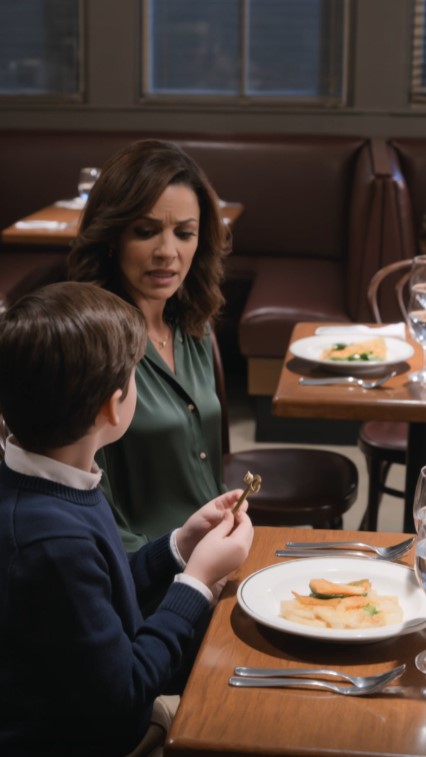
The restaurant was packed when a little boy suddenly stood up.
His mother grabbed his hand.
“Ethan, where are you going?”
He didn’t answer.
He walked past twenty tables…
Straight toward an elderly man eating alone.
Then he placed something beside the man’s plate.
A single house key.
The elderly man stared at it.
Then at the boy.
“Where did you get this?”
Ethan pointed across the restaurant.
“My mom has had it forever.”
His mother went completely pale.
“Ethan…”
The elderly man slowly stood.
He looked directly at her.
For several seconds…
Neither of them spoke.
Then he asked:
“Is your name Rebecca?”
She froze.
“How do you know my name?”
The entire table beside them went quiet.
The man looked back at the key.
“I made this key thirty years ago.”
Rebecca shook her head.
“No. My father gave me that.”
The elderly man whispered:
“I know.”
Then Ethan asked the question nobody was expecting.
“Mom… why is his picture inside Grandpa’s wallet?”
Silence.
Rebecca stared at her son.
“What picture?”
Ethan reached into his small backpack.
The elderly man immediately said:
“Don’t take it out.”
Rebecca looked at him.
“Why?”
His answer changed the entire night.
“Because your father spent thirty years making sure you never saw it.”
Rebecca’s expression hardened.
“Who are you?”
The elderly man looked around the restaurant.
People had started staring.
“My name is Thomas Walker.”
“That doesn’t answer my question.”
“No.”
Thomas nodded.
“It doesn’t.”
Rebecca took Ethan’s hand.
“We’re leaving.”
Thomas didn’t try to stop her.
He didn’t touch her.
He simply picked up the key and placed it back on the table.
Then he said:
“Ask your father about 214 Maple Street.”
Rebecca stopped.
She turned around.
“What did you say?”
“214 Maple Street.”
The color disappeared from her face.
That was the address engraved on a small wooden box her father kept in his bedroom.
Rebecca had seen it hundreds of times growing up.
She’d once asked him what it meant.
He told her:
“An old house.”
Nothing more.
Thomas continued.
“Ask him who lived there.”
Rebecca stared at him.
“My father died six months ago.”
Thomas closed his eyes.
“Oh.”
For the first time, his confidence disappeared.
“When?”
“March.”
Thomas sat back down.
“I didn’t know.”
Rebecca looked at Ethan.
“What were you saying about Grandpa’s wallet?”
Ethan opened his backpack.
Rebecca’s father, Henry Carter, had given Ethan an old leather wallet several weeks before he died.
Not to use.
Just because Ethan loved collecting his grandfather’s old things.
Coins.
Keys.
Baseball cards.
Pens.
Henry had told him:
“Someday you’ll throw all this junk away.”
Ethan had promised he wouldn’t.
That morning, while looking through the wallet, Ethan discovered a narrow compartment behind the lining.
Inside was a photograph.
He brought it with him because he’d planned to ask his mother about it.
Then he saw Thomas in the restaurant.
The same face.
Older.
But unmistakably the same man.
Rebecca sat down across from Thomas.
“Show me.”
Ethan removed the photograph.
Thomas looked away.
Rebecca stared at it.
Two young men stood in front of a small white house.
One was her father.
Henry.
Maybe twenty-five years old.
Beside him stood Thomas.
Between them was a woman Rebecca didn’t recognize.
On the back, in Henry’s handwriting:
214 MAPLE STREET — 1994
Underneath:
THOMAS, HENRY & ANNA
Rebecca looked at Thomas.
“Who’s Anna?”
Thomas didn’t answer immediately.
Then:
“My sister.”
Rebecca waited.
“And?”
Thomas looked directly at her.
“Your mother.”
Rebecca laughed.
Not because it was funny.
Because it was impossible.
“My mother’s name was Margaret.”
“I know.”
“She raised me.”
“I know.”
“She was married to my father for thirty-eight years.”
“I know.”
“Then don’t sit there and tell me someone else was my mother.”
Thomas shook his head.
“I said Anna was your mother.”
“Margaret was your mother too.”
Rebecca stood again.
“I’m done.”
Thomas reached into his coat.
Not toward Rebecca.
Toward an old envelope.
He placed it on the table.
Across the front:
FOR REBECCA — IF HENRY NEVER FINDS THE COURAGE
Rebecca froze.
She recognized the handwriting.
Her father’s.
Thomas pushed the envelope toward her.
“I’ve carried this for eleven years.”
Rebecca didn’t touch it.
“Why?”
“Because Henry gave it to me.”
“When?”
“The last time I saw him.”
Rebecca sat down again.
“Eleven years ago?”
Thomas nodded.
“Your father and I weren’t strangers.”
“We were best friends.”
That photograph had been taken thirty years earlier.
Henry Carter and Thomas Walker had grown up on the same street.
They went to the same school.
Worked at the same repair shop.
Eventually they rented the little house at 214 Maple Street together.
Thomas’s younger sister Anna visited constantly.
Then Henry and Anna fell in love.
Rebecca stared at the photograph.
“My father never mentioned her.”
“I know.”
“Why?”
Thomas looked at Ethan.
Then at Rebecca.
“Because talking about Anna meant talking about what happened after you were born.”
Rebecca’s hands tightened.
Thomas continued carefully.
Anna became pregnant.
Henry was twenty-six.
Anna was twenty-four.
They were terrified.
But happy.
Henry bought the little house from the landlord.
Thomas helped repair it.
Anna chose yellow curtains for the kitchen.
Henry hated them.
Thomas laughed.
“She told him nobody cared what he thought because he couldn’t tell yellow from beige.”
Rebecca almost smiled.
Then stopped herself.
“What happened?”
Anna developed serious medical complications after Rebecca’s birth.
For several months, the family believed she would recover.
She didn’t.
Anna died before Rebecca’s first birthday.
Rebecca stared at Thomas.
“No.”
“I’m sorry.”
“My mother never told me this.”
“Margaret wasn’t in Henry’s life yet.”
Thomas explained.
Margaret was a nurse Henry met more than a year later.
They eventually married.
Margaret adopted Rebecca legally and raised her as her daughter.
“She was your mother in every way that mattered,” Thomas said.
“Anna’s existence doesn’t change that.”
Rebecca looked at the photograph again.
“Then why hide her?”
That was the painful part.
Henry didn’t initially intend to.
When Rebecca was small, he kept photographs of Anna.
He planned to tell her when she was old enough.
Margaret supported that.
But Thomas was grieving too.
He and Henry began arguing.
Thomas believed Henry was moving forward too quickly.
Henry believed Thomas treated every happy moment as a betrayal of Anna.
The arguments became worse.
Then came the house.
214 Maple Street belonged to Henry.
But Thomas had invested years of unpaid work helping renovate it.
After Anna died, Thomas wanted the house kept because it was full of memories of her.
Henry wanted to sell.
“I told him selling that house was like erasing my sister.”
Thomas looked ashamed.
“He told me keeping Rebecca inside a museum of grief wasn’t fair to her.”
Rebecca looked at him.
“Who was right?”
“Probably both of us a little.”
Thomas paused.
“And both of us were mostly just hurting.”
One night, they had their final argument.
Thomas accused Henry of trying to replace Anna with Margaret.
Henry ordered him out.
Thomas said something he regretted for the rest of his life.
“If Rebecca grows up not knowing her mother, that’s on you.”
Henry slammed the door.
They didn’t speak for nineteen years.
Rebecca stared.
“Nineteen?”
Thomas nodded.
During that time, Henry and Margaret built a life.
Rebecca grew up.
Thomas moved to another state.
Henry apparently kept Anna’s photographs but stopped displaying them.
Every year that passed made the conversation harder.
“How do you tell a ten-year-old?” Thomas asked.
“Then she’s fifteen.”
“Then eighteen.”
“Then she’s getting married.”
“Then she’s having a child.”
“At some point Henry wasn’t protecting a little girl anymore.”
“He was a father who had waited so long that admitting the delay became harder than telling the truth.”
Rebecca’s eyes filled.
“And Margaret?”
“She knew.”
That hurt differently.
Rebecca looked away.
“She knew the whole time?”
“Yes.”
“Why didn’t she tell me?”
Thomas shook his head.
“I can’t answer for her.”
Rebecca’s mother Margaret had died three years earlier.
There would be no chance to ask.
Then Thomas pointed toward the key.
“That belonged to 214 Maple Street.”
Rebecca looked at it.
“My father gave me this on my eighteenth birthday.”
“What did he say?”
Rebecca remembered.
Henry had placed the key in a tiny envelope.
He told her:
“Keep this. It belongs to the first place you were ever loved.”
Rebecca had assumed it belonged to the apartment where she and Henry lived before Margaret.
She’d never questioned it.
Thomas smiled sadly.
“He didn’t lie.”
Rebecca picked up the key.
“Why did you say you made it?”
“I worked at a hardware store then.”
“When Henry bought the house, I changed the locks.”
“I cut three keys.”
“One for Henry.”
“One for Anna.”
“One for me.”
Thomas reached beneath his shirt.
A thin chain hung around his neck.
On it was another old brass key.
Rebecca stared.
“You kept yours?”
“For thirty years.”
Ethan, who had been unusually quiet, asked:
“Does the house still exist?”
Thomas looked at him.
“Yes.”
Rebecca turned sharply.
“What?”
“214 Maple Street is still there.”
“Who owns it?”
Thomas hesitated.
“You do.”
Rebecca stared at him.
“No, I don’t.”
“Yes.”
“My father’s estate didn’t include another house.”
“Because it wasn’t part of Henry’s estate.”
Thomas reached for the envelope again.
“Open his letter.”
Rebecca’s hands shook as she broke the seal.
Her father’s handwriting covered four pages.
Rebecca,
If you’re reading this, I failed to tell you something myself.
She stopped.
Then continued.
I have rehearsed this conversation more times than I can count.
Your mother Margaret knew that.
She told me repeatedly that waiting would not make it easier.
Rebecca covered her mouth.
Thomas had been right.
Margaret hadn’t wanted the secret kept forever.
Henry had.
The letter continued.
Margaret is your mother.
Nothing in these pages changes that.
She raised you when you were sick.
She sat beside you on your first day of school because you refused to go inside.
She taught you to drive.
She cried at your wedding.
She loved Ethan before he was born.
Do not let what I am about to tell you take one inch of motherhood away from her.
Rebecca started crying.
Ethan moved beside her.
She put an arm around him.
Then she read about Anna.
Her biological mother.
Her laugh.
Her terrible cooking.
Her yellow curtains.
How she sang the same song every night during pregnancy.
How she insisted Rebecca’s middle name be Rose.
How she held her daughter for the first time and said:
“She has Henry’s serious face. Poor kid.”
Rebecca laughed through tears.
Then she reached the part about Anna’s death.
Henry wrote:
I didn’t hide her because she did something wrong.
I hid her because losing her hurt me so badly that I confused silence with healing.
Rebecca stopped.
Thomas lowered his eyes.
Then I met Margaret.
She never asked me to erase Anna.
That was my mistake.
Margaret once told me: “A child can have room in her heart for a woman who gave her life and a woman who helped her live it.”
Rebecca whispered:
“Mom…”
The letter continued.
I kept saying I would tell you next year.
Then next year became thirty years.
At the bottom:
I’m sorry.
Dad
There was another sheet.
Legal information.
214 Maple Street had been sold decades earlier.
So how could Rebecca own it?
Thomas explained.
Eleven years ago, he and Henry finally reconciled.
Henry found him.
Not the other way around.
One morning Thomas opened his door and Henry was standing outside holding a coffee.
His first words were:
“We’re getting too old for this.”
Thomas let him in.
They talked for seven hours.
They apologized.
Not perfectly.
Not dramatically.
They simply admitted that two grieving young men had turned pain into pride and allowed it to steal nineteen years.
Then Henry told Thomas something strange.
214 Maple Street was for sale again.
The owners were moving.
Henry wanted to buy it.
Thomas thought he was being sentimental.
Henry said:
“Maybe I am.”
They bought it together.
Not to live there.
To restore it.
They repaired the porch.
Replaced the roof.
And in the kitchen, Henry did something Thomas thought was ridiculous.
He painted it yellow.
“The exact ugly yellow Anna loved.”
Rebecca laughed.
Then cried harder.
“What does that have to do with me owning it?”
Thomas pointed to the legal page.
Henry later transferred his share into a trust intended for Rebecca, with Thomas serving temporarily as trustee until the disclosure and paperwork could be properly completed.
Thomas’s share was also designated to transfer to her under the arrangement once she chose whether she wanted the property.
“I didn’t want it anymore,” Thomas said.
“Henry didn’t either.”
“Then why buy it?”
Thomas smiled.
“Because we wanted you to have the choice we never gave you.”
Rebecca looked at him.
“What choice?”
“To know where you came from.”
The next morning, Rebecca called the attorney named in Henry’s letter.
She didn’t simply take Thomas’s word for anything.
The attorney confirmed the trust.
The property.
The documents.
Everything.
Henry had left instructions.
Rebecca could keep the house.
Sell it.
Donate it.
Rent it.
Whatever she wanted.
No condition.
No emotional obligation.
The following weekend, Rebecca drove to 214 Maple Street.
Daniel, her husband, came.
Ethan sat in the back seat holding the old key.
Thomas waited on the sidewalk.
The house was small.
White siding.
Blue shutters.
A narrow porch.
Rebecca remained in the car.
“This is where I lived?”
Thomas nodded.
“For your first year.”
Ethan asked:
“Can I use the key?”
Rebecca looked at him.
Then smiled.
“That’s why we brought it.”
The lock had been replaced during restoration.
But Henry had kept the original lock mechanism on the interior door leading from the porch.
Thomas had restored it.
Ethan inserted the thirty-year-old key.
Turned it.
Click.
Rebecca started crying before the door opened.
Inside, the house was mostly empty.
Except for one room.
The kitchen.
Yellow.
On the table was a wooden box.
Rebecca opened it.
Photographs.
Dozens.
Anna pregnant.
Anna painting.
Anna holding newborn Rebecca.
Henry asleep in a chair with Rebecca on his chest.
Thomas holding a bottle while baby Rebecca grabbed his nose.
And one photograph that made Rebecca sit down.
Margaret.
Standing beside Anna.
Rebecca looked at Thomas.
“They knew each other?”
“Briefly.”
Margaret had been one of the nurses involved during Anna’s illness.
She wasn’t romantically involved with Henry then.
But she knew Anna.
Months after Anna died, Margaret encountered Henry again through a hospital support group.
Their relationship developed much later.
On the back of the photograph, Margaret had written:
Two mothers. Different chapters. Same little girl.
Rebecca pressed the photograph to her chest.
That sentence answered the question she’d been afraid to ask.
Learning about Anna didn’t mean Margaret’s motherhood had been false.
It made Margaret’s love larger.
She’d known Rebecca came with a history.
And loved all of it.
Thomas showed Rebecca the final room.
Her old nursery.
Most of the original furniture was gone.
But Henry had restored one small shelf.
On it sat an old photograph of Anna holding Rebecca.
Beside it was another photograph.
Margaret holding Rebecca on her first day of kindergarten.
Henry had placed a note between them:
DON’T MAKE HER CHOOSE.
Rebecca cried for a long time.
Thomas remained in the hallway.
Eventually she called him in.
“You said Dad kept your photograph hidden from me.”
Thomas nodded.
“That wasn’t exactly fair.”
“What?”
“I blamed him for thirty years.”
“But I helped create the silence too.”
Rebecca looked at him.
“You could have found me.”
“Yes.”
“Why didn’t you?”
Thomas didn’t make excuses.
“Pride.”
Then:
“Fear.”
“Of what?”
“That you’d think I was trying to replace your father.”
“You’re my uncle.”
“I know that now.”
He smiled sadly.
“Back then, I kept thinking relationships had only one available position.”
“One father.”
“One mother.”
“One family.”
“Your dad thought the same way for a while.”
“We were both wrong.”
Ethan appeared in the doorway.
“Can I ask something?”
Rebecca wiped her eyes.
“Sure.”
“Is Uncle Thomas coming to dinner?”
Thomas looked surprised.
Rebecca stared at Ethan.
“You’ve known him for one day.”
Ethan shrugged.
“He’s family.”
Children had an irritating way of making complicated things sound simple.
Rebecca smiled.
“Yes.”
Thomas came to dinner.
Then another.
And another.
There was no instant perfect family.
Rebecca was angry.
She asked difficult questions.
Sometimes Thomas’s answers hurt.
Sometimes he didn’t know.
Sometimes Henry’s letters contradicted Thomas’s memories.
They didn’t force the pieces into a cleaner story than reality allowed.
Two men had loved Anna.
One as a partner.
One as a brother.
Both lost her.
Both made mistakes afterward.
Margaret entered that broken family and spent decades loving Rebecca without demanding that Anna disappear.
Henry loved his daughter deeply.
And still failed her by waiting thirty years to tell her something she deserved to know.
Both things could be true.
A year later, Rebecca made her decision about 214 Maple Street.
She didn’t move there.
She didn’t turn it into a museum.
She kept it.
But she changed its purpose.
Working with a local nonprofit, the property became a short-term family transition home for parents and children facing temporary housing instability.
Rebecca insisted it be professionally managed.
No giant plaque about her family.
No dramatic shrine.
Only one small framed sentence remained in the entrance.
Margaret’s words:
A child can have room in her heart for more than one person who loved her.
Thomas volunteered occasionally.
Ethan became obsessed with helping him repair things.
One afternoon, Ethan found the original house key hanging in Rebecca’s kitchen.
“Mom?”
“Yes?”
“Do you still need this?”
Rebecca looked at it.
Thirty years earlier, Thomas had cut that key.
Henry had kept it.
Then given it to Rebecca on her eighteenth birthday without explaining what it opened.
For years it had been just an old piece of brass.
Until Ethan carried it across a crowded restaurant.
“Yes,” Rebecca said.
“What for?”
She smiled.
“To remember that locked doors aren’t always supposed to stay locked.”
Ethan rolled his eyes.
“That sounds like something from a movie.”
“It does.”
“Can I have it when I’m older?”
Rebecca thought about her father.
Then Anna.
Margaret.
Thomas.
The photograph hidden inside Henry’s wallet.
And all the years lost because adults kept deciding there would be a better time to tell the truth.
She handed Ethan the key.
“You can have it now.”
“Really?”
“Yes.”
“But there’s one rule.”
“What?”
“If someday somebody asks you what it opens…”
Rebecca looked directly at him.
“Tell them.”
Years later, Ethan still kept it.
So did the photograph.
The one that had started everything.
Henry.
Thomas.
Anna.
Standing outside 214 Maple Street.
Whenever people asked Ethan how his family discovered Thomas, they expected something complicated.
It wasn’t.
An eight-year-old boy had been looking through his late grandfather’s old wallet.
He found a hidden photograph.
Later, in a crowded restaurant, he saw the same man from that picture eating alone.
Then he remembered something else his mother always carried.
An old house key.
So Ethan walked across the restaurant…
Placed the key beside the stranger’s plate…
And accidentally opened a door his grandfather had kept closed for thirty years.