
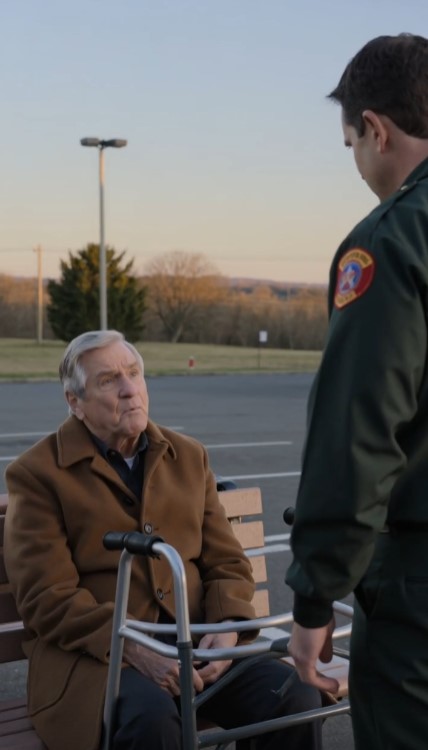
I thought the elderly man was confused.
Then I saw what he’d tied to his walker.
We found him alone outside a closed gas station just before sunrise.
He wasn’t injured.
He knew his name.
He knew where he was.
But he kept repeating the same sentence:
“Don’t take me away yet.”
I asked why.
He pointed toward the empty road.
“I’m waiting.”
“For who?”
He wouldn’t answer.
My partner brought over a blanket.
That’s when I noticed it.
Something was tied beneath his walker.
A tiny child’s sneaker.
Just one.
Old.
Faded.
Carefully knotted to the metal frame.
I asked:
“Whose shoe is that?”
The man’s entire expression changed.
He looked down at it.
Then whispered:
“She told me she’d come back for it.”
My partner and I exchanged a look.
“Who?”
Before he could answer…
A car entered the parking lot.
The elderly man stood as straight as he could.
“No…”
A woman stepped out.
She saw him.
Then saw the sneaker.
And immediately covered her mouth.
The old man whispered:
“You came.”
But the woman shook her head.
“I didn’t come for you.”
Silence.
She pointed toward the ambulance behind us.
“I came because somebody called me twenty minutes ago.”
I froze.
Neither my partner nor I had called her.
Then she asked the elderly man one question:
“Where is the other shoe?”
His face went pale.
And suddenly we understood…
We hadn’t found him there by accident.
My name is Daniel Harris.
I’d been a paramedic for fourteen years.
My partner, Rachel Carter, and I had been returning from an overnight call when we spotted the man beside the gas station.
It was 5:37 in the morning.
The business didn’t open until seven.
There were no other vehicles in the lot.
The elderly man was eighty-two.
His name was Henry Wilson.
He knew the date.
He knew the town.
He knew his home address.
He knew the gas station had once been called Miller’s Service before it changed owners.
Nothing about him suggested the kind of confusion I’d initially expected.
He was simply exhausted.
Cold.
And determined not to leave.
The woman who had just arrived was maybe fifty.
She introduced herself as Emily Carter.
Then she looked at Henry.
“You still have it.”
Henry touched the tiny sneaker.
“You said you’d come back.”
Emily’s eyes filled.
“That was forty-three years ago.”
Rachel looked at me.
Forty-three?
I asked the obvious question.
“You know each other?”
Emily nodded.
“I haven’t seen him since I was seven.”
Henry corrected her.
“Eight.”
Emily almost smiled.
“Seven.”
“Your birthday was the next month.”
She stared at him.
“You remember that?”
“I remember everything about that morning.”
Then Emily looked at the shoe.
“But I thought there were two.”
Henry’s face changed.
“There were.”
“Where’s the other one?”
Henry stared toward the highway.
“I don’t know.”
Emily looked frightened now.
“Then why are you here?”
Henry didn’t answer.
I crouched beside him.
“Henry, start at the beginning.”
He took a slow breath.
Then pointed toward the gas station.
“This used to belong to my brother.”
In 1983, Henry was thirty-nine.
His younger brother, Thomas, owned the small service station.
Henry worked there on weekends.
Emily’s mother, Margaret Carter, lived nearby.
She was raising Emily alone.
Money was tight.
Their car was unreliable.
One rainy morning, Margaret’s car broke down outside the station.
Thomas repaired it.
Margaret couldn’t pay the entire bill.
Thomas told her to pay when she could.
Henry remembered eight-year-old Emily sitting on an overturned bucket in the garage.
She wore bright red sneakers.
“She talked constantly,” Henry said.
Emily laughed through tears.
“I still do.”
“You asked me thirty-seven questions about tire pressure.”
“That sounds like me.”
Then something happened.
While Margaret spoke with Thomas, Emily wandered toward the front of the station.
She stepped into a puddle.
One sneaker came loose in the mud.
Henry helped retrieve it.
The sole was separating.
So he cleaned it.
Glued it.
Then tied the laces together so Emily could carry both shoes while her mother found dry socks in the car.
But when Margaret and Emily left, one sneaker remained beneath the workbench.
Henry found it that evening.
He expected them to return the next day.
They didn’t.
Two days later, Henry learned why.
Margaret had received a job offer in another state.
She’d already been planning to move.
The broken car had been one of the last things keeping them there.
They left almost immediately.
Henry called the number on the repair invoice.
Disconnected.
He mailed the shoe to the forwarding address Thomas had.
It came back.
No such resident.
“So you kept it?” Rachel asked.
Henry nodded.
“At first.”
But there was more.
Several weeks later, an envelope arrived at the gas station.
Inside was a child’s drawing.
A gas station.
Two men.
A little girl.
And one red sneaker.
Underneath, in crooked handwriting:
THANK YOU FOR FIXING MY SHOE. I WILL COME BACK FOR IT.
Emily stared at Henry.
“I wrote that?”
Henry nodded.
She covered her mouth.
“My mother must’ve mailed it.”
Henry had kept both the drawing and the shoe.
For years.
Then Thomas died.
The gas station was sold.
Henry married.
Had children.
Worked as a mechanic.
Retired.
Life moved forward.
The little red sneaker went into a box.
Then another box.
Then a garage shelf.
Eventually Henry’s wife, Anna, asked him why he was keeping one child’s shoe from 1983.
He showed her the drawing.
Anna laughed.
“She promised.”
Henry shrugged.
“She might come back.”
“She was eight.”
“A promise is a promise.”
Anna made him keep it.
But Emily never returned.
Until that morning.
Rachel asked:
“How did someone know to call her?”
Emily pulled out her phone.
“The caller didn’t identify himself.”
“What did he say?”
“That an elderly man named Henry Wilson was waiting outside the old Miller gas station and that I should come if the name meant anything.”
My partner and I looked at each other.
Henry hadn’t given us Emily’s number.
We didn’t even know Emily existed.
“Did you recognize Henry’s name?”
Emily shook her head.
“No.”
“Then why did you come?”
“The gas station.”
That she remembered.
And one more thing.
“The caller said something about a red shoe.”
Henry looked up sharply.
“What exactly?”
Emily checked her call history.
The number was blocked.
“He said, ‘Ask Henry about the red sneaker.’”
Henry’s hands began trembling.
I asked:
“Who knew about it?”
Henry whispered:
“My son.”
“What’s his name?”
“Michael.”
“Where is Michael?”
Henry didn’t answer.
Rachel crouched beside him.
“Henry?”
Finally:
“I don’t know.”
That changed everything.
Henry explained.
His son Michael was fifty-one.
For the last several months, father and son had been cleaning out Henry’s house.
Henry was moving into a smaller apartment near his daughter.
During the cleanup, Michael found the old sneaker.
He thought it was ridiculous.
“You kept one shoe for forty-three years?”
Henry showed him the drawing.
Michael teased him.
Then he became curious.
Who was Emily?
What happened to her?
Could she still be found?
Henry didn’t care.
“She has her life.”
But Michael did.
He began searching.
A name.
An approximate age.
The old address.
Margaret’s name.
Eventually he found an Emily Carter who seemed to match.
He didn’t contact her immediately.
He wanted to be sure.
Then, two weeks earlier, Henry and Michael argued.
Not about Emily.
About Henry’s move.
Henry didn’t want to leave his house.
Michael believed living alone had become too difficult.
Henry accused his son of trying to control him.
Michael left angry.
They barely spoke afterward.
Then the previous afternoon, Michael came back.
He carried a small cardboard box.
Inside was something Henry hadn’t seen in decades.
The second red sneaker.
Emily stared.
“You had both?”
Henry shook his head.
“No.”
Michael had found the second one somewhere else.
“Where?”
“He wouldn’t tell me.”
Henry said Michael only smiled and said:
“Tomorrow morning, we’re finishing a forty-three-year-old job.”
Then he told Henry to be ready at four-thirty.
Henry thought his son had arranged a meeting with Emily.
Instead, Michael drove him to the old gas station.
He helped Henry out.
Gave him the walker.
Tied the original sneaker to it.
Then said:
“Wait here.”
Henry became angry.
“Where are you going?”
“To get the other one.”
Michael drove away.
That was shortly after five.
He never returned.
I immediately contacted dispatch.
Now we weren’t simply dealing with an elderly man waiting at a gas station.
We had a potentially missing driver.
Michael Wilson.
Fifty-one.
Vehicle description.
Phone number.
Last known direction of travel.
Rachel asked Henry:
“Why didn’t you tell us this immediately?”
“I thought he’d come back.”
“How long were you going to wait?”
“As long as it took.”
Emily sat beside him.
“You really haven’t changed.”
Henry looked at her.
“You don’t know me.”
She smiled.
“You kept my shoe for forty-three years.”
“Fair.”
Then my radio came alive.
Dispatch had located Michael’s vehicle.
Not through anything dramatic.
A county road worker had reported a car off a narrow side road several miles away.
No major crash.
The vehicle had apparently slid into a muddy ditch while turning around.
The driver was conscious.
A second ambulance was already responding.
Henry closed his eyes.
“Is he okay?”
Initial report suggested yes.
Michael had a minor injury and couldn’t get the vehicle out.
His phone had been damaged in the slide.
But before the accident, he’d made one call.
To Emily.
That explained the mysterious caller.
Michael had contacted her while driving back toward the gas station.
He hadn’t told her who he was because he wanted Henry to explain the story himself.
Then his car left the road.
But that still didn’t explain the second shoe.
Emily asked again:
“Where did he find it?”
Henry looked toward the highway.
“I honestly don’t know.”
We found out later that morning.
After Michael was evaluated, he arrived at the hospital where we’d taken Henry as a precaution.
He walked in with mud on his jeans and a bandage on his forehead.
Henry immediately started shouting.
“You left me at a closed gas station!”
Michael laughed.
“You told me you could wait.”
“For ten minutes!”
“I had a transportation problem.”
“You drove into a ditch!”
“It wasn’t intentional.”
Then Michael saw Emily.
He stopped.
“You came.”
She nodded.
“Apparently that’s today’s theme.”
Michael smiled.
Then reached into his jacket.
The other red sneaker.
Emily stared.
The pair matched.
Same faded red canvas.
Same white rubber toe.
Same tiny flower Margaret had drawn inside the tongue so Emily could tell left from right.
Emily touched it.
“Where did you get this?”
Michael looked at Henry.
“Uncle Thomas kept it.”
Henry stared.
“What?”
Thomas had died thirty-six years earlier.
After his death, Henry helped empty the service station.
He took the child’s drawing and the sneaker he knew about.
But many of Thomas’s belongings went to storage.
Eventually they passed to Thomas’s daughter, Laura.
Michael had recently contacted Laura while researching Emily.
Laura remembered an old box from the gas station.
Inside were invoices.
Photographs.
Tools.
And a small red sneaker.
Thomas had apparently found the second shoe after Henry believed the pair had been separated.
Nobody knew exactly when.
A note was tucked inside:
MATCHES HENRY’S LITTLE GIRL SHOE. GIVE IT TO HIM.
Michael looked at his father.
“Uncle Thomas had the other one the entire time.”
Henry started laughing.
Then crying.
“You’re telling me we’ve had one shoe each for forty-three years?”
“Pretty much.”
“You couldn’t just bring it to my house?”
Michael smiled.
“I had a better idea.”
Henry pointed toward the bandage on his son’s head.
“Clearly.”
Emily held both sneakers.
They were impossibly small.
She couldn’t believe she’d once worn them.
Then Michael handed her something else.
The original drawing.
Henry had apparently given it to Michael during the house cleanup.
Emily read her eight-year-old handwriting.
I WILL COME BACK FOR IT.
“I didn’t,” she whispered.
Henry shook his head.
“You were eight.”
“I still said it.”
“You don’t owe an old man forty-three years because you forgot a shoe.”
That sentence hit harder than anyone expected.
Emily looked at him.
“You waited anyway.”
Henry smiled.
“Not every day.”
“I had things to do.”
That was important.
Henry hadn’t spent forty-three years sitting beside a gas station.
He lived a full life.
Married Anna.
Raised children.
Worked.
Traveled.
Buried his brother.
Later buried his wife.
The shoe was simply an object he’d kept.
A tiny unfinished story.
Then Michael found a way to finish it.
Emily sat beside Henry.
“My mother died twelve years ago.”
Henry lowered his eyes.
“I’m sorry.”
“She would’ve remembered you.”
“Maybe.”
“She remembered the gas station.”
Emily explained.
Margaret used to tell the story about two brothers who fixed her car when she couldn’t afford the full bill.
She never remembered their last name.
But she remembered Thomas refusing to charge interest on the unpaid amount.
And Henry repairing Emily’s shoe.
“She paid the bill later,” Emily said.
Henry smiled.
“I know.”
“You do?”
“Your mother mailed Thomas a money order six months later.”
Emily laughed.
“That sounds like her.”
Henry nodded.
“She added five dollars.”
“For the shoe?”
“Apparently.”
Emily looked at the sneaker.
“Expensive repair.”
“Inflation.”
They laughed.
A week later, we all met again.
This time at the old gas station.
It hadn’t reopened.
The current owner planned to renovate the property into a small convenience store.
With permission, Emily stood near the place where the old garage bays had been.
Michael brought the box of Thomas’s belongings.
Inside was an old photograph.
Henry and Thomas standing beneath a Miller’s Service sign.
Henry was young.
Dark hair.
Grease on his shirt.
Emily stared.
“I remember that shirt.”
Henry laughed.
“You remember a shirt from when you were eight?”
“It had a patch hanging off.”
Henry looked at the photograph.
She was right.
Then Michael found another photograph.
A little girl sitting on an overturned bucket.
No shoes.
White socks.
Holding a bottle of orange soda.
Emily gasped.
“That’s me.”
Henry had never seen it.
Thomas must have taken it.
On the back:
EMILY WAITING FOR MARGARET’S CAR — 1983
Emily sat down.
For forty-three years, she had remembered the morning only in fragments.
Rain.
Oil smell.
A red vending machine.
Two mechanics.
A wet shoe.
Now she had a photograph.
Michael gave her both sneakers.
Emily shook her head.
“One belongs to Henry.”
Henry refused.
“They’re yours.”
“You kept one longer than I did.”
“That’s because you’re terrible at keeping track of footwear.”
She laughed.
Eventually they compromised.
Emily kept one.
Henry kept the other.
Not because they wanted the pair separated again.
Because the separation had become part of the story.
Emily placed hers beside the old photograph.
Henry tied his back onto the walker.
His daughter hated that.
“Dad, people are going to think you’re wandering around with children’s shoes.”
Henry smiled.
“Let them ask.”
A year later, Henry moved into the smaller apartment he’d resisted.
He eventually admitted Michael had been right.
Michael promised never to quote him.
He quoted him constantly.
Emily became part of their lives.
Not as some long-lost relative.
She wasn’t.
Henry had simply been a kind adult from one small moment in her childhood.
That was enough.
On Henry’s eighty-fourth birthday, Emily gave him a box.
Inside was a pair of brand-new red children’s sneakers.
Henry looked horrified.
“What am I supposed to do with these?”
“Donate them.”
So they did.
The shoes went through a local family-support organization along with several more pairs purchased by Emily and Michael.
No dramatic charity named after anyone.
Just practical help.
Inside the box, Emily included a small anonymous note:
For the next kid who loses a shoe.
Henry laughed when he heard about it.
Years later, after Henry died, Michael gave Emily the sneaker that had been tied to his walker.
She finally had the pair again.
Forty-six years after she’d worn them.
She placed them together in a small shadow box.
Between them was the photograph of eight-year-old Emily at Miller’s Service.
Underneath, she placed her childhood drawing.
And one sentence:
SHE CAME BACK FOR IT.
I saw that frame once.
Emily brought it to the ambulance station because she wanted Rachel and me to see how the story ended.
I asked her something.
“What would’ve happened if we hadn’t stopped that morning?”
She smiled.
“Michael would’ve come back eventually.”
“After driving into a ditch.”
“Eventually.”
Then she became serious.
“But you did stop.”
I thought about that morning often.
At first, I’d assumed Henry was confused.
An elderly man alone before sunrise.
A child’s sneaker tied to his walker.
Refusing to leave.
Repeating:
“I’m waiting.”
But Henry knew exactly where he was.
He’d been brought there by his son.
Michael had spent weeks tracing a woman his father hadn’t seen in forty-three years.
He found Emily.
Then he found something nobody knew still existed.
The matching shoe.
His plan was unnecessarily complicated.
Henry reminded him of that for the rest of his life.
But it worked.
Almost.
A muddy ditch interrupted it.
A damaged phone made the morning stranger than it needed to be.
And by the time Emily arrived, neither Rachel nor I knew someone had already called her.
So when she stepped from her car…
Saw Henry…
Then saw the tiny sneaker tied beneath his walker…
she asked:
“Where is the other shoe?”
For a moment, we thought that question meant something terrible.
It didn’t.
The truth was much simpler.
Forty-three years earlier, an eight-year-old girl had accidentally left a shoe behind.
A mechanic repaired it.
His brother unknowingly kept its match.
The girl moved away.
And life carried all of them in different directions.
But one little promise survived in a child’s handwriting:
I WILL COME BACK FOR IT.
She didn’t keep that promise at eight.
Or eighteen.
Or forty.
She didn’t even remember making it.
But just before sunrise, forty-three years later…
she finally did.