
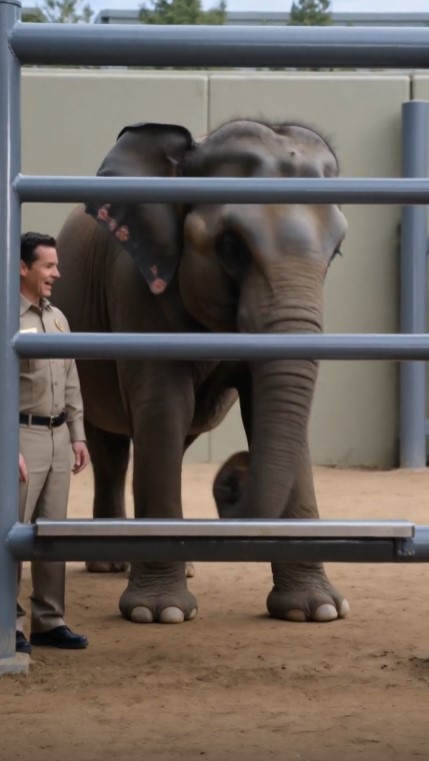
The elephant picked up the ranger’s hat…
And carried it away.
Everyone laughed.
The ranger held out his hand.
“Okay, Maya. Give it back.”
She did.
Five minutes later…
She took it again.
Same hat.
Same direction.
This time, she carried it across the protected enclosure…
Dropped it beside one particular fence post…
And waited.
The ranger retrieved it.
Maya picked it up again.
“She’s not playing.”
The senior keeper stopped smiling.
They followed from the safe walkway.
Maya returned to the exact same post.
Dropped the hat.
Then touched the ground once with her trunk.
The ranger looked down.
There was something partially visible in the dirt.
A small metal ring.
Staff safely examined the area.
Attached beneath it was an old identification plate.
The senior keeper wiped away the loose soil.
Then froze.
“That’s impossible.”
The ranger asked:
“What?”
The keeper stared at Maya.
“This was removed before she even arrived here.”
Maya suddenly made a low call.
From a distant protected enclosure…
another elephant answered.
Everyone stopped moving.
The senior keeper whispered:
“She wasn’t showing us where something was buried.”
The ranger looked at him.
“Then what was she showing us?”
The senior keeper’s name was Daniel Harris.
He had worked with elephants for twenty-seven years.
And he recognized the number on that plate immediately.
E-17.
Daniel looked toward the distant enclosure.
Then back at Maya.
“That’s Nala’s old identification plate.”
The younger ranger, Rachel Carter, frowned.
“Who’s Nala?”
Daniel didn’t answer immediately.
He was still staring at the metal.
Finally he said:
“The elephant that just answered her.”
Rachel looked across the facility.
The distant elephant wasn’t visible from where they stood.
A row of trees and two protected barriers separated the habitats.
But everyone had heard the call.
“What do you mean her old identification plate?”
Daniel held it carefully.
“Nala lived in this enclosure years ago.”
“How many?”
“Almost fifteen.”
Rachel looked at Maya.
“But Maya has only been here six.”
“Exactly.”
That was the part Daniel couldn’t explain.
Maya couldn’t have watched staff remove the plate.
She hadn’t been at the facility.
And yet, for the third time that morning, she’d carried Rachel’s hat directly to the exact place where it had been buried beneath years of soil.
Daniel radioed the records office.
“I need the historical file for enclosure three.”
A pause.
“Specific year?”
“Start fifteen years ago.”
Then he added:
“And pull everything we have on Nala.”
The records arrived an hour later.
What they revealed made the mystery stranger.
Nala had arrived at the sanctuary nearly sixteen years earlier.
She was already an adult.
Her records showed multiple previous facilities.
Several transfers.
Incomplete documentation from her earliest years.
For almost five years, she lived in the enclosure where Maya now spent part of her day.
Then the habitat was renovated.
Old fixtures were removed.
Fence posts replaced.
Identification plates taken down.
Nala moved to another section of the sanctuary.
The plate marked E-17 was recorded as removed during that renovation.
Then it disappeared from inventory.
Nobody thought much about it.
It was just an old metal tag.
A maintenance item.
Daniel examined the ring attached to it.
“This would’ve been mounted on the old gate.”
Rachel looked at the current fence post.
“So somebody dropped it?”
“Probably.”
“And it got covered?”
“That’s my guess.”
“But Maya couldn’t know that.”
Daniel shook his head.
“We don’t know what Maya knew.”
That distinction mattered.
They knew what she had done.
She repeatedly carried the same object to the same location.
She touched the ground near the old plate.
They didn’t know why.
Then Rachel noticed something in Nala’s file.
“Daniel.”
She turned the page around.
A photograph showed Nala at another facility many years earlier.
Standing beside her was a smaller elephant.
Rachel pointed.
“Is that Maya?”
Daniel leaned closer.
The photograph was grainy.
But the second elephant had Maya’s distinctive ear shape.
He didn’t guess.
He checked Maya’s historical records.
Facility.
Dates.
Transfer documents.
Then he went silent.
“It’s her.”
The records showed that more than twenty years earlier, Maya and Nala had lived at the same wildlife facility.
For at least seven years.
Rachel stared.
“You didn’t know?”
“No.”
“How?”
“Different names.”
Maya hadn’t always been Maya.
Her earliest records listed her as Mara.
Nala had been called Ella at that time.
Both names were later changed before they arrived at the current sanctuary.
Their records had never been cross-referenced closely enough to reveal the connection.
Daniel kept reading.
There were photographs.
Veterinary notes.
Behavioral observations.
Transfer records.
Then one sentence:
Mara frequently seeks proximity to Ella during unfamiliar events and transport preparation.
Rachel read it twice.
“They were close.”
“They spent years together.”
“What happened?”
Nala—then Ella—was transferred first.
Maya remained behind.
Over the following years, both elephants moved through different facilities.
Different states.
Different management systems.
Different names.
Eventually, by coincidence, both ended up at the same sanctuary.
But they were placed in separate areas.
Not because staff knew they had a history.
Because their individual management plans, health needs and social groupings were different.
Rachel looked toward Maya.
“So she’s been living near Nala for six years?”
Daniel nodded.
“Apparently.”
“Without us knowing they knew each other?”
“Yes.”
Another low call came from the distant habitat.
Maya lifted her head.
A few seconds later, she responded.
Daniel’s expression changed.
“How long has she been doing that?”
Rachel thought.
“The calling?”
“Yes.”
“Months, maybe.”
Keepers had heard the elephants vocalize before.
That wasn’t unusual.
Elephants communicate over distance.
Nobody had interpreted the calls as proof of a particular relationship.
And Daniel still wouldn’t.
“We can’t say they’re calling specifically to each other unless we have evidence.”
Rachel nodded.
“But today?”
“Today we have something worth investigating.”
Staff began reviewing behavioral logs.
A pattern emerged.
Maya had recently started spending more time near the same side of her enclosure.
Especially in the early morning.
Nala’s records from the distant habitat showed something similar.
She frequently paused near her eastern boundary during those same periods.
Still, that wasn’t proof of anything extraordinary.
There were many possible environmental cues.
Sounds.
Keeper routines.
Feeding times.
Other elephants.
But now staff knew the two animals had a documented history.
That changed what observations meant.
The veterinary and behavioral teams were notified.
Nobody simply opened a gate.
Nobody decided an emotional reunion would make a good story and ignored safety.
These were enormous, intelligent animals with individual personalities, health histories and social needs.
Any change required planning.
The team reviewed old records first.
Then current behavior.
Then health information.
Only after that did they consider whether carefully managed closer access would be appropriate.
Meanwhile, Daniel couldn’t stop thinking about the identification plate.
If Maya hadn’t been there when it was removed, why had she repeatedly taken Rachel’s hat to that exact spot?
A maintenance supervisor named Thomas Reed provided the first clue.
“You’re assuming that post is important because of the plate.”
Daniel frowned.
“Isn’t it?”
“Maybe not.”
Thomas pulled up an old site plan.
Before the renovation, that location wasn’t simply part of a fence.
It was the site of a connecting gate.
Daniel stared.
“A connecting gate to what?”
Thomas pointed.
“The old east holding yard.”
Daniel knew immediately.
That yard had later been divided and rebuilt.
But fifteen years earlier, it connected to the route staff used when moving Nala between the main habitat and protected holding areas.
The plate wasn’t what mattered.
The location might.
Rachel looked at Maya.
“So she wasn’t interested in the buried plate.”
Daniel nodded slowly.
“The plate may just have been sitting at a place she was already interested in.”
“But she never lived here with Nala.”
“No.”
“Then how would she know about Nala’s old gate?”
“She wouldn’t.”
Daniel looked toward the distant habitat.
“Unless we’re asking the wrong question.”
Maybe Maya wasn’t showing them anything about fifteen years ago.
Maybe she was repeatedly choosing a location in the present because of what she could hear, smell or otherwise detect from that direction.
The old plate was simply an accidental clue that caused staff to investigate the site’s history.
Thomas checked the current maps.
Despite all the renovations, a service corridor extending from that old gate location eventually led toward the protected section where Nala now lived.
Not directly.
There were multiple barriers.
Turns.
Buildings.
Vegetation.
But geographically, Maya had been carrying the hat toward Nala’s side of the sanctuary.
Rachel smiled.
“So she was showing us where Nala was.”
Daniel immediately corrected her.
“We don’t know that.”
“But—”
“We know she repeatedly carried your hat toward a particular location.”
“We know Nala was housed generally in that direction.”
“We know they lived together decades ago.”
“And we know they vocalized after Maya reached that spot.”
He looked at Maya.
“That’s already remarkable. We don’t need to invent the part we can’t prove.”
Over the following weeks, the team observed both elephants carefully.
They didn’t force anything.
At first, Maya and Nala were allowed access to separate areas where they could potentially hear and smell one another more clearly while still maintaining appropriate protected barriers.
Maya approached.
Nala approached too.
Both remained calm.
The team documented everything.
No dramatic assumptions.
No declaration that they “remembered each other instantly.”
Then came visual access.
Nala entered her protected area first.
Maya entered the neighboring space several minutes later.
Daniel stood with the veterinary team.
Rachel watched from farther back.
For several seconds, neither elephant moved toward the dividing barrier.
Then Maya lifted her trunk.
Nala stopped feeding.
She turned.
The two elephants stood facing each other.
Nala approached first.
Maya followed.
No running.
No cinematic charge.
Just slow movement.
Then both extended their trunks through the protected-contact space.
Rachel whispered:
“Oh my God.”
Daniel didn’t answer.
Maya touched Nala’s trunk.
Nala touched hers.
Then they remained close.
The interaction lasted less than a minute before Maya moved away.
Rachel looked disappointed.
“That’s it?”
Daniel smiled.
“What were you expecting?”
“I don’t know.”
“A movie?”
“Maybe.”
Daniel pointed.
Maya had walked only a short distance.
Then stopped.
Nala remained nearby.
Both began feeding.
Calmly.
Parallel to one another.
Daniel smiled.
“That may actually tell us more than fireworks would.”
Over the following days, the pattern continued.
They voluntarily spent time near each other.
Sometimes touching.
Sometimes vocalizing.
Sometimes completely ignoring each other.
That last part made Rachel laugh.
“Twenty years apart and already acting like sisters.”
Daniel smiled.
“Careful.”
“I said acting like sisters. I didn’t publish it in a scientific journal.”
Eventually, after extensive behavioral assessment and veterinary review, the team determined that additional managed social opportunities were appropriate.
Progress remained gradual.
Nobody assumed that because two elephants had lived together decades earlier, they automatically belonged together now.
Animals change.
Social relationships change.
Health changes.
But Maya and Nala consistently chose proximity when given the opportunity.
Months later, they were spending long periods in compatible shared space under the sanctuary’s established management protocols.
Rachel still had the hat.
Maya had stopped stealing it.
Mostly.
One morning Rachel deliberately left it within the appropriate keeper area during training.
Maya reached for it.
Rachel laughed.
“Don’t you dare.”
Maya picked it up.
Daniel watched.
“Here we go.”
But this time Maya didn’t carry it toward the old fence post.
She held it briefly.
Then dropped it.
Rachel retrieved it.
“Apparently the message was delivered.”
Daniel smiled.
“Or she likes stealing your hat.”
“You ruin everything.”
“Occupational requirement.”
The old identification plate was cleaned.
But the sanctuary didn’t put it on display as proof of some impossible elephant memory.
That would have claimed more than anyone actually knew.
Instead, it went into the facility archive alongside copies of the historical records that had revealed Maya and Nala’s shared past.
The discovery also triggered something larger.
Staff reviewed the historical records of other elephants at the sanctuary.
Names had changed.
Facilities had closed.
Records had been transferred imperfectly.
Some animals had decades-long histories scattered across boxes, databases and old paper files.
The sanctuary began consolidating those histories.
Not because every past relationship should be recreated.
But because history mattered.
An elephant’s previous companions, routines and experiences could help staff understand present behavior.
During that work, Daniel found another photograph.
Maya and Nala.
Decades earlier.
Both standing near a water trough.
On the back, a keeper had written:
MARA + ELLA — ALWAYS TOGETHER AT MORNING FEED
Daniel stared at it for a long time.
Then he showed Rachel.
“Names changed,” she said.
“Everything changed.”
“Not everything.”
Daniel gave her a warning look.
She laughed.
“Fine. We don’t know.”
“Thank you.”
“But we know they were together.”
“Yes.”
“And now they’re together again.”
“Yes.”
“That’s enough for me.”
Daniel smiled.
“Me too.”
Years later, Rachel became a senior keeper herself.
New staff eventually heard the story.
It had grown, as stories do.
One version claimed Maya dug the identification plate out of the ground herself.
She didn’t.
Another claimed Maya somehow knew Nala’s name was written on it.
It wasn’t.
Another said Maya led staff through the sanctuary directly to Nala.
That never happened either.
Whenever Rachel heard those versions, she corrected them.
“The real story is better.”
Then she’d tell it exactly as she remembered.
Maya took her hat.
Carried it toward a fence post.
Dropped it.
Did it again.
And again.
Staff finally investigated.
They found an old identification plate near a former gate.
The plate belonged to an elephant named Nala.
Then Maya called.
An elephant in a distant enclosure answered.
Historical records revealed something nobody on the current team knew.
Maya and Nala had lived together for years at another facility decades earlier under different names.
Staff then followed proper behavioral and veterinary procedures.
Over time, the elephants were given opportunities for closer contact.
And both repeatedly chose to approach and spend time near each other.
“What did Maya understand when she took the hat?” new keepers sometimes asked.
Rachel always gave the same answer.
“I don’t know.”
“Did she know Nala was there?”
“Maybe.”
“Did she remember her after all those years?”
“Possibly.”
“But you can’t say?”
“No.”
Then Rachel would smile.
“We don’t have to.”
Because the extraordinary part wasn’t something humans needed to add.
The documented facts were enough.
Two elephants had once shared years of their lives.
They were separated.
Their names changed.
Their paths moved through different places.
Decades passed.
Eventually they arrived at the same sanctuary without current staff realizing their histories overlapped.
Then one morning Maya repeatedly carried a ranger’s hat toward one particular side of her enclosure.
Staff paid attention.
That led them to an old piece of metal.
The metal led them to old records.
And the records led them to a photograph.
MARA + ELLA — ALWAYS TOGETHER AT MORNING FEED
Years later, Rachel kept that photograph in the staff office.
Beside it was another.
Maya and Nala, much older, standing near each other in their shared habitat.
Underneath, Rachel had written only:
TOGETHER AGAIN.
No explanation of what Maya remembered.
No claim about what she intended.
No attempt to turn animal behavior into a human conversation.
Just what they knew.
And beside the photographs, hanging from a hook…
was Rachel’s old ranger hat.
The same one Maya had carried away that morning.
The same one she dropped beside an ordinary fence post.
The same place where staff found a forgotten clue to a history nobody realized Maya and Nala shared.
People often asked Rachel why she kept the hat.
Her answer was simple:
“Because sometimes the important part isn’t knowing exactly why an animal does something.”
“It’s noticing when she keeps doing it.”