
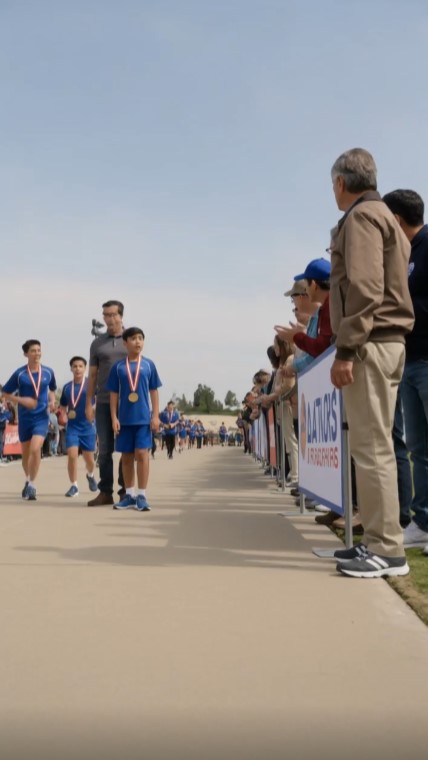
The 11-year-old had just won the biggest race of his life.
Everyone expected him to celebrate.
Instead…
He walked straight past the podium.
Past his parents.
Past the cameras.
And stopped beside an elderly man standing alone behind the crowd.
Then the boy removed his medal…
And placed it in the man’s hand.
His father rushed over.
“Lucas, what are you doing?”
The boy pointed at the elderly man’s shoes.
“These are his.”
Everyone looked down.
Old running shoes.
Worn almost completely smooth.
The elderly man looked confused.
“Son, we’ve never met.”
Lucas nodded.
“I know.”
Now even his father was confused.
“Then why are you giving him your medal?”
Lucas reached into his pocket…
And showed his father something.
His father’s face changed instantly.
“Where did you get that?”
“Grandma gave it to me.”
The elderly man saw it.
And stepped backward.
“No…”
Lucas asked:
“You recognize it?”
The man stared at him.
Then asked:
“What’s your grandmother’s name?”
Lucas answered.
“Margaret Carter.”
The old man closed his eyes.
His father whispered:
“What is happening?”
The elderly man looked at Lucas…
Then at the medal…
And said:
“I was supposed to run that race with your grandfather.”
But what he revealed next explained why he had been standing at the finish line alone.
The elderly man’s name was Thomas Miller.
He was seventy-six.
And the object Lucas was holding was a tiny brass race token.
It was scratched.
Bent near one edge.
Almost impossible to read.
But stamped across the front were the words:
RIVERSIDE JUNIOR MILE — 1972
On the back were two initials.
H.C.
Lucas’s grandfather had been Henry Carter.
He’d died six years earlier.
Lucas’s father, Daniel, stared at Thomas.
“You knew my dad?”
Thomas looked at the old token.
“Knew him?”
He laughed softly.
“Your father was my best friend.”
Daniel’s expression changed.
“My father never mentioned a Thomas Miller.”
Thomas looked down.
“I know.”
That answer immediately bothered Daniel.
“What does that mean?”
Thomas closed his fingers around the medal Lucas had given him.
“It means we didn’t exactly finish as friends.”
Lucas looked between them.
“But Grandpa kept this.”
He held up the token.
Thomas nodded.
“Apparently he did.”
The Riverside Junior Mile had been a local tradition for decades.
Children ran it.
Teenagers ran it.
Years later, an adult community race was added.
Lucas had just won the eleven-to-twelve age division.
But in 1972, Henry Carter and Thomas Miller were both eleven.
And both thought they were going to become professional runners.
Thomas laughed when he said it.
“We were terrible.”
Lucas frowned.
“I thought you said Grandpa raced.”
“Oh, he raced.”
“Was he fast?”
“No.”
Daniel laughed.
Lucas looked offended on behalf of his grandfather.
Thomas continued.
“Neither was I.”
But they trained anyway.
Every afternoon after school.
Down dirt roads.
Around the football field.
Between telephone poles.
Their running shoes weren’t really running shoes.
Their families couldn’t afford specialized equipment.
Henry wore an older pair his brother had outgrown.
Thomas wore cheap canvas shoes his mother bought from a discount store.
Then came the 1972 Riverside Junior Mile.
Henry and Thomas made a promise.
No matter what happened…
they would finish together.
Not necessarily tied.
Not necessarily last.
But neither would leave the other behind.
On race morning, Thomas waited at the starting line.
Henry never arrived.
Thomas ran anyway.
He finished near the back.
Then went looking for his friend.
Henry’s father had suffered a medical emergency that morning.
The family spent the day at the hospital.
Thomas didn’t know.
All he knew was that Henry had broken their promise.
The next week, Henry returned to school.
He tried explaining.
Thomas was still angry.
At eleven, explanations didn’t always defeat hurt feelings.
Thomas said:
“You left me.”
Henry answered:
“I didn’t have a choice.”
Thomas said something he remembered for the next sixty-five years.
“You always have a choice.”
Then he walked away.
They eventually became friends again.
Mostly.
But the race became a running joke between them.
“Still owe me a mile,” Thomas would say.
Henry would answer:
“Someday.”
Years passed.
School ended.
They got jobs.
Henry married Margaret.
Thomas married Evelyn.
Children arrived.
Running disappeared beneath work, mortgages and family responsibilities.
But every few years, Thomas would see Henry.
At a grocery store.
A football game.
A community event.
And one of them would say:
“The mile.”
“Someday.”
Daniel smiled.
“That sounds like Dad.”
Thomas nodded.
“He never forgot.”
Then why had Daniel never heard Thomas’s name?
That part came later.
When Henry was forty-two and Thomas forty-three, the Riverside event announced an anniversary race for former participants.
Thomas called Henry.
“This is it.”
Henry laughed.
“We’re too old.”
“That’s the point.”
They registered.
For the first time since 1972, Henry and Thomas were going to run the Riverside Mile together.
Thomas trained.
Henry pretended he trained.
Margaret knew better.
“She used to call me,” Thomas said.
“She’d say, ‘Can you please convince this idiot that walking to the refrigerator isn’t training?’”
Daniel laughed.
Lucas smiled.
“What happened?”
Thomas stopped smiling.
Three weeks before the race, Thomas’s wife Evelyn was diagnosed with cancer.
Everything changed.
Thomas withdrew from the race.
Henry told him:
“Don’t worry about it.”
But Thomas was devastated.
Not because of the race itself.
Because Henry had missed the first one due to a family emergency.
Now, thirty-one years later, Thomas was missing the second for the same reason.
Henry visited him at the hospital.
Thomas said:
“Looks like we’re even.”
Henry shook his head.
“There was never anything to make even.”
That was when Thomas finally understood something his eleven-year-old self hadn’t.
Sometimes people really don’t have a choice.
Sometimes showing up for the person who needs you means not showing up somewhere else.
Henry gave Thomas his race token from 1972.
The one Lucas was now holding.
“What’s this for?”
Thomas asked.
Henry said:
“So you stop pretending I owe you a mile.”
Thomas pushed it back.
Henry refused.
“Keep it until we finally run.”
But Thomas didn’t keep it.
A few months later, Evelyn’s condition improved.
Treatment worked.
Life slowly became normal again.
Thomas mailed the token back to Henry.
Inside the envelope, he wrote:
NEXT YEAR.
They never ran the race.
Not the next year.
Or the year after.
Then something happened that damaged their friendship for good.
Thomas and Henry started a small construction business together.
At first, it worked.
Then a major customer failed to pay.
The business collapsed.
Both men lost money.
Both were frightened.
And both blamed the other.
Henry believed Thomas had taken risks without telling him.
Thomas believed Henry had abandoned the business when things became difficult.
Their arguments became personal.
Old resentments returned.
Even the childhood race came back.
“You’ve been walking away from things since we were eleven,” Thomas said during their final argument.
The moment he said it, he regretted it.
Henry stared at him.
Then answered:
“And you’ve spent thirty years pretending everybody who can’t stay beside you chose to leave.”
Thomas stopped.
But pride won.
Neither apologized.
The friendship ended.
Daniel looked at Thomas.
“How long ago?”
“Twenty-six years.”
Lucas stared.
“You didn’t talk for twenty-six years?”
“No.”
“That’s stupid.”
Daniel said:
“Lucas.”
Thomas raised a hand.
“No. He’s right.”
Lucas looked at the old shoes.
“Then why are you wearing those?”
Thomas looked down.
They weren’t the same shoes he’d worn in 1972.
Of course not.
But they were old.
Very old.
Then Thomas explained.
Four months earlier, a package arrived at his house.
There was no return address.
Inside was a shoebox.
The shoes belonged to Henry.
Thomas recognized them.
Henry had bought them when they were in their fifties, during one of his brief attempts to start running again.
Thomas had once mocked them.
“Those aren’t running shoes. Those are lawn-mowing shoes.”
Henry wore them anyway.
Inside the shoebox was a letter.
Thomas pulled a folded page from his jacket.
“Your grandmother sent it.”
Lucas’s eyes widened.
“Grandma?”
“Yes.”
Margaret had found the letter among Henry’s belongings years after his death.
Henry had written it but never mailed it.
She spent months deciding whether she should.
Eventually she did.
Thomas handed it to Daniel.
The top said:
TOM
Daniel recognized his father’s handwriting immediately.
He began reading.
I’ve started this letter six times.
Every version sounds like I’m trying to prove I was right.
Maybe that’s the problem.
Daniel stopped.
Thomas nodded.
“Keep going.”
The business failed.
You made mistakes.
So did I.
Neither of us stole from the other. Neither of us wanted it to fail.
We were two scared men watching something we’d built disappear, and blaming each other felt easier than admitting we didn’t know how to save it.
Thomas looked away.
Daniel continued.
But there’s one thing I was right about.
Thomas laughed.
“Of course there is.”
The next line:
You still owe me a mile.
Lucas smiled.
Daniel kept reading.
I missed the first race.
You missed the second.
Then we both missed about twenty years because we were idiots.
If you’re reading this while we’re both alive, call me.
Thomas closed his eyes.
The final lines were harder.
If I’m gone, go to Riverside anyway.
Stand at the finish line.
Watch some kid run harder than we ever could.
Then stop keeping score.
— Henry
Nobody spoke.
Lucas looked at Thomas.
“That’s why you’re here.”
Thomas nodded.
“This is the first Riverside race I’ve attended since your grandfather died.”
Daniel looked confused.
“But Dad died six years ago.”
“I got the letter four months ago.”
“Grandma only sent it now?”
“Yes.”
Margaret had included her own note.
Thomas,
Henry kept this because he was as stubborn as you.
I’m sending it because I’m tired of both of you wasting time, even if one of you isn’t here to argue anymore.
The shoes were beside the letter. I think you know what to do with them better than I do.
Margaret
So Thomas came.
He wore Henry’s old running shoes.
Not to race.
At seventy-six, with arthritis in one knee and strict instructions from his doctor about what he should and shouldn’t do, running a competitive mile wasn’t sensible.
He came simply to stand at the finish line.
Exactly as Henry had asked.
Then he saw Lucas.
Thomas didn’t know who he was.
He didn’t know Lucas was Henry’s grandson.
He simply watched an eleven-year-old boy running.
Near the final turn, Lucas was second.
The leader was several steps ahead.
Lucas accelerated.
The crowd started shouting.
Lucas crossed the finish line first.
Thomas applauded.
And for one strange second, he thought about Henry at eleven.
The race they’d never run together.
Then Lucas walked toward him.
Thomas assumed the boy was heading for someone behind him.
Instead, Lucas stopped.
Removed his medal.
And put it in Thomas’s hand.
Why?
Because Lucas had recognized the shoes.
Margaret had shown him a photograph the previous evening.
Henry wearing those exact shoes.
She’d also given Lucas the 1972 token.
“Why did Grandma give me the token?” Lucas asked later.
Daniel called her from the race.
Margaret laughed.
“Because I knew Thomas might be there.”
“You planned this?”
“Not the medal.”
She sounded surprised when Daniel explained what Lucas had done.
Margaret had known Thomas intended to attend because they’d spoken after she mailed Henry’s letter.
She gave Lucas the old token in case they happened to meet.
But she hadn’t told Lucas exactly who Thomas was.
She wanted Thomas to decide how much of the story he was ready to tell.
Lucas had spotted the shoes first.
The token confirmed it.
Daniel looked at his son.
“You gave away the medal you just won?”
Lucas shrugged.
“I can win another.”
Thomas immediately shook his head.
“No.”
He held it toward Lucas.
“This is yours.”
Lucas refused.
“Grandpa told you to watch some kid finish.”
“I watched.”
“And he said stop keeping score.”
Thomas smiled.
“He did.”
“So stop.”
Daniel tried not to laugh.
Thomas stared at Lucas.
“You sound like Henry.”
“Is that good?”
“Usually not.”
Lucas smiled.
Then Thomas did something unexpected.
He removed one of Henry’s old running shoes.
Daniel stared.
“What are you doing?”
Thomas pulled out the insole.
Underneath was a folded strip of paper.
“I found this when Margaret sent them.”
He handed it to Daniel.
Henry had hidden a note inside the shoe.
Just six words:
IF TOM WEARS THESE, WE’RE EVEN.
Daniel laughed.
Thomas shook his head.
“Your father always needed the last word.”
Lucas pointed at the other shoe.
“Check that one.”
Thomas stared.
“I already did.”
“Check again.”
Thomas removed it.
Lifted the insole.
There was another note.
He hadn’t noticed it because it had slipped toward the toe.
Daniel unfolded it.
Three words:
JUST KIDDING. RUN.
Thomas laughed so loudly that people nearby turned around.
For the first time that day, he looked less like an old man standing alone.
He looked like the eleven-year-old boy from the story.
“I can’t run.”
Lucas pointed toward the finish line.
“You can walk.”
Thomas looked at Daniel.
Daniel smiled.
“Dad said a mile.”
Thomas shook his head.
“Your family is exhausting.”
The official races had ended.
The course was being cleared.
Daniel spoke with the organizers.
They couldn’t simply send people onto a closed course without permission.
But after hearing the situation, one organizer offered a safe alternative.
The final straightaway remained open to participants leaving the event.
About two hundred yards.
Thomas looked at it.
Then at Henry’s shoes.
“No.”
Lucas grabbed his hand.
“Come on.”
“Absolutely not.”
“You’ve been waiting fifty-four years.”
Thomas looked at him.
“That is emotional manipulation.”
“Is it working?”
Thomas laughed.
“Yes.”
So they walked.
Not a mile.
Not a race.
Just the final stretch.
Thomas wore Henry’s old shoes.
Lucas walked beside him.
Daniel followed a few steps behind.
Several people who had heard the story began clapping.
Thomas immediately looked embarrassed.
“I hate this.”
Lucas whispered:
“You’re smiling.”
“I can do both.”
Halfway down, Thomas slowed.
Lucas matched him.
“You okay?”
“My knee.”
“We can stop.”
Thomas looked at him.
That mattered.
Lucas wasn’t dragging him toward a dramatic finish.
He was giving him the choice Henry and Thomas had failed to give each other for years.
Thomas rested.
Then said:
“Let’s finish.”
They continued.
Slowly.
When they crossed the finish line, Thomas stopped.
He looked down at Henry’s shoes.
Then whispered:
“There.”
Lucas asked:
“What?”
“Now we’re even.”
Lucas shook his head.
“No.”
Thomas frowned.
“No?”
“Grandpa said stop keeping score.”
Thomas stared at him.
Then laughed.
“You really are his grandson.”
Thomas kept Lucas’s medal for exactly one week.
Then he went to Margaret’s house.
It was the first time they’d seen each other since Henry’s funeral.
Margaret opened the door.
Saw Thomas.
Then saw Henry’s shoes.
“You actually wore them.”
“Unfortunately.”
“Did they still hurt your feet?”
“Your husband bought terrible shoes.”
Margaret laughed.
Then cried.
Thomas handed her Lucas’s medal.
“This belongs to your grandson.”
Margaret shook her head.
“He gave it to you.”
“I know.”
“Then keep it.”
Thomas thought for a moment.
Instead, he suggested something else.
A month later, the medal was placed in a small shadow box.
Inside were four things.
Lucas’s medal.
Henry’s 1972 race token.
A photograph of eleven-year-old Henry and Thomas.
And one of Henry’s ridiculous old running shoes.
The second shoe stayed with Thomas.
On the bottom of the frame, Margaret placed Henry’s words:
STOP KEEPING SCORE.
Lucas kept the shadow box.
Thomas kept the shoe.
And something else changed.
He started visiting Margaret.
At first, they mostly talked about Henry.
Then about other things.
Daniel brought Lucas.
Thomas told stories Daniel had never heard.
How Henry once tried jumping a creek and landed directly in mud.
How he failed his first driving test.
How he was terrified before asking Margaret out.
How he cried when Daniel was born and then denied crying for thirty years.
Daniel realized he’d known his father as a father.
Thomas had known him as a boy.
Both versions mattered.
One afternoon, Thomas handed Daniel an old photograph.
Henry and Thomas at eleven.
Standing beside the starting line of the 1972 Riverside Junior Mile.
Thomas was wearing cheap canvas shoes.
Henry had no race clothes at all.
On the back, someone had written:
TOM + HENRY — BEFORE THE RACE
Daniel looked confused.
“Dad wasn’t there.”
Thomas smiled.
“This was taken the afternoon before.”
Then Daniel noticed something.
Both boys were holding up two fingers.
“What does that mean?”
Thomas laughed.
“We’d decided we’d finish first and second.”
“Which one of you was supposed to win?”
“Me.”
“What would Dad say?”
“That I’m lying.”
Years passed.
Lucas kept running.
He didn’t become an undefeated prodigy.
He lost races.
Won others.
Got injured once and had to sit out an entire season.
Thomas came to several events.
He never stood alone behind the crowd again.
At sixteen, Lucas ran the Riverside Mile once more.
Thomas was eighty-one.
Margaret was there.
Daniel stood beside them.
Lucas didn’t win.
He finished fourth.
He walked over afterward.
Thomas smiled.
“No medal for me this time?”
Lucas laughed.
“Nope.”
“Good.”
Then Lucas handed him something else.
A new pair of running shoes.
Thomas stared.
“What am I supposed to do with these?”
“Walk.”
“I already own shoes.”
“Those are terrible.”
Thomas looked at Daniel.
“He really is your father’s grandson.”
Thomas used them.
Slowly.
Around his neighborhood.
Then at a local track.
Not because he was training for a race.
Because moving felt good.
On the inside of one shoe, Lucas had written:
NO SCORE.
Inside the other:
JUST SHOW UP.
Thomas discovered the words weeks later.
He called Lucas.
“You wrote in brand-new shoes?”
“Yes.”
“You ruined them.”
“Are you wearing them?”
“Yes.”
“Then they’re fine.”
Thomas died at eighty-four.
After the funeral, his daughter Emily gave Lucas a small box.
Inside was Henry’s remaining old running shoe.
And Lucas’s original race medal.
Lucas stared.
“I thought the medal was in my shadow box.”
It was.
Thomas had purchased a second medal from the event organizers years earlier.
Not as a replacement.
On the back, he’d engraved:
THE RACE WE FINALLY FINISHED
Beneath it:
HENRY + TOM + LUCAS
There was also a letter.
Lucas,
When you were eleven, you gave an old stranger your medal because you recognized his shoes.
I spent years thinking your grandfather and I had missed our chance to finish something.
I was wrong.
Finishing didn’t mean recreating the race exactly.
Henry wasn’t there.
I couldn’t run anymore.
We didn’t even walk a full mile.
But you walked beside me.
Then:
Your grandfather and I wasted twenty-six years keeping score.
Who apologized last.
Who hurt whom more.
Who should call first.
Don’t do that.
The final sentence was underlined.
People are more important than winning arguments against them.
Lucas kept the letter.
Years later, when his own son began running, Lucas showed him the shadow box.
The boy pointed at the ancient shoe.
“Whose is that?”
“Your great-grandfather’s.”
“Was he a good runner?”
Lucas smiled.
“Not really.”
“What about Thomas?”
“Also not really.”
“Then why do you have all this race stuff?”
Lucas looked at the medal.
The token.
The photograph.
The old shoe.
“Because sometimes the important part of a race isn’t who gets there first.”
His son rolled his eyes.
“That sounds like something parents say when you lose.”
Lucas laughed.
“Probably.”
Then he told him the story.
Two eleven-year-old boys promised to run a mile together.
One didn’t arrive because his father had a medical emergency.
Decades later, they planned to try again.
The other couldn’t come because his wife was ill.
Eventually pride separated them longer than either emergency ever had.
Henry died before they reconciled face-to-face.
But he left a letter.
Margaret eventually mailed it.
Thomas followed Henry’s instructions.
He went to Riverside.
Stood alone at the finish line.
And watched an eleven-year-old boy run.
Thomas had no idea the boy was Henry’s grandson.
Until Lucas walked straight past the podium…
removed the biggest medal he’d ever won…
and placed it into the hand of a stranger wearing his grandfather’s old shoes.
Thomas had spent fifty-four years believing there was a race he and Henry never finished.
Lucas showed him something different.
Sometimes finishing doesn’t mean going back and doing everything exactly as planned.
Sometimes the person is gone.
The moment has passed.
The original road is closed.
All you can do is stop keeping score…
take whatever distance is still available…
and walk it together.