
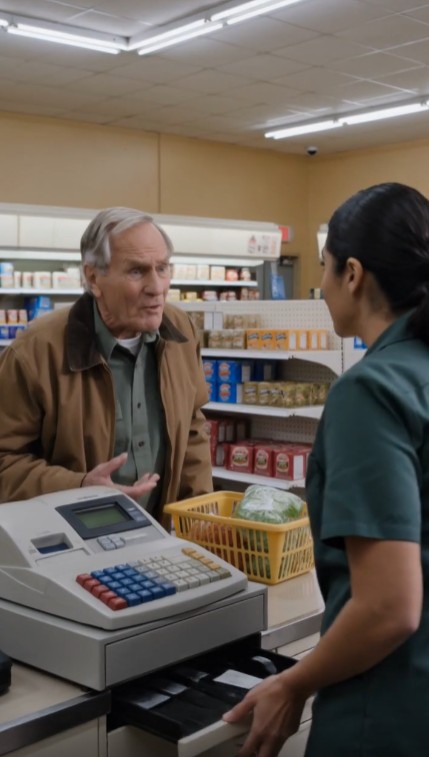
The grocery line was ten people long.
Then an elderly man reached the register.
The cashier looked at him…
And closed it.
Everyone stared.
The man quietly asked:
“Did I do something wrong?”
The cashier shook her head.
“No, sir.”
She took his groceries.
Bagged every item.
Then pushed his money back toward him.
“You don’t pay here.”
The man looked embarrassed.
“I can pay.”
“I know.”
Now the customers were watching.
The manager walked over.
“Claire, what’s going on?”
She looked at the elderly man’s face.
Then asked:
“Do you remember a little girl who came into your store every Friday after school?”
He frowned.
“I’ve known thousands of kids.”
“She never had enough money.”
The old man stopped moving.
Claire continued:
“But somehow…
her groceries always cost exactly what she had.”
His eyes widened.
“What’s your name?”
“Claire.”
The man covered his mouth.
The manager looked confused.
“You two know each other?”
Claire shook her head.
“He doesn’t know me.”
Then she pushed the groceries toward him.
“But I know exactly who he is.”
The elderly man started crying.
Claire reached beneath the counter…
And pressed one button.
Suddenly every register in the store closed.
The manager smiled.
Then employees began walking toward the front.
The old man looked around.
“What is happening?”
Claire answered:
“You’re finally going to see what happened to all those kids you quietly helped.”
And when the first person stepped out of the crowd…
he recognized her immediately.
“Maria?”
The woman was in her early forties now.
But the moment she smiled, Henry Walker saw the thirteen-year-old girl who used to enter his neighborhood grocery store carrying a handwritten shopping list.
Maria covered her mouth.
“Hi, Mr. Walker.”
Henry stared.
“You’re…”
“Older?”
She laughed.
“So are you.”
Henry began crying harder.
Maria stepped forward and hugged him.
Then Henry looked around.
“What is this?”
Claire smiled.
“Keep watching.”
Another person approached.
A tall man wearing a mechanic’s uniform.
Henry didn’t recognize him.
The man held up a small red notebook.
“Maybe this will help.”
Henry stared at it.
Then his expression changed.
“Thomas?”
The man smiled.
“You remember.”
Henry shook his head in disbelief.
Thomas had been eleven when Henry knew him.
Every Wednesday evening, he came into Walker’s Market with his younger sister.
Their mother worked late.
Thomas was responsible for buying bread, milk and whatever inexpensive dinner ingredients he could afford.
He always counted his money twice.
Henry noticed.
So did something strange.
If Thomas had $8.40…
his groceries somehow cost $8.37.
If he had $6.15…
the total became $6.12.
Henry never announced a discount.
Never called attention to it.
He simply removed a few cents here.
Marked down something there.
Sometimes he quietly paid the difference himself after the children left.
Thomas had always wondered.
Now he knew.
“You weren’t supposed to notice,” Henry whispered.
Thomas laughed.
“It took me about fifteen years.”
Another woman stepped forward.
Then another man.
Then two sisters together.
Henry recognized some immediately.
Others only after hearing their names.
Every one of them had been a child or teenager who once shopped at Walker’s Market.
And almost all of them had something in common.
Their families had gone through a difficult period.
A parent lost a job.
A mother became ill.
A father died.
A family moved into temporary housing.
A grandparent suddenly became responsible for grandchildren.
And Henry had noticed.
Not by interrogating them.
Not by making them explain their lives at the checkout.
He noticed what children notice when they’re forced to think like adults too early.
Which items disappeared from their baskets.
How carefully they counted coins.
How often they asked:
“How much is it now?”
Whether they chose food for younger siblings before themselves.
Henry had owned Walker’s Market for thirty-two years.
It wasn’t a big supermarket.
Four aisles.
Two registers.
A produce section barely larger than a living room.
But almost everybody in the neighborhood knew Henry.
Claire had been one of those children.
Her father died when she was nine.
Her mother, Rachel, worked evenings cleaning offices.
Every Friday after school, Claire walked to Walker’s Market.
Rachel gave her a short list and whatever money she could spare.
Bread.
Milk.
Eggs.
Cereal.
Sometimes soup.
Claire learned quickly that the numbers didn’t always work.
The first time she came up short, she stood at Henry’s register and began putting things back.
Henry stopped her.
“What are you doing?”
“I don’t have enough.”
“How much do you have?”
She showed him.
Henry looked at the total.
Then pressed several buttons.
“Funny.”
“What?”
“Computer made a mistake.”
Claire stared at him.
“Computers make mistakes?”
“This one does.”
The new total was three cents less than the money in Claire’s hand.
She paid.
The following Friday, it happened again.
And again.
For nearly two years.
Claire believed Walker’s Market had the least reliable register in America.
Then one afternoon, she caught Henry.
She’d turned around because she’d forgotten her backpack.
Henry was reopening the transaction.
He took several dollars from his own wallet and placed them into the register.
Claire stood behind him.
“You paid for my food.”
Henry spun around.
“No.”
“I saw you.”
“Then you saw incorrectly.”
“My teacher says you shouldn’t lie.”
Henry sighed.
“Your teacher sounds exhausting.”
Claire didn’t laugh.
“Why?”
Henry closed the register.
“Because your mother works hard.”
“How do you know?”
“I see her walking home at midnight.”
Claire looked down.
Henry continued:
“And because you’re ten years old.”
“So?”
“So ten-year-olds should worry about spelling tests and bicycles.”
He handed her backpack over.
“Not whether their little brother gets breakfast.”
Claire’s eyes filled.
Henry crouched slightly.
Then said something she never forgot.
“Listen to me.”
“There is nothing embarrassing about being short on money.”
“Understand?”
Claire nodded.
“If somebody helps you, you don’t owe them your shame.”
She wiped her face.
“Then what do I owe you?”
Henry smiled.
“Nothing.”
Claire frowned.
“That doesn’t seem fair.”
“Fine.”
Henry thought for a moment.
“Someday you’ll see somebody else counting coins.”
“When you do, don’t stare.”
“Help.”
Claire remembered every word.
Henry apparently didn’t.
Standing in the modern supermarket decades later, he shook his head.
“I said that?”
Claire laughed.
“You said a lot.”
Henry looked around.
“But why are all these people here?”
The manager, Daniel Carter, finally stepped forward.
“Because Claire told us about you.”
Henry looked at him.
Claire explained.
Six months earlier, Henry had entered the supermarket where she worked.
He hadn’t seen her.
Claire saw him.
She recognized him immediately.
The white hair was new.
The cane was new.
But the face wasn’t.
She nearly approached him.
Then stopped.
Henry was buying ordinary groceries.
He looked healthy enough.
Independent.
She didn’t want to embarrass him by turning a routine shopping trip into an emotional reunion.
So she waited.
Henry returned the following week.
Then again.
Claire finally asked Daniel if she could do something.
“What?”
“I want to find the kids from Walker’s Market.”
Daniel thought she meant two or three people.
She found thirty-seven.
Some through old neighborhood groups.
Some through school connections.
Some through former customers.
Then those people found others.
The stories began arriving.
Maria sent hers first.
Her mother had been receiving cancer treatment when Maria was thirteen.
Maria had been responsible for shopping after school.
One evening, she was nearly twelve dollars short.
Henry looked at her groceries and said:
“Tomatoes are apparently free today.”
Maria knew tomatoes didn’t cost twelve dollars.
Henry knew she knew.
Neither mentioned it.
Thomas remembered Henry placing a bag of oranges into his basket.
“We didn’t buy those.”
Henry replied:
“Store’s trying to get rid of them.”
The oranges were perfectly fresh.
Another former customer, Daniel Reed, remembered coming in at fourteen with his little brother.
They had enough for one sandwich.
Henry somehow “found” a second sandwich that had supposedly been made by mistake.
A woman named Evelyn remembered Henry keeping a box beneath the counter.
Children could take pencils, notebooks and basic school supplies from it.
He called them “manufacturer samples.”
Years later, Evelyn learned Henry bought everything himself.
Henry listened to story after story.
Then he became uncomfortable.
“Stop.”
Everyone went quiet.
“I didn’t do anything special.”
Maria shook her head.
“You don’t get to decide that for us.”
Henry looked at her.
“I ran a grocery store.”
“You noticed us.”
“Anybody would’ve.”
“No.”
Her voice became softer.
“Not everybody did.”
That silenced him.
Claire reached beneath her register again.
This time she pulled out a faded photograph.
Walker’s Market.
Henry stood outside wearing an apron.
Beside him was his wife, Margaret.
Henry touched the photograph.
“Where did you get this?”
“Your daughter.”
Henry looked up sharply.
“My daughter?”
The front doors opened.
A woman in her fifties entered.
“Hi, Dad.”
“Emily?”
Henry looked completely overwhelmed.
“You knew about this?”
Emily smiled.
“I’ve known for three months.”
Henry pointed around.
“What exactly is this?”
Claire answered.
“Your retirement party.”
Henry frowned.
“I’m already retired.”
“Not that kind.”
She turned toward Daniel.
The manager nodded.
Then Claire explained.
The supermarket had recently created a small community assistance program.
Customers could voluntarily contribute.
The store would match donations up to an established monthly amount.
Approved local community organizations would help distribute assistance discreetly.
No public humiliation.
No checkout-line interrogations.
No photographs of people receiving help.
No social-media videos.
Just practical assistance.
Henry listened.
“What does that have to do with me?”
Claire turned a small sign around.
THE WALKER FUND
Henry stared.
“No.”
Claire laughed.
“We knew you’d say that.”
“Take my name off.”
“No.”
“I mean it.”
Maria stepped forward.
“Mr. Walker.”
Henry looked at her.
“You spent thirty years helping people without putting your name on anything.”
“Exactly.”
“So this isn’t for you.”
“What?”
“It’s for us.”
She pointed toward the people gathered around him.
“So we remember what to do next.”
Henry didn’t answer.
Claire handed him a folder.
Inside were letters.
Dozens.
Each from someone who had once entered Walker’s Market as a child.
Henry opened the first.
Mr. Walker,
My mother never knew you were paying the difference.
Neither did I until years later.
But there were Fridays when the food from your store was what we had until Monday.
He opened another.
You hired me at sixteen even though I had no experience.
When I broke a jar on my first day, I thought you’d fire me.
You handed me a broom and said, “Congratulations. Now you have experience.”
Henry laughed through tears.
Another:
You let my father pay his grocery balance three weeks late without ever mentioning it in front of us.
Another:
When my shoes were falling apart, you told my mother a shoe store had accidentally delivered a pair to the grocery store.
Henry stopped.
“That one really was ridiculous.”
Everyone laughed.
Then he opened Claire’s.
It contained only four sentences.
You told me that if someone helped me, I didn’t owe them my shame.
You told me to notice the next person counting coins.
I did.
A lot of us did.
Henry looked around.
“What do you mean?”
Claire nodded toward Thomas.
Thomas explained.
Years earlier, when a young apprentice at his repair shop couldn’t afford lunch, Thomas started keeping a refrigerator stocked for employees.
No questions.
Maria became a school counselor.
Every winter she quietly organized grocery cards for families going through difficult periods.
Evelyn became a teacher.
Her classroom always had a cabinet containing school supplies, hygiene items and snacks that students could take without asking publicly.
Daniel Reed became a restaurant owner.
Once a week, his restaurant donated meals through a local community organization.
Another former Walker’s Market child became a nurse.
Another became an electrician.
Another drove a city bus.
Most weren’t wealthy.
That wasn’t the point.
They had simply repeated some version of what Henry had done.
Henry sat down.
Claire crouched beside him.
“You thought you were helping kids buy groceries.”
Henry looked at her.
“You were teaching us what to do when we grew up.”
He shook his head.
“I never planned any of that.”
“I know.”
“Then don’t make me sound like some saint.”
Claire smiled.
“Nobody said you were.”
Henry looked offended.
Everyone laughed again.
Emily stepped forward.
“Dad, should I tell them about the time you chased a customer into the parking lot because he stole a watermelon?”
Henry pointed at her.
“Absolutely not.”
“Or when you banned Uncle Robert from the store for changing the radio station?”
“He knew the rules.”
The mood changed.
Henry relaxed.
The gathering wasn’t about turning him into a perfect man.
He wasn’t one.
He had been impatient.
Stubborn.
Terrible at paperwork.
He sometimes argued with suppliers for twenty minutes over fifty cents.
His employees had stories.
So did his daughter.
But none of that changed what he’d done for children who entered his store with too little money.
Then Daniel, the manager, brought over Henry’s groceries.
“Now we have one problem.”
Henry looked at him.
“What?”
“You still haven’t paid.”
Henry reached for his wallet.
Claire pushed his hand down.
“I already told you.”
“I am not taking free groceries.”
Maria crossed her arms.
“Really?”
“Yes.”
Thomas stepped beside her.
“Interesting.”
Henry looked suspicious.
“Why?”
Thomas smiled.
“Because apparently accepting help is embarrassing now.”
Henry realized immediately what they’d done.
Claire repeated his own words.
“If somebody helps you, you don’t owe them your shame.”
Henry closed his eyes.
“You people have been waiting all day to say that.”
“Pretty much.”
He finally laughed.
“Fine.”
Claire handed him the bags.
“Thank you.”
Then Henry reached into his wallet anyway.
He removed fifty dollars.
Claire groaned.
“Henry.”
He placed it on the counter.
“For the fund.”
“No.”
“You can’t stop me.”
“Watch me.”
Daniel stepped between them.
“We can accept a voluntary donation through the proper system.”
Henry pointed at him.
“I like this one.”
Claire shook her head.
“You met him ten minutes ago.”
“He understands business.”
The registers reopened.
Customers who had been waiting were directed appropriately, and the interruption had been arranged with management rather than simply abandoning normal operations.
Some people who had witnessed the gathering asked whether they could contribute.
Daniel gave them information about the formal program.
Nobody was pressured.
Nobody was told dramatic stories about specific families without permission.
Henry insisted on that.
“If you’re going to help people,” he told Claire, “don’t turn their hard week into somebody else’s entertainment.”
Claire nodded.
That became one of the fund’s rules.
The Walker Fund grew slowly.
That was intentional.
It wasn’t supposed to become a spectacle.
Local partner organizations identified families who could use temporary grocery assistance.
The supermarket contributed.
Customers contributed if they wished.
Former Walker’s Market children contributed when they could.
Sometimes assistance meant a grocery card.
Sometimes diapers.
Sometimes school lunch support through an established program.
Sometimes it meant connecting someone to longer-term resources.
Henry attended exactly one planning meeting.
He complained for forty-five minutes.
Then gave them three good ideas.
The best was simple.
“Don’t wait until people are desperate.”
Claire wrote it down.
Henry continued.
“If somebody is counting coins today, help today.”
Years later, Claire became store manager.
Daniel moved into regional operations.
The Walker Fund continued.
Henry occasionally visited.
He still tried to pay for everything.
Claire still argued with him.
Then one winter morning, Henry didn’t arrive for his usual shopping trip.
Claire noticed.
She waited another week.
Nothing.
She called Emily.
Henry had been admitted to the hospital after developing pneumonia.
He was expected to recover.
Claire visited.
So did Maria.
Then Thomas.
Then so many former Walker’s Market children tried to visit that Emily finally said:
“Dad is eighty-seven. This is not a convention.”
Henry recovered.
When he returned home, his refrigerator was full.
He opened it.
Soup.
Milk.
Bread.
Fruit.
Prepared meals.
A note was taped to the shelf.
Apparently the store was trying to get rid of these.
Henry laughed until he started coughing.
He kept the note.
Three years later, Henry died peacefully.
At his memorial, Claire brought the red notebook Thomas had shown him at the supermarket.
It contained names.
Not of people Henry had helped.
Of people those children had later helped.
Each person added another name only with permission or used initials when privacy mattered.
By then there were hundreds.
Claire placed the notebook beside Henry’s photograph.
Emily stared at it.
“Dad never knew about all of these.”
“No.”
“Good.”
Claire smiled.
“Why good?”
“Because he would’ve become unbearable.”
They laughed.
Then Emily became serious.
“He really didn’t think he was doing anything important.”
“I know.”
“He used to tell me it was just a few dollars.”
Claire looked at the notebook.
“For him, maybe.”
For a ten-year-old girl trying to feed her little brother…
it hadn’t been just a few dollars.
It had meant she didn’t have to put the milk back.
It meant she didn’t have to explain her family’s finances to a line of strangers.
It meant an adult had noticed without making her feel small.
Years later, when Claire trained new cashiers, she told them part of Henry’s story.
Not as an instruction to secretly alter prices or personally cover customer purchases. Modern stores needed clear policies, proper accounting and formal assistance programs.
The lesson was simpler.
Pay attention.
Be respectful.
If someone appears to need help, know what legitimate options the store can offer.
And never assume a person’s difficult moment tells you everything about their life.
The old Walker’s Market building was eventually demolished.
Before it came down, Emily found one thing in the storage room.
Henry’s original register.
It hadn’t worked in decades.
Claire asked if she could keep one key from it.
Emily agreed.
Claire framed it beside Henry’s photograph.
Underneath she placed the sentence he’d once told a frightened little girl:
SOMEDAY YOU’LL SEE SOMEBODY ELSE COUNTING COINS.
DON’T STARE.
HELP.
And that was what Henry finally discovered on the afternoon Claire closed her register.
All those years, he thought the story ended when a child walked out of his store carrying groceries.
It didn’t.
Maria grew up.
Thomas grew up.
Claire grew up.
So did dozens of others.
They became teachers.
Parents.
Mechanics.
Nurses.
Managers.
Drivers.
Business owners.
And when they encountered someone having a difficult week, many of them remembered the elderly grocer who had somehow made a register total match exactly what a frightened child had in her hand.
Henry had never asked them to repay him.
So they didn’t.
They passed it forward.
And decades later, when Henry Walker stood at Claire’s register insisting he could pay for his own groceries, Claire finally got to return the lesson he’d given her as a child.
She pushed his money back.
Looked him directly in the eyes.
And said:
“I know you can pay.”
“Today, you don’t have to.”
For once…
Henry let somebody else help him.