
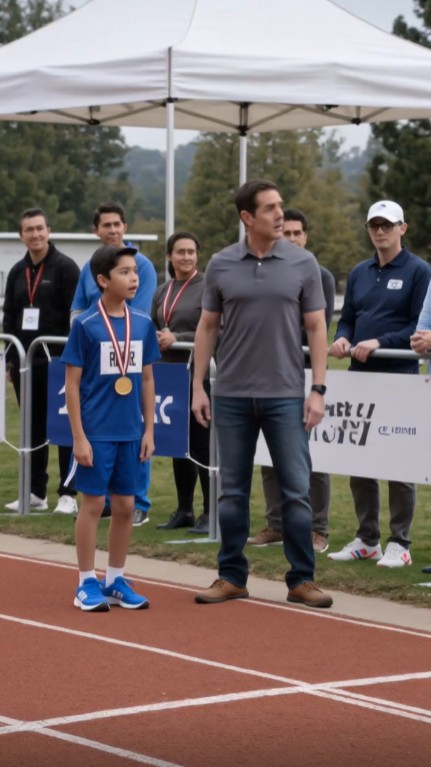
The 11-year-old had just won the biggest race of his life.
His father expected him to celebrate.
Instead…
The boy walked straight past him.
Past the other runners.
Past the cheering crowd.
And stopped in front of an elderly man he had never met.
Then he removed his medal.
His father hurried after him.
“Lucas… what are you doing?”
The boy held the medal toward the stranger.
“This belongs to you.”
The elderly man stared at him.
“No, son. That’s yours.”
Lucas shook his head.
“My grandma said you should’ve gotten one first.”
The man’s expression changed instantly.
“What did you just say?”
Lucas’s father looked confused.
“Dad… do you know this man?”
“No.”
Lucas reached into his pocket.
And pulled out a tiny old race token his grandmother had given him that morning.
The moment the elderly man saw it…
he grabbed the railing.
“Where did you get that?”
“My grandma.”
“What’s her name?”
“Margaret Carter.”
The man closed his eyes.
For several seconds…
he couldn’t speak.
Then he looked at Lucas’s father.
“Your family never told you about me?”
His father shook his head.
“Should they have?”
The elderly man looked toward the finish line.
Then at Lucas’s medal.
“I was supposed to cross that finish line with your father.”
Lucas frowned.
“My dad is standing right here.”
The old man shook his head.
“Not him.”
He looked directly at Lucas.
“Your grandfather.”
Nobody spoke.
Then Lucas asked:
“What happened?”
The elderly man turned the old token over in his hand.
His name was Thomas Miller.
And fifty-four years earlier, he and Lucas’s grandfather, Henry Carter, had stood on this same track.
They were both twelve.
Best friends.
Neighbors.
And absolutely convinced they were going to become professional runners.
Thomas smiled at the memory.
“We weren’t very good.”
Lucas looked confused.
“But Grandpa ran?”
“Everywhere.”
Thomas laughed.
“Usually because he’d forgotten something.”
Lucas’s father, Daniel, finally spoke.
“My father never told me he raced.”
Thomas looked at him.
“He stopped.”
“Why?”
Thomas looked toward the finish line.
“Because of what happened here.”
The race was called the Riverside Junior Mile.
Back then, it was one of the biggest community events of the summer.
Hundreds of people lined the course.
Every child who finished received a small brass token.
The winner received a larger medal.
Henry and Thomas had trained for months.
They weren’t trying to win.
They had one goal.
Finish together.
Thomas was faster.
Henry had more endurance.
So they made a deal.
If Thomas got ahead, he’d slow down.
If Henry got ahead, he’d wait.
“No matter what,” Thomas told Lucas, “we were crossing that line together.”
Lucas held up the old token.
“This one?”
Thomas nodded.
“That’s from the race.”
The token was tiny.
Barely larger than a coin.
On one side:
RIVERSIDE JUNIOR MILE — 1972
On the other were scratched initials.
H.C. + T.M.
Lucas stared.
“Grandpa scratched those?”
“With a nail behind his father’s garage.”
Daniel looked at Thomas.
“But if you ran the race, why did Grandma say you should’ve gotten a medal first?”
Thomas’s expression changed.
“Because I never finished.”
The morning of the race, Henry arrived late.
Thomas was already at the starting area.
“Where were you?”
Henry was breathing hard.
“My dad isn’t feeling good.”
Thomas told him to go home.
Henry refused.
“My mom’s with him.”
The starting announcement began.
Henry grabbed Thomas’s shoulder.
“We trained all summer.”
Thomas asked:
“You sure?”
Henry nodded.
They lined up.
The race began.
For the first half mile, everything went according to plan.
Thomas pulled ahead.
Then slowed.
Henry caught him.
They laughed.
Near the final turn, they could see the finish line.
Thomas remembered Henry saying:
“Ready?”
Thomas answered:
“Together.”
Then someone shouted Henry’s name from behind the barrier.
It was Margaret.
She wasn’t Henry’s wife yet.
She was a girl from school who lived three houses away.
She was waving frantically.
“Henry!”
Henry stopped running.
Thomas stopped too.
Margaret ran toward them.
“It’s your dad.”
Henry’s face changed.
His father had collapsed at home.
An ambulance had arrived.
His mother had sent Margaret to find him.
Henry turned toward Thomas.
“Go.”
Thomas shook his head.
“No.”
“Go finish.”
“We said together.”
“Tom.”
“No.”
Henry grabbed him by both shoulders.
“My dad needs me.”
“Then I’ll come.”
“Finish the race.”
Thomas looked at the finish line.
Less than two hundred yards away.
Then back at Henry.
“I’ll wait.”
Henry said:
“Don’t.”
Thomas didn’t listen.
Henry ran away with Margaret.
Thomas sat beside the track.
Other runners passed him.
Then the last runner.
Then event staff approached.
“You okay?”
Thomas nodded.
“You finishing?”
He looked toward the road where Henry had disappeared.
“No.”
Thomas never crossed the line.
Lucas stared at him.
“You stopped?”
“I was twelve.”
“Why?”
“Because I was stupid.”
Lucas frowned.
“That doesn’t sound stupid.”
Thomas smiled.
“It felt very noble for about twenty minutes.”
“What happened to Grandpa’s dad?”
“He survived.”
Henry’s father had suffered a serious medical emergency, but treatment came in time.
He lived another nine years.
Daniel exhaled.
“So Dad could have come back.”
“He did.”
“When?”
“The next morning.”
Henry found Thomas outside his house.
In his hand was the brass token.
Race organizers had given Henry one even though he’d left the course because everyone knew why he’d gone.
Henry tried to give it to Thomas.
Thomas refused.
“You didn’t finish either.”
Henry said:
“Then we’ll finish next year.”
Thomas agreed.
But next year never happened.
Thomas’s family moved.
His father lost his job.
They relocated nearly two hundred miles away.
The boys wrote letters.
At first, every week.
Then every month.
They promised to return to Riverside someday.
They even mailed the brass token back and forth.
Henry kept it for six months.
Then Thomas.
Whenever one mailed it, he added another tiny scratch to the edge.
A reminder.
Race unfinished.
Years passed.
Henry married Margaret.
Thomas married Evelyn.
They had children.
Jobs.
Mortgages.
Their lives moved in different directions.
But they stayed in contact.
Then, when they were forty-seven, Henry called Thomas.
“Riverside is bringing the race back.”
Thomas laughed.
“We’re too old.”
“Speak for yourself.”
“You have a bad knee.”
“You have a bad everything.”
They agreed to enter the community mile.
Not competitively.
They would walk if necessary.
The promise was the same.
Cross together.
Margaret found the old token in Henry’s desk.
She mailed it to Thomas with a note:
NO EXCUSES THIS TIME.
Thomas still had that note.
But two days before the race, Thomas’s wife Evelyn received a cancer diagnosis.
Everything else stopped mattering.
Thomas called Henry.
“I can’t come.”
Henry didn’t hesitate.
“Don’t.”
“I promised.”
“Tom.”
“I’ve already missed it once.”
Henry answered:
“It’s a finish line, not a wedding.”
Thomas laughed despite himself.
“Stay with Evelyn.”
Henry didn’t run either.
Instead, he mailed the token back.
On a piece of paper, he wrote:
POSTPONED AGAIN.
Evelyn underwent treatment.
For years, Thomas’s attention was where it needed to be.
Henry and Margaret visited when they could.
The two families remained connected.
Then life became complicated.
Henry and Thomas started a small construction business together.
At first, it did well.
Then came a difficult year.
A large client failed to pay.
The company nearly collapsed.
Henry believed Thomas had taken financial risks without telling him.
Thomas believed Henry had abandoned the business when it needed him most.
They argued.
Then they stopped speaking.
Daniel looked at Thomas.
“For how long?”
“Twenty-six years.”
Lucas’s eyes widened.
“You were friends your whole life and stopped talking for twenty-six years?”
Thomas looked embarrassed.
“When you say it like that, it sounds particularly stupid.”
“It is.”
Daniel touched Lucas’s shoulder.
“Lucas.”
Thomas shook his head.
“No. He’s right.”
Thomas and Henry lived less than forty miles apart for most of those twenty-six years.
Neither called.
Margaret tried.
Evelyn tried.
Their children occasionally tried.
But both men had built entire explanations for why the other should make the first move.
Then Evelyn died.
Thomas expected Henry to attend the funeral.
Henry didn’t.
That hardened Thomas even more.
What Thomas didn’t know was that Henry had been in the hospital that week after heart surgery.
Margaret sent a card.
Thomas never received it.
Another misunderstanding.
Another year lost.
Then Henry died.
Daniel’s face changed.
“My father died five years ago.”
“I know.”
“You didn’t come to his funeral.”
Thomas lowered his head.
“No.”
“Why?”
“Because I found out three days afterward.”
Daniel stared.
“How?”
“I’d moved. Margaret didn’t have my new address. Your father’s obituary was published under a funeral home I didn’t know.”
Thomas looked toward Lucas.
“By the time I found out, he was already buried.”
Daniel’s voice became harder.
“You could’ve contacted Mom.”
“I should have.”
“But you didn’t.”
“No.”
“Why?”
Thomas answered without defending himself.
“Because I was ashamed.”
That silenced Daniel.
Thomas continued.
“I’d spent twenty-six years telling myself Henry was the stubborn one.”
“Then suddenly there was no Henry left to blame.”
Thomas eventually wrote Margaret.
One sentence:
I’m sorry I waited longer than Henry had.
Margaret didn’t answer for nearly a month.
Then an envelope arrived.
Inside was the brass race token.
The same one Lucas was now holding.
There was also a letter.
Thomas remembered every word.
Tom,
Henry kept this in the top drawer beside his watch.
He was angry with you.
He missed you too.
Both things were true.
Then:
He never threw this away.
Make of that what you will.
Thomas called Margaret.
For the first time in decades, they talked.
Margaret told him something Henry had never shared.
Months before he died, Henry had written Thomas a letter.
But he’d never mailed it.
Thomas asked:
“What did it say?”
Margaret refused to read it over the phone.
Instead, she sent it.
Thomas received it four days later.
Henry’s handwriting was shaky.
Tom,
I don’t remember anymore which one of us is supposed to apologize first.
That’s probably a sign we’ve waited too long.
Thomas had to stop reading.
The next line was worse.
If you’re still angry, that’s fine.
Come be angry in person.
Then:
Riverside still runs that race every year.
We don’t have to run it.
At our age, finishing without an ambulance would be impressive enough.
Thomas laughed and cried at the same time.
The final paragraph said:
If I go before you, don’t turn this into another promise you refuse to finish because I’m not beside you.
Go to Riverside.
Stand at the finish line.
Watch some kid run harder than we ever could.
Then stop keeping score.
Thomas folded the letter.
He didn’t go to Riverside that year.
Or the next.
He still wasn’t ready.
Then Margaret called him three months ago.
“I have a grandson.”
Thomas smiled.
“I know.”
“Lucas.”
“Yes.”
“He runs.”
Thomas didn’t know that.
Margaret continued.
“He’s entering Riverside.”
Thomas became quiet.
“Which race?”
“The junior mile.”
The same race.
Same distance.
Same finish line.
Thomas almost laughed at the coincidence.
Margaret said:
“I want you there.”
“I don’t think that’s a good idea.”
“I didn’t ask whether you thought it was.”
“You haven’t changed.”
“Neither have you.”
Then Margaret told him her plan.
She would give Lucas the old brass token on race morning.
She wouldn’t tell him the entire story.
Only this:
“If you see an elderly man standing alone near the finish line wearing old gray running shoes, show him this.”
Thomas protested.
“How would he know it’s me?”
“He won’t.”
“Then what—”
“I told him your name.”
Thomas became quiet.
Then Margaret added:
“And I told him something else.”
“What?”
“That if he wins, the medal isn’t the most important thing he’ll bring across the finish line.”
Thomas had no idea what she meant.
Until Lucas won.
The boy crossed first.
Everyone cheered.
Daniel ran toward him.
But Lucas looked past his father.
Toward an elderly man standing near the railing.
Old gray running shoes.
Alone.
Lucas remembered his grandmother’s instructions.
So he walked over.
And offered Thomas the medal.
Back in the present, Thomas stared at it.
“This doesn’t belong to me.”
Lucas held it out again.
“Grandma said you should’ve gotten one first.”
Thomas smiled.
“Your grandmother has been bossing me around for sixty years.”
“Are you taking it?”
“No.”
“Why?”
“Because you finished your race.”
Lucas thought.
Then looked toward the track.
“Did you ever finish yours?”
Thomas didn’t answer.
Lucas turned toward his father.
“Can he?”
Daniel looked confused.
“Can he what?”
“Finish.”
Thomas laughed.
“I don’t think the organizers are going to restart a race from 1972.”
Lucas looked toward the final straightaway.
“You don’t need to restart it.”
Then he took Thomas’s hand.
“Just cross the line.”
Thomas stopped laughing.
“No.”
“Why?”
“Because your grandfather isn’t here.”
Lucas looked down at the token.
Then said:
“He sent this.”
Thomas’s face crumpled.
Daniel looked away.
Lucas continued.
“And Grandma sent me.”
The race director had heard enough of the conversation to understand what was happening.
No active race was on the track.
After checking that Thomas was physically comfortable walking the short distance, the organizers allowed him onto the final straightaway.
Thomas refused at first.
Then Lucas stepped beside him.
“You don’t have to run.”
Thomas looked at his old shoes.
They weren’t ordinary shoes.
Daniel finally noticed.
“My dad’s?”
Thomas nodded.
Margaret had sent them after Henry died.
Thomas had never worn them.
Until today.
Inside the left shoe, Henry had written:
IF TOM WEARS THESE, WE’RE EVEN.
Inside the right:
JUST KIDDING. RUN.
Daniel laughed through tears.
“That sounds like him.”
Thomas stepped onto the track.
The crowd gradually realized something was happening.
Nobody made a big announcement.
Nobody needed one.
Thomas walked.
Slowly.
Lucas beside him.
Daniel followed several yards behind.
Halfway down the straight, Thomas stopped.
Lucas looked up.
“You okay?”
Thomas nodded.
“I was just thinking.”
“About Grandpa?”
“Yes.”
“What?”
“That he’d complain I was going too slowly.”
Lucas smiled.
“Then walk faster.”
Thomas laughed.
They continued.
Ten yards.
Five.
Two.
Then Thomas Miller crossed the Riverside finish line.
Fifty-four years after he’d sat down beside the track and refused to cross without his best friend.
There was no official medal.
No recorded finishing time.
It wasn’t part of the competitive result.
It didn’t need to be.
Lucas removed his medal again.
Thomas shook his head.
“No.”
This time Lucas listened.
Instead, he placed the old brass token into Thomas’s hand.
“You keep this.”
Thomas immediately tried returning it.
“No. This belongs to your family.”
Lucas shook his head.
“Grandma told me if you crossed the line, I was supposed to give it to you.”
Thomas stared.
“She planned all of this?”
“Pretty much.”
Thomas laughed.
“Of course she did.”
Then Lucas pulled out a folded note.
“I forgot this.”
Thomas recognized Margaret’s handwriting.
He opened it.
Tom,
Henry couldn’t cross with you.
Lucas can.
Stop keeping score.
Thomas pressed the note against his chest.
Later that afternoon, Daniel called his mother.
“Mom.”
Margaret immediately asked:
“Did he show up?”
“You knew?”
“Of course I knew.”
“You sent my eleven-year-old son into a family situation I knew nothing about.”
Margaret became quiet.
“You’re right.”
Daniel hadn’t expected that.
“I should have told you.”
“Why didn’t you?”
“Because your father asked me not to turn his regret into your responsibility.”
Daniel sat down.
Margaret continued.
“Henry and Thomas’s argument belonged to them.”
“You didn’t need to inherit it.”
“Then why involve Lucas?”
“Because Thomas needed to see that the family wasn’t angry with him.”
Daniel looked across the field.
Thomas and Lucas were sitting together.
Thomas was showing him the tiny scratches around the token’s edge.
“Dad missed him?”
“Terribly.”
“Why didn’t he call?”
Margaret sighed.
“Same reason Thomas didn’t.”
“Pride?”
“Mostly.”
Then she added:
“Sometimes people wait so long that calling tomorrow feels easier than explaining why they didn’t call yesterday.”
Daniel said nothing.
Margaret’s voice softened.
“Your father ran out of tomorrows.”
That evening, Thomas came to Margaret’s house.
It was the first time he’d entered in twenty-six years.
Margaret opened the door.
Thomas held up the token.
“Still bossy.”
Margaret smiled.
“Still slow.”
They hugged.
Not romantically.
Not dramatically.
Just two elderly people who had both loved the same stubborn man.
Inside, Margaret had placed a box on the table.
Henry’s belongings.
Photographs.
Letters.
Race programs.
And one photograph Thomas had never seen.
Henry and Thomas at twelve.
Standing at the Riverside starting line.
Both wearing oversized white shirts.
Both grinning.
On the back Henry had written years later:
WE THOUGHT THE HARD PART WAS THE MILE.
Thomas stared at it.
“He wrote that?”
Margaret nodded.
“About a year before he died.”
Thomas turned it over again.
There was another line.
TURNS OUT THE HARD PART WAS COMING BACK.
Thomas sat silently for a long time.
After that day, he became part of the Carter family’s life again.
Not as a replacement for Henry.
Nobody wanted that.
He was simply Thomas.
The person who knew stories about Henry nobody else did.
He told Lucas how his grandfather once tried to train for a race by eating six bananas because he’d heard runners needed potassium.
He told Daniel about the time Henry hid a broken bicycle from his parents for three months.
Margaret corrected approximately half his stories.
Thomas corrected hers.
Sometimes they disagreed about events from sixty years earlier.
Lucas loved it.
A year later, Lucas entered Riverside again.
He didn’t win.
He finished fourth.
Thomas was waiting near the line.
Lucas walked over.
“No medal this year.”
Thomas shrugged.
“Good.”
“Good?”
“Now you know whether you actually like running.”
Lucas thought about it.
“I do.”
“Then fourth doesn’t matter much.”
The following year, Lucas finished second.
Then third.
Then first again at fourteen.
Every year Thomas came.
And every year he carried the brass token.
When Thomas turned eighty, Lucas gave him a small wooden box.
Inside was a new medal.
Not an official race medal.
A custom one.
Engraved:
THE RACE WE FINALLY FINISHED
Underneath:
HENRY + TOM + LUCAS
Thomas cried.
Then complained the engraving was crooked.
Lucas said:
“Grandpa would’ve complained too.”
“Exactly.”
Years later, after Thomas died, the old brass token returned to Lucas.
There was a note inside Thomas’s belongings.
Lucas,
Your grandfather and I spent twenty-six years keeping score.
Who called last.
Who apologized less.
Who was more wrong.
Who had the better excuse.
Do yourself a favor.
If you love somebody, don’t turn the relationship into a race neither of you is willing to finish first.
Then:
Keep the token.
Not because your grandfather and I failed to finish a race when we were twelve.
Because eventually, we did.
Lucas kept it.
Decades later, when his own daughter ran her first Riverside mile, Lucas stood near the finish line.
She didn’t win.
She came seventh.
But when she crossed, Lucas cheered louder than anyone.
Afterward, she noticed the tiny brass object in his hand.
“What’s that?”
“A race token.”
“Did you win it?”
“No.”
“Grandpa?”
“No.”
“Then whose is it?”
Lucas looked toward the finish line.
“Two boys who spent fifty-four years trying to finish the same race.”
She frowned.
“That doesn’t make sense.”
Lucas smiled.
“It will someday.”
The medal Lucas won at eleven eventually disappeared into a box with dozens of other childhood things.
But the brass token never did.
Because that was the real reason Margaret had secretly placed it in her grandson’s pocket on race morning.
She wasn’t trying to make Lucas give away his victory.
She wasn’t trying to force a dramatic reunion.
She wanted Thomas to know one thing before another year passed.
Henry had died angry.
Thomas had survived ashamed.
But the family wasn’t asking Thomas to repay anything.
They weren’t asking him to apologize perfectly.
They were simply leaving the finish line open.
And an eleven-year-old boy who knew almost none of the history became the one person uncomplicated enough to walk up to an elderly stranger and say:
“This belongs to you.”
Thomas didn’t keep Lucas’s medal.
He didn’t need it.
He finally received something more important.
The old brass token.
A walk across the finish line.
And the message Henry had been trying to send before he died:
Stop keeping score.