
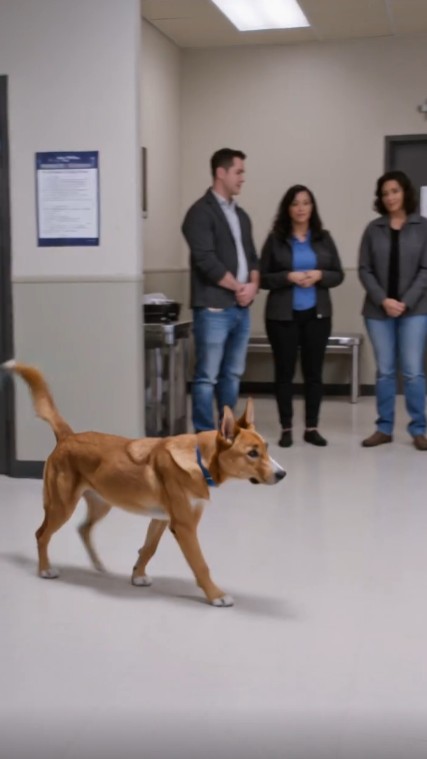
Everyone thought the rescue dog was choosing his new family.
Instead…
He walked past every adopter.
Then stopped beside an empty wheelchair.
The shelter worker stared.
“Buddy?”
The chair belonged to an elderly man who had stepped outside for a moment.
Buddy sat beside it.
And wouldn’t move.
Then the man returned.
The second Buddy saw him…
his tail started moving.
The elderly man froze.
“No…”
The shelter worker asked:
“Do you know this dog?”
The man slowly shook his head.
“I’ve never seen him before.”
Buddy gently approached.
Then placed his head against the man’s knee.
The man started crying.
Everyone was confused.
Until he reached into his coat…
and removed a tiny wooden whistle.
Buddy’s ears immediately lifted.
The shelter worker whispered:
“Where did you get that?”
“My brother made it.”
“When?”
“Almost fifteen years ago.”
She went completely still.
Then ran to the shelter records.
When she came back…
she was holding Buddy’s intake paperwork.
“Sir…”
“What?”
“There’s something you need to know about where Buddy came from.”
The man looked at the dog.
Then at the whistle.
The worker pointed to one line in the file.
And whispered:
“Your brother’s name is here.”
The elderly man’s name was Henry Wilson.
He was seventy-eight.
His younger brother was Thomas.
And Henry hadn’t seen Thomas in eleven years.
“Show me.”
Shelter worker Rachel Carter turned the paperwork toward him.
Buddy had arrived six weeks earlier.
He’d been found wandering near an abandoned farmhouse outside town.
No collar.
Thin.
Dirty.
But otherwise in surprisingly good condition for an older dog.
His microchip was still readable.
The registered owner was listed as:
THOMAS WILSON
Henry stared.
Then shook his head.
“No.”
Rachel pointed.
“Is that your brother?”
“Yes.”
Henry looked at Buddy.
“But this can’t be his dog.”
“Why?”
“My brother’s dog was named Scout.”
Rachel immediately turned to another page.
Buddy’s intake name had been given by the shelter.
He’d arrived without a collar, so staff had chosen a temporary name.
But the microchip database contained an older entry.
Rachel read it aloud.
Animal name: Scout.
Henry’s hand tightened around the wooden whistle.
“Oh, Thomas…”
Buddy—Scout—looked toward him.
Henry lifted the whistle.
He didn’t blow it.
Not yet.
Instead, he turned it over.
Two letters had been carved into the wood.
S.W.
Rachel noticed.
“Scout Wilson?”
Henry nodded.
“Thomas made this for him.”
“When?”
“Scout was a puppy.”
Rachel looked at the estimated age on the veterinary report.
Approximately fourteen to fifteen years.
It fit.
Henry’s eyes filled again.
“But how?”
Rachel crouched beside him.
“What do you mean?”
Henry looked at the dog.
“Scout disappeared eleven years ago.”
Rachel stopped.
“Eleven?”
“My brother searched for months.”
Henry’s voice became quieter.
“It nearly destroyed him.”
The adoption event continued around them, but nobody nearby was paying attention to anything else now.
Henry asked:
“Where exactly was he found?”
Rachel named the road.
Henry’s face changed again.
“That was Thomas’s property.”
“The farmhouse?”
“He owned it.”
Rachel frowned.
“The house has been vacant for years.”
“I know.”
“What happened?”
Henry looked down at the whistle.
“That depends which brother you ask.”
Henry and Thomas had grown up on a small farm.
Their father died when they were young.
Their mother, Evelyn, raised them there.
Henry was six years older.
He became the responsible one.
Or at least he thought he did.
Thomas was different.
Quieter.
More patient.
The kind of person who could spend an hour repairing something instead of buying a new one.
He made furniture.
Birdhouses.
Small wooden toys.
And whistles.
When Thomas was sixty-three, his wife Margaret died.
They had no children.
The farmhouse became unbearably quiet.
Six months later, a neighbor’s dog had puppies.
Thomas chose the smallest male.
Black-and-brown coat.
One white patch on his chest.
He named him Scout.
Henry smiled at the memory.
“Thomas talked to that dog like he was a person.”
Rachel smiled.
“A lot of people do.”
“No, I mean full conversations.”
“What did Scout think?”
“Apparently he had strong opinions about property taxes.”
Rachel laughed.
Henry did too.
For a moment.
Then his face changed.
“Scout saved him.”
Rachel looked at him.
“From what?”
“Being alone.”
Thomas started walking again.
Working outside.
Visiting neighbors.
He built Scout a bed beside his workshop.
And because Thomas disliked plastic dog whistles, he carved one from a piece of maple.
Two short blows meant come.
One long blow meant stop.
At least that was Thomas’s system.
Henry never knew whether Scout actually understood the difference or simply responded to the familiar sound.
But the dog came running whenever Thomas used it.
Then, eleven years earlier, a storm damaged part of the farm fence.
Scout disappeared.
Thomas searched everywhere.
Neighbors searched.
Henry searched.
Flyers went up.
Veterinary offices were contacted.
Shelters were checked.
Nothing.
Weeks became months.
Thomas continued leaving food near the workshop.
Henry finally told him:
“You have to stop.”
Thomas looked at him.
“Stop what?”
“Waiting.”
It was the wrong word.
Thomas became furious.
“You don’t get to tell me when to stop waiting.”
“I’m trying to help.”
“No. You’re trying to make me grieve on your schedule.”
The argument grew.
Henry said Thomas cared more about a missing dog than the brother standing in front of him.
Thomas answered:
“Scout never asked me to become somebody else just because I was hurting.”
Henry left.
They apologized later.
Partly.
But something had changed.
Then their mother Evelyn died.
The brothers disagreed over the farm.
Henry wanted to sell.
Thomas refused.
Henry believed Thomas was trapping himself inside old memories.
Thomas believed Henry wanted to erase them.
Their final argument ended with Thomas saying:
“Go live your life.”
Henry replied:
“I already am.”
He regretted the sentence before reaching his car.
But he didn’t turn around.
Thomas didn’t call.
Neither did Henry.
Eleven years passed.
Rachel asked quietly:
“You really haven’t seen him since?”
Henry shook his head.
“Not in person.”
“What about phone calls?”
“Three.”
“In eleven years?”
“Yes.”
“Letters?”
“A Christmas card some years.”
Henry looked embarrassed.
“Families can be very efficient at wasting time.”
Rachel looked at Scout.
“But Thomas’s name is still attached to the microchip.”
“Then where is Thomas?”
That was now the important question.
Rachel explained that the shelter had attempted to contact the registered owner.
The phone number was disconnected.
Mail sent to the listed address came back.
The farmhouse was vacant.
A local animal-control officer had found Scout near an outbuilding after a nearby resident reported seeing an older dog wandering along the property.
Henry immediately reached for his phone.
Thomas’s old number didn’t work.
He tried the last number he had.
Disconnected.
Then he called their cousin Daniel.
“Do you know where Thomas is?”
A pause.
“Why?”
“Just tell me.”
Daniel hesitated.
“He moved.”
“When?”
“Three years ago.”
“Where?”
“Henry…”
“Where is my brother?”
Daniel finally answered.
Thomas was living in a rehabilitation and assisted-living center two counties away.
Henry went silent.
“Why?”
“He had a stroke.”
The phone nearly slipped from Henry’s hand.
“When?”
“Three years ago.”
“And nobody told me?”
Daniel’s voice hardened.
“We thought you knew.”
“How would I know?”
“Thomas said he’d written you.”
Henry froze.
“I never got anything.”
Rachel watched his face.
Daniel continued.
“He asked me once whether you’d answered.”
“What did you tell him?”
“That I hadn’t heard from you.”
Henry closed his eyes.
Another silence.
Another misunderstanding.
Another year.
“Is he alive?”
“Yes.”
“Can he talk?”
“Some.”
“Does he know people?”
“Usually.”
Henry looked down at Scout.
The dog was still beside his wheelchair.
Then Henry lifted the wooden whistle.
“I’m going to see him.”
Rachel stopped him gently.
“Before we do anything with Scout, we need to handle this properly.”
The microchip registration strongly suggested a connection, but eleven years had passed.
Ownership history needed to be verified.
Thomas’s current circumstances needed to be confirmed.
Scout’s welfare mattered too.
Nobody was going to load an elderly dog into a car and create an emotional reunion without planning.
Henry nodded.
“What do you need?”
Over the next two days, the shelter worked through the records.
Thomas’s former veterinarian had old files.
Scout’s markings matched photographs.
The microchip number matched.
Age matched.
Dental and medical history contained several details consistent with the records.
Then they found something else.
A photograph from fifteen years earlier.
Thomas sat outside the farmhouse.
Scout was a puppy in his lap.
Around Thomas’s neck hung a wooden whistle.
The same kind Henry was holding.
Rachel called Henry.
“We’re confident.”
Henry’s voice shook.
“It’s him?”
“Yes.”
Then came the question nobody could answer.
Where had Scout been for eleven years?
There was no reliable record.
He may have been taken in by someone who never checked his chip.
He may have lived with another household.
He may have moved between people.
Nobody knew.
The shelter refused to invent an adventure.
What they knew began again only when Scout was found near Thomas’s former property.
But Henry knew one person who might have part of the answer.
A neighbor named Margaret Reed had lived near the farm for thirty years.
He called her.
The moment he said Scout’s name, she became quiet.
“You found him?”
“You know?”
“I think so.”
Margaret explained.
Years earlier, shortly after Scout disappeared, a seasonal worker living several miles away had begun caring for a dog matching his description.
The man believed the dog was abandoned.
He moved out of the area months later.
Margaret had wondered whether it might have been Scout but had never been certain.
“Why didn’t you tell Thomas?”
“I did.”
“What?”
“I told him there was a similar dog.”
“What happened?”
“By the time we tracked down where the man had lived, both were gone.”
That was as far as anyone could responsibly trace it.
Maybe Scout had lived with that person.
Maybe not.
The missing eleven years remained largely missing.
But Scout had somehow survived.
And eventually, as an old dog, he’d been found near the farm where his documented life had begun.
Henry visited Thomas first without the dog.
The assisted-living center sat beside a small lake.
Henry waited in the lobby.
His hands wouldn’t stop shaking.
Then an aide pushed Thomas into the room.
Thomas was seventy-two.
Thinner.
Gray.
One side of his body still showed effects from the stroke.
He looked at Henry.
Nothing happened.
Henry wondered if Thomas recognized him.
Then Thomas said:
“You got old.”
Henry laughed.
“So did you.”
Thomas looked at the wheelchair.
“I have an excuse.”
Henry started crying.
Thomas didn’t.
At least not immediately.
Henry sat beside him.
“I didn’t know.”
Thomas looked away.
“I wrote.”
“I never got it.”
“I thought you didn’t answer.”
“I thought you didn’t want me.”
Thomas turned back.
“That’s stupid.”
“Yes.”
“You could’ve called.”
“So could you.”
For one dangerous second, they were almost back inside the old argument.
Then Henry laughed.
Thomas did too.
“Still doing it,” Henry said.
“Doing what?”
“Keeping score.”
Thomas looked down.
“Yeah.”
Henry reached into his coat.
He placed the wooden whistle on the table.
Thomas stopped breathing.
“Where did you get that?”
“You gave it to me.”
“When?”
“After Scout disappeared.”
Thomas touched it.
“I gave you the spare.”
“You said you couldn’t look at it anymore.”
Thomas picked it up.
His fingers trembled.
“Why did you bring this?”
Henry leaned closer.
“They found Scout.”
Thomas stared.
“No.”
“They did.”
“No.”
“Tom.”
“My Scout?”
“Yes.”
Thomas shook his head.
“He’d be…”
“About fifteen.”
“No.”
Henry took out the old veterinary photograph Rachel had provided.
Thomas stared at it.
Then covered his face.
For several minutes, he couldn’t speak.
Finally:
“Where?”
“Near the farm.”
Thomas began crying.
“He went home.”
Henry didn’t correct him.
Nobody knew why Scout had been there.
Maybe the dog had some familiarity with the area.
Maybe someone had recently brought him nearby.
Maybe coincidence and wandering had done what humans wanted to call memory.
They didn’t know.
Thomas asked:
“Can I see him?”
The reunion was arranged carefully.
The center approved an outdoor visit.
The shelter transported Scout with staff.
A veterinarian had already confirmed he was fit for the short trip.
Nobody crowded around.
No cheering.
No cameras pushed into anyone’s face.
Thomas waited beneath a covered patio.
Henry sat beside him.
Rachel brought Scout around the corner on leash.
The dog stopped.
Thomas stopped breathing.
For several seconds, Scout simply looked.
Then his tail moved.
Slowly.
Thomas whispered:
“Scout.”
The dog stepped forward.
Rachel allowed him to approach at his own pace.
Scout sniffed Thomas’s shoes.
His wheelchair.
His hand.
Then Thomas reached into his pocket.
The wooden whistle.
He lifted it.
Rachel said:
“You don’t have to blow it.”
Thomas looked at her.
“I want to know.”
He gave two soft notes.
Scout’s ears lifted.
The dog moved closer.
Thomas began crying.
Scout rested his head against Thomas’s leg.
Henry turned away.
Rachel didn’t claim the whistle proved Scout remembered a training signal from fourteen years earlier.
Familiar sounds can produce responses for many reasons.
The dog’s behavior was meaningful to Thomas.
That was enough.
Thomas whispered:
“You took your time.”
Scout remained beside him.
Then Thomas looked at Henry.
“So did you.”
Henry nodded.
“Yeah.”
The next question was harder.
What happened now?
Thomas couldn’t independently care for an elderly dog.
The assisted-living center allowed scheduled animal visits but not permanent resident pets of Scout’s size.
Henry lived in an accessible ground-floor home with a fenced yard.
But he used a wheelchair after complications from a spinal condition.
He could manage many daily tasks, but caring for a senior dog would require support.
Henry said:
“He can live with me.”
Thomas immediately answered:
“Don’t do that for me.”
“I’m not.”
“You don’t even know him.”
Henry looked at Scout.
“He seems to know my chair.”
Thomas smiled.
Then Henry became serious.
“I’ve got home assistance three mornings a week.”
“My daughter lives fifteen minutes away.”
“I can pay for a dog walker.”
“And I have a fenced yard.”
Rachel interrupted.
“We still need to do the adoption properly.”
Henry nodded.
“Then do it properly.”
The shelter completed the process.
Home assessment.
Veterinary planning.
Senior-dog care discussion.
Contingency arrangements.
Henry’s daughter Emily agreed to be Scout’s backup caregiver.
Thomas remained the historical owner, but given his circumstances and the verified legal process surrounding Scout’s intake and rehoming, the family and shelter worked through the appropriate arrangements.
Two weeks later, Scout went home with Henry.
But every Sunday…
Henry drove him to see Thomas.
At first, the brothers talked mostly about Scout.
It was easier.
“His hearing’s worse.”
“So is yours.”
“He snores.”
“So do you.”
“He stole my sandwich.”
“That proves it’s Scout.”
Then gradually they talked about everything else.
Their mother.
The farm.
The argument.
The eleven lost years.
Henry finally asked:
“Why didn’t you sell the place?”
Thomas looked toward the lake.
“Because I kept thinking Scout might come back.”
Henry didn’t answer.
Thomas continued.
“Stupid, right?”
“No.”
“I waited eight years.”
Henry looked at him.
“Then what?”
“The stroke.”
After Thomas entered rehabilitation, the farm was eventually sold through arrangements made with his legal representative.
The house remained vacant while ownership issues were completed.
Thomas never returned.
Henry asked:
“Did you really think he’d come back after eight years?”
Thomas smiled.
“Not every day.”
“Some days?”
“Some days.”
Henry looked at Scout sleeping beneath the table.
“Apparently he was late.”
Thomas laughed.
The brothers never learned exactly how Scout returned to the area.
And eventually, they stopped needing an answer.
The more important fact was that he had been found.
A year passed.
Scout slowed.
His walks became shorter.
Henry installed a small ramp at his back door.
Thomas’s health improved enough that he could spend occasional afternoons at Henry’s house with assistance.
For the first time in more than a decade, the brothers sat together on a porch.
Scout slept between them.
One afternoon, Thomas asked:
“Do you remember what you said when Scout disappeared?”
Henry knew immediately.
You have to stop waiting.
“Yes.”
“I hated you for that.”
“I know.”
“You were trying to help.”
“I know.”
“You were still wrong.”
Henry laughed.
“I know.”
Thomas looked down at Scout.
“Sometimes waiting is stupid.”
Henry nodded.
“And sometimes?”
Thomas looked at his brother.
“Sometimes what you’re waiting for comes back.”
Henry didn’t answer.
Because both men knew Thomas wasn’t only talking about the dog.
Scout lived another eighteen months.
Near the end, his health declined.
Henry and Thomas made decisions with veterinary guidance, focusing on comfort rather than stretching time for themselves.
Scout died peacefully with both brothers nearby.
Thomas held the wooden whistle.
Henry held Scout’s paw.
Afterward, Henry asked:
“What do you want to do with this?”
He held up the whistle.
Thomas thought.
“Keep it.”
“Why me?”
“Because apparently you’re the one who doesn’t lose things.”
Henry laughed.
“You didn’t lose Scout.”
Thomas looked at him.
“For eleven years I thought I had.”
The shelter later asked permission to tell part of Scout’s story in its senior-dog adoption program.
Henry agreed under one condition.
“Don’t say Scout magically knew everything.”
Rachel smiled.
“Deal.”
“He was a dog.”
“A remarkable dog.”
“Yes.”
“But still a dog.”
“Yes.”
They told the story carefully.
An older dog arrived at a shelter with a microchip connected to Thomas Wilson.
During an adoption event, Scout showed unusual interest in an empty wheelchair and then in Henry, Thomas’s estranged brother.
Henry happened to carry a wooden whistle made by Thomas years earlier for Scout.
That coincidence prompted staff to look more closely at Scout’s history.
Records established the connection.
And that connection eventually reunited Scout with his original owner.
It also reunited two brothers.
Years later, after Thomas died, Henry found an envelope among his belongings.
On the front:
FOR HENRY
Inside was a photograph.
Thomas as a younger man.
Scout as a puppy.
The farmhouse behind them.
On the back, Thomas had written:
I spent years thinking this dog was the thing I lost.
Then underneath:
Turns out I lost my brother too.
I’m glad one of them found his way back.
Henry framed the photograph.
Beside it, he hung the wooden whistle.
Visitors sometimes asked about it.
Henry would tell them the story.
People always wanted to know the same thing.
“Did Scout recognize you because you looked or smelled like Thomas?”
Henry would shrug.
“Maybe.”
“Did he remember the whistle?”
“Maybe.”
“Did he deliberately return to Thomas’s old farm after eleven years?”
“I don’t know.”
Then they’d ask:
“But why did he choose your wheelchair?”
Henry would smile.
“You’re asking the wrong question.”
“What should we ask?”
He’d look at Scout’s photograph.
“How lucky was I that somebody checked the paperwork?”
Because that was where the real story began.
Not with magic.
Not with a dog somehow explaining his past.
With a shelter worker who noticed an unusual reaction…
then looked at a microchip record…
and saw one familiar surname.
WILSON.
Thomas Wilson.
The name of Henry’s brother.
The man Henry hadn’t seen in eleven years.
Scout’s story still contained mysteries nobody could solve.
Where he’d spent most of those missing years.
How he’d returned to the area near the old farm.
What he recognized when he saw Henry.
What the whistle meant to him after so long.
But Henry eventually decided unanswered questions weren’t always problems.
Sometimes the facts you had were enough.
A dog had disappeared.
A family had fractured.
Eleven years passed.
Then an old dog sat beside an empty wheelchair.
A shelter worker checked one line in a file.
And two brothers who had spent more than a decade waiting for the other one to make the first move…
finally stopped waiting.