
Everyone thought Mr. Collins was confused.
The school gym was packed with parents, teachers, and children sitting shoulder to shoulder on folding chairs. Phones were raised in the air. A row of students stood onstage in bright costumes, singing nervously under the warm lights.
It was the biggest night of the year.
The annual talent show.
And Mr. Collins, the old janitor, had just walked into the middle of it.
He was seventy-two years old, with silver hair, tired knees, and a set of keys that jingled from his belt wherever he went. Most students liked him, but many adults barely noticed him unless something spilled, broke, or needed to be unlocked.
That night, he was supposed to stay near the back hallway.
But instead, he stepped into the gym and raised one hand.
The music kept playing.
Parents kept filming.
A few children giggled.
The principal, Mrs. Howard, hurried toward him with an embarrassed smile.
“Mr. Collins,” she whispered sharply, “please sit down. We’re in the middle of a performance.”
But the janitor did not look at her.
He was staring at the lockers near the gym entrance.
One locker.
Blue paint.
Third from the end.
It moved.
Just once.
So slightly that most people would have missed it.
Mr. Collins froze.
Then he lifted one finger to his lips.
The principal frowned.
“What are you doing?”
He walked slowly toward the locker.
A few parents laughed under their breath.
Someone whispered, “Poor man probably forgot where he was.”
But Mr. Collins ignored them.
He pressed his ear against the metal door.
For one second, nothing happened.
Then his face changed.
All the color drained from it.
He turned toward the principal.
“Stop the music.”
Mrs. Howard blinked.
“What?”
“Stop the music now.”
His voice was not loud.
But something in it made the teacher at the sound table cut the track.
The children onstage stopped singing.
The gym fell into confused silence.
Then Mr. Collins knocked gently on the locker.
Once.
From inside came a tiny sound.
A weak knock back.
The laughter died instantly.
Mrs. Howard rushed over.
“What is that?”
Mr. Collins pulled out his keys with shaking hands.
The first key did not work.
Neither did the second.
The crowd began to rise from their seats.
“Everyone stay back,” the principal ordered, her voice trembling now.
Mr. Collins found the right key.
The lock clicked.
He opened the door.
Nobody laughed anymore.
Curled inside the narrow locker was a little boy.
He was maybe seven years old, wearing a wrinkled white shirt and one missing shoe. His knees were pressed tightly to his chest. His face was wet with tears. His breathing came in tiny, frightened gasps.
For a moment, the entire gym froze.
Then Mrs. Howard covered her mouth.
“Oh my God.”
Mr. Collins reached in carefully.
“It’s okay, son,” he said softly. “I’ve got you.”
The boy collapsed forward into his arms.
A nurse from the audience ran over. A teacher called 911. Parents lowered their phones, suddenly ashamed that moments earlier they had been laughing.
The boy’s name was Daniel.
He was a first grader who had come to watch his older sister perform. During the chaos before the show, he had wandered near the gym entrance looking for the restroom.
A group of older boys had dared him to climb inside the locker.
Then they shut the door.
At first, they thought it was a joke.
Then the crowd got louder.
The music started.
The gym filled with applause.
And no one heard Daniel crying.
He kicked the door until his foot hurt.
He shouted until his voice disappeared.
He tried to bang on the metal, but the songs and cheering swallowed every sound.
For nearly thirty minutes, hundreds of people walked past him.
Teachers.
Parents.
Students.
Even the principal.
Nobody noticed.
Except Mr. Collins.
The janitor had been sweeping near the hallway when he heard something strange between songs.
Not a scream.
Not a clear voice.
Just one dull bump from the locker area.
Then, when he looked closer, he saw the metal door move.
Just once.
That was enough.
Paramedics checked Daniel and said he was shaken, overheated, and badly frightened, but safe. His mother arrived from the front row in tears, pushing through the crowd as soon as she realized what had happened.
“Daniel!” she cried.
The little boy reached for her with both arms.
She held him on the gym floor and sobbed into his hair.
His older sister came down from the stage still wearing her costume, crying too.
“I thought he was with Mom,” she whispered.
Everyone had thought someone else was watching him.
That was the worst part.
The principal stood beside Mr. Collins, pale and silent.
Only minutes earlier, she had told him to sit down.
Now she could barely look him in the eyes.
“I’m sorry,” she said quietly.
Mr. Collins looked at the locker.
“Don’t apologize to me,” he said. “Just make sure no child is ever invisible in this school again.”
The words struck harder than any shouting could have.
The talent show did not continue that night.
Parents went home quietly.
The school launched an investigation.
The older boys who locked Daniel inside were identified, but the lesson reached far beyond punishment. Staff changed supervision rules. Locker areas were checked before every event. Teachers were assigned to hallways, exits, and bathrooms during large gatherings.
And Mr. Collins?
The next morning, the children made him cards.
Some wrote, Thank you for saving Daniel.
Some drew pictures of him with his broom and keys.
But one card made him cry.
It was from Daniel.
The letters were shaky, written in blue crayon.
Thank you for hearing me.
Mr. Collins kept that card in the small supply closet where he drank his coffee every morning.
Weeks later, during a school assembly, Mrs. Howard called him to the stage.
This time, nobody laughed.
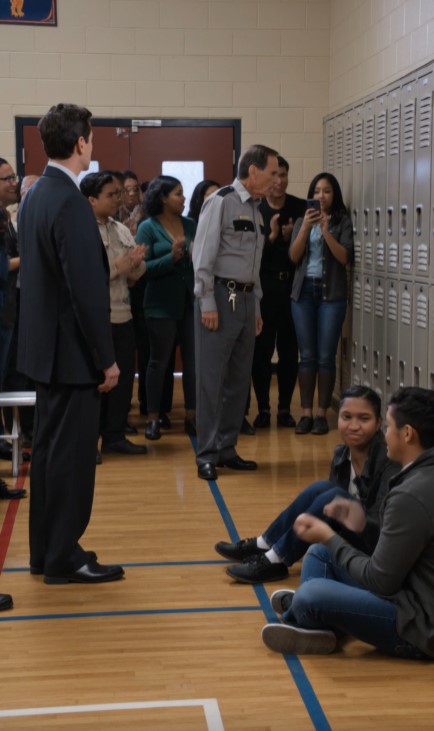
The entire gym stood and clapped.
Parents.
Teachers.
Students.
Even Daniel, sitting in the front row beside his mother, clapped with both hands and smiled shyly.
Mr. Collins looked uncomfortable under the attention.
He was used to fixing things after everyone left.
He was not used to being seen.
When the principal handed him a certificate, he shook his head.
“I didn’t do anything special,” he said.
But Daniel’s mother stood up.
“Yes, you did,” she said through tears. “You listened when everyone else was too busy.”
The gym went quiet.
Because everyone knew it was true.
That night, the old janitor had not stopped a show.
He had stopped a nightmare.
He had noticed one moving locker in a room full of music, applause, and distraction.
He had heard the child everyone else walked past.
And because he did, Daniel went home in his mother’s arms.
Sometimes heroes do not wear uniforms people respect.
Sometimes they carry mops, keys, and tired bones.
Sometimes they stand at the edge of the room while everyone else watches the stage.
And sometimes the person everyone ignores is the only one paying attention.
Mr. Collins was not confused.
He was listening.
And that made all the difference.