
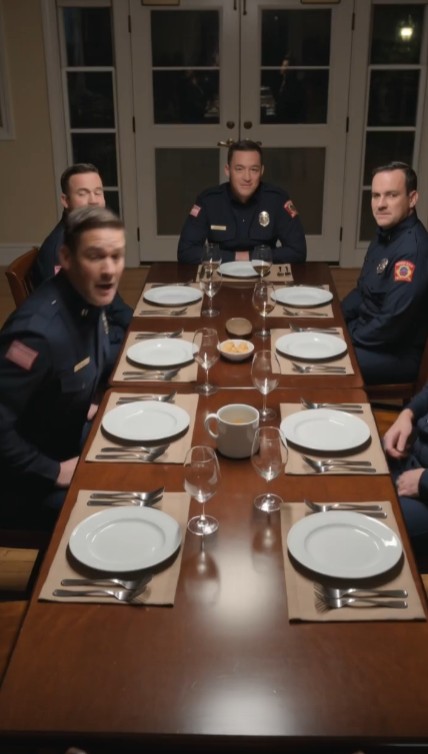
Every Friday night…
The firefighters set the table for dinner.
Eight plates.
But only seven people sat down.
The eighth chair always stayed empty.
A new firefighter finally asked:
“Who’s that seat for?”
Nobody answered.
The captain simply said:
“Leave it.”
Friday after Friday…
Same empty chair.
Same untouched plate.
Then one stormy evening…
Someone knocked on the station door.
An elderly woman stood outside.
She looked at the dinner table…
And immediately started crying.
The captain froze.
“Mrs. Miller?”
She nodded.
“I wasn’t sure any of you would remember.”
Every firefighter stood up.
The new firefighter whispered:
“Who is she?”
The captain walked toward the empty chair.
Pulled it out.
And said:
“We’ve been saving your seat.”
The woman stared at him.
“My seat?”
The captain nodded.
She looked around the room.
Then asked:
“Did he really talk about me that much?”
Nobody spoke.
The captain smiled.
“Every Friday.”
She sat down.
But before anyone touched their food…
The youngest firefighter noticed something outside.
Headlights.
One car.
Then another.
Then another.
Within seconds…
Cars were filling the parking area.
The elderly woman looked frightened.
“What’s happening?”
The captain smiled.
“They’re not here for us.”
The station door opened.
The first visitor stepped inside.
The woman recognized him instantly.
“Daniel?”
The man was nearly fifty now.
Gray beginning to show around his temples.
But the elderly woman recognized his eyes.
Daniel Carter stopped inside the doorway.
For a moment, neither moved.
Then he whispered:
“Mrs. Miller.”
The woman covered her mouth.
“Oh, my goodness.”
Daniel walked toward her.
She stood slowly.
He hugged her.
Then she pulled away and held his face between her hands.
“You were so little.”
Daniel laughed through tears.
“I was twelve.”
“You were little.”
The firefighters smiled.
Then another person entered.
A woman.
Then another man.
Then a couple with two teenagers.
The elderly woman looked around in confusion.
More people were coming through the station doors.
Some she recognized immediately.
Others had to tell her their names.
Within fifteen minutes, nearly forty people were standing inside the station.
Captain Michael Reed waited until everyone had found a place.
Then he turned toward the new firefighter.
“You wanted to know who the eighth chair was for?”
The young firefighter nodded.
Michael pointed toward the elderly woman.
“Evelyn Miller.”
Then he looked at the crowd.
“And these are the reason we still set it.”
Evelyn shook her head.
“I don’t understand.”
Michael sat beside her.
“Then we need to tell you what Thomas was doing.”
Evelyn’s expression changed at the sound of the name.
Thomas Miller had been her husband.
He had also been a firefighter at Station 14 for thirty-six years.
And for most of those years…
Friday dinner had belonged to Evelyn.
Not because she worked at the station.
She never had.
Not because she was expected to cook for the firefighters.
She wasn’t.
The tradition had begun almost by accident.
Forty-one years earlier, Thomas came home after a Friday shift and found Evelyn standing in their kitchen with enough food for twenty people.
Thomas stared.
“Who are we feeding?”
Evelyn looked at the pots.
“I miscalculated.”
“You made two pans of lasagna.”
“I know.”
“And three loaves of garlic bread.”
“I know.”
“Evelyn.”
She sighed.
“I was nervous.”
“About what?”
“Your mother is coming Sunday.”
Thomas laughed.
“So you cooked for an army on Friday?”
“Do you want dinner or not?”
Thomas took one pan of lasagna to the station.
The firefighters loved it.
The following Friday, someone jokingly asked:
“What’s Evelyn making tonight?”
Thomas told her.
Evelyn sent another meal.
Then another.
Within months, Friday dinner had become a tradition.
But the food wasn’t what made Evelyn important to Station 14.
It was what happened afterward.
Evelyn was a school secretary.
She knew families.
Teachers.
Children.
Neighbors.
And she noticed things.
One winter afternoon, she learned that the father of one of her students had been injured at work.
The family was struggling.
She mentioned it to Thomas.
Not with private details the family hadn’t agreed to share.
Just enough to ask whether the firefighters knew of community resources.
Thomas did.
The station helped connect the family to a legitimate local assistance program.
A week later, Evelyn brought an extra tray of food to the station.
Thomas looked at it.
“What’s this?”
“For the family.”
“They already got help.”
“This isn’t help.”
“What is it?”
“Lasagna.”
Thomas smiled.
“There are rules about these things.”
“Then follow the rules.”
So he did.
The meal was delivered through the appropriate community program.
No photograph.
No public announcement.
No family standing in front of a camera holding a donated box.
That mattered to Evelyn.
She always said:
“If someone is having a hard week, don’t make them perform gratitude for you.”
Michael looked toward her.
“You remember saying that?”
Evelyn nodded slowly.
“I suppose.”
Thomas remembered it too.
And over the years, it became something of an unofficial principle at Station 14.
Help when you can.
Use proper channels.
Protect people’s dignity.
Don’t turn someone’s difficult day into your moment.
Daniel Carter, the first visitor through the door that night, stepped forward.
“That’s how I met your husband.”
Evelyn looked at him.
Daniel had been twelve when his family’s apartment caught fire.
It wasn’t a large fire.
Everyone got out.
Nobody was seriously hurt.
But smoke and water damage left the apartment temporarily uninhabitable.
Daniel, his mother Rachel and his six-year-old sister Emily spent several nights in emergency accommodation.
Thomas had been one of the responding firefighters.
Daniel remembered almost nothing about the fire itself.
He remembered what happened two days later.
Thomas arrived carrying a red backpack.
Inside were school supplies.
A notebook.
Two library books.
A clean sweatshirt.
And Daniel’s science project.
“You saved that?”
Daniel had asked.
Thomas shrugged.
“It was near the door.”
The project was ruined around the edges.
But it was still readable.
Daniel had spent three weeks making it.
Thomas told him:
“Looks good to me.”
Daniel stared at the burned corner.
“No, it doesn’t.”
Thomas sat beside him.
“Then fix what you can.”
Daniel looked at him.
“And what I can’t?”
Thomas smiled.
“Leave the marks.”
Daniel never forgot that sentence.
Years later, he became a teacher.
On difficult days, he sometimes told his students a version of the same thing.
Fix what you can.
Don’t let the damaged part convince you the whole thing is ruined.
Evelyn stared at him.
“Thomas never told me that.”
Daniel smiled.
“He told us about you.”
“What did he say?”
“That the backpack was your idea.”
Evelyn frowned.
“It was?”
“You told him children needed something normal after an emergency.”
She looked down.
“I’d forgotten.”
Daniel hadn’t.
Neither had many of the people now standing inside Station 14.
A woman named Maria stepped forward.
Her mother had experienced a medical emergency when Maria was nine.
Thomas’s crew responded.
While paramedics cared for her mother, Thomas noticed Maria standing barefoot on the porch in winter.
He took off his station sweatshirt and wrapped it around her.
The sweatshirt was enormous.
It reached her knees.
Weeks later, Maria’s mother tried returning it.
Thomas told her to keep it.
Maria still had it.
She’d brought it that evening.
The old Station 14 emblem was faded almost beyond recognition.
Evelyn touched it.
“He loved that sweatshirt.”
Maria smiled.
“I know.”
“Then why didn’t he take it back?”
“Apparently you told him he owned too many.”
The room laughed.
Evelyn did too.
Then another man stepped forward.
Marcus Reed.
At sixteen, Marcus had been sleeping in his car with his father after they lost their apartment.
One cold morning, Thomas noticed the car repeatedly parked near the station.
He didn’t confront them.
He didn’t call attention to them.
He spoke privately with Marcus’s father.
Then helped connect them with a local housing organization.
Marcus looked at Evelyn.
“But that’s not why I’m here.”
“What did he do?”
Marcus smiled.
“He gave me a job.”
Evelyn frowned.
“At the fire station?”
“No. Your garage.”
Now she laughed.
“I remember you.”
Marcus nodded.
“You paid me to clean that garage every Saturday.”
“You were terrible.”
“I was sixteen.”
“You put the paint cans upside down.”
“I thought that kept them fresh.”
Evelyn laughed harder.
Thomas had asked whether Marcus could do small jobs for them until the family stabilized.
Evelyn agreed.
But she insisted on paying him.
Marcus spent six months cutting grass, cleaning the garage and helping Thomas repair the backyard fence.
Years later, Marcus became a contractor.
He eventually rebuilt that same fence for free.
Evelyn pointed at him.
“That was you?”
Marcus smiled.
“You thought Thomas arranged it.”
“He told me the lumber company made a mistake.”
“Thomas lied badly.”
“Very badly.”
Story after story followed.
Not dramatic rescues.
Not all emergencies.
Often they were small things.
A ride arranged through proper channels.
A phone call.
A meal.
A winter coat.
A connection to someone who knew how to help.
A firefighter returning the following day to check whether an elderly resident’s smoke alarm had been properly replaced.
A family receiving information about temporary housing after a fire.
A teenager being encouraged to apply for firefighter training years later.
And somewhere in many of those stories was Evelyn.
Sometimes because she cooked.
Sometimes because she knew which community organization to call.
Sometimes because Thomas came home after a difficult shift and talked to her.
Evelyn listened.
Then asked:
“What happens to them tomorrow?”
That question became famous inside Station 14.
Firefighters were trained to solve the immediate emergency.
But Thomas said Evelyn always reminded him that the people they helped still had a morning after the sirens left.
Michael looked at the new firefighter.
“That’s why the chair is here.”
The young man glanced at Evelyn.
“I thought it was for a firefighter who died.”
Michael nodded.
“In a way, it started because of one.”
Evelyn’s smile disappeared.
Thomas had died six years earlier.
Not in a fire.
Not during a dramatic rescue.
He had retired at sixty-five.
Three years later, he developed cancer.
He died at home with Evelyn beside him.
The week after his funeral, Station 14 prepared Friday dinner.
Seven firefighters sat at the table.
One chair remained empty.
Thomas’s chair.
Michael had been a young lieutenant then.
He told everyone:
“Leave it tonight.”
So they did.
The following Friday, somebody automatically left the same chair empty.
Then the next.
Eventually Michael realized they weren’t leaving it for Thomas anymore.
Because Thomas had always complained about that particular chair.
It wobbled.
He hated it.
What they remembered was something Thomas had said shortly before retiring.
He’d been standing beside the Friday table.
Evelyn wasn’t there.
She rarely ate at the station herself.
Thomas looked at the firefighters and said:
“If my wife ever comes through that door, somebody better give her my seat.”
One firefighter joked:
“Why?”
Thomas answered:
“Because half the good I’ve done started with her asking me what happened after we left.”
So after Thomas died, Michael changed the tradition.
The empty chair wasn’t Thomas’s memorial.
It was Evelyn’s seat.
A reminder that the work surrounding emergencies often involved people outside the station too.
Family members.
Dispatchers.
Teachers.
Neighbors.
Community organizations.
Volunteers.
People whose names never appeared on reports.
Michael had tried inviting Evelyn several times.
Letters were returned.
Her old phone number stopped working.
She had moved after Thomas died.
Nobody at the station knew where.
Then, three months earlier, Michael finally found her through Daniel.
He wrote one letter.
Mrs. Miller,
We still eat together on Fridays.
There’s a chair here if you ever want it.
Evelyn had read the letter dozens of times.
But she couldn’t make herself go.
The station contained too much Thomas.
His old locker number.
His photograph.
The sound of the alarm.
The kitchen where he’d spent hundreds of Friday nights.
Then that stormy Friday, she finally got into her car.
She almost turned around twice.
When she reached the station, she sat outside for fifteen minutes.
Then knocked.
What Evelyn didn’t know was that Michael had contacted several people Thomas had helped over the years.
He didn’t tell them to come.
He simply said:
If Mrs. Miller ever accepts the Friday invitation, I’ll let you know.
That afternoon, when Evelyn called to say she might come, Michael sent one message.
That explained the cars.
Daniel.
Maria.
Marcus.
And dozens of others.
They weren’t there because Thomas had performed one legendary rescue.
They were there because he’d spent decades doing small things after the emergency was technically over.
And because Thomas had always said he learned that from Evelyn.
Evelyn looked around the station.
“He made me sound much better than I was.”
Michael smiled.
“He also said you burned meatloaf.”
She pointed at him.
“Now that sounds like Thomas.”
Everyone laughed.
Then Lily Carter entered.
She was twenty-six.
Daniel’s daughter.
She carried a cardboard box.
Evelyn recognized Daniel, but not Lily.
Daniel introduced them.
“My daughter.”
Lily smiled.
“My dad has told me about Mr. Miller my entire life.”
Evelyn looked at the box.
“What’s that?”
“Something we thought you should have.”
Inside were letters.
Copies of thank-you notes sent to Station 14 over decades.
Photographs people had voluntarily contributed.
Old newspaper clippings.
Cards.
A child’s drawing of a fire truck.
A school photograph of Daniel holding the repaired science project.
And an old recipe card.
Evelyn recognized her own handwriting immediately.
FRIDAY LASAGNA
She laughed.
“Where did you find this?”
Michael raised his hand.
“Thomas’s locker.”
“He kept my recipe in his locker?”
“For thirty years.”
“Why?”
“He claimed nobody here could be trusted to remember the amount of garlic.”
Evelyn smiled.
“He was right.”
Then she turned the card over.
Something was written on the back.
Thomas’s handwriting.
Evelyn read it silently.
Then started crying.
Michael hadn’t known what it said.
Neither had anyone else.
Evelyn read it aloud.
IF SOMEBODY ASKS WHY WE DO FRIDAY DINNER, TELL THEM IT’S BECAUSE EVELYN SAYS PEOPLE SHOULDN’T EAT ALONE AFTER A BAD WEEK.
Underneath, Thomas had added:
SHE THINKS I DON’T LISTEN.
Evelyn pressed the card against her chest.
“He listened.”
Michael smiled.
“Apparently.”
For the first time that evening, everyone finally ate.
Evelyn sat in the eighth chair.
Someone put lasagna in front of her.
She took one bite.
Then frowned.
“Who made this?”
The youngest firefighter raised his hand cautiously.
“I did.”
“You need more garlic.”
The room exploded with laughter.
The following Friday, Evelyn came back.
This time there were no dozens of visitors.
Just the firefighters.
Eight plates.
Eight people.
Evelyn brought dessert.
The Friday after that, she returned again.
Then she missed two weeks.
Michael worried.
She called him.
“I have a life, Captain.”
“Yes, ma’am.”
“You don’t need to check on me every Friday.”
“Yes, ma’am.”
“And stop calling me ma’am.”
“Yes, Mrs. Miller.”
She hung up on him.
Then returned the following week.
Over time, Evelyn became part of Station 14 again.
Not as a mascot.
Not as somebody they expected to feed them.
The firefighters cooked.
Sometimes badly.
She simply ate with them.
She learned the names of new recruits.
She asked about their families.
When someone had a difficult call, she didn’t demand details.
She simply asked:
“You okay?”
Sometimes they said yes.
Sometimes they didn’t.
When Evelyn turned eighty, the station held a small birthday dinner.
Daniel came.
Maria came.
Marcus came.
But Evelyn insisted:
“No parade of people this time.”
Michael promised.
There were only twenty-three.
Evelyn called him a liar.
Years later, a new recruit asked about the eighth chair.
By then, the tradition had changed.
The chair was no longer always empty.
Sometimes Evelyn occupied it.
Sometimes a retired firefighter.
Sometimes a dispatcher.
Sometimes a community volunteer.
Sometimes someone whose family had recently experienced an emergency and who had been invited through appropriate support channels.
But the eighth plate remained part of Friday dinner.
Not as a promise that firefighters could solve every problem after an emergency.
They couldn’t.
It represented something more realistic.
Remember the person after the call.
Know what legitimate resources exist.
Treat people with dignity.
And understand that the end of an emergency response is often only the beginning of somebody else’s recovery.
Evelyn lived another seven years after that first stormy Friday.
When she died at eighty-seven, Station 14 held Friday dinner as usual.
Eight plates.
Seven firefighters.
One empty chair.
The youngest firefighter from that first night was now a lieutenant.
He asked Michael:
“Do we leave it empty?”
Michael looked at Evelyn’s chair.
Then at the recipe card framed on the wall.
“No.”
Everyone looked at him.
Michael pulled out the chair.
“Evelyn hated people eating alone.”
So they invited the station’s retired dispatcher, Rachel Harris, who had recently lost her husband.
She sat in the eighth chair.
Dinner continued.
Years later, Daniel visited Station 14 with his grandson.
The boy noticed the framed recipe.
He read the sentence on the back.
Then asked:
“Who was Evelyn?”
Daniel looked toward the table.
“The woman who asked what happened tomorrow.”
“What does that mean?”
Daniel thought about it.
“Firefighters came when my family’s apartment caught fire.”
“Did they save you?”
“We were already outside.”
“So what did they do?”
“They helped us through what came afterward.”
“Because of Evelyn?”
“Partly.”
The boy looked confused.
“But she wasn’t a firefighter.”
Daniel smiled.
“Exactly.”
That was the part Thomas had understood.
A uniform wasn’t required to matter.
Neither was a dramatic rescue.
Sometimes a person’s contribution was asking a question nobody else remembered to ask.
What happens after everyone goes home?
The tradition at Station 14 continued long after everyone who knew Thomas personally had retired.
The story changed slightly depending on who told it.
But the important details remained.
Every Friday, eight places were set.
For years, only seven firefighters sat down.
The eighth chair remained empty.
New recruits assumed it honored a firefighter who had died.
But that wasn’t quite right.
It had been saved for the firefighter’s wife.
A school secretary who cooked too much lasagna one Friday…
who believed people shouldn’t have to publicly prove they deserved kindness…
and who kept asking her husband about the families left behind after the sirens stopped.
Thomas carried those questions into his work.
Other firefighters carried them after him.
And dozens of people carried the effects into their own lives.
That’s why, when Evelyn finally appeared at Station 14 on a stormy Friday night, the captain didn’t tell her Thomas’s chair had been waiting.
He pulled out the eighth chair.
Looked at the woman Thomas had talked about for decades.
And said:
“We’ve been saving your seat.”
Evelyn thought that was the surprise.
It wasn’t.
The real surprise arrived minutes later.
Headlights filled the parking area.
Cars lined the street.
And one by one, people Thomas and Evelyn had quietly helped over more than thirty years walked through the station doors.
Not to thank a hero.
Not to repay a debt.
But to show Evelyn something Thomas had never been able to explain while he was alive.
Every small kindness they’d thought disappeared into an ordinary Friday…
had gone somewhere.
Daniel became a teacher.
Maria became a nurse.
Marcus built a business and later hired people who needed a second chance.
Others raised families, volunteered, coached children, helped neighbors and carried forward their own versions of the same lesson.
Thomas had always believed the emergency mattered.
Evelyn had taught him something else mattered too.
Tomorrow.
And that was why the eighth chair never really belonged to one person.
It belonged to whoever reminded them that after the trucks returned…
after the equipment was cleaned…
after the report was filed…
someone out there was still living through what happened.
And sometimes the most important thing anyone could do was remember them after everyone else had gone home.