
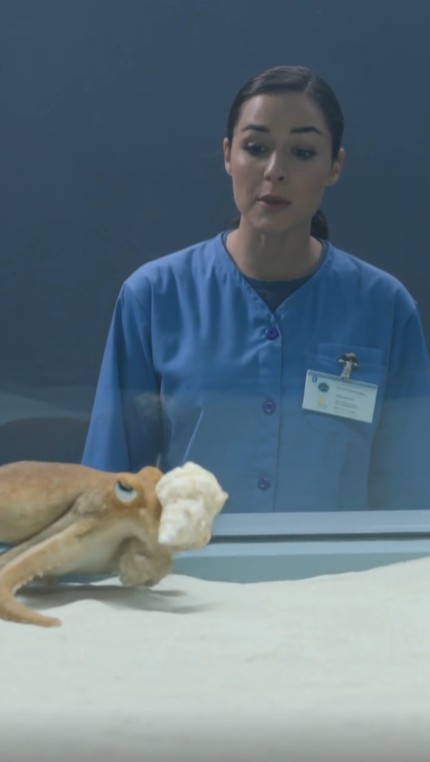
Every morning…
the aquarium staff cleaned the same viewing window.
And every morning…
Oliver the octopus did something bizarre.
He covered one corner with shells.
The keeper moved them.
Oliver put them back.
Day after day.
Same corner.
Same shells.
Then one morning…
Oliver stopped.
Instead…
he pressed himself safely near the glass…
and stared through it.
The keeper followed his gaze.
Nothing.
Just an empty public corridor.
Then an adult visitor appeared.
Oliver immediately changed behavior.
He moved toward the exact corner he’d been covering.
The visitor stopped walking.
“Wait…”
The keeper looked at him.
“You’ve seen him before?”
The man stepped closer to the public viewing area.
“No.”
Then he noticed the shells.
His expression changed.
“Where did he get those?”
The keeper frowned.
“They’re enrichment shells from his habitat.”
The man shook his head.
“No…”
He pointed toward their unusual arrangement.
“I’m talking about that pattern.”
The keeper looked again.
Five shells.
Three together.
Two apart.
The man took out his phone…
but instead of taking a picture…
he showed the keeper an old digital record.
The keeper compared them.
Same pattern.
She looked at him.
“What am I looking at?”
The man answered:
“Something we documented before this aquarium even existed.”
Then Oliver moved one shell.
The visitor’s face went pale with surprise.
“He remembers that too?”
The keeper turned toward him.
“Remembers what?”
The visitor’s name was Thomas Reed.
And what he told keeper Rachel Carter over the next several minutes sent her directly to the aquarium’s animal-care director.
But Thomas began with an important correction.
“I shouldn’t have said he remembers.”
Rachel frowned.
“You just did.”
“I know. I got excited.”
He looked through the glass again.
“We need to verify what animal this is before I claim anything.”
That answer surprised Rachel.
Most visitors who saw unusual animal behavior immediately had an explanation.
Thomas seemed determined not to invent one.
“Then what is the record?” she asked.
Thomas enlarged the image on his phone.
It was dated eleven years earlier.
The photograph showed a large tank at what appeared to be a marine research facility.
Inside were five pale shells.
Three positioned close together.
Two separated by several inches.
Beside the photograph was a typed observation:
Session 48 — Object arrangement repeated after reset.
Underneath were several numbers and the identification:
OCT-17
Rachel looked from the phone to Oliver.
“Where was this?”
“North Coast Marine Research Center.”
Rachel knew the name.
The facility had closed years earlier.
Its animal rehabilitation and behavioral research programs had been transferred to several institutions.
“What did the pattern mean?”
Thomas hesitated.
“We never proved it meant anything.”
“But you recorded it.”
“Because he kept doing it.”
Rachel pointed toward Oliver.
“And you’re saying an octopus there arranged shells exactly like this?”
“Yes.”
“Eleven years ago?”
“Yes.”
“Was his name Oliver?”
Thomas shook his head.
“We didn’t use names in the research records. He was OCT-17.”
Rachel immediately contacted the animal-care director, Dr. Emily Wilson.
Emily arrived expecting a routine visitor question.
Then she saw Thomas’s photograph.
Her expression changed.
“Can you send me that record?”
“If you give me an official email address.”
Within minutes, the image was on Emily’s computer.
She pulled up Oliver’s acquisition records.
Oliver had arrived at the aquarium seven months earlier through a transfer from another accredited facility.
That facility had received him from a coastal rehabilitation program.
The paperwork included several older identification numbers.
Emily scrolled.
Then stopped.
Previous institutional ID: NC-17
Thomas leaned toward the screen.
“Can you open the original transfer file?”
Emily did.
More records appeared.
A faded scanned page from North Coast Marine Research Center.
Near the bottom:
Behavioral observation designation: OCT-17
Nobody spoke.
Rachel looked toward the habitat.
“That’s him?”
Emily didn’t answer immediately.
She checked physical descriptions.
Species.
Sex.
Approximate age at the time.
Distinctive markings documented in photographs.
Transfer dates.
Institutional records.
Everything aligned.
Finally, Emily said:
“It appears Oliver is the same animal documented as OCT-17.”
Thomas sat down.
For several seconds, he simply stared through the office window toward the public gallery.
“I thought he was dead.”
Rachel looked at him.
“Why?”
“Because I lost track of where he went.”
Thomas had been twenty-six when he began working at North Coast.
He wasn’t the lead scientist.
He was a behavioral research assistant.
His job involved preparing enrichment materials, recording observations and maintaining detailed logs.
OCT-17 arrived after being collected under the facility’s authorized program.
Thomas remembered him because he was unusually persistent with objects.
Plastic puzzle containers.
Rocks.
Shells.
Lids.
Anything that could be manipulated.
One of the enrichment exercises involved five large shells.
The shells weren’t intended to teach numbers.
They weren’t intended to create a language.
Researchers simply placed objects in different locations and documented what the octopus did with them.
Most sessions were unremarkable.
OCT-17 moved the shells.
Turned them over.
Carried them.
Stacked one against another.
Then, during one session, Thomas noticed something.
Three shells ended up near the left side of the observation window.
Two remained farther away.
Thomas reset them.
The octopus moved them again.
Three together.
Two apart.
Thomas reset them again.
Same general arrangement.
He told the supervising researcher, Dr. Henry Miller.
Henry’s response was immediate.
“Record it.”
“What do you think it means?”
“I don’t.”
“You don’t think it’s strange?”
Henry smiled.
“Strange is why we record it. Meaning comes later, if the evidence supports it.”
So Thomas documented it.
Session 31.
Session 32.
Session 33.
The arrangement didn’t appear every time.
Sometimes OCT-17 ignored the shells completely.
Sometimes he moved only one.
But often enough, the three-and-two grouping reappeared.
Then Thomas noticed a second behavior.
After arranging the shells, OCT-17 occasionally moved one of the separated shells toward the group when Thomas approached the observation window.
Thomas jokingly called it “the sixth move,” even though there were only five shells.
Henry immediately told him not to put that phrase in the formal records.
“Why?”
“Because you’ll start seeing a story instead of behavior.”
Thomas never forgot that.
So the official notes remained deliberately boring.
Subject relocated shell following observer approach.
No claim of greeting.
No claim of recognition.
No claim of communication.
Just what they could observe.
But Thomas privately became fascinated.
He spent hundreds of hours around OCT-17 during his three years at North Coast.
Never touching him unnecessarily.
Never treating him like a pet.
Just preparing enrichment, maintaining equipment and recording behavior.
Then the research program ended.
Funding changed.
The facility began closing sections.
Animals were transferred.
Thomas accepted another job across the country.
He asked where OCT-17 was going.
He was told the animal would be transferred to another authorized facility.
Thomas assumed he’d be able to follow the records later.
But institutions merged.
Names changed.
Databases changed.
Thomas changed jobs again.
The trail disappeared.
For years, he occasionally searched old professional databases.
Nothing.
Eventually, he stopped.
Now, eleven years later, he had walked into an aquarium during a business trip.
He hadn’t come looking for OCT-17.
He hadn’t even known an octopus named Oliver lived there.
He’d simply had three free hours before his flight.
Then he’d turned a corner…
and seen five shells.
Three together.
Two apart.
Rachel listened quietly.
Then asked:
“What about the shell he moved when he saw you?”
Thomas looked through the glass.
“That happened at North Coast.”
“With you?”
“Sometimes.”
“Only with you?”
Thomas shook his head.
“That’s exactly the problem.”
Rachel waited.
“I don’t remember.”
Thomas had thousands of old notes stored on an external drive at home.
The photograph on his phone existed only because he’d shown it during a university lecture several years earlier.
He couldn’t responsibly claim the shell movement had been unique to him.
Emily agreed.
“We shouldn’t interpret this as proof that Oliver recognized Thomas.”
Thomas nodded.
“Exactly.”
Rachel looked at Oliver.
“But something changed when Thomas arrived.”
“Something observable changed,” Emily said. “Why it changed is another question.”
Thomas smiled.
“You would’ve gotten along with Henry.”
“Your supervisor?”
“He ruined every good story with evidence.”
Emily smiled.
“Sounds useful.”
Thomas’s flight was that afternoon.
Before leaving, he asked one question.
“Can I come back?”
Emily nodded.
“As a normal visitor, absolutely. If we’re going to conduct any structured observations, that needs to go through our animal-care and research procedures.”
Thomas understood.
He returned home that evening.
Then spent almost the entire night searching old files.
At 2:17 AM, he found a folder labeled:
NC OCT-17 ARCHIVE
Inside were 486 documents.
Observation logs.
Photographs.
Videos.
Transfer paperwork.
And a spreadsheet Thomas had forgotten existed.
He searched one word.
shell
Seventy-three results.
Then he searched:
observer approach
Nine results.
Thomas read every one.
At 3:46 AM…
he found it.
Session 61.
Five shells arranged.
Three near observation panel.
Two separated.
Observer TR entered viewing area.
Subject remained stationary for 14 seconds.
Subject relocated one separated shell toward cluster.
Thomas stared.
TR.
Thomas Reed.
He opened Session 64.
Same note.
Session 70.
Again.
Then he found something even more important.
Session 72.
Different observer.
OCT-17 also moved a shell.
Session 81.
Another staff member.
Another movement.
So Thomas’s memory had been incomplete.
The behavior wasn’t exclusive to him.
That mattered.
He emailed the records to Emily with a short message:
I found the old logs. Please don’t tell anyone he moved the shell only for me. He didn’t. Attached are the relevant sessions.
Emily replied the following morning:
Thank you. This is exactly what we needed.
The aquarium began reviewing Oliver’s history.
What they discovered was more interesting than the dramatic version.
And much more complicated.
The five-shell arrangement had appeared repeatedly at North Coast.
Then it vanished from the records after Thomas left.
But that didn’t necessarily mean Oliver stopped doing it.
Later facilities hadn’t used the same five shells.
Their enrichment objects were different.
No one had been looking for the pattern.
Seven months before Thomas’s visit, Oliver arrived at his current aquarium.
Rachel had introduced several large shells as part of a rotating enrichment program.
Within days…
Oliver began moving them.
Three together.
Two apart.
But there was another detail.
The corner he repeatedly covered with shells wasn’t random.
Emily compared photographs from North Coast with Oliver’s current habitat.
At North Coast, Thomas usually stood outside the left side of the primary observation panel.
The shell grouping often appeared near that location.
In the new aquarium, the public viewing window was shaped differently.
But the corner Oliver chose was the area where staff most often paused during morning checks.
Rachel stared at the comparison.
“So he’s putting them where people stand?”
“Possibly,” Emily said.
“Why?”
“We don’t know.”
“Could it be because he associates shells with people?”
“Possibly.”
“Could he remember Thomas?”
“Possibly.”
Rachel laughed.
“You really enjoy that word.”
“It’s better than pretending certainty.”
They decided to perform structured observations within the aquarium’s approved animal-care program.
No theatrical reunion.
No forcing Oliver to interact.
No repeatedly manipulating him for a viral video.
They simply documented what he already did.
Shell locations.
Time.
Staff present.
Visitor activity.
Feeding schedule.
Lighting.
Enrichment schedule.
Oliver’s position.
For several weeks, the pattern appeared inconsistently.
Sometimes three and two.
Sometimes four and one.
Sometimes Oliver buried everything.
Sometimes he carried a shell into his den and ignored everyone for hours.
That was important too.
The original story was already becoming less magical.
But then Thomas returned.
This time, the aquarium knew exactly when he would arrive.
He didn’t enter the public gallery immediately.
Staff first recorded Oliver’s baseline behavior.
Five shells were distributed naturally throughout the habitat as part of his regular enrichment.
Nobody arranged them.
Nobody directed Oliver toward them.
For almost an hour, he ignored the shells.
Thomas then entered the public viewing area.
He stood where any visitor could stand.
Oliver remained in his den.
Five minutes passed.
Nothing.
Thomas smiled.
“There goes the reunion movie.”
Rachel laughed.
“Apparently.”
Then Oliver emerged.
He moved across the habitat.
Paused.
Changed direction.
And approached the viewing window.
Thomas didn’t move.
Oliver remained there for almost a minute.
Then he collected one shell.
Placed it near the corner.
A second.
Then a third.
Rachel stopped writing.
Thomas whispered:
“Keep recording.”
Fourth shell.
Separated.
Fifth shell.
Separated.
Three together.
Two apart.
Nobody spoke.
Then Oliver moved one of the separated shells toward the group.
Thomas closed his eyes.
Rachel continued recording.
After several seconds, Oliver moved away.
That was it.
No dramatic embrace.
No magical message.
No proof that an octopus had recognized a specific human after eleven years.
But it was enough to justify deeper examination.
Emily later reviewed the footage.
“The behavior is striking.”
Thomas nodded.
“But?”
“But we still can’t say what caused it.”
Thomas smiled.
“There it is.”
“What?”
“The Henry Miller sentence.”
Emily laughed.
The aquarium contacted Dr. Henry Miller.
Thomas wasn’t even sure Henry was alive.
He was.
Eighty-one years old.
Retired.
Living near the coast.
When Thomas called, Henry answered:
“Who is this?”
“Thomas Reed.”
Silence.
Then:
“The shell kid.”
Thomas laughed.
“You remember me?”
“I remember you asking me every week what the shells meant.”
Thomas explained everything.
When he finished, Henry was silent for a long time.
Finally:
“OCT-17 is alive?”
“Yes.”
“And still rearranging those ridiculous shells?”
“Yes.”
Henry laughed so loudly Thomas had to move the phone away from his ear.
A month later, Henry visited the aquarium.
He walked with a cane now.
Thomas met him at the entrance.
They hadn’t seen each other in more than a decade.
Henry hugged him.
Then immediately said:
“Don’t make this sentimental.”
Thomas laughed.
“You flew four hours to see an octopus.”
“I flew four hours to correct your methodology.”
“Of course.”
Rachel escorted them to the viewing area.
Oliver was hidden.
Henry waited.
Ten minutes.
Twenty.
Nothing.
Then Henry sat on a bench.
“Good.”
Rachel looked confused.
“Good?”
“He doesn’t owe us a performance.”
Eventually Oliver emerged.
Henry leaned forward.
He didn’t call.
Didn’t tap the glass.
Didn’t attempt to attract attention.
Oliver moved through the habitat.
Touched one shell.
Ignored it.
Then changed color as he crossed the substrate.
Henry smiled.
“There you are.”
Thomas looked at him.
“You think he recognizes you?”
Henry shook his head.
“I think I’m looking at the same animal I spent several years studying.”
That distinction mattered to him.
Then Oliver collected a shell.
Henry’s smile disappeared.
A second.
Third.
Three together.
Two remained elsewhere.
Thomas whispered:
“Here we go.”
Oliver moved the fourth.
Then the fifth.
Three and two.
Henry watched.
Oliver paused.
Then moved one shell from the separated pair toward the group.
Henry sat completely still.
Rachel looked at him.
“You’ve seen that?”
“Many times.”
“What did it mean?”
Henry smiled.
“You’re going to hate my answer.”
“We don’t know.”
“Exactly.”
But Henry had brought something.
Not shells.
A hard drive.
On it were archived videos the aquarium hadn’t received in Oliver’s original transfer paperwork.
That evening, Thomas, Rachel, Emily and Henry watched footage recorded more than a decade earlier.
There was OCT-17.
Smaller.
Younger.
Five shells scattered across the habitat.
Thomas appeared in the background.
Twenty-six years old.
More hair.
Henry pointed.
“Terrible haircut.”
Thomas sighed.
“Can we focus?”
On screen, OCT-17 gathered three shells.
Two remained separated.
Young Thomas approached.
The octopus moved one.
Thomas’s voice could be heard.
“See? He did it again.”
Then Henry’s younger voice:
“Record what happened. Don’t tell me what you think happened.”
Everyone laughed.
But another video changed the direction of their investigation.
Session 93.
Thomas wasn’t present.
A female research assistant named Anna Wilson approached.
OCT-17 arranged the shells.
Then moved one.
Session 101.
Henry himself approached.
Same behavior.
Session 104.
Nobody approached.
The octopus still created the three-two grouping.
Thomas leaned back.
“So it wasn’t about me.”
Henry looked at him.
“I told you that eleven years ago.”
“I know.”
Thomas smiled.
“I’m slightly disappointed.”
Rachel asked:
“Then what was it about?”
Henry opened another record.
At North Coast, staff had sometimes used five shells during a simple enrichment routine.
Three shells were associated with one side of the habitat.
Two with another.
Food was occasionally hidden near or under selected objects to encourage exploration.
The arrangement varied intentionally so the animal couldn’t simply rely on one fixed location.
But during early sessions, there had been an accidental pattern.
Three shells were often placed near the area where enrichment began.
Two were held back temporarily.
Staff would approach.
Then introduce one of the remaining shells.
Thomas stared at Henry.
“You think Oliver copied the setup?”
“I think that’s one possibility.”
Rachel looked toward the habitat.
“So when he moves the separated shell toward the three…”
Henry nodded.
“He may be reproducing part of a sequence that became familiar.”
“After eleven years?”
Henry lifted one hand.
“We need to be careful.”
There were gaps in the records.
They didn’t know how frequently similar objects had been used at later facilities.
They couldn’t establish that the behavior had remained unchanged for eleven continuous years.
And even if Oliver retained a long-term association, they couldn’t know exactly what he associated the arrangement with.
Food?
Enrichment?
Staff approaching?
A familiar sequence?
The visual arrangement itself?
Something else entirely?
Thomas looked almost relieved.
The mystery hadn’t disappeared.
It had become more interesting.
Then Rachel remembered something.
“Why was he covering the corner?”
Henry looked at her.
“What?”
“When this started, we thought Oliver was piling shells against the glass. Every morning we moved them away.”
She showed Henry photographs.
His expression changed.
“Wait.”
He enlarged one.
Then another.
“These aren’t random piles.”
Rachel nodded.
“We know.”
“No. Look at the orientation.”
Thomas leaned over.
Three shells near the glass.
Two slightly behind.
From the public side, they looked like one cluster.
From above…
three and two.
Rachel stared.
For weeks, staff had unknowingly dismantled the arrangement every morning.
And every morning, Oliver rebuilt it.
Henry smiled.
“You kept resetting the experiment.”
Rachel covered her face.
“We thought we were cleaning.”
Thomas laughed.
“Oliver probably thought you were extremely slow learners.”
Even Emily laughed at that.
But the most surprising discovery came from an old staff schedule.
Thomas noticed the time.
At North Coast, morning enrichment sessions with OCT-17 usually began between 8:15 and 8:45.
At his current aquarium…
Rachel performed her first visual habitat check at approximately 8:30.
The shells often appeared shortly before or during that period.
It didn’t prove intent.
But it suggested the arrangement might be associated with a familiar daily routine.
Rachel looked through the glass.
“So maybe he wasn’t decorating the window.”
Henry nodded.
“Maybe.”
“He might have been anticipating enrichment.”
“Maybe.”
“Or staff interaction.”
“Maybe.”
Rachel sighed.
Henry smiled.
“Welcome to animal behavior.”
The aquarium changed one thing.
They stopped automatically moving the shells simply because they were near the window.
If there was no husbandry or safety reason to relocate them, Oliver could leave them where he wanted.
Some mornings…
five shells remained scattered.
Other mornings…
three appeared together.
Two apart.
And occasionally, after a keeper arrived…
one moved.
Thomas returned home.
But he and the aquarium stayed in contact.
He helped organize the North Coast records so they could be added to Oliver’s history.
Henry did something even more valuable.
He donated the remaining research archive.
Years of behavioral observations that might otherwise have disappeared.
The aquarium used the material carefully.
Not to advertise Oliver as a genius.
Not to claim he’d created a secret code.
And not to tell visitors that he definitely remembered individual people after eleven years.
Instead, they created a small educational display outside the habitat.
It explained that octopuses are capable of complex learning and object manipulation, while individual behavior can be difficult to interpret.
A photograph showed the five shells.
Underneath:
Three together. Two apart.
Then:
This arrangement appeared in historical observations of Oliver and has also been observed in his current habitat. Researchers and caregivers can document the behavior, but its exact meaning—if it has one—is unknown.
Thomas loved the final sentence.
Henry hated one thing.
“They made the font too small.”
“You’re eighty-one.”
“Exactly. Make it bigger.”
They did.
Several months later, Henry’s health declined.
He couldn’t travel again.
But Rachel occasionally sent him approved updates.
One morning, she emailed a photograph.
Five shells.
Three together.
Two apart.
Henry replied:
Still making you write things down, I see.
Rachel printed the message and kept it in the animal-care office.
Thomas visited Oliver once more the following year.
This time he brought his daughter, Lily.
She was fourteen.
Thomas had told her the story.
Probably too many times.
When they reached the habitat, Oliver was sleeping inside his den.
Lily waited.
Ten minutes.
Twenty.
Thirty.
“Dad?”
“Yeah?”
“I don’t think he’s coming out.”
“Probably not.”
“Aren’t you disappointed?”
Thomas looked at the habitat.
“No.”
“Why?”
“Because this isn’t a reunion.”
Lily frowned.
Thomas pointed toward the den.
“He’s an octopus. He gets to be an octopus.”
They went to lunch.
When they returned an hour later…
Oliver was out.
Lily saw the shells first.
“Dad.”
Thomas stopped.
Three together.
Two apart.
Oliver moved across the habitat.
Thomas stood near the viewing window.
For several seconds, the octopus remained still.
Then he touched one of the separated shells.
Thomas held his breath.
Oliver picked it up.
Carried it toward the group.
And dropped it.
Lily looked at her father.
“Does that mean he remembers you?”
Thomas smiled.
“I don’t know.”
“Do you think he does?”
Thomas watched Oliver disappear behind a rock.
“I’d like to.”
“But you can’t prove it.”
“No.”
Lily thought about that.
Then smiled.
“That’s kind of better.”
Thomas looked at her.
“How?”
“Because now you still have something to wonder about.”
Thomas laughed.
“Henry would’ve liked you.”
Years later, the five-shell records became one of the longest behavioral histories associated with Oliver.
Not because scientists had decoded a message.
They hadn’t.
The value was in continuity.
Observations made by one team years earlier had survived long enough to be compared with observations by another.
It showed why careful records mattered.
Without Thomas’s old photograph, Rachel would’ve continued seeing shells in a corner.
Without Henry’s archive, Thomas might have convinced himself that one shell movement had been a special greeting meant only for him.
Without the aquarium’s newer observations, the historical pattern might have remained forgotten on an old hard drive.
Together…
the records told a more careful story.
Oliver had repeatedly manipulated five shells into a similar arrangement at two institutions separated by many years.
The behavior had occurred around familiar human activity and enrichment routines.
He sometimes changed the arrangement when people approached.
Exactly why…
nobody could say.
One morning, Rachel arrived for her shift.
Oliver was near the viewing window.
Five shells waited in the corner.
Three together.
Two apart.
Rachel stopped.
“Morning, Oliver.”
She recorded the arrangement on her tablet.
Then began preparing the day’s enrichment.
When she returned…
one shell had moved.
Rachel smiled.
But she didn’t write:
Oliver asked for enrichment.
She didn’t write:
Oliver remembered Thomas.
She didn’t write:
Oliver sent a message.
Instead, she entered exactly what she could support:
08:31 — Five shells observed in 3/2 arrangement near primary viewing panel.
08:36 — Keeper returned to viewing area.
08:37 — Oliver relocated one shell from separated pair toward group.
Then she saved the record.
Because eleven years earlier…
in another building…
a young research assistant had watched the same octopus do almost exactly the same thing.
And his supervisor had given him a lesson neither of them realized would still matter more than a decade later:
Don’t rush to decide what an animal is thinking.
Watch.
Record.
Compare.
And sometimes…
leave enough room for the mystery to remain.
Thomas had walked into the aquarium believing he was looking at a strange shell pattern from his past.
Instead, he discovered an animal he’d assumed was long gone.
Oliver may have recognized him.
He may not have.
The five shells may have represented an old enrichment routine.
A learned association.
A preferred arrangement.
Or several things the humans still didn’t understand.
But one fact remained.
Before the aquarium existed…
before Rachel became his keeper…
before anyone there called him Oliver…
an octopus identified in a research log only as OCT-17 had repeatedly placed five shells in a peculiar arrangement.
Three together.
Two apart.
Eleven years later…
Thomas turned a corner in an aquarium he’d never visited before.
He saw the same five-shell pattern behind the glass.
Then Oliver moved one shell.
And for the first time in more than a decade…
someone standing on the other side knew enough to stop…
look…
and write it down.