
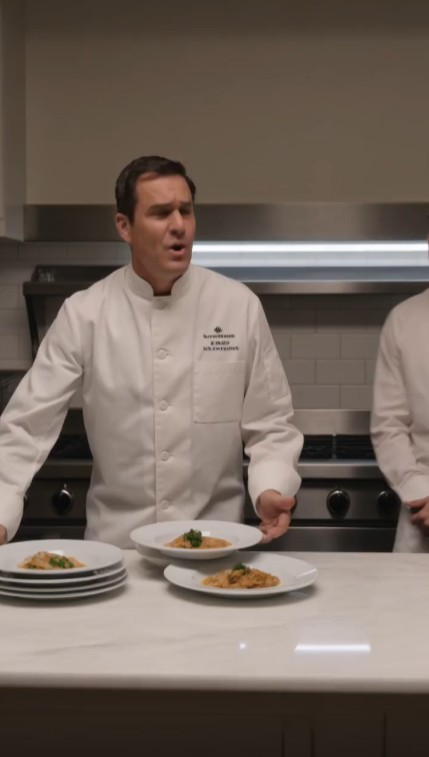
At 7:15 PM…
the first plate came back to the kitchen.
“Something wrong?”
The waiter shook his head.
“No.”
Then another plate returned.
And another.
Within five minutes…
every table had sent its food back.
The chef stared at the untouched plates.
“Is the food bad?”
“No.”
“Then why is everyone returning it?”
The waiter smiled.
“They’re waiting.”
“For what?”
Nobody answered.
Then the restaurant doors opened.
A young dishwasher named Alex walked in for his shift.
The dining room went completely silent.
Alex stopped.
“Why is everyone looking at me?”
The chef came out of the kitchen.
“Alex… come here.”
Alex looked worried.
“Am I fired?”
Suddenly…
one customer began clapping.
Then another.
Then the entire restaurant.
Alex looked around.
“What did I do?”
A woman at Table 6 stood.
“You don’t remember me.”
Alex shook his head.
“No.”
She pointed toward her untouched dinner.
“Three months ago, I came here alone.”
Alex frowned.
“I wash dishes. I don’t serve tables.”
“I know.”
Then she said:
“That’s exactly why nobody knew what you were doing.”
Alex’s smile disappeared.
“What was I doing?”
Another customer stood.
Then another.
Then another.
All of them had the same story.
The chef turned toward Alex.
“You’ve been leaving the kitchen during every break.”
Alex went silent.
The woman smiled.
“We finally figured out where you were going.”
Then the restaurant’s back door opened…
and dozens of people Alex did recognize were waiting outside.
Alex covered his mouth.
The chef whispered:
“Tonight, they’re here to return the favor.”
The woman from Table 6 was named Emily Carter.
Three months earlier, she’d entered Miller’s Kitchen at 8:40 on a Tuesday evening.
She’d been sitting in a hospital waiting room most of the day.
Her father, Henry, had undergone surgery that morning.
The operation had gone as planned, but Emily was exhausted.
She hadn’t eaten since breakfast.
So when a nurse told her to go get something while Henry slept, Emily walked three blocks and entered the first restaurant she saw.
She ordered soup.
Then realized she’d left her wallet at the hospital.
Emily searched every pocket.
Nothing.
She checked her phone.
Five percent battery.
Her digital payment app wouldn’t load properly.
Embarrassed, she called the waiter over.
“I’m sorry. I need to cancel.”
The soup was already being prepared.
The waiter told her it wasn’t a problem.
Emily stood anyway.
“I’ll come back.”
She walked toward the door.
What she didn’t notice was Alex.
He’d been carrying a rack of clean glasses from the dish station.
He heard enough of the conversation to understand what happened.
Alex disappeared into the kitchen.
Two minutes later, Emily was outside trying to get her phone to work when someone called:
“Ma’am?”
She turned.
Alex stood near the staff entrance holding a paper bag.
“Your soup.”
Emily shook her head.
“I couldn’t pay.”
“I know.”
“Then I can’t take it.”
Alex held out the bag.
“It’s already made.”
Emily hesitated.
“Did the restaurant give this to me?”
Alex glanced toward the kitchen.
“Something like that.”
It wasn’t exactly true.
Alex had paid for it himself.
He’d used part of the cash he’d planned to spend on dinner after his shift.
Emily didn’t know that.
She accepted the bag.
“Thank you.”
Alex nodded.
Then he noticed her hospital visitor sticker.
“Someone sick?”
“My dad.”
Alex looked toward the hospital.
“I’m sorry.”
“He’s okay. I think. It’s just been a long day.”
Alex reached into the paper bag.
He added a plastic spoon and extra napkins.
Then he said:
“Go eat with your dad.”
Emily smiled.
“What’s your name?”
“Alex.”
“Thank you, Alex.”
He went back inside.
Emily returned to the hospital.
Henry woke twenty minutes later.
He couldn’t eat.
But he watched his daughter finish the soup.
“Where’d you get that?”
“A restaurant.”
“Good?”
Emily nodded.
Then smiled.
“Very.”
Two weeks later, Henry was recovering at home.
Emily returned to Miller’s Kitchen.
She asked for Alex.
The manager told her he wasn’t working yet.
“What does he do here?”
“Dishwasher.”
Emily was surprised.
She’d assumed Alex was a waiter.
She left an envelope with the manager.
Inside was the cost of the soup and a thank-you card.
When Alex arrived, he refused the money.
“Give it to someone else.”
The manager laughed.
“You paid for her dinner.”
“So?”
“So take your money back.”
Alex shook his head.
“She needed it that night. I didn’t.”
That should have been the end of the story.
But it wasn’t.
Because Emily wasn’t the only person Alex had helped.
The next customer to stand in the dining room was Marcus Reed.
He was a delivery driver.
Two months earlier, his van had broken down near the restaurant.
Marcus had spent almost his entire afternoon waiting for a tow truck.
By the time the vehicle was removed, his phone was dead.
He had no charger.
He walked into Miller’s Kitchen and asked whether he could use a wall outlet for ten minutes.
The hostess agreed.
Marcus sat near the entrance.
Alex was on his break.
He noticed Marcus staring at a map on the wall.
“You lost?”
Marcus laughed.
“Temporarily.”
He explained that he lived four miles away.
Buses were running less frequently that evening.
His phone was dead.
He was trying to work out the route home.
Alex sat beside him.
“I know the bus.”
Marcus looked over.
“Which one?”
“Number 18. Stop’s two blocks south.”
Alex checked the clock.
“You’ve got twelve minutes.”
Marcus thanked him and started walking.
Alex followed.
“Where are you going?”
“Same direction.”
That wasn’t true.
Alex’s break was only twenty minutes.
The bus stop was in the opposite direction from his usual break spot.
But Marcus didn’t know.
Alex walked him to the stop.
The bus arrived.
Marcus reached for his wallet.
Then froze.
His wallet was in the van.
The tow company had already taken it to a repair shop across town.
Marcus stared at the bus.
“I can’t believe this.”
Alex pulled out his transit card.
He tapped Marcus on.
Marcus protested.
Alex waved him away.
“Just get home.”
“What about you?”
“I’ll walk back.”
Marcus later returned to repay him.
Alex refused.
Again.
The third person to stand in the restaurant was an elderly woman named Margaret Wilson.
She hadn’t needed money.
She hadn’t needed food.
She’d needed someone to sit down.
Margaret’s husband of forty-seven years had died six months earlier.
For decades, they’d eaten at Miller’s Kitchen every Friday.
Same table.
Same time.
After he died, Margaret stopped coming.
Then one Friday, she forced herself to return.
She sat at their usual table alone.
Ordered coffee.
Then started crying.
Quietly.
She tried to hide it.
Most people didn’t notice.
Alex did.
He was taking trash out during his break.
He saw Margaret through the side patio.
He didn’t know what to say.
So he didn’t say much.
He sat on the empty chair across from her.
Margaret looked up.
“Do I know you?”
“No.”
“Then why are you sitting here?”
Alex shrugged.
“You looked like you didn’t want to sit alone.”
Margaret stared at him.
Then laughed through her tears.
“That’s a terrible reason.”
“I can leave.”
“No.”
So Alex stayed.
Seven minutes.
Maybe eight.
Margaret told him about her husband, Thomas.
How he always stole the pickles from her plate.
How he complained about the coffee but ordered it every week.
How he’d once proposed to her in a parking lot because the restaurant was too crowded and he couldn’t wait.
Alex listened.
Then his break ended.
“I have to go wash dishes.”
Margaret smiled.
“You work here?”
“Unfortunately.”
She laughed.
It was the first time she’d laughed in days.
The next Friday, Margaret returned.
Alex didn’t sit with her.
He was too busy.
But when she finished dinner, the waiter brought a tiny plate.
One pickle.
Nothing else.
Margaret looked toward the kitchen.
Alex was already gone.
The fourth person stood.
Then the fifth.
Each story was small.
That was the part that surprised chef Daniel Miller most.
Alex hadn’t paid someone’s rent.
He hadn’t rescued anyone from a dramatic emergency.
He hadn’t secretly donated thousands of dollars.
He was twenty-two years old.
He earned an hourly wage washing dishes.
He didn’t have thousands to give.
So he gave what he had.
Ten minutes.
A bus fare.
A bowl of soup.
Half a sandwich.
A phone charger.
An umbrella.
A conversation.
One customer, Rachel Wilson, had been caught in heavy rain after dinner.
Alex gave her his umbrella.
“How will you get home?”
“I have a hood.”
“You’ll get soaked.”
“I wash dishes. I’m wet half my life anyway.”
Rachel laughed and took it.
She returned the umbrella the next day.
Inside it she’d placed a $20 bill.
Alex removed the money and gave it back.
Another customer, Thomas Carter, had come in after a job interview.
He was sitting outside with his tie loosened, looking defeated.
Alex was eating his employee meal on the back steps.
“You okay?”
Thomas shrugged.
“Didn’t get the job.”
Alex held up half his sandwich.
“Want this?”
Thomas stared at him.
“That’s your solution?”
“I don’t have a company to hire you.”
Thomas laughed.
Then accepted half the sandwich.
They talked for fifteen minutes.
A month later, Thomas got another job.
He never forgot the stranger who shared dinner with him when he felt useless.
There were more.
A mother whose toddler dropped a favorite toy beneath an outdoor bench.
Alex crawled underneath and retrieved it.
An elderly man who couldn’t read the parking payment screen.
Alex helped him.
A teenage employee from the bakery next door whose bicycle chain came off.
Alex fixed it during his break.
A hospital worker who finished a sixteen-hour shift and discovered she’d missed the last bus.
Alex called his older brother, Michael, who was already picking him up, and asked if they could drive her home too.
None of these people thought the moments were connected.
Neither did Alex.
Then Emily came back for dinner one evening.
She saw Margaret sitting alone.
The two started talking.
Emily mentioned the dishwasher who’d paid for her soup.
Margaret stared.
“What did he look like?”
Emily described him.
Margaret smiled.
“Alex.”
“You know him?”
“He sat with me after my husband died.”
At the next table, Marcus overheard the name.
“Alex? Young guy? Dark hair?”
Both women looked at him.
Marcus told them about the bus.
That was the moment the mystery began.
Emily asked the manager:
“How long has Alex worked here?”
“About a year.”
“Does he always leave during his breaks?”
The manager shrugged.
“He usually goes outside.”
“Where?”
Nobody knew.
So they started asking.
Not spying on him.
Not following him.
Just talking to regular customers and nearby workers.
The stories appeared almost immediately.
Alex had become the person people remembered from difficult little moments.
The chef, Daniel, was stunned.
“He’s never told me any of this.”
Emily smiled.
“That’s why we’re telling you.”
Daniel began paying closer attention.
At 6:20 one evening, Alex clocked out for his break.
Instead of sitting in the staff room, he walked outside carrying his employee meal.
Daniel watched through the kitchen door.
Alex crossed the alley.
Behind the restaurant was a small community outreach center.
It provided showers, job-search assistance, laundry access and scheduled meal support for people experiencing housing insecurity or temporary hardship.
Alex entered.
Twelve minutes later, he returned without his food container.
Daniel stopped him.
“Where’s your dinner?”
Alex froze.
“Ate it.”
“You ate the container too?”
Alex looked down.
Daniel waited.
Finally Alex sighed.
“There are people over there who sometimes miss the evening meal cutoff.”
“So you’re giving away your employee dinner?”
“Not every day.”
“How often?”
Alex shrugged.
Daniel didn’t like that answer.
“You need to eat too.”
“I do.”
“When?”
“At home.”
Daniel crossed his arms.
“Alex.”
Alex looked embarrassed.
“It’s just food.”
“No. It’s your meal.”
“I know.”
“Why didn’t you tell me?”
Alex looked genuinely confused.
“Why would I?”
Daniel had no answer.
The next day, Daniel walked to the outreach center.
He spoke with its coordinator, Anna Reed.
He learned Alex had been coming there for nearly eight months.
Not as part of an official restaurant program.
Just Alex.
Sometimes he brought his employee meal.
Sometimes unopened packaged items that the restaurant had properly cleared for staff consumption.
Sometimes he simply sat with people.
But Anna was careful.
“Alex isn’t running a food program.”
Daniel nodded.
“And we don’t want people assuming he is.”
The center had its own procedures.
Food donations needed to follow safety requirements.
Alex had occasionally shared his personal meal with someone he knew there, but the center didn’t depend on him for meals.
Daniel understood.
“What does he do here, then?”
Anna smiled.
“Mostly?”
“Yeah.”
“He remembers names.”
Daniel looked confused.
Anna pointed across the room.
“See Henry?”
An older man sat at a computer.
“Alex helped him make an email address so he could apply for work.”
She pointed toward another man.
“Marcus—not the delivery driver, another Marcus—Alex helped him replace the laces on his work boots before an interview.”
A woman near the window waved toward them.
“That’s Sarah. Alex helped her carry two bags to the bus.”
Daniel looked around.
“Why?”
Anna shrugged.
“You’ll have to ask Alex.”
Daniel did.
That evening.
“Why do you keep spending your breaks helping people?”
Alex dried his hands.
“My dad.”
Daniel waited.
Alex rarely discussed his family.
“My dad lost his job when I was fourteen.”
Daniel leaned against the counter.
“We almost lost our apartment.”
“I didn’t know that.”
“Most people didn’t.”
Alex explained.
His father, Michael, had worked in a warehouse.
When it closed, he spent months unemployed.
Savings disappeared.
Bills accumulated.
Michael was embarrassed.
He stopped seeing friends.
One afternoon, after another failed interview, Michael sat alone in a diner.
He ordered coffee because it was the cheapest thing on the menu.
When he asked for the check, the waitress told him someone had already paid.
Michael looked around.
The person was gone.
But they’d left a note.
Bad days shouldn’t have to be lonely too.
That sentence stayed with Michael.
Two weeks later, he found work.
Years passed.
The family recovered.
But Michael kept the note inside his wallet.
When Alex turned eighteen, his father showed it to him.
“He told me he couldn’t remember the person’s face,” Alex said.
“But he remembered how it felt.”
Daniel nodded.
“So you started helping people?”
Alex shrugged.
“Not like a mission or anything.”
“Then what?”
“I don’t know.”
Alex thought.
“I guess if I notice something small that I can fix, I fix it.”
Daniel smiled.
“That might be the most dishwasher answer possible.”
Alex laughed.
Then Daniel asked:
“Do you realize how many people remember you?”
Alex shook his head.
“No.”
Daniel decided not to tell him.
Not yet.
Emily had already suggested the dinner.
She wanted Alex to see that small kindness didn’t disappear just because he walked back into the kitchen afterward.
But Daniel insisted on one rule.
“No collecting money for him.”
Emily agreed.
“No huge gift.”
Agreed.
“No making him feel like some kind of hero.”
Emily smiled.
“That’s exactly why we’re doing it this way.”
They contacted people whose stories they could actually confirm.
Each was asked to do one thing before coming to dinner.
Help someone else.
It could be tiny.
No money required.
Then write what happened on a card.
The response grew faster than expected.
Emily paid for coffee for a hospital visitor.
Marcus helped a coworker repair a flat tire.
Margaret began eating lunch once a week with another widow from her church.
Rachel returned Alex’s old kindness by keeping two spare umbrellas in her office for coworkers caught in bad weather.
Thomas, the man who’d lost the job interview, volunteered to review résumés at the outreach center.
The mother whose toddler lost the toy donated children’s books.
The bakery employee began repairing bicycles with his younger brother.
The hospital worker who’d received a ride home started offering rides to colleagues when their shifts ended together.
Nobody claimed Alex had transformed their lives.
He hadn’t.
But each person could identify one moment when Alex had made a difficult day slightly easier.
That was enough.
Then came the plan.
At 7:15 PM, every participating table would send its food back untouched.
Not because anything was wrong.
They simply wanted Alex to arrive before anyone started eating.
Daniel arranged for the meals to be held and served fresh once the surprise was revealed.
The kitchen staff knew.
The servers knew.
Alex didn’t.
When he walked through the doors at 7:22…
37 people were waiting.
Then the back door opened.
Outside stood another group.
People from the outreach center.
Workers from neighboring businesses.
Hospital employees.
Residents.
People Alex actually recognized.
Henry from the computer.
Sarah from the bus stop.
The second Marcus.
Anna.
And Michael.
Alex’s father.
That was when Alex covered his mouth.
“Dad?”
Michael smiled.
“Hey, kid.”
Alex stared at Daniel.
“You called my father?”
“Emily did.”
Alex turned toward Emily.
“You don’t even know my father.”
“I do now.”
Michael stepped forward.
In his hand was an old folded piece of paper.
Alex recognized it.
The diner note.
Bad days shouldn’t have to be lonely too.
“Why did you bring that?”
Michael looked around the restaurant.
“Because I think it’s been doing more work than I realized.”
Alex shook his head.
“Dad…”
Michael hugged him.
The applause stopped.
The room became quiet again.
Michael whispered something only Alex heard.
When they separated, Alex wiped his eyes.
Then immediately looked embarrassed that everyone had seen him.
Daniel rescued him.
“All right. Nobody paid to watch Alex cry. Sit down.”
People laughed.
But nobody touched their food yet.
Emily handed Alex a stack of cards.
“What are these?”
“Read one.”
Alex opened the first.
Someone bought my soup when I forgot my wallet. Last week, I bought breakfast for a woman waiting alone at the hospital. — Emily
Second:
Someone paid my bus fare when my wallet was stuck in a tow truck. This week, I drove a coworker home when his car broke down. — Marcus
Third:
Someone sat with me when I couldn’t bear to eat alone. Now I have lunch every Thursday with someone else who lost her husband. — Margaret
Alex stopped.
He looked around.
“You all did this?”
Emily nodded.
“Not for you.”
Alex frowned.
She smiled.
“Because of what you reminded us to notice.”
Daniel stepped forward.
“That’s the part you didn’t know.”
Alex looked at him.
Daniel explained what he’d discovered.
Alex’s breaks.
The outreach center.
The meals.
The little favors.
Alex looked uncomfortable.
“I didn’t do anything big.”
“Correct,” Daniel said.
Everyone laughed.
Alex stared at him.
Daniel continued.
“You didn’t save 37 people.”
“Good.”
“You didn’t change everybody’s life.”
“Also good.”
“You noticed people.”
Daniel pointed toward the cards.
“And apparently that can travel farther than you think.”
Alex looked toward his father.
Michael held up the old diner note.
“That’s how it reached you.”
Alex finally understood.
The person who’d paid for Michael’s coffee years earlier had never met Alex.
Probably never knew Michael had a son.
Never knew Michael would show that note to him.
Never knew Alex would remember it.
One anonymous cup of coffee had become a story inside a family.
That story influenced a young dishwasher.
The dishwasher bought soup.
Paid bus fare.
Shared meals.
Sat with strangers.
And those strangers eventually helped other people.
Not a perfect chain.
Not something anyone could measure scientifically.
Just human behavior moving outward in ways nobody could completely trace.
Daniel clapped his hands.
“Now can we please eat before my entire kitchen quits?”
Everyone laughed.
Servers returned the plates.
Alex tried to go to the dish station.
Daniel blocked him.
“Where are you going?”
“Work.”
“No.”
“I start at seven-thirty.”
“Not tonight.”
Alex looked horrified.
“Who’s doing dishes?”
Daniel pointed toward the kitchen.
Three cooks simultaneously looked away.
Alex laughed.
Then Daniel pulled out a chair.
“For once, sit on this side.”
Alex hesitated.
He had worked at Miller’s Kitchen for almost a year.
He’d never eaten in the dining room during dinner service.
Michael sat beside him.
Emily sat across from him.
Margaret moved her plate slightly toward Alex.
“You want my pickle?”
Alex laughed.
“I heard about the pickle.”
Margaret froze.
“You did?”
“Daniel told me.”
She smiled.
Then gave it to him anyway.
Dinner lasted nearly two hours.
People told stories.
Some were funny.
Some were emotional.
But Daniel noticed something important.
The evening wasn’t really about Alex after the first twenty minutes.
People started talking to each other.
Emily met Henry from the outreach center.
Marcus talked with Thomas about job interviews.
Margaret met Sarah.
The hospital worker recognized someone she’d seen in the waiting room months earlier.
Connections formed without anyone planning them.
Alex looked around.
“This is weird.”
Michael smiled.
“Good weird?”
“Very weird.”
Then Michael asked:
“You know what the person who paid for my coffee looked like?”
Alex shook his head.
“You said you didn’t remember.”
“I didn’t.”
Michael reached into his jacket.
“But I found something last week.”
He placed an old diner receipt on the table.
Alex stared.
“You kept the receipt too?”
“It was folded with the note.”
On the back was a handwritten first name.
Henry
Nothing else.
Michael had never noticed it.
Alex looked toward the outreach-center table.
Henry, the older man Alex had helped create an email account, was sitting there.
For one ridiculous second, Alex stared at him.
Henry noticed.
“What?”
Alex laughed.
“Nothing.”
There was no reason to believe it was the same Henry.
And nobody pretended otherwise.
That mattered.
The night didn’t need an impossible coincidence.
It was already enough.
After dinner, Daniel finally revealed the only practical change he had planned.
He’d spoken with Anna at the outreach center.
The restaurant would begin a formal partnership.
Not Alex secretly giving away his own employee meals.
Instead, Miller’s Kitchen would work within proper food-safety procedures to provide scheduled meals to the center when feasible.
Participation would depend on available food, staffing and the center’s needs.
Alex stared at Daniel.
“You’re serious?”
“Yes.”
“You don’t have to do that.”
“I know.”
“It’s going to cost money.”
Daniel nodded.
“That’s how restaurants work.”
Alex laughed.
Daniel continued.
“And one more thing.”
Alex groaned.
“No.”
“You’re getting your breaks back.”
“I already take my breaks.”
“No. You perform unpaid community outreach during your breaks.”
The room laughed.
Daniel pointed at him.
“Eat your own dinner sometimes.”
Alex nodded.
“No promises.”
Three months later, the restaurant partnership was running quietly.
No giant sign.
No photograph of Alex.
No slogan printed across the windows.
Daniel refused to turn it into marketing.
But inside the staff room, one small card appeared.
It read:
If you notice something small you can fix, fix it.
Alex saw it.
“Did you write that?”
Daniel nodded.
“Take it down.”
“Why?”
“It sounds like something from a motivational poster.”
Daniel laughed.
“It stays.”
Alex continued washing dishes.
That surprised some people.
They assumed Daniel would promote him immediately.
But Alex didn’t want another position yet.
He was taking evening classes and saving money.
Dishwashing fit his schedule.
Eventually, he trained new kitchen assistants.
And he became very strict about breaks.
Especially other people’s.
“You’ve been working six hours. Go sit down.”
One employee laughed.
“You’re telling me that?”
Alex pointed toward the staff room.
“Go.”
He’d learned.
Mostly.
A year after the surprise dinner, Emily returned at 7:15 PM.
She ordered the same soup.
This time Alex was working.
Emily asked the waiter:
“Can you send this back?”
The waiter looked alarmed.
“Why?”
She smiled.
“Just tell Alex.”
The plate reached the kitchen.
Alex saw it.
Then looked through the service window.
Emily waved.
Alex laughed.
He came into the dining room.
“What now?”
Emily handed him an envelope.
Alex refused immediately.
“No money.”
“There isn’t any.”
Inside was a photograph from the dinner.
All 37 customers.
The outreach-center group.
Daniel.
Michael.
Alex standing in the middle looking completely overwhelmed.
On the back, Emily had written:
Nobody returned the favor to you.
We passed it on.
Alex read it twice.
Then placed it in his locker.
Years later, it was still there.
The restaurant changed.
Staff came and went.
Daniel eventually renovated the kitchen.
The old dish station was replaced.
Alex finished his classes and left for a full-time job with a local logistics company.
On his last shift, Daniel handed him something.
A clean white dinner plate.
Alex stared.
“What am I supposed to do with this?”
“Take it.”
“Why?”
Daniel turned it over.
On the back, the restaurant staff had written their names.
In the center were two words:
NOTICE PEOPLE.
Alex laughed.
“This is incredibly cheesy.”
Daniel nodded.
“Emily’s idea.”
“I knew it.”
He took the plate anyway.
Alex didn’t become famous.
The story didn’t turn into a massive organization.
Most people who later benefited from the restaurant’s community partnership never knew his name.
That suited him perfectly.
Years afterward, Alex’s father still carried the old diner note.
Alex kept the photograph.
And whenever someone tried to tell him he’d started something extraordinary, he corrected them.
“I didn’t start it.”
“Then who did?”
Alex would think about the stranger who once paid for his father’s coffee.
“I don’t know.”
That became his favorite part of the story.
Maybe nobody knew where these things started.
A person helped another person.
That person remembered.
Years later, when an opportunity appeared…
they helped someone else.
Most chains disappeared from view.
No records.
No applause.
No reunion dinner.
But once in a while, people managed to trace one.
And that was exactly what happened at 7:15 on a crowded evening at Miller’s Kitchen.
Every customer returned an untouched plate.
The chef thought something was wrong with the food.
Then Alex walked through the door.
Thirty-seven strangers stood.
Dozens more waited outside.
And for the first time, the young dishwasher who spent his breaks quietly noticing other people’s difficult days discovered something he’d never expected.
They had noticed him too.