
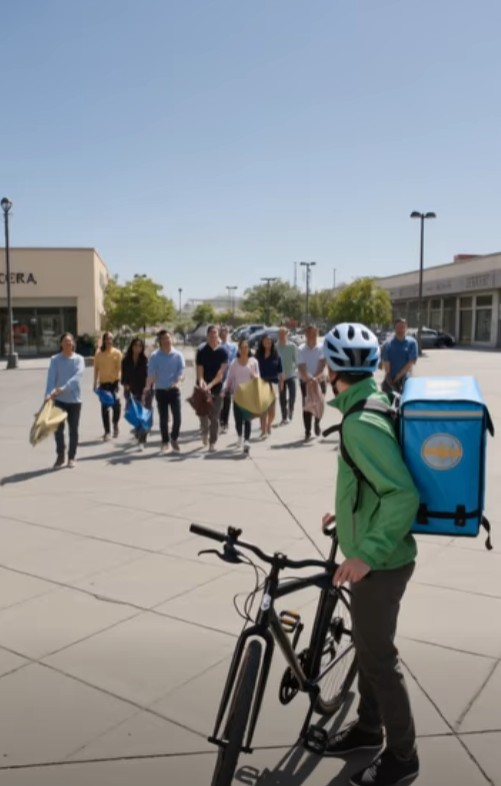
The sky was completely clear.
Not a drop of rain.
Then one woman in the plaza opened an umbrella.
A man across from her opened another.
Then another.
And another.
Within seconds…
nearly 100 people were standing beneath open umbrellas.
A bicycle courier stopped.
“What is going on?”
Nobody answered.
Then something stranger happened.
Every umbrella was tilted toward him.
The courier looked behind himself.
Nobody.
“Guys…?”
A woman stepped forward.
“Are you Marcus?”
He nodded slowly.
“Yes.”
She smiled.
“Then we’re in the right place.”
Marcus looked at the umbrellas.
“Why are you doing this?”
The woman asked:
“Do you remember delivering food during that huge rainstorm last year?”
Marcus laughed.
“I delivered hundreds of orders.”
“I know.”
She closed her umbrella.
Underneath it…
was another adult holding a small sealed meal bag.
Then another umbrella closed.
Another meal.
Another.
Marcus stared.
“What is this?”
The woman said:
“During that storm, one customer couldn’t pay.”
Marcus remembered.
“I left the food anyway.”
The woman nodded.
“That customer did something the next day.”
Marcus frowned.
“What?”
Another umbrella closed.
Then another.
Each revealed someone holding the same kind of meal bag.
Marcus looked around.
“How many people are involved?”
The woman smiled.
“You’re looking at only the people who could make it today.”
Marcus went silent.
Then a delivery van safely pulled into the designated plaza loading area.
The doors opened.
Marcus saw what was inside…
and whispered:
“All this started with one meal?”
The woman smiled.
“Not exactly.”
Her name was Rachel Carter.
Marcus stared at her for several seconds.
Then recognition appeared.
“Apartment 614.”
Rachel laughed.
“You remember?”
“You had the broken intercom.”
“And the red door.”
“Your building manager kept promising to fix it.”
Rachel nodded.
“That was me.”
Marcus looked at the meal bags surrounding him.
Then at the van.
Inside were insulated containers packed in organized rows.
Each was labeled.
Some were destined for a family shelter.
Others for an overnight hospital staff room.
Several were marked for a community senior center.
Marcus looked back at Rachel.
“I don’t understand.”
“You will.”
One year earlier, the city had been hit by one of the worst rainstorms of the season.
By 5:00 PM, streets were flooding.
Buses were delayed.
Several intersections closed.
Most bicycle couriers stopped accepting orders.
Marcus probably should have done the same.
He was twenty-eight and had been delivering food for almost three years.
He knew when conditions were becoming unsafe.
So when the rain intensified, he decided the order already in his bag would be his last.
Apartment 614.
One vegetable soup.
One chicken sandwich.
One bottle of water.
The restaurant was only six blocks from the customer.
Normally, Marcus could cover that distance in minutes.
That night, it took almost half an hour.
He walked his bicycle through the worst sections.
Water soaked through his jacket.
His shoes were completely wet.
When he finally reached Rachel’s building, the intercom wasn’t working.
Marcus called.
No answer.
He called again.
Nothing.
He was about to contact support when the building door opened.
A woman hurried toward him.
“Marcus?”
“Rachel?”
“Yes. I’m sorry.”
She looked exhausted.
Marcus handed her the bag.
Then Rachel reached into her coat.
Stopped.
Checked another pocket.
Then her face changed.
“My wallet.”
Marcus waited.
“I left it at the hospital.”
Marcus glanced at his phone.
The order had been marked for cash payment.
Rachel closed her eyes.
“I can’t believe this.”
“No problem. You can contact the restaurant.”
“No, I ordered cash because my card was locked after a fraud alert.”
Marcus could see she was becoming increasingly embarrassed.
“I’ll cancel it.”
Marcus looked at the rain behind him.
Then at the bag.
The restaurant couldn’t use the food again.
He had already ridden it across the neighborhood.
“Just take it.”
Rachel stared.
“What?”
“Take the food.”
“I can’t.”
“It’s going to get thrown away otherwise.”
“But you’ll have to pay.”
Marcus hesitated.
The order wasn’t expensive.
But yes.
Under the arrangement with that restaurant, the cash was still expected.
Rachel shook her head.
“No.”
Marcus handed her the bag.
“Seriously.”
“Marcus—”
“Were you at the hospital all day?”
Rachel looked surprised.
“How did you know?”
She was still wearing a visitor sticker.
“My mother had surgery.”
“Have you eaten?”
Rachel looked at the bag.
“Not since this morning.”
Marcus pushed it gently toward her.
“Then eat.”
Rachel accepted it.
“Give me your number. I’ll pay you tomorrow.”
Marcus shook his head.
“No.”
“Why?”
“Because I don’t want a stranger having my number.”
Rachel laughed.
Marcus smiled.
“Now eat before the soup becomes cold water.”
Then he turned toward his bicycle.
Rachel called after him.
“You’re riding in this?”
“Not anymore.”
He planned to walk to a nearby transit station and take his bicycle aboard if service was still operating.
Rachel looked at the umbrella in her hand.
Then at Marcus’s soaked jacket.
“Wait.”
She opened the umbrella.
“Take this.”
“You need it.”
“My building has a roof.”
Marcus laughed.
“You’re going back to the hospital.”
“My sister is picking me up.”
She pushed the umbrella toward him.
“Take it.”
Marcus hesitated.
Then accepted.
It was bright yellow.
One metal rib was slightly bent.
Marcus looked at it.
“This thing has seen better days.”
Rachel smiled.
“So have you.”
Marcus laughed.
Then left.
That should have been the entire story.
One meal.
One umbrella.
Two strangers who expected never to meet again.
But the following morning, Rachel returned to the hospital.
Her mother, Evelyn, was awake and recovering well.
Rachel told her what happened.
Evelyn listened.
Then asked:
“What was his name?”
“Marcus.”
“You’re going to pay him back?”
“He wouldn’t let me.”
Evelyn smiled.
“Then don’t.”
Rachel frowned.
“What?”
“Do what he did.”
Rachel understood immediately.
On her way home that afternoon, she stopped at a small café.
A construction worker was standing at the counter.
His card had been declined.
He apologized and began putting his sandwich back.
Rachel stepped forward.
“I’ve got it.”
The man turned.
“No, that’s okay.”
Rachel smiled.
“Someone bought my dinner yesterday.”
The man looked confused.
“So?”
“So apparently this is what we’re doing now.”
She paid.
The man laughed.
His name was Daniel Wilson.
Before leaving, Rachel told him only one thing.
“Don’t pay me back.”
Daniel asked:
“Then what am I supposed to do?”
Rachel thought about Marcus disappearing beneath her yellow umbrella.
“Next time you see somebody having a bad day, help if you can.”
Daniel nodded.
Rachel forgot about it.
Three days later, Daniel was leaving work when he saw a young father struggling with a stroller and two grocery bags at a bus stop.
Daniel helped carry the bags onto the bus.
It cost nothing.
The father thanked him.
Daniel said:
“Somebody bought my lunch this week. I’m apparently paying it forward.”
The father laughed.
But he remembered.
His name was Michael Reed.
Two weeks later, Michael noticed an elderly neighbor named Henry trying to carry a broken lamp toward the trash.
Michael repaired electrical equipment for work.
He took the lamp home.
Replaced a damaged switch.
Returned it the next morning.
Henry offered him money.
Michael refused.
“Somebody helped me with groceries.”
Henry frowned.
“You couldn’t carry groceries?”
Michael laughed.
“Long story.”
Henry kept the lamp.
And the story.
A month later, Henry was at a pharmacy.
A woman ahead of him realized she was several dollars short for non-prescription items and household supplies.
Henry quietly covered the difference.
The woman tried to repay him.
Henry said:
“Fix somebody else’s lamp.”
She stared.
“What?”
Henry laughed.
“Never mind.”
That woman was Anna Miller.
She worked at a community center.
She told her coworkers about the strange older man who’d paid the remaining balance and then told her to repair a lamp.
The story became a joke.
But the idea didn’t.
A week later, the center was preparing meals for a scheduled evening program.
A volunteer canceled.
Anna stayed an extra hour to help pack meals.
Another volunteer asked:
“Why are you still here?”
Anna smiled.
“Apparently I’m fixing somebody’s lamp.”
Nobody understood.
Anna explained.
By then, the story had already become distorted.
A courier gave someone food.
Someone bought a construction worker lunch.
The construction worker helped with groceries.
The father repaired a lamp.
The lamp somehow led to a pharmacy.
Nobody knew exactly how the pieces connected.
So Anna wrote the sequence on a whiteboard.
At the top:
ONE MEAL
Then arrows.
Meal → lunch.
Lunch → groceries.
Groceries → lamp.
Lamp → pharmacy.
Pharmacy → community meals.
One of the volunteers photographed the board.
She sent it to her sister.
Her sister shared it with coworkers.
Someone called it the “One Meal Chain.”
Anna hated the name.
“It sounds like a restaurant promotion.”
But the phrase stuck.
Importantly, nobody tried to turn it into a promise that every good deed had to produce another.
People helped when they could.
Sometimes with money.
Usually without it.
A ride.
A repaired zipper.
A meal.
A phone charger.
A few minutes carrying boxes.
An hour helping someone prepare for a job interview.
The point wasn’t to keep an exact chain alive.
The point was simply to notice an opportunity.
But Rachel had become curious.
How far had the original meal traveled?
She called Daniel.
“Do you remember me?”
“The sandwich woman?”
Rachel laughed.
“Yes.”
“Did I accidentally join a cult?”
“No.”
“Good.”
“Who did you help after me?”
Daniel told her about Michael.
Rachel contacted Michael.
Michael told her about Henry.
Henry told her about Anna.
Anna showed her the whiteboard.
Rachel stared at it.
“This came from Marcus.”
Anna asked:
“Who’s Marcus?”
“The delivery courier.”
“You know him?”
“Not really.”
“Can you find him?”
Rachel tried.
She contacted the restaurant.
They couldn’t give out an employee or courier’s private information.
She contacted the delivery platform.
Same answer.
That was appropriate.
Marcus’s privacy mattered more than satisfying their curiosity.
So Rachel stopped searching.
But Anna had another idea.
“Don’t find Marcus.”
Rachel frowned.
“What?”
“Keep the chain going.”
The community center began using the idea informally with volunteers.
Not as a requirement.
Not as a fundraising program.
Just a monthly question:
What small thing did somebody do for you that you could pass forward?
The answers surprised them.
One volunteer’s neighbor had watched her dog during an emergency.
So she offered to walk an elderly resident’s dog twice that week.
Someone had helped him build a résumé.
He later helped a teenager practice for an interview.
A restaurant worker received a ride home after a late shift.
Later, she covered a coworker’s shift when his child was sick.
A mechanic repaired a community-center van at reduced cost.
The center used the savings to purchase more meal containers.
The chain became impossible to trace.
Rachel liked that.
Then the umbrellas appeared.
Not literally at first.
The yellow umbrella Marcus had taken during the storm returned to Rachel six weeks later.
She came home one evening and found it leaning against her apartment door.
A note was attached.
Made it back. Thanks for the shelter. — Marcus
Rachel laughed.
He had remembered the address.
She kept the umbrella.
Months passed.
Then the anniversary of the storm approached.
Anna suggested a community meal-packing day.
Several local restaurants and a licensed community kitchen agreed to participate.
Meals would be prepared and handled under proper food-safety procedures.
The bags would go to established local programs that had requested them.
No random distribution.
No leaving food on doorsteps.
No giant publicity stunt.
Just an organized community effort.
Rachel looked at the volunteer list.
Ninety-six people.
She smiled.
“I have an idea.”
Anna immediately looked suspicious.
“That sentence always causes work.”
Rachel held up the yellow umbrella.
On the anniversary of the storm, the forecast was perfectly clear.
They arranged to meet in the central plaza.
Everyone was told to bring an umbrella if they had one.
Not necessarily yellow.
Any umbrella.
Each participant would stand with one of the sealed meal bags prepared for the event.
But Rachel still had one problem.
Marcus.
She had no idea whether he’d be working.
Then Daniel—the construction worker from the café—mentioned that his company regularly used the same courier service.
One of his coworkers recognized Marcus.
Rachel contacted the delivery platform again.
This time she didn’t ask for Marcus’s personal information.
She asked whether they could forward an invitation to him.
The company agreed to pass along a message without revealing any private details.
The invitation said:
If you’re working near Central Plaza at 2:00 Saturday, please stop by. Someone has your umbrella.
Marcus almost ignored it.
He assumed Rachel simply wanted to return the umbrella he’d already returned.
But he was curious.
So he accepted a delivery route near the plaza.
When he arrived…
the sky was blue.
Then one umbrella opened.
Then another.
Nearly one hundred.
Marcus stopped his bicycle.
That was the moment Rachel stepped forward.
Now, surrounded by meal bags, Marcus finally understood.
Or thought he did.
“All this started with one meal?”
Rachel shook her head.
“No.”
Marcus looked confused.
“You just said—”
“I said the chain we traced started with your meal.”
She pointed toward the crowd.
“But you weren’t the first person to help someone.”
Marcus laughed.
“Obviously.”
“And you won’t be the last.”
Rachel held up the old yellow umbrella.
“This is just the part we were able to follow.”
Marcus looked toward the van.
“What exactly is in there?”
Anna approached.
“Meals for three local programs.”
“From these people?”
“Prepared through partner kitchens. These volunteers helped pack and coordinate them.”
Marcus nodded.
“And why am I here?”
Rachel smiled.
“Because you never got to see what happened after you rode away.”
Marcus became quiet.
Rachel handed him a card.
On the front:
ONE MEAL
On the back was a simple chain.
Marcus → Rachel → Daniel → Michael → Henry → Anna → hundreds of smaller moments we couldn’t trace
Marcus read it.
Then laughed.
“You’re telling me my sandwich became a lamp?”
Rachel burst out laughing.
“Eventually.”
“How?”
Daniel stepped forward.
“I was the sandwich.”
Marcus looked at him.
Daniel explained.
Then Michael explained the groceries.
Henry explained the lamp.
Anna explained the pharmacy.
The stories became increasingly ridiculous when told one after another.
Marcus laughed harder.
“So I left soup with a woman in a rainstorm, and somehow a community center got involved?”
Anna nodded.
“That’s the short version.”
Marcus looked around.
Then asked the question nobody expected.
“Who paid for the soup?”
Rachel pointed at him.
“You did.”
Marcus shook his head.
“No.”
Rachel frowned.
“You told me—”
“I covered the cash order, yeah. But that wasn’t what I meant.”
Marcus leaned his bicycle against the designated rack.
Then removed his phone.
He searched through old photographs.
Finally, he found one.
A handwritten receipt.
A year earlier.
The same storm.
Before Rachel’s delivery.
Marcus had stopped at the restaurant to collect the order.
He’d been soaked already.
His waterproof gloves had torn.
He was standing near the pickup counter trying to dry his phone.
An older restaurant employee named Evelyn had noticed.
“You’re delivering in this?”
“Last one.”
“You eaten?”
Marcus hadn’t.
Evelyn disappeared into the kitchen.
She returned with a small container of pasta.
Marcus told her he hadn’t ordered it.
“I know.”
“I can’t take restaurant food.”
“It was my employee meal.”
“You eat it.”
“I already had half.”
Marcus accepted.
Then Evelyn noticed his gloves.
She gave him two small plastic covers used by staff for transporting items in wet weather.
“Put these over your hands until you get home.”
Marcus laughed.
“They’ll look ridiculous.”
“You’re riding a bicycle in a thunderstorm. We’re past dignity.”
Marcus remembered that line.
He ate the pasta before collecting Rachel’s order.
Then rode into the rain.
“When Rachel couldn’t pay,” Marcus said, “I was annoyed for about three seconds.”
Rachel laughed.
“Thank you.”
“But then I remembered Evelyn giving me dinner.”
Marcus looked at the card.
“So if we’re drawing arrows, you missed one.”
Anna immediately pulled out a pen.
“What’s her name?”
“Evelyn.”
“Where does she work?”
Marcus pointed across the plaza.
The restaurant was still there.
Everyone turned.
Rachel smiled.
“Is she working today?”
Marcus shrugged.
“Only one way to find out.”
They didn’t march nearly one hundred people into the restaurant.
That would’ve been chaos.
Rachel and Marcus walked over with Anna.
Evelyn was working.
She recognized Marcus almost immediately.
“Rain boy.”
Marcus laughed.
“That’s me.”
She looked outside.
“Why are there ninety people holding umbrellas when it’s sunny?”
Marcus smiled.
“That’s complicated.”
He explained.
Evelyn listened.
Then shook her head.
“No.”
Marcus frowned.
“What?”
“You’re not blaming me for all that.”
Anna laughed.
“We aren’t blaming anyone.”
“I gave you leftover pasta.”
“Half your dinner.”
“It would’ve gone cold.”
Marcus smiled.
“Sounds familiar.”
Evelyn understood.
She looked through the restaurant window at the plaza.
Umbrellas.
Meal bags.
Volunteers.
A van waiting in the proper loading area.
Her eyes filled.
“I didn’t do anything.”
Marcus nodded.
“I know.”
That made her laugh.
He continued:
“Neither did I.”
Rachel crossed her arms.
“You two are impossible.”
Evelyn couldn’t leave her shift.
So Marcus asked her to step outside for one minute.
Her manager agreed.
When Evelyn reached the plaza…
the umbrellas rose again.
She stopped.
Marcus stood beside her.
“Apparently this is what happens when you feed bicycle couriers.”
Evelyn laughed.
Then Rachel handed her a meal bag.
“What’s this?”
“Nothing for you to deliver.”
“Good.”
“It’s symbolic.”
Evelyn opened it.
Inside was no food.
Only dozens of small cards.
Each described one act someone had received and another they’d later chosen to give.
My coworker covered my shift when my son was sick. I later covered another coworker’s shift when her father was hospitalized.
A neighbor shoveled my sidewalk. I repaired his fence in spring.
Someone helped me practice for an interview. I helped another person build a résumé.
A stranger returned my lost wallet. I spent an afternoon helping someone search for their missing keys.
My sister brought dinner when I was exhausted. I cooked for my neighbor after surgery.
Evelyn read several.
Then closed the bag.
“None of these people know me.”
Rachel smiled.
“Most don’t know Marcus either.”
“Then why am I reading them?”
Anna answered:
“Because sometimes people think kindness disappears if nobody says thank you.”
She looked around the plaza.
“It doesn’t always.”
Evelyn wiped her eyes.
Then pointed at Marcus.
“I still want my food container back.”
Marcus stared.
“After a year?”
“It was a good container.”
Everyone laughed.
The event continued.
The umbrellas were closed.
The meal bags were loaded.
Volunteers traveled to their assigned locations.
Marcus expected the van to leave.
Instead, Rachel stopped him.
“There’s one more thing.”
The rear doors opened fully.
Marcus had already seen the insulated meal containers.
But now workers rolled out something from behind them.
A bicycle.
New.
Built for delivery work.
Rear cargo rack.
Weatherproof panniers.
Strong lights.
Reflective equipment.
Marcus stared.
“No.”
Rachel smiled.
“Yes.”
“No.”
Anna stepped forward.
“Before you panic, this isn’t from random people collecting cash for you.”
Marcus looked suspicious.
“A local bicycle shop heard about the event.”
Daniel continued:
“They donated the frame.”
Michael added:
“My company donated the rack.”
Another volunteer raised his hand.
“I installed the lights.”
Rachel pointed toward the weatherproof bags.
“The courier cooperative contributed those.”
Marcus shook his head.
“I can’t take this.”
“Why?”
“My bike works.”
Everyone looked toward Marcus’s bicycle.
The rear fender was held together with two zip ties.
One pedal made a clicking noise.
The seat had been repaired with black tape.
Rachel raised an eyebrow.
Marcus looked at the bicycle.
“It has personality.”
“So does a broken toaster.”
Marcus laughed.
But he still hesitated.
“This whole thing wasn’t supposed to be about paying me back.”
Rachel nodded.
“It isn’t.”
“Then why give me a bicycle?”
“Because the shop asked what would help you do your job more safely.”
Marcus became quiet.
Rachel pointed toward the new bicycle.
“This isn’t payment for the meal.”
“Then what is it?”
“A tool.”
“For what?”
Rachel smiled.
“Whatever comes next.”
Marcus looked at Evelyn.
She shrugged.
“Take the bike.”
“You’re supposed to support me.”
“I gave you pasta. My responsibilities ended there.”
Marcus laughed.
Finally, he accepted.
But he made one request.
The bicycle shop had attached a small metal plate to the rear rack.
It read:
ONE MEAL STARTED THIS.
Marcus asked them to change it.
A week later, the replacement arrived.
It read:
ONE MEAL CONTINUED THIS.
Rachel saw it.
“That is better.”
Marcus nodded.
“Because mine wasn’t the first.”
“And it won’t be the last.”
“Exactly.”
The story might have ended there.
But six months later, Rachel received an email from someone she’d never met.
His name was Thomas Wilson.
He worked overnight security at a hospital.
One evening, a community volunteer had delivered several approved meals to staff working an extended shift.
Thomas received one.
Attached was a card:
One Meal Continued This.
Thomas searched the phrase online and eventually found a small community-center post about the plaza event.
He emailed Rachel.
I got one of the meals. Last night I brought breakfast to the new guard who forgot his lunch. I guess it’s still going.
Rachel forwarded the message to Marcus.
Marcus replied:
Tell him to keep the container.
Rachel laughed.
A year after the umbrella gathering, they met again.
Not nearly one hundred people this time.
Just a few.
Rachel.
Marcus.
Anna.
Daniel.
Michael.
Henry.
Evelyn.
They sat outside the same restaurant.
The sky was cloudy.
Marcus looked upward.
“If it rains, I’m leaving.”
Rachel laughed.
“You’re a delivery courier.”
“Exactly. I’ve suffered enough.”
Evelyn brought food outside.
Marcus pointed toward her.
“Did you pay for this?”
“My manager did.”
“Good.”
They ate.
At one point, Henry looked around.
“Do you think that original chain is still going?”
Anna answered first.
“Probably not.”
Rachel looked surprised.
Anna smiled.
“Not as one chain.”
She explained.
People forgot.
Connections ended.
Some people received help and never passed anything forward.
Others helped for reasons that had nothing to do with Marcus.
There was no magical unbroken sequence.
And there didn’t need to be.
The point wasn’t to create an obligation.
Kindness wasn’t a debt.
Marcus nodded.
“Good.”
He hated the idea of Rachel feeling she owed him forever because of one meal.
She didn’t.
The meal had been a gift.
What she did afterward was her choice.
That distinction mattered.
Anna continued:
“But the idea spread.”
That was undeniable.
People who heard the story became more likely to notice small opportunities around them.
Some volunteered.
Some shared meals.
Some gave rides.
Some simply called someone who was alone.
Not because Marcus ordered them to.
Most had never met him.
They simply liked the idea that something small could continue without needing to return to the person who started it.
Marcus looked at Evelyn.
“Still your fault.”
Evelyn threw a napkin at him.
Three years later, Marcus stopped working full-time as a courier.
He became a dispatcher for a local delivery cooperative.
He still rode occasionally.
The bicycle from the plaza remained in his apartment.
Well maintained.
No tape.
No zip ties.
Rachel eventually replaced her yellow umbrella.
The original finally broke during another storm.
She couldn’t bring herself to throw it away.
So she removed the handle.
On it, with a permanent marker, she wrote the date of the original storm.
Then she gave it to Anna.
The community center placed it beside the One Meal whiteboard.
By then, the board had been erased and rewritten dozens of times.
The original chain remained in one corner.
Evelyn → Marcus → Rachel → Daniel → Michael → Henry → Anna
After Anna’s name:
→ ?
Nobody filled in the question mark.
That was the point.
Years later, a teenager volunteering at the center asked:
“Did all this really start because someone couldn’t pay for dinner?”
Anna shook her head.
“No.”
The teenager looked confused.
“But that’s what the story says.”
“The part we can trace started earlier.”
She pointed toward Evelyn’s name.
“So Evelyn started it?”
Anna smiled.
“Probably not.”
Maybe someone had helped Evelyn once.
Maybe someone had helped that person.
Maybe the chain went back years.
Maybe there was no chain at all.
Maybe ordinary generosity simply appeared again and again because people sometimes noticed each other.
Nobody knew.
And nobody needed to.
But Marcus remembered the day in the plaza.
Clear sky.
No rain.
One umbrella opening.
Then another.
Then nearly one hundred.
All tilted toward him.
At first, he thought it was a joke.
Then the umbrellas closed.
One by one.
Under each stood someone holding a meal.
And when the delivery van opened…
Marcus saw enough food prepared for people he’d never met.
He’d whispered:
“All this started with one meal?”
At the time, he thought the answer was yes.
Later, he learned it wasn’t.
His meal hadn’t started the story.
It had continued one.
Evelyn had fed him.
He fed Rachel.
Rachel helped Daniel.
Daniel helped Michael.
Michael helped Henry.
Henry helped Anna.
And after that…
the arrows became impossible to follow.
That was exactly how everyone eventually decided it should be.
Because the best kindness didn’t always come back.
Sometimes it went somewhere else.
To another street.
Another apartment.
Another hospital.
Another person standing in the rain.
And sometimes, if you were very lucky…
a year later, on a perfectly clear afternoon…
nearly one hundred umbrellas opened at once.
Not because a storm was coming.
But because people wanted to show one bicycle courier just how far a little shelter could travel.