
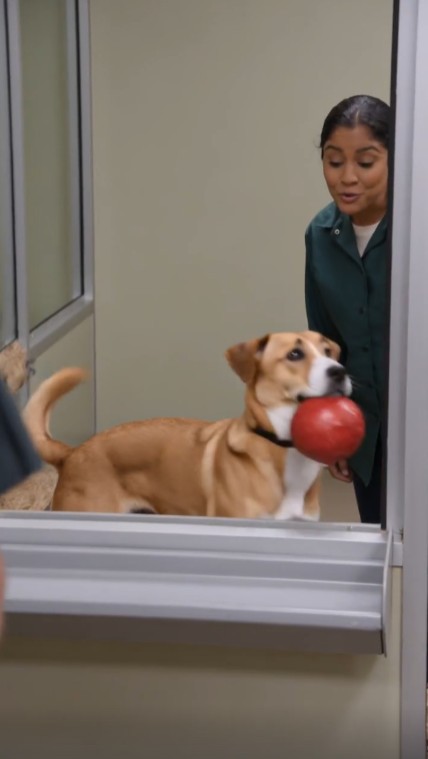
Every dog at the sanctuary loved getting a new toy.
Except Cooper.
Whenever workers gave him one…
he carried it away.
Not to his bed.
Not to his food bowl.
He brought it to another kennel.
Then walked away.
First a ball.
Then a rope toy.
Then a stuffed toy.
By Friday…
Cooper had nothing left.
The worker laughed.
“Buddy, why do you keep giving everything away?”
Then she noticed something.
Cooper wasn’t choosing random dogs.
Every toy went to a dog arriving that same day.
The newest dog got the newest toy.
Always.
The sanctuary manager checked the cameras.
Monday.
Same thing.
Tuesday.
Again.
Wednesday.
Again.
Then Saturday morning…
a nervous but healthy new rescue dog arrived.
Workers prepared a quiet kennel.
Cooper watched from his own secure area.
But this time…
he had no toys left.
He searched his bed.
Nothing.
Then Cooper did something that made the worker stop.
He picked up his favorite blanket.
The only thing he’d never given away.
He carried it toward the safe transfer point between kennel areas…
and gently left it there.
The new dog approached from the other side…
lay down beside the blanket…
and relaxed.
The worker whispered:
“He gave away the last thing he had.”
The sanctuary manager looked at Cooper’s intake history.
Then his expression changed.
“Wait…”
“What?”
He showed her one detail.
“Cooper knows exactly what the first night here feels like.”
The worker looked back at him.
“What happened his first night?”
The manager closed the file.
And the answer explained why Cooper might have been welcoming frightened newcomers before the humans even noticed.
Cooper had once been the frightened newcomer.
And on his first night…
another dog had done almost the same thing for him.
Three years earlier, Cooper arrived at Willow Creek Animal Sanctuary shortly after midnight.
He wasn’t injured.
He wasn’t starving.
But he was terrified.
The transport coordinator, Rachel Miller, remembered him immediately when current sanctuary manager Daniel Carter called her.
“You still have Cooper?”
“Still here.”
Rachel laughed.
“I can’t believe that dog.”
Daniel looked at the old intake report.
“Tell me about his first night.”
There was a pause.
“Why?”
Daniel glanced through the office window.
Cooper was lying near the kennel divider.
His blanket was still on the other side with the new dog.
“Because I think something from that night might still be happening.”
Rachel’s voice changed.
“What did he do?”
Daniel told her about the toys.
The ball.
The rope.
The stuffed animal.
And finally the blanket.
Rachel went quiet.
Then she said:
“Blue.”
Daniel frowned.
“What?”
“Was the blanket blue?”
Daniel looked through the window.
“Yes.”
Rachel laughed softly.
“Of course it was.”
Daniel sat down.
“Rachel, what happened?”
She began at the beginning.
Cooper had been approximately two years old when he arrived.
His previous owner, an elderly man named Henry Wilson, had developed health problems and could no longer care for him safely.
There had been no cruelty.
No dramatic rescue.
No abandonment on the side of a road.
Henry had simply reached the painful point where loving Cooper wasn’t enough to meet Cooper’s daily needs.
A relative contacted a local animal-welfare group.
Cooper was transferred to Willow Creek while a suitable long-term home was sought.
The transfer happened late because of transportation delays.
By the time Cooper reached the sanctuary, most dogs were sleeping.
Rachel and another worker prepared a quiet kennel.
Fresh water.
Clean bedding.
A soft toy.
They moved slowly.
No crowding.
No forcing interaction.
But Cooper wanted none of it.
He remained near the back wall.
He wouldn’t touch the toy.
He wouldn’t eat.
Every unfamiliar sound made him stand.
A metal bowl moving.
A door closing.
A dog barking two kennels away.
Footsteps in the corridor.
Rachel sat outside his kennel for almost forty minutes.
“It’s okay.”
Cooper watched her.
But he didn’t approach.
Rachel eventually left the area so he could settle without being observed.
Before going, she checked the dog in the neighboring kennel.
Her name was Daisy.
Daisy was an older mixed-breed dog.
Gentle.
Quiet.
She had been at Willow Creek for nearly four months.
Her kennel wasn’t directly connected to Cooper’s.
There was a controlled divider area between them so the dogs could not physically interact.
Daisy had a habit the workers knew well.
She carried blankets everywhere.
If workers gave her two blankets, she’d drag both into one pile.
If they moved one for cleaning, she’d immediately retrieve it afterward.
Her favorite was blue.
That night, Rachel noticed Daisy standing near the divider.
She was watching Cooper.
Rachel didn’t think much of it.
She finished her checks and walked away.
Twenty minutes later, she returned.
The blue blanket was no longer in Daisy’s bed.
It was pushed against the divider.
Cooper had moved from the back of his kennel.
He was lying on his side of the barrier…
as close to Daisy’s blanket as he could get.
Rachel remembered standing there for several seconds.
Daisy had returned to her bed.
Cooper had stopped pacing.
Rachel wrote it in the overnight notes.
12:48 AM — Daisy moved blue blanket to divider. Cooper settled adjacent on opposite side.
Daniel stared at the report.
“That actually happened?”
“I wrote it down because I thought it was unusual.”
“Did Daisy give it to him?”
Rachel immediately corrected him.
“I wouldn’t say that.”
Daniel paused.
Rachel continued.
“We don’t know what Daisy intended. Maybe she liked lying near the divider. Maybe she’d moved the blanket there before. Maybe Cooper was responding to Daisy’s scent, the blanket, her presence, or all three.”
“So we can’t say she was comforting him.”
“No.”
“But Cooper settled beside it.”
“That part we can say.”
Daniel looked through the window again.
That distinction mattered.
The sanctuary staff loved their dogs.
But they tried not to turn every interesting behavior into a human story.
They could observe what Cooper did.
They could document when he did it.
They could notice patterns.
But they couldn’t ask him why.
Rachel continued.
The following morning, Cooper was still beside the divider.
Daisy’s blue blanket remained there.
When staff cleaned the kennels, they returned the blanket to Daisy.
Later that afternoon…
Daisy moved it back.
Again.
Cooper approached.
Again.
On Cooper’s second night, he slept near the divider.
On his third day, something else happened.
A volunteer gave Daisy a rubber ball.
Daisy carried it around for several minutes.
Then dropped it near the same divider.
Cooper approached from the other side.
He lay down.
The ball remained between them, separated by the barrier.
Rachel photographed it for the behavioral log.
Daniel asked:
“Do you still have the picture?”
“Maybe.”
Rachel searched old files while they remained on the phone.
A minute later, Daniel’s email notification appeared.
He opened the photograph.
There was Cooper.
Younger.
Thinner.
Lying against the divider.
On the other side was Daisy.
Between them…
a blue blanket and a red rubber ball.
Daniel stared at it.
Then looked through the window.
Cooper was doing almost the same thing now.
Only the positions had reversed.
Three years earlier, he had been the new dog.
Now he was the established one.
Rachel asked:
“Still think that’s nothing?”
Daniel smiled.
“I definitely don’t think it’s nothing.”
“But?”
“But I don’t know what it means.”
“Good answer.”
Daniel laughed.
Rachel had trained him well.
Over the following week, Daniel and the staff decided to observe Cooper more carefully.
They didn’t encourage the behavior.
They didn’t deliberately place new dogs near him.
Kennel assignments continued to be made according to each dog’s welfare and the sanctuary’s normal procedures.
They simply recorded what happened.
Monday:
A newly arrived beagle mix named Max was placed in a kennel within Cooper’s visual range.
Cooper carried a rope toy toward the controlled divider area.
He dropped it.
Walked away.
Tuesday:
No new dog arrived.
Cooper kept both of his remaining toys.
Wednesday:
A young shepherd mix named Luna arrived.
Cooper carried a stuffed fox toward the divider.
Thursday:
No arrival.
No toy movement.
Friday:
An older dog named Buddy arrived after his owner moved into assisted living.
Cooper carried his rubber ball toward the transfer point.
Then Saturday came.
The new dog was called Rosie.
She was healthy but visibly nervous in the unfamiliar environment.
Cooper had no toys left.
Rachel wasn’t there.
But worker Emily Carter was.
Emily watched Cooper walk back to his bed.
He sniffed around.
Turned once.
Then looked toward Rosie.
Cooper picked up the blue blanket.
His favorite.
The one he slept on almost every night.
He carried it toward the divider.
Dropped it.
Then stepped away.
Rosie approached later from the opposite side.
She sniffed near the barrier.
Then lay down beside the blanket.
Her body gradually relaxed.
Emily whispered:
“He gave away the last thing he had.”
At the time, Daniel had answered emotionally.
“Cooper knows exactly what the first night here feels like.”
Later, after speaking with Rachel, he corrected himself.
They couldn’t know exactly what Cooper understood.
But they did know something fascinating.
Cooper had experienced a remarkably similar situation on his own first night.
A familiar resident dog had moved a favored blanket toward him.
Cooper had settled beside it.
Now, years later, Cooper repeatedly moved toys and eventually his own blanket toward areas associated with newly arrived dogs.
Whether he was intentionally welcoming them in the human sense couldn’t be proven.
But the behavioral pattern was real.
And it became even more interesting when Daniel searched Cooper’s older records.
Daisy wasn’t the only clue.
On Cooper’s fifth day at Willow Creek, another new dog arrived.
Rachel’s notes said Cooper had watched the intake from his kennel.
That evening, Cooper moved the red rubber ball Daisy had previously left near his divider toward the side closest to the newcomer.
At the time, nobody considered it significant.
A week later, another arrival.
Another object moved.
The behavior had apparently started much earlier than anyone realized.
Emily stared at the old records.
“He’s been doing this for three years?”
“Maybe intermittently.”
“How did nobody notice?”
“Because we weren’t looking for a pattern.”
That answer stayed with her.
In a busy sanctuary, objects moved constantly.
Dogs carried toys.
Blankets shifted.
Balls rolled.
Staff cleaned kennels and returned items.
Nobody had reason to connect a toy beside one divider on Monday with another toy beside another area two weeks later.
Until Cooper gave away everything.
Then the pattern became impossible to ignore.
Daniel contacted Rachel again.
“What happened to Daisy?”
Rachel was quiet.
“She was adopted.”
Daniel smiled.
“Good.”
“Very good.”
Daisy had been adopted by a retired teacher named Margaret Lewis.
Rachel still had the old contact information but would not share it without permission.
Instead, the sanctuary contacted Margaret directly and explained why they were asking.
Margaret agreed to speak with them.
Daisy was now thirteen.
Slower.
Gray around the muzzle.
But still alive.
And still obsessed with blankets.
Margaret laughed when Daniel told her the story.
“That sounds like Daisy.”
“Does she move things toward other dogs?”
“Not exactly. But whenever my daughter’s dog visits, Daisy drags her blanket into the hallway.”
Daniel smiled.
Again, interesting.
Again, not proof of motive.
Then Margaret said something unexpected.
“I still have the blue blanket.”
Daniel stopped.
“The original one?”
“Unless she had two identical ones.”
Margaret sent a photograph.
Faded blue fleece.
One corner repaired.
Daniel compared it with the old intake photograph.
It appeared to be the same blanket.
Margaret offered to bring Daisy for a controlled visit if the sanctuary’s staff thought it appropriate.
Daniel hesitated.
He didn’t want to stage an emotional reunion for human entertainment.
Daisy was elderly.
Cooper had not seen her in three years.
There was no guarantee either dog would respond in any meaningful way.
So the sanctuary’s animal-care team considered the dogs’ health, stress levels and normal procedures first.
They decided that if the visit happened, it would be quiet.
No crowd.
No forcing contact.
No cameras pushed into their faces.
Margaret arrived on a calm Tuesday morning.
Daisy stepped slowly from the car.
She looked smaller than Daniel expected.
Margaret carried the blue blanket.
Emily stood nearby.
Cooper remained in a separate secure area.
At first…
nothing happened.
Cooper sniffed the ground.
Daisy looked toward a tree.
Emily almost laughed.
“This is probably healthier than the movie version.”
Daniel smiled.
“Definitely.”
Then Cooper noticed Daisy.
He stopped.
Daisy noticed him.
Neither ran.
Neither barked.
Cooper approached the barrier slowly.
Daisy walked toward it.
They sniffed through the safe divider.
Then Daisy wandered away.
That might have been the entire reunion.
And that would have been fine.
But Margaret placed Daisy’s old blue blanket in her resting area.
Daisy stepped onto it.
Cooper watched.
Then Cooper walked away.
Emily’s shoulders dropped slightly.
“What were you expecting?”
Daniel asked.
“Nothing.”
“You were expecting something.”
“Maybe a little.”
Daniel smiled.
Ten minutes passed.
Then Cooper returned carrying a tennis ball.
He placed it near the divider.
Daisy didn’t touch it.
She lay on her blanket.
Cooper lay down on his side.
No dramatic embrace.
No miraculous recognition anyone could prove.
Just two older dogs resting a few feet apart.
Margaret wiped her eyes anyway.
“I know you can’t tell me they remember each other.”
Daniel nodded.
“We can’t.”
She smiled.
“But I can still enjoy this.”
“Absolutely.”
They stayed for twenty minutes.
Then Daisy went home.
Cooper kept the tennis ball.
For once, he didn’t leave it behind.
After the visit, Daniel changed one small thing at the sanctuary.
Not because he wanted every resident dog copying Cooper.
And not because toys should simply be passed between unfamiliar animals without staff oversight.
The sanctuary already had cleaning and disease-control procedures.
Those remained important.
Instead, Daniel focused on the idea behind what the staff had observed.
First nights were difficult.
Even for healthy dogs.
New smells.
New sounds.
Different people.
Different routines.
So the sanctuary developed standardized newcomer comfort kits using appropriate clean items.
A blanket.
A suitable toy when safe for that individual dog.
Familiar-smelling material from transport when appropriate.
Clear intake notes.
Quiet settling time.
Nothing revolutionary.
Good shelters and sanctuaries had long understood the importance of reducing stress.
But at Willow Creek, the staff jokingly called them Cooper Kits.
Daniel eventually stopped them.
“Don’t turn the dog into a brand.”
Emily laughed.
“You’re no fun.”
“Correct.”
The official name became First-Night Kits.
Cooper didn’t care.
He continued doing his own thing.
Sometimes a new dog arrived and Cooper moved a toy.
Sometimes he didn’t.
Sometimes he watched.
Sometimes he slept through the entire intake.
That inconsistency mattered too.
It reminded the staff not to force a neat story onto him.
Then one winter afternoon, something changed.
A family came to meet Cooper.
He had lived at Willow Creek for years.
Not because nobody wanted him.
Cooper had been considered for adoption several times.
But finding the right home took patience.
He needed a calm environment.
He didn’t enjoy crowded dog parks.
He preferred predictable routines.
He could live comfortably with the right people.
The family consisted of a woman named Anna, her husband Michael, and their adult daughter Sophie.
They had recently lost an older dog.
They weren’t looking for a puppy.
“We want the dog everyone walks past,” Anna told Emily.
Emily smiled.
“Careful saying that around here. You’ll leave with six.”
They met Cooper.
Cooper sniffed Michael’s shoes.
Ignored Sophie.
Sat beside Anna.
Then walked away.
Anna laughed.
“I think that went well.”
They returned twice.
Then again.
After the sanctuary completed its normal adoption process and everyone was comfortable with the match, Cooper was approved.
On his final morning, Emily packed his belongings.
Food information.
Medical records.
Leash.
Harness.
Two toys.
And a new blue blanket.
She placed everything near the office.
Cooper seemed to know the routine was different.
He followed Emily more closely than usual.
Then another transport vehicle arrived.
A new dog.
Young.
Nervous.
Cooper watched.
Emily immediately saw the problem.
“No.”
Cooper walked toward his belongings.
“Cooper.”
He picked up one of his new toys.
“Absolutely not.”
Daniel walked past.
“What?”
“Your favorite philanthropist is about to donate his adoption present.”
Daniel laughed.
Cooper carried the toy toward the familiar divider.
Emily looked at Daniel.
“Do we stop him?”
Daniel considered.
The toy was appropriate and could be cleaned and transferred according to their normal procedures.
He shook his head.
“Let him put it down.”
Cooper did.
He returned.
Then picked up the second toy.
Emily stepped in.
“One.”
Cooper looked at her.
“You’re allowed to own things.”
Daniel laughed.
Cooper eventually left with one toy.
His new blanket.
And his family.
Before getting into the car, Anna asked:
“What’s the story with him and toys?”
Emily looked at Daniel.
Daniel answered carefully.
“We have a theory.”
He told them about Cooper’s first night.
About Daisy.
About the blue blanket.
About the years of toys appearing near newly arrived dogs.
Anna listened.
Then asked:
“So he gives toys to scared dogs because Daisy helped him?”
Daniel smiled.
“Maybe.”
“That’s all I get?”
“That’s all we actually know.”
Sophie laughed.
“I like maybe.”
Cooper climbed into the car.
The door closed.
Emily cried.
Daniel pretended not to notice.
The car disappeared down the road.
For the first time in three years, Cooper’s kennel was empty.
That afternoon, a new dog arrived.
Emily automatically looked toward Cooper’s old space.
Then laughed at herself.
No ball appeared.
No rope toy.
No stuffed animal.
The staff prepared the First-Night Kit.
A clean blanket.
A suitable toy.
Water.
Quiet.
They gave the dog time.
That evening, Emily passed Cooper’s empty kennel again.
On the wall beside it was the old intake photograph Rachel had sent.
Young Cooper on one side of the divider.
Daisy on the other.
Blue blanket between them.
Daniel had printed it for the staff room, but Emily temporarily placed it there.
Underneath, she wrote:
FIRST NIGHT — 12:48 AM
Nothing else.
No claim that Daisy had intentionally comforted Cooper.
No claim that Cooper had consciously decided to spend the next three years welcoming every newcomer.
The photograph didn’t need an explanation.
Two dogs.
One divider.
One blanket.
And an observable pattern that seemed to echo years later.
Six months after Cooper’s adoption, Anna sent an update.
Cooper was doing well.
He slept beside their couch.
Walked the same route every morning.
Had claimed one chair as his own despite being repeatedly informed it belonged to Michael.
And he had accumulated seven toys.
Emily replied:
Seven? He finally learned to keep them?
Anna responded with a photograph.
Six toys were scattered around Cooper’s bed.
The seventh was missing.
The next photograph explained why.
Anna’s daughter had adopted a calm adult dog from another rescue.
During the dog’s first visit to the house, Cooper had carried one of his toys into the hallway.
He left it several feet from the newcomer.
Then returned to his chair.
Emily showed Daniel.
Daniel smiled.
“Interesting.”
“That’s all?”
“What do you want me to say?”
“You know what I want you to say.”
Daniel laughed.
“No.”
Emily looked at the photograph again.
“You’re impossible.”
But she knew he was right.
They couldn’t know exactly what Cooper was thinking.
Maybe the behavior had become associated with unfamiliar dogs.
Maybe it reflected social interest.
Maybe the presence of a new dog triggered a learned routine connected to objects and dividers.
Maybe the old experience with Daisy contributed.
Maybe several things did.
The uncertainty didn’t make the story weaker.
To Emily, it made it better.
Because the things they could prove were enough.
Cooper had arrived frightened.
An older dog named Daisy had moved her blue blanket toward the divider.
Cooper settled beside it.
Over the following days, objects appeared near that same divider.
Years later, workers repeatedly observed Cooper carrying his own toys toward areas associated with newly arrived dogs.
When he ran out of toys…
he carried his favorite blanket.
A nervous newcomer lay beside it.
And Cooper walked back to a bed that now contained almost nothing.
The following spring, Daisy died peacefully at home at an old age.
Margaret called the sanctuary.
Daniel answered.
“She had a good week,” Margaret said. “Then she got tired.”
“I’m sorry.”
“She had a good life.”
Margaret paused.
“I want you to have something.”
Several days later, a package arrived.
Inside was Daisy’s blue blanket.
The original.
Old.
Faded.
Repaired in two places.
Margaret had washed it before sending it.
A note was folded on top.
Daisy carried this everywhere. I don’t know what it meant to Cooper, but I know what it meant to us. Keep it if there’s a place for it.
Daniel didn’t put it into a kennel.
It was too old for regular use.
Instead, the sanctuary stored it with Daisy’s historical records and a copy of Cooper’s intake photograph.
Years passed.
New employees joined Willow Creek.
Eventually, some had never met Cooper.
During training, they heard about First-Night Kits.
One young worker asked:
“Why are you so particular about the first night?”
Emily, now a senior member of the animal-care team, answered:
“Because arrivals are stressful.”
Then she showed him the photograph.
Cooper.
Daisy.
Divider.
Blue blanket.
The worker smiled.
“Did Daisy know he was scared?”
Emily gave the same answer Daniel had taught her.
“We don’t know.”
“Did Cooper copy her?”
“We don’t know that either.”
The worker frowned.
“Then what’s the story?”
Emily pointed toward the intake note.
12:48 AM — Daisy moved blue blanket to divider. Cooper settled adjacent on opposite side.
Then she showed him later observation logs.
Toy moved after new arrival.
Another toy.
Another.
Another.
Finally, the blanket.
“This is the story,” Emily said.
“What happened.”
The worker studied the records.
Then nodded.
He understood.
Animal behavior didn’t need a human voice placed inside it to be meaningful.
Sometimes observation was more powerful.
Cooper lived many happy years with Anna and Michael.
He never became a dog who loved sharing everything.
He guarded his favorite sleeping chair fiercely from humans.
He once hid a chew behind a couch cushion and became deeply offended when Michael found it.
He stole one of Anna’s slippers every winter.
But when unfamiliar dogs visited…
Cooper often did something his family learned to watch for.
He’d find an object.
Usually a toy.
Carry it toward the hallway.
Put it down.
Then move away.
Not every time.
Not with every dog.
But often enough that Anna eventually stopped being surprised.
When Cooper became old, his walks shortened.
His muzzle turned white.
He slept more.
Anna kept a blue blanket near his bed.
Not Daisy’s.
Just another soft blue blanket.
One afternoon, Sophie visited with her dog.
Cooper was too tired to get up immediately.
The younger dog remained near the doorway.
After several minutes, Cooper stood.
Slowly.
He picked up a small stuffed toy.
Walked halfway across the room.
Dropped it.
Then returned to bed.
Sophie looked at her mother.
“He’s still doing it.”
Anna smiled.
“Apparently.”
Nobody said more.
They didn’t need to.
Back at Willow Creek, dogs continued arriving.
Some were confident.
Some were nervous.
Some wanted human attention immediately.
Others needed distance and quiet.
Each was treated as an individual.
But every newcomer received the same careful consideration on that first night.
A safe space.
Water.
Appropriate bedding.
An appropriate comfort item when suitable.
Time.
Patience.
And people who understood that the first hours in an unfamiliar place mattered.
The staff sometimes credited Cooper for reminding them.
Daniel always corrected them.
“Daisy first.”
Then Rachel would correct Daniel.
“We don’t know what Daisy meant either.”
Everyone would laugh.
That became part of the story too.
There was no need to turn either dog into something they weren’t.
Daisy had been a dog who loved blankets.
Cooper had been a frightened newcomer who settled beside one she moved.
Years later, Cooper became the resident dog who repeatedly moved his belongings toward newcomers.
Those were the facts.
The rest remained a possibility.
But on the Saturday morning that made everyone finally notice…
Cooper had nothing left to give.
His ball was gone.
His rope toy was gone.
His stuffed toy was gone.
A nervous new rescue had just arrived.
Cooper searched his bed.
Then picked up the one possession he had always kept for himself.
His favorite blue blanket.
He carried it toward the safe divider.
Dropped it.
And walked away.
The new dog approached from the other side.
Sniffed.
Lay down.
And slowly relaxed.
Emily had whispered:
“He gave away the last thing he had.”
At the time, nobody understood.
Then Daniel opened Cooper’s intake file.
And there it was.
Three years earlier.
12:48 AM.
Cooper’s first night.
A frightened dog lying beside a divider.
An older sanctuary dog named Daisy on the opposite side.
And between them…
a blue blanket.
Nobody could say for certain what Daisy intended that night.
Nobody could say exactly what Cooper remembered years later.
But the sanctuary workers knew what they had seen.
Once, when Cooper was the newcomer…
something soft had appeared beside him.
Years later, whenever another frightened dog arrived…
Cooper kept putting something soft beside them too.