
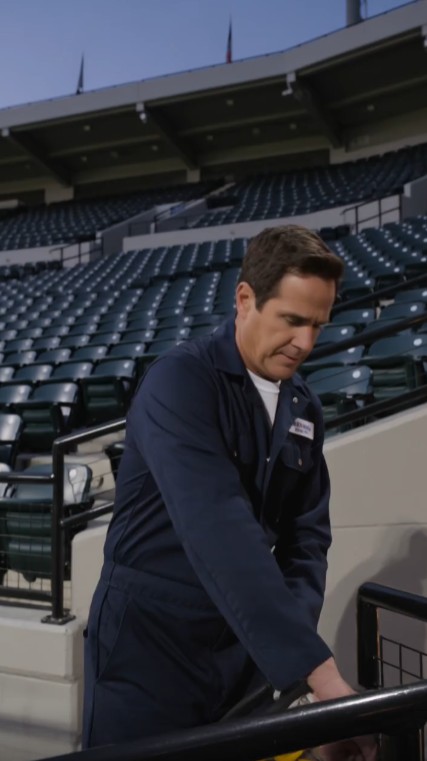
He thought he was completely alone.
The stadium had been empty for hours.
A maintenance worker named Marcus was collecting equipment after an event.
Then suddenly…
cheering erupted from the speakers.
He dropped what he was holding.
“Hello?”
Silence.
Marcus looked toward the control booth.
Dark.
He started walking toward the exit.
Then the cheering played again.
But this time…
only from one section.
Section 12.
Marcus looked up.
Every seat was empty.
Then one seat light switched on.
Row 8.
Seat 14.
Marcus stopped walking.
“No way…”
His coworker heard him over the radio.
“Marcus? What’s wrong?”
Marcus couldn’t answer.
He was staring at that seat.
His coworker asked:
“Do you know it?”
Marcus whispered:
“Yeah.”
“How?”
He slowly walked toward the section.
“My dad took me to my first game there.”
Then another seat illuminated.
And another.
And another.
A trail of lights began moving through the empty stadium.
Marcus followed from the safe aisle.
“What is this?”
His coworker answered:
“I swear I’m not controlling it.”
The lights finally stopped…
at the players’ tunnel.
Marcus reached the railing.
Then the stadium screens suddenly turned on.
But there was no video.
Just a live camera showing Marcus himself.
He stared upward.
“What the…”
Then he heard footsteps from inside the tunnel.
Dozens of them.
Marcus backed away.
“Who’s down there?”
A voice answered:
“People who know exactly what you’ve been doing here after everyone goes home.”
Marcus froze.
“What have I been doing?”
Then the first person stepped out of the tunnel…
and Marcus immediately recognized what was happening.
It was a boy named Ethan Miller.
Twelve years old.
Blue jacket.
Baseball cap two sizes too big.
And in his hands…
a baseball glove Marcus had repaired six months earlier.
Marcus covered his face.
“No.”
Ethan smiled.
“Yes.”
Behind him came his mother, Rachel.
Then another family.
Then another.
A little girl carrying a pink backpack.
An elderly man holding a baseball.
A father with two sons.
A woman Marcus recognized from Section 4.
A teenager from Section 19.
More people emerged.
Marcus looked toward his radio.
“Daniel.”
His coworker answered.
“Yeah?”
“You lied to me.”
“I said I wasn’t controlling the lights.”
“You knew about this.”
Silence.
Then Daniel laughed.
“Maybe.”
Marcus turned back toward the tunnel.
“What are all these people doing here?”
Rachel answered.
“We came to return something.”
Marcus looked at Ethan’s glove.
“I don’t want it back.”
Rachel smiled.
“Not the glove.”
She pointed toward Section 12.
“Something else.”
Marcus looked toward Row 8, Seat 14.
The seat where his father had taken him nearly thirty years earlier.
And suddenly he understood why they’d chosen it.
The story had begun there.
Long before Marcus worked at the stadium.
Long before Ethan.
Long before anyone in the tunnel knew his name.
Marcus had been eight years old when his father, Henry Reed, took him to his first professional baseball game.
They didn’t have expensive seats.
Section 12.
Row 8.
Seats 13 and 14.
Marcus remembered everything.
The smell of popcorn.
The enormous field.
The sound of thousands of people standing at once.
The way the stadium lights made the grass look almost unreal.
But he remembered something else more clearly.
During the seventh inning, Marcus dropped his glove.
It fell beneath the seats.
When he retrieved it…
the leather strap had torn.
Marcus was devastated.
It wasn’t an expensive glove.
It had belonged to his father.
Henry had used it as a teenager.
Marcus had spent the entire week imagining catching a foul ball with it.
Now the wrist strap was hanging loose.
He started crying.
His father looked at the glove.
“We can fix that.”
“No, we can’t.”
“Of course we can.”
“It’s broken.”
Henry smiled.
“Broken doesn’t always mean finished.”
After the game, they went home.
Henry sat at the kitchen table.
He found an old leather strip.
A needle.
Heavy thread.
For nearly an hour, he repaired the glove.
The stitching wasn’t beautiful.
But it held.
Henry handed it back.
“Try it.”
Marcus put it on.
Perfect.
His father said:
“See?”
Marcus smiled.
Henry tapped the repaired strap.
“Sometimes people throw things away too quickly.”
Marcus remembered that sentence for the rest of his life.
Henry died when Marcus was twenty-six.
By then, Marcus had worked several jobs.
Warehouse.
Delivery driver.
Building maintenance.
Then, nine years earlier, he was hired by the stadium’s facilities department.
It wasn’t glamorous.
Most fans never noticed him.
That was fine.
Marcus liked the building best when it was empty.
After the crowd left, the stadium became a different place.
Quiet.
Huge.
Almost peaceful.
Marcus checked seating areas.
Collected equipment.
Reported damage.
Helped with minor repairs.
Worked alongside cleaning crews.
Assisted other departments when necessary.
And like every large venue…
the stadium accumulated forgotten things.
Hats.
Gloves.
Scarves.
Children’s toys.
Souvenir cups.
Jackets.
Bags.
Most valuable or identifiable property went through the stadium’s official lost-and-found procedures.
Marcus followed those rules.
But there was another category.
Small damaged items that had been abandoned.
Things with no identifying information.
A child’s broken foam sign.
A torn baseball glove left beside a trash receptacle.
A cracked souvenir frame.
A team cap with a broken adjustment strap.
Items that appeared discarded rather than simply misplaced.
Marcus started repairing some of them.
Not everything.
Not valuable property.
Not anything that needed to remain untouched for identification.
Just small, clearly abandoned items when stadium policy allowed.
The first was a child’s baseball glove.
Marcus found it after a Tuesday night game.
The leather was cheap.
One lace had snapped.
It reminded him immediately of his father.
He took it to the maintenance room.
Found replacement cord.
Repaired it.
Then he didn’t know what to do with it.
His supervisor, Daniel Carter, saw it the following morning.
“What’s that?”
“Nothing.”
“You’re repairing garbage now?”
Marcus shrugged.
“Good glove.”
“It was in the discard pile.”
“Not anymore.”
Daniel laughed.
“What are you going to do with it?”
Marcus didn’t know.
A week later, the stadium hosted a community youth event.
Marcus asked whether the repaired glove could be donated through the stadium’s community-relations team.
They checked it.
Approved it.
A volunteer placed it with other donated sports equipment.
Marcus forgot about it.
Then he repaired another.
And another.
Not just gloves.
A backpack zipper.
A cap strap.
A small radio casing.
A plastic sign.
Again, only items that were safe, appropriate, and cleared for reuse.
Daniel started teasing him.
“You know stores sell new things, right?”
Marcus always gave the same answer.
“Broken doesn’t always mean finished.”
Daniel never knew where the phrase came from.
Then something happened after a Saturday afternoon game.
Marcus was checking Section 22 when he saw a family still sitting in the nearly empty stands.
A father.
A mother.
Two boys.
One of the boys was crying.
Marcus approached carefully.
“Everything okay?”
The father looked embarrassed.
“My son’s glove disappeared.”
Marcus immediately contacted guest services.
They checked lost-and-found.
Nothing.
The boy was maybe nine.
His name was Noah.
He’d saved allowance money for months to buy the glove.
It wasn’t expensive.
But to Noah, it mattered.
Marcus couldn’t replace a lost item from official inventory.
So he did what he was supposed to do.
He helped the family file a report.
They left.
Three days later, the glove was found beneath a folded seat several rows away.
Guest services contacted the family.
The glove was returned.
Marcus thought the story was over.
Then Noah sent a thank-you card.
Not to guest services.
To:
The man who stayed after the game and helped me look.
Nobody knew Marcus’s last name.
Daniel put the card in the maintenance room.
Marcus hated the attention.
“It was my job.”
Daniel shrugged.
“The kid still wanted to say thank you.”
Over time, staff began noticing something about Marcus.
If a family remained after an event because something was missing…
Marcus stayed when his duties allowed.
He checked beneath seats.
Asked the appropriate departments.
Walked aisles.
Helped people navigate the official lost-and-found process.
He never promised an item would be recovered.
Often it wasn’t.
But he looked.
That was the part people remembered.
Rachel Miller remembered.
She was the woman now standing beside Ethan in the players’ tunnel.
Six months earlier, Ethan had attended his first game.
He carried a glove that had belonged to his grandfather.
During the game, one of its old leather laces snapped.
Rachel told him they’d fix it at home.
But Ethan was upset.
After the crowd left, Marcus happened to see them near the concourse while finishing his rounds.
He asked if they needed help.
Rachel explained.
Marcus looked at the glove.
Then at Ethan.
“First game?”
Ethan nodded.
Marcus smiled.
“Mine broke at my first game too.”
Ethan looked surprised.
“What happened?”
“My dad fixed it.”
Marcus asked Rachel if she wanted directions to guest services for a temporary repair recommendation.
Rachel said they could handle it at home.
But Marcus noticed Ethan staring at the field.
So he said:
“Tell you what. If you have five minutes, I might have a replacement lace in the maintenance kit. Your mom stays right here with you. I’ll check.”
He returned with a suitable leather lace and a small approved hand tool.
With Rachel’s permission, he repaired the loose section while they waited.
Nothing dramatic.
Five minutes.
Maybe six.
Then Marcus handed the glove back.
Ethan put it on.
Opened his hand.
Closed it.
Marcus smiled.
“Good?”
Ethan nodded.
“What do I owe you?”
Rachel asked.
Marcus laughed.
“Nothing.”
“You sure?”
“Absolutely.”
Then he repeated the sentence his father had once told him.
“Broken doesn’t always mean finished.”
Rachel remembered it.
Ethan remembered it too.
Marcus did not realize anyone else was listening.
An usher named Anna Wilson stood several yards away.
She heard the sentence.
A week later, Anna saw Marcus repairing the strap on a child’s abandoned cap in the maintenance room.
She asked:
“Another one?”
Marcus looked embarrassed.
“Don’t start.”
Anna laughed.
Then she told Daniel.
Daniel already knew.
But Anna began noticing more.
Marcus kept a small box on a maintenance shelf.
Inside were approved reusable items waiting to go through the stadium’s community donation process.
Nothing valuable.
Nothing taken from lost-and-found.
Just repaired items that otherwise would’ve been discarded.
A glove.
Two caps.
A small backpack.
Several foam seat cushions.
Marcus had even cleaned an old equipment bag and replaced its zipper pull.
Once enough items accumulated, he sent them through the proper stadium program.
He never attached his name.
He never attended the donation events.
He didn’t even know who received most of them.
Then Ethan’s mother contacted the stadium.
She wanted to thank “the maintenance worker who repaired my son’s grandfather’s glove.”
Guest services identified Marcus.
Rachel sent a letter.
Daniel gave it to him.
Marcus read it.
Then placed it in his locker.
That should have been the end.
But Rachel mentioned something in the letter.
Ethan had become obsessed with the sentence:
Broken doesn’t always mean finished.
He started using it at home.
When his little sister’s toy truck lost a wheel, Ethan tried to repair it.
When a classmate wanted to throw away a pencil case because the zipper pull broke, Ethan attached a key ring.
Rachel wrote:
I know you were talking about a glove. But I think he heard something bigger.
Marcus never responded.
Not because he didn’t care.
He didn’t know what to say.
So he put the letter in his locker.
Daniel saw him reading it again weeks later.
That was when Daniel finally asked:
“Where did that sentence come from?”
Marcus told him about Henry.
Section 12.
Row 8.
Seat 14.
First game.
Broken glove.
Kitchen table.
Daniel didn’t say much.
But he remembered every detail.
Months passed.
The stadium’s community-relations department began receiving more messages.
A father wrote that Marcus had helped search for his daughter’s missing backpack after a concert.
It had later been found through official lost-and-found.
An elderly fan said Marcus had walked with him through three sections looking for a scarf his late wife had knitted.
They never found it.
But the man remembered Marcus refusing to rush him.
A mother wrote that Marcus had found her son’s handmade sign after most of the crowd had left.
A teenager said Marcus had repaired a loose strap on a bag while directing him to guest services.
None of these were extraordinary.
Marcus wasn’t saving lives.
He wasn’t secretly giving away thousands of dollars.
He was simply still there…
after most people had gone home.
And when someone was worried about something small, Marcus treated it as though it mattered.
Then Daniel discovered the repaired-item donations.
“How long?”
Marcus shrugged.
“Few years.”
“How many?”
“No idea.”
The community team did.
They checked their records.
At least 146 repaired or restored low-value items had come from Marcus’s maintenance box over several years.
Many went into larger community equipment distributions.
No one could trace every object to a specific recipient.
That wasn’t the point.
Daniel asked:
“Why didn’t you tell anyone?”
Marcus frowned.
“Tell them what?”
“That you’re doing this.”
“I’m fixing stuff headed for disposal.”
“After your shift.”
“Sometimes.”
“Why?”
Marcus looked at him as if the answer were obvious.
“My dad fixed things.”
That was all.
Daniel decided to do something.
But not alone.
He contacted Rachel.
Rachel contacted Ethan’s youth coach.
The stadium community team contacted several people who had previously written thank-you messages.
Anna contacted former staff.
Guest services found other notes addressed to Marcus.
The idea grew.
They wanted to surprise him.
Daniel objected to making it too big.
“Marcus will walk out.”
Rachel agreed.
“No media.”
“No public announcement.”
“No giant ceremony.”
“No pretending he personally changed hundreds of lives.”
They kept it private.
People were invited only if they had a direct connection to Marcus or to one of the stadium’s documented community programs.
Then Daniel remembered Section 12.
Row 8.
Seat 14.
The stadium’s technical team helped program the seat lights used for special events.
The audio crew prepared a short crowd-cheer recording.
The screen operator set up a live camera.
Daniel scheduled Marcus for routine post-event equipment collection.
Marcus suspected nothing.
Now he stood beside the players’ tunnel.
Ethan stepped forward.
“You remember this?”
He held up the repaired glove.
Marcus smiled.
“Yeah.”
“My grandpa gave it to me.”
“I remember.”
Ethan turned it over.
The repaired lace was still there.
Then Ethan handed Marcus something else.
A small leather strip.
Marcus frowned.
“What is this?”
“Turn it over.”
Written on the back:
BROKEN DOESN’T ALWAYS MEAN FINISHED.
Marcus looked at Rachel.
“You did this?”
“No.”
Ethan smiled.
“I did.”
Marcus laughed.
“You ruined a perfectly good piece of leather to write that?”
“It was scrap.”
“Good answer.”
Then another person stepped forward.
The elderly man from Section 4.
Thomas Wilson.
Marcus recognized him.
“The scarf.”
Thomas nodded.
“We never found it.”
Marcus’s smile faded.
“I remember.”
Thomas held up a new scarf.
“My daughter made me another.”
“That’s good.”
Thomas smiled.
“But that’s not why I’m here.”
He explained.
The night the original scarf disappeared, Thomas had been devastated because his late wife had knitted it.
Marcus had spent almost forty minutes helping him look.
Nothing.
Before Thomas left, Marcus had written the lost-and-found number on a piece of cardboard because Thomas’s phone battery was dead.
Thomas still had that cardboard.
He pulled it from his wallet.
Folded.
Soft at the edges.
Marcus stared.
“You kept that?”
Thomas laughed.
“Apparently I’m sentimental.”
One by one, people told their stories.
Not every story ended perfectly.
A lost hat had never been found.
A child’s missing souvenir remained missing.
A backpack had been recovered.
A wallet had been returned through guest services.
A glove had been repaired.
Some people had received refurbished equipment through community programs without knowing Marcus had repaired any of it.
Daniel was careful to explain that those programs involved many employees, donors and volunteers.
Marcus wasn’t responsible for everything.
But he had contributed quietly for years.
Then Rachel said:
“There’s one more person.”
Marcus looked toward the tunnel.
A woman stepped out.
She was carrying an old cardboard box.
Marcus didn’t recognize her.
“My name is Sophie Carter.”
She opened the box.
Inside was a baseball glove.
Old.
Brown.
Stitched along the wrist.
Marcus stopped breathing for a second.
“No.”
Sophie looked at him.
“You recognize it?”
Marcus walked closer.
“That looks like…”
He touched the leather.
The stitching.
The old repair.
“My dad’s glove.”
Daniel stepped forward.
“We weren’t sure.”
Marcus looked at him.
“Where did you get this?”
Daniel explained.
After Henry died, Marcus’s family had cleared his apartment.
Marcus believed the old glove had been lost during the move.
He hadn’t seen it in nearly fifteen years.
But Henry had donated several boxes to a neighborhood youth recreation center shortly before his health declined.
The center later closed.
Some of its old equipment was transferred to another community organization.
Sophie worked there.
When Daniel began asking about Henry Reed and an old repaired glove, Sophie checked their stored equipment.
One glove had a name written faintly inside:
H. REED
Marcus took it.
His hands trembled.
He turned the wrist toward the light.
There it was.
The ugly repair.
His father’s repair.
Still holding.
Marcus sat down on the nearest bench.
For the first time that night, nobody spoke.
Ethan looked at his mother.
Rachel wiped her eyes.
Marcus put his hand inside the glove.
Too small now.
But familiar.
He laughed quietly.
“He told me not to throw it away.”
Daniel sat beside him.
“He apparently didn’t either.”
Marcus looked toward Section 12.
Row 8.
Seat 14 was still illuminated.
“That was the glove I wore there.”
Daniel nodded.
Marcus’s eyes filled.
“You found my dad’s glove?”
“Sophie found it.”
Marcus looked at her.
“Thank you.”
She smiled.
“We almost gave that box away last year.”
Marcus looked down at the repaired leather.
“Would’ve been okay.”
Sophie seemed surprised.
Marcus continued.
“My dad donated it. He wanted somebody to use it.”
He looked toward Ethan.
“Maybe it should still be used.”
Ethan immediately shook his head.
“No. That’s yours.”
Marcus smiled.
“For tonight.”
But Daniel had another surprise.
Not a dramatic one.
He handed Marcus a folder.
Inside was a copy of the community center’s old inventory sheet.
Henry Reed’s name appeared beside a donation.
Sports equipment — 11 gloves, 6 baseballs, 2 bats.
Marcus stared.
“Eleven gloves?”
Sophie nodded.
“Your father repaired equipment too.”
Marcus looked at Daniel.
“You knew this?”
“Found out last week.”
Marcus laughed through tears.
“All these years I thought I was copying one thing he did at the kitchen table.”
Daniel shook his head.
“Apparently you were copying a lot more than that.”
Henry hadn’t only repaired Marcus’s glove.
After retiring, he’d spent years collecting used sports equipment from neighbors.
He cleaned it.
Replaced laces.
Repaired straps.
Then donated it to local youth programs.
Marcus never knew.
Henry never mentioned it.
Maybe because, to Henry, it wasn’t remarkable.
Broken glove.
Fix it.
Kid needs one.
Give it away.
That simple.
Marcus looked around at the people gathered near the tunnel.
“So this whole thing is because I fix old stuff?”
Rachel shook her head.
“No.”
“Then what?”
Ethan answered.
“Because you don’t act like small things are small.”
Marcus stared at him.
Ethan continued.
“My glove wasn’t important to the stadium.”
Marcus nodded.
“No.”
“But it was important to me.”
Marcus looked down at Henry’s glove.
That sentence landed harder than anything else that night.
Daniel stood.
“That’s what people kept saying.”
The lost scarf wasn’t valuable to the stadium.
But it mattered to Thomas.
The child’s sign wasn’t valuable.
But she’d made it with her father.
The old glove wasn’t valuable.
But it belonged to Ethan’s grandfather.
Marcus had never needed the objects to be expensive before treating them carefully.
He only needed someone to care about them.
Rachel pointed toward the stadium screen.
It changed.
The live image of Marcus disappeared.
A simple photograph appeared.
Not text.
A photograph of Section 12.
Row 8.
Seat 14.
Then another photograph.
A young Marcus beside Henry.
Marcus stared.
“Where did you get that?”
His sister.
Daniel had contacted her.
The photograph had been taken on the day of Marcus’s first game.
Eight-year-old Marcus stood outside the stadium.
His father beside him.
And on Marcus’s left hand…
the old brown glove.
The same one now resting in his lap.
Marcus lowered his head.
He couldn’t hide the tears anymore.
Nobody cheered.
Nobody applauded.
They simply let him have the moment.
Finally Marcus looked at Daniel.
“I hate you.”
Daniel smiled.
“I know.”
“You put my face on a forty-foot screen.”
“Technically the video team did.”
“You’re all terrible people.”
Ethan laughed.
Then the stadium speakers activated again.
Not cheering this time.
A recording of a baseball crowd from years earlier.
Daniel had found archival stadium ambience from the approximate era of Marcus’s first game.
It wasn’t necessarily the exact game.
Daniel made that clear.
But the sound was familiar enough.
Marcus closed his eyes.
For a second…
he was eight again.
Section 12.
His father beside him.
Broken glove under the seat.
“Broken doesn’t always mean finished.”
When Marcus opened his eyes, Ethan was still standing there.
He looked at the boy’s glove.
Then at his father’s.
Two repairs.
Nearly thirty years apart.
Same idea.
Marcus stood.
“Okay.”
Daniel smiled.
“Okay what?”
“Can we turn the stadium off now?”
Everyone laughed.
The surprise ended shortly afterward.
No reporters arrived.
No video was posted publicly without permission.
Most people went home.
Marcus stayed.
Of course he did.
There was still equipment to collect.
Rachel watched him pick up a storage case.
“You’re working?”
Marcus looked confused.
“Yes.”
“After all that?”
“Someone has to put this stuff away.”
Daniel laughed.
“That is the most Marcus answer possible.”
Ethan and Rachel left.
Thomas left.
Sophie left.
Eventually, the stadium was empty again.
Marcus carried Henry’s glove into the maintenance room.
He placed it carefully inside his locker.
Then changed his mind.
He took it back out.
The following week, Marcus contacted Sophie.
“I’ve been thinking about the glove.”
“You want us to preserve it?”
“No.”
“What then?”
He wanted it repaired properly.
Not restored to look new.
Just made safe enough to display and, if appropriate, eventually use in a community program honoring Henry’s original intent.
Sophie loved the idea.
The glove became part of a small stadium community initiative.
Not named after Marcus.
He refused.
Instead, they called it the Second Inning Equipment Project.
Fans could donate suitable used sports equipment through designated channels.
Items were professionally assessed.
Anything unsafe was discarded.
Anything usable was cleaned or repaired appropriately.
Then approved equipment went to community youth programs.
Marcus helped.
So did many others.
But he made Daniel promise one thing.
“No speeches about me.”
Daniel agreed.
“No synchronized phones.”
“Wrong story.”
“No stadium lights.”
“Definitely.”
“No giant screen.”
Daniel hesitated.
“Daniel.”
“Fine.”
Marcus continued his maintenance work.
He still stayed late.
Still looked under seats.
Still helped guest services when he could.
Still repaired small approved items when appropriate.
But now other employees joined him occasionally.
Anna learned to replace glove laces.
Daniel became surprisingly good at repairing backpack straps.
Marcus mocked him relentlessly.
One evening, a young maintenance employee named Noah saw Marcus repairing a worn equipment bag.
“Why bother?”
Marcus didn’t look up.
“Still usable.”
“Wouldn’t buying a new one be faster?”
“Probably.”
“Then why fix it?”
Marcus paused.
For years, he’d answered that question with his father’s sentence.
This time he said something different.
“Because somebody might care about this one.”
Noah nodded.
Then sat beside him.
“Show me.”
Marcus handed him the replacement strap.
Years passed.
Section 12 changed during a stadium renovation.
The seats were replaced.
Marcus asked if he could purchase or receive Seat 14 if venue policy allowed.
Daniel checked.
The stadium approved it as part of a staff memorabilia program involving removed seats.
Marcus took it home.
He placed it in his garage.
Above it hung one photograph.
Marcus and Henry outside the stadium.
First game.
Old glove.
No plaque.
No dramatic inscription.
Marcus didn’t need one.
Ethan kept visiting games.
He grew taller.
The oversized cap eventually fit.
The repaired glove survived.
When Ethan was sixteen, he volunteered with the Second Inning project.
Marcus found him inspecting donated equipment.
“You know we have trained people for that?”
Ethan smiled.
“I’m sorting.”
“You’re terrible at sorting.”
“You taught me.”
“That explains it.”
Ethan picked up an old glove.
One lace was broken.
He looked at Marcus.
“Finished?”
Marcus smiled.
“You tell me.”
Ethan carried it to the repair assessment table.
Marcus watched him go.
Then continued working.
That evening, long after the crowd left, Marcus walked through Section 12.
The original Seat 14 was gone.
New seats.
New lighting.
New railings.
For a moment, Marcus missed the old stadium.
Then he heard laughter from the concourse.
Ethan and several volunteers were carrying repaired equipment toward storage.
Marcus smiled.
Maybe his father had been right about more than gloves.
Broken didn’t always mean finished.
Old didn’t always mean useless.
And something didn’t have to last forever to matter.
Years after the surprise, new employees still heard the story.
They usually exaggerated it.
“Every seat in the stadium lit up.”
Marcus corrected them.
“No.”
“The entire team came out of the tunnel.”
“No.”
“Twenty thousand people were hiding outside.”
“Absolutely not.”
The truth was simpler.
A few dozen people.
An empty stadium.
A trail of lights.
One old seat.
One old glove.
And a maintenance worker who had spent years doing small things after the crowds disappeared.
Not because he expected anyone to notice.
Because his father had taught him that something being damaged didn’t automatically mean it had stopped mattering.
That was why Marcus had frozen when the first seat illuminated.
Section 12.
Row 8.
Seat 14.
He hadn’t sat there in nearly thirty years.
But he remembered exactly what had happened.
A little boy looked down at a broken glove and thought the night was ruined.
His father took it home.
Sat at the kitchen table.
Repaired it.
Then said six words Marcus never forgot:
“Broken doesn’t always mean finished.”
Decades later, Marcus had quietly repeated that lesson hundreds of times.
A glove.
A strap.
A backpack.
A cap.
Sometimes even just a few extra minutes searching beneath empty seats because somebody had lost something that mattered to them.
He thought nobody noticed.
He was wrong.
And on one quiet night, hours after everyone was supposed to have gone home, the cheering suddenly returned.
One seat lit up.
Then another.
Then another.
Marcus followed the lights to the players’ tunnel.
He heard footsteps.
Dozens of them.
Then Ethan emerged holding the glove Marcus had repaired.
And Marcus finally understood.
The people walking toward him weren’t there because he’d done one enormous thing.
They were there because he’d done hundreds of small things…
when he thought the stadium was empty.