
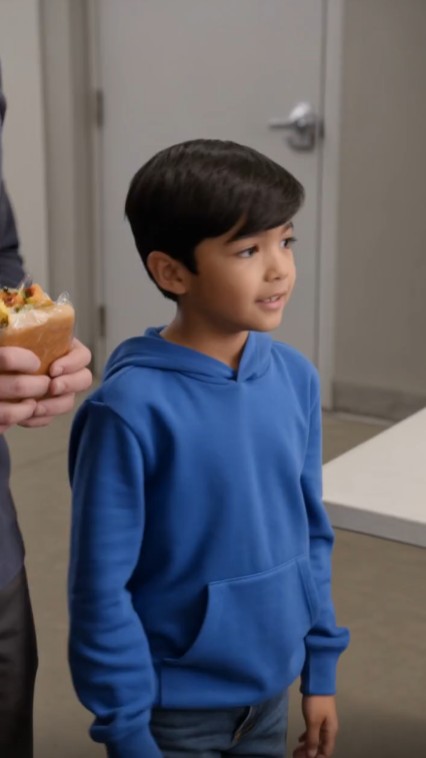
Every Saturday…
a father and his 10-year-old son ate lunch at the same food court.
But before taking his first bite…
Noah always did something strange.
He bought one extra sandwich.
Walked across the room…
and placed it on an empty table.
His father finally asked:
“Noah, who is that for?”
The boy shrugged.
“Someone who might need it.”
Week after week…
same thing.
Sometimes the sandwich disappeared.
Sometimes it didn’t.
Then one Saturday…
Noah placed the sandwich down.
Turned around…
and froze.
There were already twenty sandwiches on the table.
He ran back to his father.
“Dad!”
His father stared.
“I didn’t do that.”
Then another family arrived.
Their daughter placed a sandwich on the table.
Then another person.
Then another.
Within minutes…
people Noah had never met were adding food.
The boy looked completely confused.
“Why are they doing my thing?”
An adult woman approached him.
“Because somebody saw you.”
Noah frowned.
“Who?”
She pointed toward a man standing across the food court.
Noah didn’t recognize him.
The man walked over.
Knelt only to Noah’s eye level while Noah’s father remained beside him.
And said:
“You left the first sandwich for me.”
Noah stared at him.
“I did?”
The man smiled.
“Six months ago.”
Then he pointed around the food court.
“But I didn’t eat it.”
Noah looked confused.
“What did you do with it?”
The man’s eyes filled with tears.
“I gave it to somebody who needed it more.”
Then he pointed toward the twenty sandwiches.
“And that person did the same thing.”
Noah looked around.
“How many people?”
The man smiled.
“That’s why everybody came today.”
Noah’s father, Daniel Carter, stepped closer.
“Wait.”
He looked at the man.
“You’re saying all these people are connected to one sandwich?”
The man shook his head.
“Not exactly.”
His name was Marcus Reed.
And the real story was stranger than Noah imagined.
Six months earlier, Marcus had been sitting alone at the far end of the food court.
He was forty-two.
He’d worked for the same furniture warehouse for almost nine years.
Then the company downsized.
Marcus lost his job.
He found temporary work quickly, but the hours were inconsistent.
Some weeks were fine.
Others weren’t.
That particular Saturday had been bad.
Marcus had spent the morning filling out applications.
His bus home wasn’t due for another hour.
He entered the shopping center to get out of the cold.
He had enough money in his wallet to buy lunch.
Technically.
But that money was supposed to last until Monday.
So Marcus bought coffee.
Nothing else.
Then he noticed a boy walking across the food court.
Noah.
The boy placed a wrapped sandwich on an empty table.
Then returned to his father.
Marcus assumed they’d forgotten it.
Five minutes passed.
Nobody returned.
Ten minutes.
Still there.
Marcus finally approached.
There was a small piece of paper beneath it.
Three words written in a child’s handwriting:
IF YOU NEED IT
Marcus looked around.
Noah was already eating lunch with Daniel.
He had no idea who would take the sandwich.
Marcus picked it up.
For a moment, he intended to eat it.
Then he heard someone behind him.
“Excuse me.”
An elderly woman was standing near one of the food counters.
Her name was Margaret Wilson.
She was counting coins.
Then counting them again.
The employee behind the counter was waiting patiently.
Margaret looked embarrassed.
“Take the soup off.”
Marcus glanced at the sandwich in his hand.
He walked toward her.
“Ma’am?”
Margaret turned.
“You want this?”
She looked at the sandwich.
“No, thank you.”
“It’s already paid for.”
“I can’t take your lunch.”
“It isn’t mine.”
Marcus pointed toward the empty table.
“A kid left it for somebody who needed it.”
Margaret stared at him.
Then toward Noah.
“Why?”
Marcus shrugged.
“I don’t know.”
Margaret hesitated.
Then accepted it.
“Thank you.”
Marcus smiled.
“Don’t thank me.”
He returned to his coffee.
And that should have been the end of it.
But Margaret didn’t eat the sandwich either.
Not immediately.
She put it inside her shopping bag.
Twenty minutes later, while waiting for her daughter to pick her up, Margaret saw a young delivery driver sitting near the entrance.
His name was Thomas Miller.
He was on his break.
His lunch bag had fallen from his bicycle earlier that afternoon.
He had planned to wait until dinner.
Margaret asked:
“Have you eaten?”
Thomas laughed.
“Does coffee count?”
She handed him Noah’s sandwich.
Thomas tried to refuse.
Margaret told him what Marcus had told her.
“A little boy left it for someone who needed it.”
Thomas looked across the food court.
By then, Noah and Daniel were gone.
Thomas ate the sandwich.
So technically…
the sandwich stopped there.
It didn’t somehow travel through twenty people.
But the idea didn’t.
The following Saturday, Thomas returned.
He bought two sandwiches.
One for himself.
One extra.
He wasn’t sure what to do with the second.
Leaving unattended food on a table didn’t seem like a good long-term system, and the shopping center had rules about abandoned items.
So Thomas asked the food-court manager, Emily Carter, whether there was a safe way to offer it.
Emily listened to his story.
“A kid does what?”
“Leaves an extra sandwich.”
“Here?”
“Apparently.”
Emily knew exactly who he meant.
She had seen Noah before.
Every Saturday.
Same father.
Same son.
Same extra sandwich.
Employees had occasionally removed the food when it sat too long because they couldn’t leave unattended food indefinitely.
Emily had wondered why the boy kept doing it.
Now she knew.
Thomas handed her the second sandwich.
“If somebody asks for help today, give them this.”
Emily agreed.
Later that afternoon, a college student named Rachel came to the counter.
Her card was declined.
She looked horrified.
“Sorry. Cancel it.”
Emily remembered Thomas.
“We have an extra sandwich that’s already been paid for, if you’d like it.”
Rachel hesitated.
“Why?”
Emily told her.
Rachel accepted it.
The following week, Rachel returned.
Not with a sandwich.
With a $10 food-court gift card.
“For the next person.”
Emily smiled.
“You don’t owe anything.”
“I know.”
“Seriously.”
Rachel nodded.
“I know. I just want to.”
That distinction became important.
Nobody was required to repay anything.
Receiving lunch didn’t create a debt.
Some people never returned.
Some couldn’t.
Some simply accepted help and continued with their day.
That was exactly how it was supposed to work.
But some people did return.
And when they did…
they sometimes brought something.
A sandwich.
A meal voucher.
Five dollars.
A gift card.
Or simply another story.
Emily began keeping notes.
Not names at first.
Just dates.
January 18 — extra sandwich from bicycle courier.
January 25 — $10 gift card from student who received sandwich.
February 1 — gift card used for father with two children.
February 8 — father returned with two prepaid meal vouchers.
Then something unexpected happened.
The father who received the meal was named Henry Walker.
One of the vouchers he later left was used by a nursing assistant named Anna.
Anna told her coworker Michael about it.
Michael visited the food court weeks later and bought an extra meal.
That meal went to an elderly man.
The elderly man didn’t return with food.
Instead, he told his daughter what had happened.
His daughter worked at a nearby school.
She mentioned the story during a class discussion about community.
One student asked:
“Who started it?”
Nobody knew.
The story had already become vague.
A boy.
An extra sandwich.
An empty table.
That was all.
Then another student said:
“Maybe we should do it too.”
The teacher was careful.
She didn’t want children leaving unattended food around public spaces.
So the class worked with a local community pantry instead.
Families who wanted to participate donated sealed approved snacks and shelf-stable food.
Nobody was required to contribute.
No child was pressured.
It was simply an optional class project inspired by the story.
Marcus knew none of this.
Neither did Noah.
Every Saturday, Noah continued arriving with Daniel.
And every Saturday, he asked for one extra sandwich.
Daniel had initially assumed it was a phase.
It wasn’t.
Finally, one afternoon, Daniel asked:
“Why do you do this?”
Noah shrugged.
“I told you.”
“Someone might need it.”
“But why a sandwich?”
Noah looked confused.
“Because we’re buying sandwiches.”
Daniel laughed.
“No, I mean why did you start?”
Noah thought for a moment.
Then reminded his father of something Daniel had forgotten.
Months earlier, before the tradition began, Noah had seen a man sitting outside the food court while they were leaving.
The man wasn’t asking anyone for money.
He was simply sitting there.
Noah had been carrying half a sandwich he couldn’t finish.
He asked Daniel:
“Can I give it to him?”
Daniel had hesitated.
He didn’t know the stranger.
He didn’t know whether offering opened food would be appropriate.
So Daniel said:
“Not that one. But if you want, we can buy a new one and ask.”
They did.
The man accepted.
The following Saturday, Noah remembered.
“Can we get an extra one again?”
Daniel agreed.
There was no grand plan.
No campaign.
No social media post.
Just a 10-year-old who had remembered something his father had almost forgotten.
By the third month, Emily finally approached Daniel.
“Are you Noah’s dad?”
Daniel immediately looked concerned.
“Did he do something?”
Emily laughed.
“No.”
She explained what had been happening.
Daniel stared at her.
“You’re telling me people have been adding meals because they saw him?”
“Some of them.”
“Does Noah know?”
“No.”
“Please don’t tell him yet.”
Emily looked surprised.
“Why?”
Daniel glanced toward his son.
Noah was carefully placing his Saturday sandwich on the usual table.
“I don’t want him thinking every good thing he does turns into something huge.”
Emily understood.
Daniel continued:
“Sometimes you do something kind and nothing comes back.”
“Agreed.”
“I want him to know that’s okay too.”
So Emily kept quiet.
The food court made one change, however.
She explained to Daniel that leaving unattended food on tables wasn’t ideal.
Together, they created a safer arrangement.
Noah could purchase the extra sandwich, but instead of leaving it unattended, he handed it to the staffed customer-service point.
If someone needed it, staff could offer it appropriately while following the center’s food-handling rules.
Noah agreed.
Mostly.
He missed his table.
So Emily placed a small sign there during the Saturday lunch period.
No names.
No dramatic slogan.
Just:
EXTRA MEAL? ASK AT THE COUNTER.
Noah approved.
Then Marcus returned.
He hadn’t visited the shopping center for nearly five months.
By then, things were better.
He’d found full-time work maintaining equipment at a distribution center.
His hours were stable.
He was paying bills again.
One Saturday, he stopped at the food court.
He saw the sign.
Then he saw Noah.
Marcus froze.
He remembered him immediately.
Same boy.
A little taller.
Same father.
Same Saturday lunch.
Marcus approached Emily.
“Is that the kid?”
Emily looked at him.
“What kid?”
“The sandwich.”
She studied Marcus’s face.
“Were you one of the people who got one?”
Marcus smiled.
“Sort of.”
He told her about Margaret.
Then Emily started laughing.
“What?”
“You have no idea what happened after that.”
She brought out her notebook.
By then, the notes had become more detailed.
Not because she was tracking generosity like a scoreboard.
She simply wanted the food-court staff to know what funds or prepaid meals were available.
But as she flipped through the pages, Marcus began recognizing a chain.
Thomas.
Rachel.
Henry.
Anna.
Names connected by meals and small acts.
Some branches could be followed.
Others couldn’t.
Some stories had nothing to do with Noah at all.
Emily was careful about that.
“This isn’t one perfect chain,” she explained.
Marcus nodded.
“Of course not.”
“But you’re the earliest person I’ve met who actually saw Noah leave one.”
Marcus looked across the food court.
Noah was laughing with his father.
“Does he know?”
“No.”
Marcus smiled.
“Good.”
Emily raised an eyebrow.
“You don’t think we should tell him?”
“Not like this.”
“What do you mean?”
Marcus pointed toward the notebook.
“If you tell a 10-year-old he caused all this, he’ll either think he’s a superhero or feel responsible for fixing the world.”
Emily smiled.
“His father said almost the same thing.”
So they waited.
But the story kept growing.
Not in some impossible chain where one sandwich physically passed through dozens of hands.
Instead, people repeated the idea.
Someone received lunch and later bought lunch for another person.
Someone heard the story and donated to a pantry.
Someone else paid for a coworker’s meal.
A local family started keeping two grocery-store gift cards in their car for situations when they wanted to help.
A teacher’s class collected approved pantry items.
A delivery driver began carrying an extra sealed snack on long shifts.
Most of these actions couldn’t be proven to have happened solely because of Noah.
People had their own reasons for helping.
Many had helped others long before they heard the sandwich story.
Marcus understood that.
So did Emily.
But there was a smaller group whose connection was clear.
Twenty-three people.
Each could identify a specific moment when they’d either received one of the prepaid meals connected through the food court or directly participated after hearing the story from someone who had.
Marcus had an idea.
Not a fundraiser.
Not a public event.
A thank-you.
He called Daniel.
At first, Daniel said no.
“I don’t want cameras.”
“No cameras.”
“No news.”
“Agreed.”
“No giant presentation telling my son he’s responsible for twenty people’s lives.”
“Definitely not.”
Daniel paused.
“What exactly do you want to do?”
Marcus smiled.
“Saturday lunch.”
Six months after Marcus first picked up Noah’s sandwich…
the plan happened.
Noah arrived with Daniel as usual.
They ordered lunch.
Noah bought his extra sandwich.
He walked toward the table.
Then stopped.
Twenty sandwiches were already there.
Not unattended meals meant to sit around indefinitely.
They had been purchased moments earlier and were about to be transferred through a prearranged donation partnership after the gathering.
But Noah didn’t know that yet.
He ran toward his father.
“Dad!”
Daniel stared.
“I didn’t do that.”
Technically true.
Then a family approached.
Their daughter placed another wrapped sandwich with the others.
Another person came.
Then another.
Noah looked around.
“Why are they doing my thing?”
Emily approached.
“Because somebody saw you.”
“Who?”
She pointed.
Marcus stood across the food court.
He walked over.
Daniel remained beside Noah.
Marcus lowered himself to Noah’s eye level.
“You left the first sandwich for me.”
Noah stared.
“I did?”
“Six months ago.”
“But I leave one every Saturday.”
Marcus laughed.
“I know that now.”
Then he explained Margaret.
Noah frowned.
“You didn’t eat it?”
“No.”
“Why?”
“There was somebody there who needed lunch more than I did.”
“You gave it to her?”
“Yes.”
“And she gave it to someone?”
Marcus smiled.
“Eventually, yes.”
Noah looked toward the sandwiches.
“And then he gave it to somebody?”
“Not the same sandwich.”
Noah laughed.
“I know.”
Marcus laughed too.
“The idea kept moving.”
Then Thomas stepped forward.
He introduced himself.
“I ate your original sandwich.”
Noah’s eyes widened.
“You?”
Thomas nodded.
“It was turkey.”
Noah smiled.
“That’s what I always get.”
“I know.”
Thomas explained how he returned the following week with an extra meal.
Then Rachel stepped forward.
“I got one later.”
Then Henry.
Then Anna.
One by one, people explained their part.
Some stories connected directly.
Others began after someone simply heard about Noah.
When they finished, Noah asked:
“How many?”
Marcus looked at Emily.
She answered.
“We can clearly connect twenty-three people to the food-court meals and the stories that followed.”
Noah’s mouth opened.
“Twenty-three?”
“But listen,” Daniel said.
He knelt beside his son.
“That doesn’t mean you caused every good thing these people did.”
Noah looked confused.
Marcus nodded.
“Your dad’s right.”
“But you said it started with my sandwich.”
“My part did.”
Thomas added:
“Mine too.”
Rachel smiled.
“And mine came after theirs.”
Marcus continued:
“But people were kind before you bought that sandwich, Noah. And they’ll be kind without knowing about you.”
Noah thought about that.
“Then why did everybody come?”
Marcus smiled.
“To show you that something small can matter even when you don’t see what happens afterward.”
Noah looked toward the table.
Twenty sandwiches.
Then he asked the most practical question possible.
“Who’s going to eat all those?”
Everyone laughed.
Emily explained.
The sandwiches were being collected immediately after the gathering by a local community meal organization that had coordinated with the food vendors.
Nothing would be left sitting on the table.
Nothing wasted.
Noah nodded.
“Okay.”
Then Marcus handed him something.
Not money.
Not an award.
A small notebook.
The cover said:
ONE EXTRA
Noah opened it.
The first page belonged to Marcus.
I saw a sandwich on an empty table. I almost ate it. Then I saw Margaret.
Next page.
Margaret.
Marcus offered me lunch. I gave it to Thomas because I was going home soon and he had hours left in his shift.
Thomas.
I ate the sandwich. The next week, I bought another.
Rachel.
Someone paid for my lunch when my card didn’t work. I came back with a gift card.
Henry.
A prepaid meal helped on a difficult afternoon with my children. I returned later with two meal vouchers.
Page after page.
But several pages contained something different.
I never received a sandwich. I heard the story from Anna and started donating to our school pantry.
Another:
No connection to the original meal. I just liked the idea of keeping one extra thing for someone else.
Another:
I’ve been helping at the pantry for six years. Noah didn’t start that. But his story reminded me why I still do it.
Daniel read that one twice.
“That,” he said, “is my favorite.”
Noah looked up.
“Why?”
“Because it’s true.”
Noah sat at the table and continued reading.
Then he reached the last page.
Blank.
He looked at Marcus.
“What’s this?”
“For you.”
“What do I write?”
“Whatever you want.”
Noah thought.
Then wrote slowly:
I bought a sandwich because somebody might need it.
He stopped.
Then added:
I didn’t know who.
Marcus read it.
“Perfect.”
Noah closed the notebook.
Then he asked:
“Can we keep doing it?”
Daniel looked at Emily.
Emily nodded.
“Yes. But through the counter now.”
Noah sighed dramatically.
“I liked the table.”
Everyone laughed.
The twenty sandwiches were collected.
People began leaving.
There was no applause.
No speech.
No giant check.
Marcus preferred it that way.
Before leaving, he approached Daniel.
“You’re raising a good kid.”
Daniel smiled.
“He’s also terrible at cleaning his room.”
Marcus laughed.
“Good.”
“What?”
“Means he’s normal.”
Noah heard them.
“My room isn’t that bad.”
Daniel and Marcus looked at each other.
Neither answered.
The Saturday tradition continued.
But something changed.
Noah no longer always bought a sandwich.
Sometimes the food-court staff already had enough prepaid meals available.
On those days, Emily would tell him:
“We’re covered.”
Noah learned another lesson.
Helping wasn’t about doing something simply because it made him feel useful.
If help wasn’t needed in one form, he could listen and find out what actually was.
Sometimes the community partner needed sealed snacks.
Sometimes gift cards.
Sometimes nothing.
Once, they needed volunteers to sort boxes, but Noah was too young for that particular task.
He was disappointed.
Daniel told him:
“You don’t have to be involved in everything.”
That lesson was harder.
A year passed.
Noah turned eleven.
Marcus became a familiar face.
Not every Saturday.
Maybe once a month.
Thomas visited occasionally too.
Rachel graduated from college and moved away.
Henry’s children grew older.
Life continued.
Then one Saturday, Noah noticed another boy watching the counter.
The boy was about eight.
He was eating with his grandmother.
When they finished, the boy walked toward Emily.
He held a sealed snack.
“Can this be for the extra thing?”
Emily smiled.
“Yes.”
Noah watched.
He didn’t approach.
He didn’t tell the boy:
“I started that.”
Because by then, Noah understood something.
It wasn’t his.
It never had been.
The boy didn’t need to know his name.
Marcus happened to be sitting nearby.
He saw Noah watching.
“You going to tell him?”
Noah shook his head.
“Why not?”
Noah shrugged.
“He doesn’t need to know.”
Marcus smiled.
Six months earlier, that answer would’ve surprised him.
Now it didn’t.
Years later, the shopping center renovated the food court.
Tables changed.
Restaurants changed.
Emily eventually left for another job.
The original empty table disappeared.
But the community partnership remained.
A small sign stayed near customer service:
ONE EXTRA
Underneath:
Want to help provide a meal? Ask here. Need one today? Ask here. No explanation required.
No photographs of Noah.
No heroic story.
No pressure to give.
Just a simple system.
When Noah was sixteen, Daniel found the old notebook in his son’s room.
The cover was worn.
ONE EXTRA
“Still have this?”
Noah looked up.
“Yeah.”
Daniel opened it.
More pages had been added.
Not hundreds.
Maybe thirty.
Some stories had nothing to do with food anymore.
A neighbor carrying groceries.
A teacher staying late.
Someone returning a lost wallet.
A stranger helping change a tire.
Daniel smiled.
“You kept writing?”
“Sometimes.”
“Why?”
Noah shrugged.
“It’s easy to remember bad stuff.”
Daniel looked at his son.
“Where did you learn that?”
Noah smiled.
“I don’t know.”
Years later, Marcus would still remember that first Saturday.
He’d been sitting with a coffee he could barely justify buying.
Then he saw a sandwich sitting alone on a table.
IF YOU NEED IT
He picked it up.
He thought it was for him.
Maybe it was.
But before he opened it, he saw Margaret.
So he passed it on.
Margaret passed it to Thomas.
Thomas ate it.
Then Thomas returned with another.
That second sandwich went somewhere else.
Then another meal.
Then another.
Not one magical sandwich traveling endlessly from person to person.
Not one perfect chain.
Not proof that a single child caused every act of generosity that followed.
Something much simpler.
A boy left food for someone whose name he didn’t know.
A stranger noticed.
Then another person noticed him.
And for a while, people kept noticing one another.
That was what Marcus wanted Noah to understand on the Saturday twenty sandwiches appeared on his usual table.
Noah had arrived expecting lunch with his father.
He placed his extra sandwich down.
Turned around.
And saw twenty more.
Families began approaching.
Strangers he’d never met.
People whose names he’d never heard.
Noah asked:
“Why are they doing my thing?”
Then Marcus walked toward him.
“You left the first sandwich for me.”
Noah didn’t remember Marcus.
That was the beautiful part.
He hadn’t chosen him.
Hadn’t photographed him.
Hadn’t waited for a thank-you.
He had simply thought:
Someone might need it.
Six months later, Noah finally saw what sometimes happens after a person walks away.
Not always.
Not automatically.
But sometimes…
the sandwich disappears.
Someone remembers.
And somewhere down the line…
another person decides to leave one extra too.