
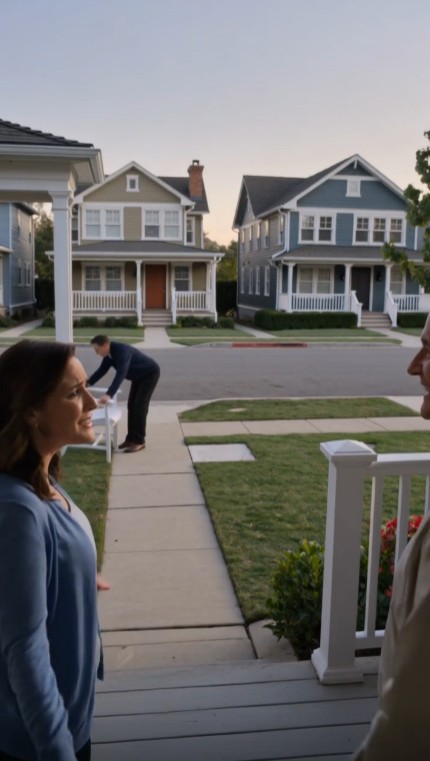
At exactly 7 PM…
Sarah looked through her window…
and saw her neighbor carrying a chair outside.
Then another neighbor did it.
Then another.
Within minutes…
there was an empty chair outside almost every house.
Nobody sat in them.
Nobody explained them.
Sarah stepped onto her porch.
“What is happening?”
Her neighbor smiled.
“Put yours out too.”
“Why?”
“You’ll see.”
Sarah brought out a chair.
7:05.
Nothing.
7:10.
Still nothing.
Then…
a city bus slowly entered the street.
It wasn’t in service.
It stopped at the corner.
The doors opened.
One adult woman stepped off.
Then another.
Then another.
Soon dozens of adults were walking down the sidewalk.
Each person stopped beside one empty chair.
But nobody sat.
Sarah whispered:
“Who are they?”
Her neighbor said:
“People who used to live here.”
Sarah frowned.
“Why did they come back?”
Then one final passenger stepped off the bus.
A woman carrying a simple casserole dish.
Sarah immediately recognized her.
“Mrs. Carter?”
The woman smiled.
“You remember me?”
“You lived next door when I was little.”
Mrs. Carter nodded.
Then pointed toward Sarah’s empty chair.
“Do you know why that’s there?”
Sarah shook her head.
Mrs. Carter’s eyes filled with tears.
“Because your mother never let anyone on this street eat alone.”
Sarah went silent.
Mrs. Carter looked down the street.
Every returning resident was standing beside the house where someone had once welcomed them.
Sarah whispered:
“But Mom helped all these people?”
Mrs. Carter smiled.
“Sarah… these aren’t even half of them.”
Then she explained why they had all chosen this night to come home.
Twenty-five years earlier, at exactly 7 PM, every light on Willow Street had gone out.
Sarah remembered pieces of that night.
She had been seven.
The neighborhood had disappeared into darkness during dinner.
Her father had already died two years earlier, leaving Sarah’s mother, Margaret Wilson, to raise her alone.
Sarah remembered standing in the kitchen while her mother searched a drawer for candles.
She remembered hearing neighbors outside.
And she remembered something cooking.
But that was about all.
Mrs. Carter remembered everything.
“It was the hottest night of the summer,” she said.
“The power went out across half the city.”
Refrigerators stopped.
Air conditioners went silent.
Streetlights went dark.
Nobody knew whether electricity would return in ten minutes or ten hours.
Margaret opened her refrigerator.
Inside was a casserole she’d prepared for Sarah and herself.
She looked at it.
Then looked outside.
Their elderly neighbor, Henry Miller, was sitting alone on his porch.
Across the street lived Rachel Reed, who had moved into the neighborhood only three days earlier with two young children.
Next door were the Carters.
Thomas Carter had been working a late shift.
His wife, Emily, was home alone with their infant daughter.
Farther down the street lived an elderly widower named Daniel Walker.
Margaret knew most of them.
Some barely knew each other.
She walked into the garage.
Dragged out a folding table.
Then carried two chairs onto the sidewalk.
Sarah followed her.
“What are we doing?”
Margaret answered:
“Dinner.”
“Outside?”
“Looks like it.”
She carried the casserole out.
Then she looked at Henry sitting alone.
“Henry!”
He turned.
“You eaten?”
“I was about to.”
“What?”
Henry looked toward his dark house.
Then laughed.
“I hadn’t figured that part out yet.”
Margaret pointed toward the empty chair.
“Problem solved.”
Henry came over.
Then Margaret knocked on Rachel’s door.
“Bring the kids.”
Rachel hesitated.
“We don’t want to interrupt.”
“You can’t interrupt. We don’t have electricity.”
Rachel laughed.
She brought the children.
Emily Carter came next.
Then Daniel Walker.
Someone had bread.
Someone else had tomatoes from a garden.
Another neighbor brought cheese.
A family near the corner had a cooler full of drinks.
People began moving chairs outside.
One table became two.
Two became four.
Children ate on the curb.
Adults introduced themselves to people they’d lived beside for years but barely knew.
Nobody had planned it.
Nobody called it anything.
It was simply dinner during a blackout.
The electricity returned at 9:43 PM.
But nobody went inside.
They stayed until nearly midnight.
Mrs. Carter looked at Sarah.
“That was the first night.”
“The first night of what?”
“The chairs.”
Sarah looked down the street.
Dozens of them.
Mrs. Carter continued.
The following Saturday, Margaret put two chairs outside again.
There was no blackout this time.
Henry saw them.
He walked over.
“You lose your electricity again?”
Margaret smiled.
“No.”
“Then what’s this?”
“Dinner.”
Henry looked confused.
Margaret pointed toward the second chair.
“Sit.”
That became a habit.
Not every Saturday.
Not on a rigid schedule.
But often enough that people noticed.
Margaret would cook too much food.
At least, that was what she claimed.
She’d carry an extra chair outside.
Sometimes Henry joined her.
Sometimes Emily.
Sometimes a child from down the street.
Sometimes nobody came, and Margaret simply brought the chair back inside.
But the empty chair remained an invitation.
If someone was alone…
there was room.
If a family was new…
there was room.
If someone had a difficult week…
there was room.
If someone simply didn’t feel like eating dinner in an empty house…
there was room.
Sarah stared at Mrs. Carter.
“Why don’t I remember this?”
“You do.”
“I don’t.”
Mrs. Carter smiled.
“You remember pieces.”
She pointed toward Sarah’s porch.
“Remember eating watermelon on those steps?”
Sarah nodded slowly.
“Remember Mr. Henry teaching you to shuffle cards?”
“Yes.”
“Remember Rachel’s boys always stealing the dinner rolls?”
Sarah laughed.
“Oh my God.”
Mrs. Carter smiled.
“That was all part of it.”
To Sarah, those had simply been childhood evenings.
She had never understood that her mother was quietly creating them.
As the years passed, the gatherings changed.
People moved.
Children grew up.
New families arrived.
The giant neighborhood dinners became less frequent.
But Margaret kept one tradition.
The empty chair.
Mrs. Carter walked toward Sarah’s porch.
“Your mother had a rule.”
“What rule?”
“If she knew somebody on Willow Street was eating alone, she added a chair.”
Sarah swallowed.
Mrs. Carter continued.
Sometimes it was literal.
A meal.
A plate.
A chair.
Other times, Margaret simply brought food to someone’s door.
When Henry had surgery, she delivered dinner.
When Rachel’s husband was away for work and both children were sick, Margaret brought soup.
When Emily Carter’s mother died, Margaret didn’t ask whether she needed anything.
She arrived with casserole and bread.
When a teenage boy named Michael lived alone with his father and his father started working night shifts, Margaret began sending an extra plate home with him.
She never called any of it charity.
She hated that word in this context.
She called it:
“Making too much again.”
Sarah smiled.
“That sounds like her.”
Mrs. Carter laughed.
“It was always the same excuse.”
Then one of the returning residents stepped forward.
A man in his thirties.
Sarah didn’t recognize him.
“I’m Michael.”
She stared.
“The kid whose dad worked nights?”
He smiled.
“That was me.”
Sarah looked at him more closely.
Then she saw it.
The eyes.
“You lived in the blue house.”
“Number 18.”
Michael pointed toward the empty chair outside the current owner’s home.
“That’s mine.”
Sarah looked confused.
“What do you mean?”
“When I was fourteen, I sat in that chair at your mother’s table at least twice a week.”
He laughed.
“I thought she didn’t know my dad wasn’t home.”
“She knew?”
“Of course she knew.”
“What did she say?”
“Nothing.”
Michael looked down.
“She’d just tell me she’d made too much.”
One evening, Michael had tried to refuse.
He was embarrassed.
He didn’t want anyone thinking his father couldn’t take care of him.
Margaret understood immediately.
She never invited him again by saying:
“Do you need dinner?”
Instead, she’d knock on his door.
“Michael, I need help.”
“With what?”
“Eating this.”
Then she’d hand him a plate.
Michael laughed softly.
“I didn’t realize until I was about twenty-five that your mother had absolutely no trouble finishing her own dinner.”
Sarah wiped her eyes.
Another woman approached.
Her name was Anna Reed.
She had lived on Willow Street for only eleven months.
Her husband had left unexpectedly.
Anna was twenty-seven with a three-year-old daughter.
She knew almost nobody.
“The first evening after he left,” Anna said, “I sat on my kitchen floor and cried.”
Sarah listened.
“I hadn’t told anyone.”
Margaret noticed that Anna’s curtains hadn’t opened all day.
At 6:30, she knocked.
Anna didn’t answer.
Margaret knocked again.
Eventually Anna opened the door.
Margaret held a chair in one hand.
Not food.
A chair.
Anna had stared at her.
“What is that?”
Margaret said:
“You don’t have to talk. But I’m eating outside at seven.”
Anna told her no.
Margaret nodded.
“Okay.”
Then she left the chair beside Anna’s porch.
At 7:15…
Anna came outside.
She sat.
Margaret didn’t ask about her husband.
Didn’t ask why she’d been crying.
Didn’t give advice.
She simply handed Anna a plate.
They ate.
The following week, Anna sat outside again.
Years later, Anna remarried and moved away.
But she kept one strange habit.
Whenever she knew someone was struggling, she didn’t always ask:
“What’s wrong?”
Sometimes she simply asked:
“Have you eaten?”
Sarah looked around.
“So all these people…”
“Have a chair story,” Mrs. Carter said.
A man standing outside Number 22 raised his hand.
“Mine was after my divorce.”
A woman near Number 31 said:
“First Christmas after my father died.”
Another man smiled.
“Failed out of college. Came home convinced everyone would judge me.”
A woman beside him laughed.
“New baby. Hadn’t slept in about six months.”
Someone farther down called:
“Job loss.”
Another:
“Moved here from another country. Barely spoke English.”
Then another:
“My wife was in the hospital.”
Sarah covered her mouth.
There were thirty-seven former residents on the street.
Mrs. Carter had been right.
They weren’t even half.
“Why didn’t Mom ever tell me?”
Mrs. Carter smiled.
“Tell you what?”
“All this.”
“To your mother, it wasn’t ‘all this.’”
She imitated Margaret’s voice.
“It’s a chair, Sarah. Calm down.”
Sarah laughed through her tears.
That sounded exactly like her.
Margaret had died the previous autumn.
Not suddenly.
She had been ill for several months.
Sarah had returned to Willow Street during those final weeks.
After the funeral, she’d stayed in her mother’s house while deciding what to do with it.
She hadn’t been ready to sell.
She wasn’t even sure she wanted to keep it.
For almost a year, she’d lived among boxes.
Her mother’s dishes.
Her mother’s books.
Her mother’s coat still hanging beside the back door.
Sarah had believed she knew everything important about Margaret’s life.
Then tonight…
thirty-seven adults stepped off a bus.
Each carrying a memory Sarah had never heard.
She looked at Mrs. Carter.
“So why tonight?”
Mrs. Carter glanced at the clock.
7:24.
“Because today is August 14.”
Sarah nodded.
“I know the date.”
“Twenty-five years ago tonight was the blackout.”
Sarah went still.
“The first dinner?”
“The first empty chair.”
That explained the date.
But not the bus.
Not the lights.
Not why everyone had suddenly returned after decades.
Mrs. Carter held up the casserole dish.
“There is one more part.”
She walked toward Sarah’s porch.
“Your mother planned this.”
Sarah stared at her.
“What?”
“Not exactly this.”
Mrs. Carter smiled.
“She would have hated the bus.”
People nearby laughed.
“She definitely would’ve hated everyone standing around crying.”
More laughter.
“But last year, before she died, Margaret gave me something.”
Mrs. Carter placed the casserole dish on Sarah’s porch table.
Then reached into her bag.
She removed a small notebook.
The cover was faded green.
Sarah recognized it.
Her mother kept it beside the telephone for years.
“I thought that was her address book.”
“It was.”
Mrs. Carter handed it to her.
Sarah opened it.
Names.
Telephone numbers.
Old addresses.
Some crossed out.
Some rewritten.
But beside dozens of names was a tiny drawing.
A chair.
Sarah looked up.
“What is this?”
Mrs. Carter answered:
“People who sat at her table.”
Sarah turned the pages.
Henry Miller.
Chair.
Emily Carter.
Chair.
Michael Reed.
Chair.
Anna Wilson.
Chair.
Rachel Miller.
Chair.
Thomas Walker.
Chair.
Page after page.
Some names had dates beside them.
Others contained notes.
No onions.
Likes tea, not coffee.
Kids love the baked pasta.
Call before Christmas.
Ask about new job.
Sarah laughed.
“She wrote everything down.”
“Your mother remembered people through food.”
Then Sarah found her own name.
SARAH — always claims she hates carrots, eats them if they’re cut small.
Sarah burst out laughing.
“That woman.”
Mrs. Carter smiled.
Then Sarah noticed something tucked into the back cover.
An envelope.
Her name was written on it.
SARAH
Her hands began shaking.
“When did she write this?”
“About three weeks before she died.”
“Did you read it?”
“No.”
Sarah opened it carefully.
Inside was a single sheet of paper.
Her mother’s handwriting was uneven but unmistakable.
Sarah read silently.
Then stopped.
She tried again.
Mrs. Carter touched her arm.
“You can read it later.”
Sarah shook her head.
“No.”
She continued.
Margaret had written:
Sarah,
If Emily gives you this notebook, it means she ignored me when I told her not to make a fuss.
Mrs. Carter immediately said:
“She knew me well.”
Sarah laughed through her tears.
She kept reading.
The little chair marks are people who ate with us at one time or another. Some once. Some a hundred times. Don’t make too much of it. Most of them fed me too.
Sarah paused.
That line mattered.
Margaret didn’t see herself as the neighborhood rescuer.
The meals went both directions.
Henry fixed her porch railing.
Rachel watched Sarah when Margaret worked late.
Emily drove Margaret to medical appointments years later.
Michael shoveled her driveway every winter until he moved away.
Anna called every Christmas.
People Margaret fed eventually fed her.
Not always with food.
But with time.
Company.
Rides.
Repairs.
Phone calls.
Friendship.
Sarah continued.
The first dinner was during the blackout. You were seven and complained that the potatoes looked weird by candlelight.
Sarah laughed.
“I remember that.”
Mrs. Carter smiled.
Sarah read on.
If you’re ever in that house and it feels too quiet, put a chair outside.
That was the final sentence.
No grand message.
No instruction to continue a movement.
Just:
If it feels too quiet, put a chair outside.
Sarah lowered the letter.
For several seconds, nobody spoke.
Then she looked at the empty chair she’d carried onto her porch less than thirty minutes earlier.
Now she understood.
Mrs. Carter had called people from Margaret’s notebook.
She’d found numbers.
Searched for old residents.
Asked neighbors for help locating others.
Some couldn’t come.
Some lived across the country.
Some had died.
Some couldn’t be found.
But thirty-seven said yes.
The city bus wasn’t actually part of the regular transit service that evening.
Thomas Reed, one of the former Willow Street children, now worked for the municipal transit department.
Through an approved community event arrangement, he’d helped organize transportation for the group.
The bus simply made it easier for everyone to arrive together.
No mystery.
No secret organization.
Just planning.
Sarah looked at Mrs. Carter.
“How long have you been arranging this?”
“Four months.”
“And everyone on the street knew?”
“Most of them.”
“Nobody told me?”
“That was the difficult part.”
Sarah looked toward her neighbor.
He raised both hands.
“I almost told you twice.”
She laughed.
Then she looked at the casserole.
“What’s that?”
Mrs. Carter smiled.
“Your mother’s recipe.”
“No.”
“Yes.”
“The chicken casserole?”
“The terrible one.”
“It wasn’t terrible.”
“It absolutely was.”
Sarah laughed.
Her mother had made the same casserole for nearly every neighborhood dinner.
Creamy chicken.
Rice.
Vegetables.
Far too much cheese.
She never measured anything.
Mrs. Carter had found the handwritten recipe inside Margaret’s kitchen binder.
Tonight, she’d recreated it.
Mostly.
“I reduced the salt,” Mrs. Carter admitted.
“Mom would be furious.”
“I know.”
Then something happened Sarah hadn’t expected.
People began sitting.
Not the returning residents.
The current residents.
Each empty chair had been placed beside another chair.
Old neighbor beside new neighbor.
Former resident beside current family.
People began introducing themselves.
“I lived in your house in 1998.”
“We found initials carved in the garage.”
“Those were probably my brother.”
“Did the basement always leak?”
“Every spring.”
Laughter moved down the street.
Tables appeared.
Food came from houses.
Not because Margaret had instructed anyone.
Because people were hungry.
And because once thirty-seven unexpected visitors arrive on a street at dinner time, somebody eventually brings plates.
Sarah carried her mother’s old folding table from the garage.
It was still there.
Same metal legs.
Same scratched white surface.
She set it on the lawn.
Mrs. Carter placed the casserole in the center.
Michael brought bread.
Anna had salad.
Henry Miller couldn’t attend.
He was ninety-one and living with his daughter several states away.
But his granddaughter had sent a video.
Mrs. Carter showed it to Sarah.
Henry appeared on the screen.
Older.
Smaller.
Still smiling.
“Sarah,” he said, “your mother burned the rolls during the blackout. Don’t let anyone rewrite history.”
Sarah laughed so loudly people turned.
Henry continued.
“She also cheated at cards.”
“That is true,” Sarah whispered.
Then Henry became serious.
“She gave people somewhere to go.”
He paused.
“That’s different from feeding them.”
Sarah replayed that sentence in her mind.
Somewhere to go.
Maybe that was what the chairs had really meant.
Food had been the excuse.
The chair was the important part.
An empty chair said:
There is space.
You don’t need an invitation.
You don’t need a reason.
You don’t need to explain why you’re alone.
Sit.
The dinner lasted for hours.
People told Sarah stories.
Michael remembered Margaret showing up at his high school graduation even though he hadn’t invited her.
“She brought a casserole?”
Sarah guessed.
“No.”
“What?”
“A sandwich.”
“Why?”
“She said graduation ceremonies were too long and I’d get hungry.”
Another woman remembered Margaret driving her to a job interview because her car wouldn’t start.
A man named Daniel remembered Margaret sitting with his father after his mother died.
Not talking.
Just sitting.
A former neighbor named Rachel remembered the only time Margaret refused to let her join dinner.
Sarah looked surprised.
“Why?”
Rachel laughed.
“I had the flu.”
“What did Mom do?”
“Left soup outside and yelled at me through the door.”
That sounded right too.
Not every story was dramatic.
Most weren’t.
A cup of coffee.
A plate of pasta.
Watching someone’s child for twenty minutes.
Saving a seat.
Giving someone tomatoes from the garden.
Calling after a job interview.
Remembering a birthday.
Returning a borrowed baking dish.
Those were the stories filling Willow Street.
And Sarah slowly understood why she’d never known the scale of it.
There hadn’t been a scale.
Margaret didn’t wake up one morning and decide to help seventy people.
She simply noticed whoever was nearby.
One person.
One meal.
One evening.
Then another.
Years accumulated.
People moved away carrying memories Margaret probably forgot she’d created.
At 9:43 PM, Mrs. Carter stood.
She tapped a glass gently.
Sarah looked at the time.
9:43.
“The power came back,” Mrs. Carter said.
People who knew the story smiled.
Twenty-five years earlier, that was the exact minute the blackout ended.
Someone turned on the porch lights.
Then another neighbor.
Then another.
Soon Willow Street was glowing.
But nobody went inside.
Just like twenty-five years earlier.
Sarah stood beside her mother’s old table.
Mrs. Carter asked:
“Do you want to say something?”
Sarah immediately shook her head.
“No.”
Everyone laughed.
“That’s definitely Margaret’s daughter,” Michael said.
Sarah smiled.
Then she looked at the chairs.
Thirty-seven returning residents.
Dozens of current neighbors.
Children running between yards.
People eating food from paper plates.
She changed her mind.
“Actually…”
The street quieted.
Sarah had no prepared speech.
So she told the truth.
“I didn’t know she did any of this.”
Someone laughed softly.
Sarah continued.
“I knew my mother fed people. I knew our house was always loud. I knew there were always too many dishes in the sink.”
More laughter.
“But I thought that was just our house.”
She looked toward Mrs. Carter.
“I didn’t know people remembered.”
Michael answered from the sidewalk.
“We remembered.”
Sarah’s voice broke.
That was all she managed.
Mrs. Carter hugged her.
Then everyone returned to dinner.
No applause.
Margaret would’ve hated applause.
Before the bus left, each returning resident did one final thing.
They turned their empty chair toward the house.
Not because it was part of some old tradition.
Mrs. Carter had invented that part.
She wanted the current residents to keep the chairs.
Not literally.
Just the idea.
One former resident told the family now living in his childhood home:
“You don’t have to do anything with this.”
The homeowner smiled.
“I know.”
“Seriously. Nobody expects dinner next Saturday.”
“Good. I can’t cook.”
They laughed.
The bus left at 10:30.
Willow Street became quiet again.
Sarah helped collect plates.
She folded her mother’s table.
Mrs. Carter picked up the casserole dish.
Then Sarah stopped her.
“Leave it.”
“The dish?”
“Yeah.”
“Why?”
Sarah smiled.
“I want it.”
Mrs. Carter handed it over.
Then pointed toward the empty chair.
“You bringing that inside?”
Sarah looked at it.
“Not yet.”
After everyone left, Sarah sat on her porch.
Her own chair beside the empty one.
For almost a year, she’d been thinking about selling the house.
It felt too full of memories when she was inside…
and too empty when she wasn’t.
Tonight, for the first time, she understood something.
Her mother hadn’t filled the house with people because she was afraid of being alone.
Margaret simply believed loneliness became easier when someone made room.
Sarah opened the green notebook again.
Dozens of chair marks.
Then she noticed several pages at the back were blank.
She found a pen.
For a moment, she considered writing the names of everyone who had returned.
Then she stopped.
That was her mother’s book.
She didn’t need to copy it.
The following Saturday, Sarah went grocery shopping.
She bought ingredients for the casserole.
She called Mrs. Carter three times while making it.
“No, Sarah, that’s too much cheese.”
“Mom used more.”
“Your mother was wrong.”
“You’re disrespecting the dead.”
“The dead used four cups of cheddar.”
Eventually, Sarah finished it.
At 6:55 PM, she carried a small table outside.
Then two chairs.
Her neighbor noticed.
“Oh no.”
Sarah laughed.
“What?”
“Are we doing this every week now?”
“Absolutely not.”
“Good.”
“I just made too much.”
Her neighbor stared at the enormous casserole.
“You made that for one person?”
Sarah smiled.
“Apparently it’s genetic.”
At 7:08, nobody had joined her.
Sarah ate alone.
She was fine with that.
The empty chair didn’t require someone to fill it.
At 7:16, she heard footsteps.
A woman from three houses down approached.
Her name was Emily.
She’d moved onto Willow Street only two months earlier.
Sarah barely knew her.
Emily pointed toward the chair.
“Is this…”
She looked embarrassed.
“Never mind.”
Sarah smiled.
“You eaten?”
Emily shook her head.
Sarah moved the casserole toward the empty place.
“Sit.”
Emily sat.
They talked for almost an hour.
Nothing life-changing happened.
Emily wasn’t secretly in desperate trouble.
Sarah didn’t solve a problem.
Two neighbors simply ate dinner.
That would’ve been enough for Margaret.
The next week, Sarah didn’t put the chair outside.
The week after that, she did.
Sometimes someone joined her.
Sometimes nobody did.
Eventually, other neighbors occasionally put chairs out too.
There was no schedule.
No organization.
No requirement.
No social media campaign.
Nobody named it after Margaret.
Sarah preferred that.
Years later, children on Willow Street would know a strange neighborhood story.
Every August 14 at 7 PM, some families carried an empty chair outside.
New residents would ask:
“What’s with the chairs?”
Someone would explain the blackout.
The dinner.
Margaret.
Twenty-five years later, the bus.
But Sarah always corrected one part when people exaggerated.
“My mother didn’t feed the whole neighborhood every night.”
She didn’t.
“She didn’t rescue everybody.”
She didn’t.
“She wasn’t perfect.”
Definitely not.
She was simply a woman who hated seeing someone eat alone when there was room at her table.
That was enough.
On the thirtieth anniversary of the blackout, only eleven former residents returned.
Henry had died peacefully two years earlier.
Several others were too far away.
Some had lost touch.
Life moved on.
But at exactly 7 PM…
Sarah carried out two chairs.
Across the street, another door opened.
Then another.
Soon empty chairs appeared along Willow Street.
Some belonged to people who had known Margaret.
Most didn’t.
A little boy asked his father:
“Who’s supposed to sit there?”
His father answered:
“Anybody.”
That was the simplest explanation Sarah had ever heard.
She smiled.
Then placed her mother’s casserole dish on the table.
At 7:12, a car stopped.
A young woman stepped out.
Sarah didn’t recognize her.
The woman walked toward Number 22.
She stared at the house.
Then at the empty chair.
Sarah approached.
“Can I help you?”
The woman smiled nervously.
“My father grew up here.”
“What’s his name?”
“Michael Reed.”
Sarah laughed.
“Michael’s daughter?”
The woman looked surprised.
“You know him?”
“Come sit down.”
The woman pointed toward the empty chair.
“Here?”
Sarah smiled.
“That’s what it’s for.”
And somewhere in that moment, Sarah finally understood why Mrs. Carter had arranged the bus years earlier.
It wasn’t to show Sarah that Margaret had been extraordinary.
Margaret would’ve rejected that idea immediately.
It was to return something.
For decades, people had left Willow Street carrying memories of a chair someone once pulled out for them.
A place at a table.
A plate they hadn’t asked for.
A night when they didn’t have to explain why they didn’t want to be alone.
On the twenty-fifth anniversary of the blackout, they brought those memories home.
That was why, at exactly 7 PM, Sarah had looked through her window and seen chairs appearing outside almost every house.
That was why a bus full of adults had arrived.
That was why each former resident stood beside a different home.
And that was why Mrs. Carter stepped off last, carrying the same kind of casserole Margaret had served all those years ago.
Sarah had thought the empty chairs were waiting for the people on the bus.
She eventually realized they weren’t.
They represented the chairs that had once been waiting for them.
One for Michael when his father worked nights.
One for Anna after her husband left.
One for Emily after her mother died.
One for Henry during the blackout.
One for every person Margaret had looked at and quietly told:
“Sit. I made too much.”
Twenty-five years later, they came back for one reason.
To make sure Margaret’s daughter knew that all those empty chairs…
had never really been empty.