
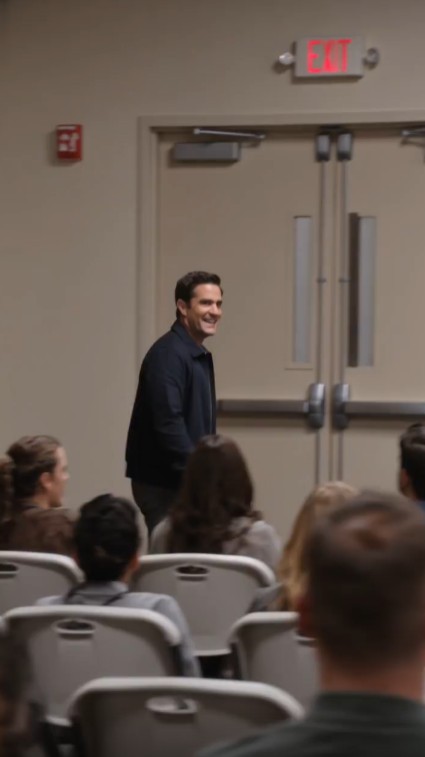
The speaker walked onto the stage…
and something bizarre happened.
The first row turned their chairs backward.
Then the second row.
Then the third.
Within seconds…
almost 200 people were sitting with their backs to the stage.
The speaker froze.
“Did I do something wrong?”
Nobody answered.
Then one woman stood.
“Keep talking.”
The speaker laughed nervously.
“To the backs of your chairs?”
“Yes.”
He looked toward the organizer.
She simply nodded.
So he started.
“My name is Michael…”
Suddenly…
everyone raised one hand.
Michael stopped.
“What is happening?”
The woman said:
“Continue.”
Michael tried again.
“Ten years ago, I started volunteering—”
Every hand went down.
Michael stared.
Then he said:
“I thought nobody knew.”
Every hand went up again.
Michael stopped speaking.
The woman smiled.
“Now turn around.”
All 200 people turned their chairs toward him.
Michael looked across the crowd.
Then froze.
Each person was holding the same small blank card.
No writing.
Just one colored corner.
Michael stepped closer.
“I know those cards.”
The woman nodded.
“You should.”
Michael’s voice cracked.
“I only made fifty.”
She smiled.
“You made the first fifty.”
Michael looked at nearly 200 cards.
“Then who made the rest?”
The woman pointed toward the back doors.
They opened.
Another group was waiting outside.
She said:
“People who received one… and decided the idea shouldn’t stop with them.”
Michael covered his mouth.
Then he asked the question everyone had been waiting for:
“How far did this go?”
The woman smiled.
“Much farther than this room.”
Her name was Rachel Carter.
Ten years earlier, she had been twenty-three and working the evening shift at a community center.
Michael had been there too.
Not as a speaker.
Not as a director.
Not even as an official volunteer at first.
He was the man who arrived after work and asked:
“Anything need doing?”
Usually, something did.
Stacking chairs.
Carrying boxes.
Cleaning tables after youth programs.
Helping unload pantry deliveries.
Putting together shelves.
Replacing loose screws on desks.
Nothing glamorous.
Michael worked at an office-supply warehouse during the day.
Most evenings, he had two or three hours before going home.
His apartment was only four blocks from the community center.
So he started stopping there.
At first, once a week.
Then twice.
Nobody paid much attention.
That was exactly how Michael liked it.
He didn’t enjoy being thanked publicly.
When Rachel once tried to mention him during a volunteer meeting, Michael interrupted.
“Please don’t.”
“Why?”
“I moved six boxes.”
“You’ve been moving boxes for three months.”
“Then I’m getting really good at boxes.”
Rachel laughed.
But she respected his request.
Then, one winter evening, Michael noticed something.
A teenage volunteer named Daniel had spent nearly an hour helping an elderly man carry donated groceries to his apartment.
Daniel returned late.
Cold.
Wet.
Nobody had seen what he’d done except Michael.
The next evening, Daniel opened his locker at the community center.
Inside was a small card.
Blank.
Except for one blue corner.
Daniel turned it over.
Nothing.
He asked Rachel:
“What’s this?”
Rachel had no idea.
Michael stood across the room pretending not to listen.
Daniel eventually put the card in his pocket.
A week later, another appeared.
This time it went to a woman named Emily.
She had quietly stayed behind after a children’s art program to clean every table because the regular cleaner had called in sick.
Then Thomas received one.
He’d repaired a broken wheelchair ramp rail and refused reimbursement for the materials.
Then Anna.
She’d brought dinner to a volunteer whose husband was in the hospital.
Nobody understood the cards.
They were completely blank.
No congratulations.
No inspirational quote.
No signature.
Only the colored corner.
Eventually Rachel confronted Michael.
“It’s you.”
Michael looked up from a box of pantry supplies.
“What?”
“The cards.”
“What cards?”
“Don’t do that.”
Michael smiled.
Rachel held one up.
“Why are you leaving these?”
Michael shrugged.
“I thought people should know somebody noticed.”
“Then why don’t you write that?”
“Because then it becomes about the message.”
Rachel frowned.
“That makes no sense.”
Michael took the card.
He turned it over.
Blank front.
Blank back.
Blue corner.
“The person knows what they did.”
“Maybe.”
“And I know what they did.”
“Okay.”
“That’s enough.”
Rachel looked at him.
“So the card means somebody noticed?”
“Basically.”
“Why the blue corner?”
Michael laughed.
“My marker was blue.”
“That profound?”
“Very.”
Rachel smiled.
Then she asked:
“How many did you make?”
“Fifty.”
“What happens when they’re gone?”
“Nothing.”
Rachel stared.
“Nothing?”
“Rachel, it’s fifty pieces of paper.”
He returned to the pantry boxes.
She didn’t argue.
Over the next several months, the cards disappeared one by one.
Michael never handed them out for ordinary assigned duties.
He wasn’t trying to create a reward system.
There were no points.
No competition.
No employee-of-the-month board.
He left them when he happened to witness somebody doing something thoughtful when there was no obvious reason to expect recognition.
Sometimes the gesture was tiny.
A teenager carrying an elderly visitor’s bags to the bus stop.
A volunteer washing someone else’s coffee cup.
A woman sitting with a nervous new volunteer until her ride arrived.
A man quietly replacing food he’d accidentally damaged while unloading a pantry box.
The card didn’t say:
You’re a hero.
It didn’t say anything.
It simply meant:
Someone saw that.
Then Card 17 disappeared.
Michael had left it for a college student named Sophie after she gave up her seat during a crowded community meeting and spent the entire evening standing.
Two weeks later, Sophie saw a custodian named Henry kneeling beneath a table.
A child’s bracelet had fallen into a narrow gap.
The family had already left.
Henry could easily have placed it in lost-and-found and continued working.
Instead, he spent twenty minutes retrieving it.
Sophie watched.
The following day…
Henry found a blank card beside his cleaning cart.
Blue corner.
Michael hadn’t left it.
Sophie had.
She had passed hers on.
When Michael found out, he laughed.
“That’s cheating.”
Rachel asked:
“Why?”
“I made the cards for people to keep.”
“You never told anyone that.”
“I didn’t think I needed rules for blank paper.”
Sophie overheard them.
She walked over.
“Did you want me to throw it away?”
“No.”
“Then what was I supposed to do with it?”
“Whatever you wanted.”
“I did.”
Michael had no answer.
A few weeks later, Henry passed the same card to someone else.
Then Card 31 moved.
Then Card 8.
Some people kept theirs.
Some pinned them to refrigerators.
Some lost them.
Some threw them away without ever understanding what they meant.
But others passed them on.
Michael didn’t know any of that.
By the end of the year, his original fifty cards were gone.
He never made another batch.
Rachel asked him once:
“Finished?”
Michael shrugged.
“I guess.”
“Why not make fifty more?”
“Because then it becomes a thing.”
“What if it already is?”
“It isn’t.”
Michael was wrong.
Three years later, he stopped volunteering regularly at the center.
His mother developed mobility problems and needed more help.
Michael changed jobs.
Moved across town.
He still visited occasionally, but the weekly routine ended.
The blank cards faded from his mind.
He assumed they’d faded from everyone else’s too.
But one of the original cards had reached a schoolteacher named Margaret Wilson.
She had received it after staying late to help a parent complete paperwork for a meal-assistance program.
Margaret didn’t know Michael.
She only knew what the card meant because the person who gave it to her explained:
“Someone noticed me once. Now I’m noticing you.”
Margaret kept the card for nearly a year.
Then one afternoon, a student named Ethan stayed behind after class.
Not because he was in trouble.
He was collecting pencils other students had dropped.
Margaret asked:
“What are you doing?”
“Cleaning.”
“You don’t have to.”
“I know.”
He continued.
Margaret went home thinking about the blue-corner card.
She didn’t give it to Ethan.
He was a child, and she didn’t want to create a strange unexplained ritual.
Instead, she photocopied the shape onto thicker paper.
Blank.
Blue corner.
Then she wrote Ethan a separate ordinary thank-you note explaining exactly what she’d appreciated.
The blank card stayed with her.
But the idea had changed.
Margaret began using blank blue-corner cards with adult colleagues.
Not as formal awards.
Just quiet acknowledgments.
A school receptionist got one after staying late with a parent waiting for transportation.
A cafeteria worker got one after packing food for a family whose car had broken down.
A teacher got one after covering another teacher’s class during an emergency.
Eventually one of those teachers asked:
“Where did these come from?”
Margaret showed her the original.
“I don’t actually know.”
That teacher made ten more.
Then a nurse at a nearby clinic received one.
She made five.
A bus driver received one.
He made twenty.
Nobody coordinated it.
Nobody kept a master list.
And because the cards contained no names or written instructions, their meaning sometimes changed.
For some people, the card meant:
I noticed your kindness.
For others:
Thank you for doing something nobody required you to do.
In one workplace, employees started using yellow corners instead of blue because they didn’t have a blue marker.
At another, the corner was green.
Some versions had rounded edges.
Others were ordinary index cards cut in half.
There was no official design.
That mattered later.
Because it meant nobody could honestly claim every blank colored-corner card came from Michael.
Many probably didn’t.
Ideas can arise independently.
Rachel understood that.
So when she began researching the cards years later, she was careful.
She didn’t tell people:
“Michael created all of this.”
Instead, she asked:
“Where did yours come from?”
The answers created a strange map.
Margaret’s card could be traced backward.
Margaret received it from Anna.
Anna received hers from Thomas.
Thomas received his from Sophie.
Sophie had received Card 17 directly from Michael.
That branch was clear.
Another branch went through Henry.
Another through Daniel.
Another through the original community center.
But some trails ended.
A person remembered receiving a card but couldn’t remember from whom.
Someone else had heard about the idea rather than receiving a physical card.
Some people made cards after seeing one pinned to a bulletin board.
Rachel stopped counting anything she couldn’t reasonably connect.
Even then…
she documented 187 people whose cards or stories could be traced through credible personal accounts back to Michael’s original batch or to someone directly connected to it.
That was why nearly 200 people were now sitting in front of him.
Michael stared at the cards.
“You tracked these?”
Rachel nodded.
“How?”
“With great difficulty.”
The audience laughed.
Michael picked up one of the cards from the front row.
Its corner was green.
“This isn’t mine.”
“No.”
“Mine were blue.”
A woman stood.
“That one’s mine.”
Her name was Emily Reed.
She worked at a rehabilitation center.
She explained that she’d received a blue-corner card from a coworker after spending her lunch break helping an elderly patient’s daughter understand transportation options.
Emily kept it for months.
Then she saw another coworker quietly buying groceries for an employee whose hours had been reduced.
She wanted to pass the card on.
But she couldn’t find it.
“So I made another.”
Michael looked at the green corner.
“You didn’t have a blue marker?”
Emily smiled.
“Exactly.”
Michael laughed.
Then another person stood.
His card had an orange corner.
Another had purple.
Another red.
Michael looked across the room.
Now he understood.
These weren’t copies.
They were descendants.
Not literally.
Not in one perfect chain.
But enough of them had a documented connection to the original idea that Rachel could show how it had traveled.
Michael looked toward the people waiting outside the doors.
“How many are out there?”
“Seventy-three.”
“Why aren’t they in here?”
“Room capacity.”
Michael laughed.
“So you invited too many people?”
“Apparently your blank-card idea has terrible logistics.”
He shook his head.
Then remembered the beginning of the event.
“The chairs.”
Rachel smiled.
“What about them?”
“Why did everyone turn around?”
A man in the second row answered.
“Because that’s what the cards were about.”
Michael waited.
The man continued:
“Doing something when nobody is watching.”
Rachel corrected him gently.
“Not exactly.”
She looked at Michael.
“You never said people should do good things because nobody was watching.”
Michael nodded.
“No.”
“You made the cards because somebody was watching.”
That distinction mattered.
Michael hadn’t wanted invisible kindness.
He’d wanted invisible people to feel visible.
The chairs had been Rachel’s idea.
When Michael walked onto the stage, everyone turned away.
For a few seconds, he was speaking to people who refused to look at him.
Then, when he said:
“I thought nobody knew…”
every hand went up.
The message was simple.
They knew.
Someone had noticed.
Michael sat on the edge of the stage.
“I don’t know what I’m supposed to say.”
Rachel smiled.
“For once, nothing.”
That got another laugh.
Then the back doors opened fully.
The additional guests entered in smaller groups.
Some held cards.
Some didn’t.
One elderly man carried his inside a plastic sleeve.
Michael stared at him.
“Seriously?”
The man smiled.
“My granddaughter said I was going to destroy it in my wallet.”
Another woman had framed hers.
Michael groaned.
“Oh, come on.”
She laughed.
“It meant something to me.”
Michael became quiet.
“What did you get it for?”
The woman introduced herself as Laura Miller.
Eight years earlier, she had worked nights at a hospital reception desk.
One evening, a family arrived after a relative had been admitted unexpectedly.
They had driven several hours.
They were exhausted.
Confused.
The cafeteria was closed.
Laura gave them the dinner she’d brought for herself and ordered another meal later.
A coworker saw it.
The following morning, Laura found a blank card with a blue corner beside her keyboard.
She had no idea what it meant.
Her coworker explained.
“Someone noticed.”
Laura looked at Michael.
“That was a difficult year for me.”
He listened.
“My husband had died seven months earlier.”
Michael’s expression changed.
“I’d gotten very good at coming to work, doing my job and going home.”
She looked at the framed card.
“That stupid little piece of paper made me cry in a supply closet.”
The room laughed softly.
Laura smiled.
“I hadn’t realized how badly I needed somebody to notice me too.”
Michael looked down.
That was the first moment he seemed unable to control his emotions.
Because ten years earlier, that was exactly why he’d made the cards.
And he’d never told Rachel the real reason.
She noticed.
“Michael?”
He remained quiet.
Then he reached into his jacket.
His wallet was old.
Inside, behind his driver’s license, was a folded piece of paper.
Not one of the cards.
A note.
He unfolded it.
The paper was worn almost transparent along the creases.
“My dad wrote this.”
Michael’s father, Robert, had worked as a school custodian for thirty-four years.
Michael grew up watching him leave home before sunrise.
Robert fixed doors.
Cleaned classrooms.
Moved furniture.
Shoveled snow.
Stayed late after school events.
Most students knew his face.
Few knew his name.
When Michael was nineteen, Robert retired.
At the retirement gathering, a teacher handed him a box.
Inside were more than one hundred handwritten notes from former students.
Michael had watched his father read them at the kitchen table.
One note made Robert stop.
A former student wrote that when she was thirteen, she’d been sitting alone outside the principal’s office after a terrible day.
Robert was cleaning nearby.
He didn’t ask questions.
He simply brought her a chair because she was sitting on the floor.
Then he left.
She remembered it for twenty years.
Robert had no memory of doing it.
Michael looked at the audience.
“My dad kept saying the same thing.”
“What?” Rachel asked.
Michael smiled.
“He said, ‘I didn’t know anybody noticed.’”
After Robert died, Michael found one final note inside his father’s wallet.
Robert had written it himself.
Only one sentence:
People notice more than we think.
Michael carried it ever since.
Years later, when he saw Daniel quietly helping the elderly man with groceries…
he thought about his father.
He wanted Daniel to know somebody had noticed.
But he didn’t want to write a speech.
Didn’t want his name attached.
So he cut fifty pieces of card stock.
Then marked one corner blue.
That was it.
No organization.
No plan.
No intention for the cards to leave the community center.
Michael looked at Rachel.
“I never told you that.”
“No.”
“Why didn’t you ask?”
“I did.”
“What did I say?”
“You said your marker was blue.”
The room laughed.
Michael smiled.
“That part was true.”
Then Rachel brought out a large board.
Michael immediately objected.
“Oh no.”
“Relax.”
“I don’t like boards.”
“It’s a map.”
The board showed dots.
No rankings.
No totals claiming impossible precision.
Just locations where Rachel had confirmed that people connected to the traceable card branches now lived.
The original community center.
Three schools.
Two hospitals.
A warehouse.
A bus depot.
Several offices.
A rehabilitation center.
A grocery store.
Then other cities.
Michael stood.
“How did it leave the state?”
Rachel pointed toward Margaret Wilson’s name.
“Her daughter moved.”
Another branch followed a nurse who relocated.
Another followed a teacher.
One card traveled inside a book.
One was mailed with a thank-you note.
One never physically traveled at all; its recipient simply explained the idea to a sibling living hundreds of miles away.
Michael studied the map.
“This is ridiculous.”
Rachel smiled.
“Very.”
“I made fifty blank cards.”
“Yes.”
“Because I didn’t want to write thank-you notes.”
“Also yes.”
Michael laughed.
Then he noticed a dot farther away than the others.
“What’s that?”
“A school in Oregon.”
“How?”
A man near the back raised his hand.
“My sister.”
Michael pointed.
“You’re going to have to give me more than that.”
The man explained.
He had received a card while volunteering at a food pantry.
Years later, his sister visited.
She saw it on his refrigerator.
Asked what it meant.
He told her.
She returned home and adapted the idea for adult staff at her school.
Not students.
Not as a reward program.
Just colleagues quietly acknowledging one another.
Michael stared.
“So she never received one?”
“No.”
“She just heard the story?”
“Yes.”
Michael turned toward Rachel.
“Does that count?”
Rachel shook her head.
“Not in the 187.”
“Good.”
“That’s why I said it went farther than this room.”
Michael looked at the map again.
The traceable cards were one thing.
The stories were another.
Nobody could count those accurately.
Rachel refused to try.
She didn’t want to turn kindness into a number.
She didn’t want Michael believing he had personally caused every good act connected to the cards.
He hadn’t.
The people in the room made their own choices.
Many were already generous long before receiving a card.
Some would’ve done exactly the same things without it.
Michael’s contribution was smaller.
But real.
He had created a simple way to tell someone:
What you did wasn’t invisible.
That idea resonated.
And people reused it.
Rachel handed Michael one final card.
Blank.
Blue corner.
He stared at it.
“Is this original?”
“No.”
“Good.”
“Why good?”
“The originals were badly cut.”
Rachel laughed.
“Turn it over.”
Michael did.
Still blank.
He looked confused.
“You didn’t write anything.”
“Exactly.”
“Then what’s this for?”
Rachel pointed toward the audience.
“Your turn.”
Michael looked around.
“You want me to give it to somebody here?”
“If you notice something.”
He smiled.
“That could take a while.”
“We have time.”
The formal event ended soon afterward.
People ate.
Talked.
Compared cards.
Some discovered their connections.
Others didn’t.
Michael spent nearly two hours listening.
Then something small happened.
An elderly guest named Henry accidentally dropped a stack of papers.
Before anyone reacted, a young facilities worker near the wall walked over.
He gathered every sheet.
Helped Henry reorganize them.
Then returned quietly to his work.
Michael watched.
Nobody applauded.
No one announced it.
The worker didn’t know who Michael was.
Michael looked down at the blank blue-corner card Rachel had given him.
He smiled.
Then walked across the room.
The worker was replacing a trash liner.
Michael held out the card.
The man stared.
“What’s this?”
Michael almost laughed.
Ten years earlier, he’d heard the same question.
“Nothing.”
The worker turned it over.
“It’s blank.”
“I know.”
“What am I supposed to do with it?”
Michael thought about Daniel.
Sophie.
Margaret.
Laura.
His father.
Nearly 200 people in the room.
Dozens more outside.
Schools and hospitals he’d never visited.
People he’d never met.
Then he gave the answer he’d never thought to give ten years earlier.
“Keep it if you want.”
The worker frowned.
“And if I don’t?”
Michael smiled.
“Give it to somebody you notice.”
The worker looked at the card again.
Then placed it carefully in his pocket.
Michael walked away.
Rachel had seen everything.
“You just started another one.”
Michael shook his head.
“No.”
“You definitely did.”
“No.”
“Michael.”
He laughed.
“I gave one guy a blank card.”
Rachel smiled.
“That’s how this happened last time.”
Michael stopped.
He looked back at the worker.
Then at the room.
Cards everywhere.
Blue corners.
Green.
Yellow.
Red.
Purple.
Nearly every one made by someone Michael had never met.
For ten years, Michael had believed his fifty cards had disappeared.
In a way, they had.
Some were lost.
Some discarded.
Some tucked into drawers and forgotten.
But the idea behind them kept resurfacing.
Not because Michael ordered anyone to continue it.
Not because people owed him.
Not because a blank card magically made anyone kinder.
It simply gave people a way to say something that was often left unsaid.
I saw what you did.
Years later, when Michael walked onto a stage expecting to give a small talk about volunteering, nearly 200 people turned their backs on him.
He thought he’d done something wrong.
Then he said:
“I thought nobody knew.”
Every hand rose.
That was the answer.
They knew.
They turned around.
And suddenly Michael was staring at nearly 200 blank cards.
He recognized them immediately.
But he’d only made fifty.
The rest had been created by people who received one and decided that being noticed shouldn’t end with them.
Some copied the blue corner.
Others changed the color.
Some passed the original card along.
Others kept theirs and made another.
The chain wasn’t perfect.
Nobody could prove every branch.
Nobody could count how many people had heard the idea and adapted it independently.
But the documented trail was already enough to leave Michael speechless.
He’d thought the cards were about noticing other people.
That evening, the room turned the idea back toward him.
For once…
Michael was the person being noticed.