
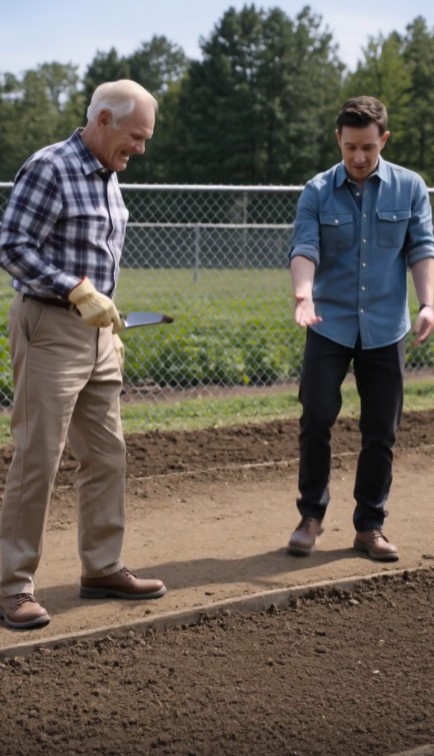
Thirty volunteers arrived early Saturday morning to reopen the abandoned community garden.
The place had been closed for years.
Old wooden beds had collapsed.
Weeds had swallowed the paths.
The greenhouse windows were cloudy with dust.
Still, everyone was excited.
Some carried shovels.
Others brought gloves, buckets and fresh soil.
The plan was simple:
Clear everything.
Repair what could be saved.
Start over.
But before the first shovel touched the ground, the oldest volunteer raised his hand.
“Not there.”
Everyone turned.
Arthur Hale was seventy-eight and had once helped maintain the garden before it closed.
He pointed toward a tiny square of dirt beside the greenhouse.
One volunteer frowned.
“We’re rebuilding the whole garden.”
Arthur nodded.
“Everything except that square.”
People looked at the patch.
There was nothing special about it.
No flowers.
No sign.
No stone.
Just dirt.
A younger volunteer laughed.
“What’s so special about empty soil?”
Arthur looked at him.
“It isn’t empty.”
That stopped everyone.
Arthur slowly knelt.
With both hands, he brushed away the loose soil.
At first, nothing happened.
Then someone noticed something green.
Tiny shoots.
A whole row of them.
One volunteer smiled.
“Okay. Someone planted something.”
Arthur shook his head.
“No one has planted here for seventeen years.”
The group became quiet.
“That’s impossible.”
Arthur glanced toward the old greenhouse.
“That’s what I thought too.”
Then a woman standing near the back stepped forward.
She looked to be in her forties.
“Seventeen years?”
Arthur nodded.
The woman dropped her gardening gloves.
“What kind of flowers are they?”
Arthur answered:
“Forget-me-nots.”
Her face went pale.
“My mother planted those.”
Arthur stared at her.
“What was your mother’s name?”
“Elaine Mercer.”
Arthur sat down.
For several seconds, he couldn’t speak.
Then he whispered:
“We’ve been trying to find you.”
The woman stared at him.
“My name is Sarah.”
Arthur nodded slowly.
“I know.”
Sarah looked around at the thirty volunteers.
“Who’s ‘we’?”
Arthur raised one hand.
Then pointed toward the group.
“All of them.”
The volunteers exchanged confused looks.
Most had never met before that morning.
Some lived nearby.
Others had driven from neighboring towns.
A few had simply responded to a social media post asking for help reopening the garden.
Sarah looked back at Arthur.
“What do you mean?”
Arthur took a breath.
Seventeen years earlier, the community garden had been very different.
It was busy almost every day.
Families grew vegetables.
Retired neighbors cared for roses.
Children painted signs and helped water seedlings.
Elaine Mercer had been one of the regular volunteers.
Sarah barely remembered that part of her mother’s life.
At the time, Sarah had moved away for work.
She visited when she could, but she never spent much time at the garden.
Arthur remembered Elaine clearly.
“She came every Tuesday and Thursday.”
Sarah smiled faintly.
“That sounds like her.”
But Elaine wasn’t interested only in gardening.
She had started something Arthur called the “one-square project.”
The idea was simple.
Anyone going through a difficult time could plant something in the small patch beside the greenhouse.
No names were required.
No explanation.
Just one seed or bulb.
Arthur pointed toward the dirt.
“This was that square.”
Sarah looked down.
Elaine believed people sometimes needed a place to leave something hopeful behind.
A widow planted tulips after her husband died.
A teenager planted herbs while waiting for college results.
A man recovering from surgery planted a sunflower.
A mother whose son had moved overseas planted lavender.
Dozens of people used the square.
Then Elaine became ill.
She stopped coming regularly.
Before she left for the final time, she planted forget-me-nots.
Arthur remembered asking why.
Elaine smiled and said:
“Because some things should come back even after people think they’re gone.”
Sarah looked away.
Her mother died later that year.
Not long afterward, the garden began struggling.
Funding disappeared.
Volunteers moved away.
The greenhouse roof leaked.
Eventually, the property closed.
For years, the one-square patch disappeared beneath weeds.
Arthur assumed everything planted there had died.
Then, three weeks earlier, he returned to inspect the property before the reopening project.
He cleared some weeds beside the greenhouse.
That was when he saw the first tiny green shoot.
Then another.
Then another.
Forget-me-nots.
Arthur couldn’t believe it.
Plants could reseed themselves, of course.
But these seemed to be emerging from the exact patch Elaine had used.
He posted an old photograph in a local community group.
The picture showed Elaine standing beside the greenhouse with several volunteers.
Arthur hoped somebody might recognize her family.
Instead, something unexpected happened.
People began recognizing themselves.
A woman named Teresa saw the photograph first.
She had been the widow who planted tulips.
Then Marcus recognized the greenhouse.
He had been the teenager waiting for college results.
Another person remembered bringing his daughter there every weekend.
Within days, messages started arriving.
“I planted there.”
“My mother planted there.”
“That garden helped me.”
People who hadn’t spoken in years began reconnecting.
Then Arthur announced the garden reopening.
Thirty people volunteered.
Sarah looked around.
“You’re telling me all of them were connected to that patch?”
Arthur smiled.
“Ask them.”
The first volunteer stepped forward.
His name was Marcus.
“I planted a sunflower here when I was seventeen.”
Another woman raised her hand.
“Lavender.”
A man near the greenhouse said:
“Tomatoes. Mine never grew.”
Everyone laughed.
One by one, stories emerged.
Nearly every person there had either planted something in the small square or had a relative who did.
Some remembered Elaine.
Others knew only the idea she created.
Sarah slowly looked at the volunteers.
“None of you knew I was coming?”
They shook their heads.
Sarah had discovered the volunteer event independently.
She had recently moved back to town.
When she saw a notice asking people to help restore the old garden, she signed up because the address seemed familiar.
She hadn’t realized why.
Arthur reached into his coat pocket.
“There’s more.”
He pulled out an old envelope.
Sarah stared.
Her name was written across the front.
The handwriting belonged to her mother.
Sarah’s hands began shaking.
“Where did you get that?”
“Elaine gave it to me.”
“When?”
“Seventeen years ago.”
Sarah looked stunned.
Arthur explained.
Elaine knew the garden might not survive.
She also knew Sarah had built a life elsewhere and might never return.
So she left Arthur an envelope.
He was supposed to give it to Sarah if she ever came back to the garden.
Arthur had tried to locate her several times.
Old phone numbers stopped working.
Letters came back.
Eventually, he gave up.
Until that morning.
Sarah opened the envelope.
Inside was one page.
Her mother had written:
Sarah,
If you ever find yourself standing beside the greenhouse, don’t worry about what’s missing.
Look at what came back.
Sarah stopped reading.
Arthur handed her a tissue.
She continued.
Elaine wrote about the one-square project.
She explained that the flowers were never really the point.
The square existed because people needed reminders that difficult seasons could end.
Seeds disappeared underground before anything new appeared.
Some never returned.
Others surprised everyone.
Then came the line Sarah read twice:
If the forget-me-nots ever grow again, I hope somebody is there to remember why they were planted.
Sarah covered her mouth.
Nobody spoke.
Then one of the volunteers asked:
“Why did she leave that letter for you?”
Sarah smiled through tears.
“Because we argued about this place.”
She explained that when she was younger, she thought her mother spent too much time helping strangers.
Sarah wanted Elaine to travel.
Rest.
Spend more time with family.
Once, during an argument, Sarah said:
“It’s just a garden.”
Elaine never became angry.
She simply answered:
“Maybe someday you’ll understand that it was never about the garden.”
Sarah looked around.
Now she understood.
The garden was full of people who had carried Elaine’s kindness into their own lives.
Marcus had become a school counselor.
Teresa now volunteered with a grief-support group.
Another former visitor ran a neighborhood food pantry.
One woman had started a small gardening club for children.
Nobody had planned it.
But something they received in that garden had followed them.
Arthur stood carefully.
“So now we have a problem.”
Sarah wiped her eyes.
“What problem?”
He pointed toward the tiny patch.
“We still need to rebuild everything.”
Sarah laughed.
“But not that square.”
“Exactly.”
The volunteers got to work.
They repaired broken beds.
Cleared pathways.
Painted the greenhouse frame.
Built new benches.
But nobody touched the forget-me-not patch.
Instead, they placed a simple wooden border around it.
No dramatic memorial.
No large plaque.
Only a small handwritten sign:
ONE SQUARE
Plant something you hope will return.
When the garden officially reopened two months later, neighbors filled the paths.
Children carried seed packets.
Families claimed new planting beds.
Near the greenhouse, the forget-me-nots had fully bloomed.
Tiny blue flowers covered the once-empty dirt.
Sarah stood beside Arthur.
A little boy approached holding one sunflower seed.
“Can I put this here?”
Sarah looked at Arthur.
He smiled.
She knelt beside the boy.
“Of course.”
He pushed the seed into the soil.
Then ran back to his family.
Sarah watched him go.
“What happens when this square gets full?”
Arthur smiled.
“It never really gets full.”
Sarah looked around at the volunteers who had returned because of something her mother started seventeen years earlier.
Then she looked at the small blue flowers.
For years, she had thought her mother had spent too much time in an ordinary community garden.
Now she finally understood.
Elaine hadn’t just planted flowers.
She had planted reasons for people to come back.