
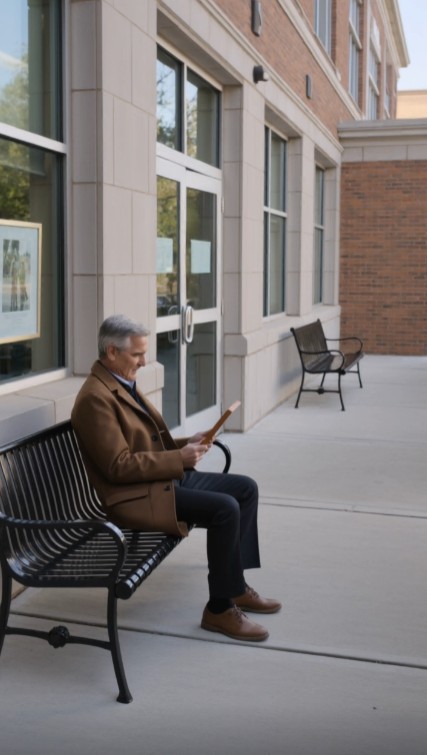
For eleven months, everyone walked past the same elderly man outside the library.
He never asked for money.
Never bothered anyone.
He simply sat on the same wooden bench every afternoon.
Rain or sunshine.
And every day, he carried an empty picture frame.
At first, librarian Emma barely noticed.
The man was polite.
Quiet.
He usually arrived around two o’clock and left before sunset.
Sometimes he read.
Sometimes he watched people coming and going.
But the empty frame was always beside him.
After several months, Emma became curious.
Then, one rainy afternoon, she finally walked outside.
The man was sitting beneath the library awning.
The empty wooden frame rested across his knees.
Emma smiled.
“Sir… can I ask you something?”
He looked up.
“Of course.”
“Why do you bring that frame every day?”
The man looked down at it.
Then smiled.
“I’m waiting for the picture.”
Emma thought she had misheard him.
“What picture?”
“The one that belongs inside.”
He turned the frame toward her.
There was nothing there.
No photograph.
No drawing.
Not even a piece of backing paper.
Emma sat beside him.
“Who’s supposed to be in it?”
The man looked toward the library entrance.
“I don’t know yet.”
Now Emma was completely confused.
Before she could ask another question, the doors opened.
A group of children came outside after the library’s weekly art program.
They were laughing and carrying painted paper folders.
The elderly man suddenly stood.
Emma looked toward the children.
But he wasn’t watching them.
He was staring at the woman walking behind them.
Their teacher.
The teacher saw him.
And dropped everything she was carrying.
Paper scattered across the pavement.
“Mr. Harris?”
The elderly man froze.
“You know me?”
The woman covered her mouth.
“You don’t remember me?”
He slowly shook his head.
“No.”
She stepped closer.
Her eyes moved from his face to the empty frame.
Then her expression changed completely.
“Where did you get that?”
Mr. Harris looked confused.
“I’ve had it for years.”
The teacher shook her head.
“No.”
She touched the edge carefully.
“You gave that frame away.”
“When?”
Her eyes filled.
“Twenty-eight years ago.”
Emma looked between them.
“To who?”
The teacher turned toward the library window.
Then pointed inside.
Toward a photograph hanging on the far wall.
Emma had walked past it hundreds of times.
It was part of a small display about the library’s history.
A group of children stood outside the old building.
Behind them was a much younger man.
Emma stared.
Then she looked at Mr. Harris.
Same eyes.
Same face.
Just decades younger.
The elderly man stepped toward the glass.
He stared at the photograph.
Then down at his empty frame.
His hands began trembling.
“That’s the picture.”
Emma leaned closer.
“What?”
His voice softened.
“That’s the picture I’ve been waiting for.”
The teacher began crying.
Her name was Laura Bennett.
Twenty-eight years earlier, she had been one of the children in that photograph.
Mr. Harris had been her teacher.
Not just hers.
For nearly thirty years, he taught children at a small elementary school several blocks from the library.
But according to Laura, he was known for something besides teaching.
Every year, he chose one photograph of his class.
He placed it inside the same wooden frame.
It sat on his desk until the school year ended.
On the final day, he gave the framed photograph to one student.
Not the student with the highest grades.
Not the most popular.
He gave it to the child he believed needed the reminder most.
A reminder that they had belonged somewhere.
That somebody had noticed them.
Laura looked at the frame.
“That year, you gave it to me.”
Mr. Harris stared at her.
“Why?”
She smiled through tears.
“Because I was leaving.”
Laura’s parents were separating.
Her mother was moving several states away.
Laura had spent most of that school year withdrawn and frightened.
She stopped raising her hand.
Stopped playing with other children.
Mr. Harris noticed.
On Laura’s final day, he handed her the framed class photograph.
She remembered exactly what he said.
“You may leave this classroom, but that doesn’t mean you disappear from it.”
Laura carried that frame through four moves.
College.
Her first apartment.
Her first classroom when she became a teacher herself.
Mr. Harris listened silently.
Then frowned.
“But if I gave it to you, why do I have the frame?”
Laura looked toward the library photograph.
“That’s what I don’t understand.”
Emma had an idea.
“Maybe the photograph was removed?”
Laura nodded slowly.
She explained that years earlier, the old school building had closed.
Many historical photographs and records were donated to the library.
She had returned the class photograph for a local-history exhibit.
But she had kept the frame.
At least, she thought she had.
Then Mr. Harris quietly said:
“I don’t remember any of this.”
Laura’s expression softened.
Emma already suspected why.
Over the previous year, Mr. Harris had occasionally seemed confused.
He sometimes asked what day it was.
Once, he forgot where the bus stop was.
Another time, he called Emma by a different name.
She had assumed it was ordinary forgetfulness.
Now Laura looked at him carefully.
“Mr. Harris, are you living alone?”
He hesitated.
“Mostly.”
That answer worried them both.
Emma invited them inside.
They walked toward the photograph.
Mr. Harris stopped directly beneath it.
There were twenty-three children in the picture.
Laura stood near the front.
Mr. Harris was behind them.
He looked happy.
Proud.
The elderly man lifted one hand and touched the bottom of the display case.
“I know these faces.”
Laura smiled.
“You taught us.”
Mr. Harris stared.
Then suddenly pointed toward one boy.
“Kevin.”
Laura gasped.
“Yes.”
Another child.
“Maria.”
“Yes.”
One by one, names began returning.
Not all of them.
But enough.
Then Emma noticed something unusual.
The frame around the photograph didn’t match the others in the historical display.
It was newer.
Simple.
Generic.
She called the library director.
Together, they carefully removed the picture from the wall.
Laura stood beside Mr. Harris.
Emma turned the photograph over.
There was writing on the back.
Old handwriting.
Laura recognized it immediately.
“That’s yours.”
Mr. Harris leaned closer.
The message read:
If this picture ever comes back to me, it means one of them remembered.
Everyone went quiet.
Below that sentence was another line.
Give the frame away again.
Laura covered her mouth.
Emma looked at Mr. Harris.
“Do you remember writing this?”
He shook his head.
“No.”
But Laura did.
Suddenly, the story made sense.
Years after receiving the frame, Laura had returned to visit Mr. Harris.
She had just graduated from college and had decided to become a teacher.
She brought the photograph with her.
She wanted him to know what his kindness had meant.
During that visit, Mr. Harris asked if he could write something on the back.
Then he returned the photograph to her.
Years later, when Laura donated the photograph to the library archive, she never looked at the back again.
But that still didn’t explain how Mr. Harris had gotten the empty frame.
Then Laura remembered.
“Wait.”
She looked at him.
“Five years ago.”
Mr. Harris stared.
Laura had visited him after hearing he was retiring.
She brought the old wooden frame.
The photograph was already at the library.
She intended to reunite the two.
But when she arrived, Mr. Harris refused.
“He told me the frame shouldn’t belong to the past.”
Laura’s voice broke.
“He said I should give it to another child.”
Mr. Harris listened as if hearing someone else’s story.
Laura continued.
She had taken the frame back to her classroom.
For several years, she used it exactly as Mr. Harris had.
One class photograph.
One student at the end of each year.
Then, eighteen months earlier, something happened.
The frame disappeared.
Laura assumed one of the students had accidentally packed it away.
She searched everywhere.
Never found it.
Mr. Harris looked down at the frame in his hands.
“So how did I get it?”
Emma turned toward him.
“Where were you living eighteen months ago?”
He gave an address.
Laura’s eyes widened.
“That’s beside my school.”
Mr. Harris often walked through the neighborhood.
One afternoon, he apparently entered the school office.
The receptionist knew him.
He had taught there decades earlier.
Laura wasn’t working that day.
According to records they later checked, Mr. Harris found the old frame in a box of unclaimed items near the office.
Nobody knew its history.
He recognized it.
Perhaps not consciously.
But something about it felt familiar enough that he took it home after staff told him he could have it.
Then, months later, he began bringing it to the library.
Why?
Mr. Harris couldn’t explain.
He only knew he felt certain that something was missing.
“The picture,” he whispered.
Laura wiped her eyes.
Even as parts of his memory faded, some part of him had remembered that the empty frame belonged with something.
And somehow, he had ended up sitting outside the exact building where the photograph hung.
Emma placed the photograph carefully into the frame.
It fit perfectly.
Mr. Harris stared at it.
Then he smiled.
“There you are.”
Laura sat beside him.
“Who?”
He pointed toward the children.
“All of them.”
Then he looked at Laura.
“And you.”
Laura began crying.
Over the following weeks, Emma helped contact Mr. Harris’s family.
His nephew lived in another state and hadn’t realized how much his uncle’s memory had declined.
Arrangements were made so Mr. Harris would no longer be alone.
But Laura had another idea.
She started searching for the other students in the photograph.
Social media helped.
Old school records helped more.
Within three months, fifteen former students had been found.
A nurse.
A mechanic.
Two teachers.
A restaurant owner.
An accountant.
A firefighter.
Parents.
Grandparents.
People who had scattered across the country.
When they learned Mr. Harris was still alive, they began sending messages.
Then photographs.
Then letters.
Emma created a new display inside the library.
At the center was the old class photograph.
Around it were newer photographs of the same students as adults.
Beneath each one was a short note describing what they remembered about Mr. Harris.
One read:
He was the first adult who told me I was good at something.
Another:
He stayed after school until my mother could pick me up.
Another:
He bought me a notebook when he realized I had none.
Another:
He made me feel like being quiet didn’t mean being invisible.
The final note came from Laura.
He gave me a picture so I would remember I belonged somewhere. I became a teacher because of him.
The empty frame was not placed around the old photograph permanently.
Instead, Laura hung it beside the display.
Empty again.
Emma asked why.
Laura smiled.
“Because he wrote that we were supposed to give it away.”
Several weeks later, Laura brought one of her students to the library.
A quiet eleven-year-old girl whose family was moving away.
Laura showed her the display.
Then she handed her the empty frame.
The girl looked confused.
“What goes in it?”
Laura smiled.
“Something you don’t want to forget.”
Across the room, Mr. Harris was visiting with Emma.
He watched the exchange.
For a moment, his expression became perfectly clear.
He pointed toward the frame.
“Good.”
Laura turned.
“You remember?”
Mr. Harris smiled.
“Not everything.”
Then he looked at the girl holding the frame.
“But I remember what that is for.”
And after twenty-eight years, the old wooden frame left the library once again.
Empty.
But not waiting for the past anymore.
Waiting for the next picture that deserved to be remembered.