
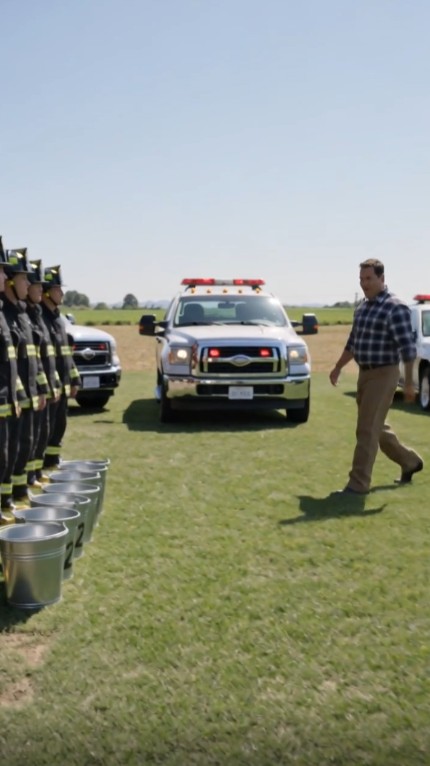
Twenty-four firefighters arrived at the same small farm.
But there was no smoke.
No flames.
No emergency.
The farmer, Daniel, ran outside the moment he saw the trucks.
“What happened?”
Nobody answered.
Instead, the firefighters began unloading something.
Buckets.
Old metal buckets.
One by one, they carried them toward the farmhouse and placed them in a perfect line.
Twenty-four in total.
Daniel stared.
“What is going on?”
Then the farmhouse door opened.
His mother, Margaret, stepped outside.
She was seventy-six now.
The moment the firefighters saw her, they stood a little straighter.
Margaret looked at the row of buckets.
Then she stopped walking.
“No.”
One firefighter smiled.
“You remember them?”
Margaret stepped closer.
Her hands were trembling.
“I haven’t seen buckets like those in fifty years.”
Daniel looked between them.
“Mom, what are they talking about?”
Margaret walked toward the first bucket.
She turned it slightly.
Painted underneath was a small number.
The next one carried a 2.
Then 3.
All the way to 24.
Margaret covered her mouth.
“I thought these were gone.”
Daniel frowned.
“What are they?”
The fire captain stepped forward.
His name was Thomas.
He looked at Margaret.
“Ask your mother what happened here in 1976.”
Daniel turned.
“Mom?”
Margaret looked toward the old barn.
For several seconds, she said nothing.
Then she whispered:
“I was sixteen.”
The firefighters followed her gaze.
Thomas asked:
“Do you still have the twenty-fifth one?”
Margaret went completely still.
Daniel looked confused.
“Twenty-fifth what?”
She turned and hurried toward the barn.
Minutes passed.
Then Margaret returned carrying something nobody expected.
Another metal bucket.
Older than the others.
More worn.
Its handle had been repaired with wire.
Painted underneath was the number:
The firefighters removed their helmets.
Daniel stared at the bucket.
Then at his mother.
“What happened here?”
Margaret sat down on the porch.
And finally told him.
Fifty years earlier, the farm had belonged to her parents.
There had been no modern water system near the barn.
No hydrant.
No reliable hose long enough to reach the far pasture.
Late one summer afternoon, smoke appeared near an equipment shed.
A small fire had started.
Nobody ever determined exactly how.
The wind was strong.
Within minutes, flames spread toward the barn.
Margaret’s father ran to get help.
Her mother began moving animals away.
Neighbors saw the smoke.
Then something extraordinary happened.
People started arriving with buckets.
Farm workers.
Teenagers.
Shop owners.
A mail carrier.
Two teachers.
Anyone who could get there quickly.
They formed a line from the old well to the barn.
One person filled.
Passed.
Next person passed.
Then the next.
Bucket after bucket.
Water moved down the line.
Empty buckets moved back.
There had been no organized fire brigade close enough to arrive immediately.
For those first critical minutes, the neighbors were the only thing standing between the fire and the barn.
Margaret was sixteen.
She joined the line.
She remembered the heat.
The shouting.
The sound of metal handles hitting one another.
And one older farmer yelling:
“Don’t stop passing!”
There were twenty-five buckets in constant rotation.
Numbered because several belonged to different farms and families.
Someone had painted numbers on them earlier during harvest season.
Margaret had bucket number 25.
She stood near the end of the line.
When the local volunteer fire crew finally arrived, the neighbors had already slowed the spread enough for firefighters to bring it under control.
The barn survived.
So did every animal.
Daniel looked at the old building.
“That happened here?”
Margaret nodded.
“You never told me.”
“I didn’t think there was much to tell.”
Thomas smiled.
“There’s more to tell than she thinks.”
After the fire, the twenty-five buckets became a local symbol.
For several years, they appeared during community events.
People joked about the “bucket brigade.”
Then families moved.
Farms changed hands.
People died.
The buckets disappeared one by one.
Eventually, Margaret assumed they were gone forever.
Daniel looked at the twenty-four lined up in front of the house.
“How did you find them?”
Thomas smiled.
“One at a time.”
The project had begun nearly two years earlier.
A retired firefighter found an old photograph while helping clean out the town station archive.
The picture showed the 1976 farm fire.
In the foreground stood a line of neighbors.
And at their feet were several numbered buckets.
On the back of the photograph someone had written:
25 buckets saved the Miller barn before Engine 4 arrived.
The retired firefighter became curious.
He started asking questions.
Most people remembered the fire vaguely.
Then someone mentioned Margaret.
She had been one of the youngest people in the line.
But Thomas didn’t contact her.
Not yet.
Instead, firefighters from the department began searching for the buckets.
Number 7 was hanging inside an old garage.
Number 11 had become a flower planter.
Number 3 was found in a shed almost sixty miles away.
One had been donated to an antique shop.
Another had spent decades holding tools.
Several families had kept theirs without knowing why the numbers were painted underneath.
Word spread among fire departments.
Firefighters began helping.
One bucket was recovered from another state.
Another was shipped back by the grandson of someone who had stood in the original line.
Slowly, the collection grew.
Twenty-four buckets were found.
Only one remained missing.
Number 25.
Thomas looked toward Margaret.
“We couldn’t find yours.”
She held the bucket tightly.
“My father kept it.”
After the fire, Margaret’s father repaired the handle.
He told her not to throw it away.
Years later, when he died, Margaret inherited the farm.
The bucket went into the barn.
Then into a storage room.
Then behind an old cabinet.
She had almost forgotten it existed.
Daniel stared at his mother.
“So all twenty-five are here now?”
Thomas nodded.
“For the first time in fifty years.”
Margaret looked at the firefighters.
“But why would twenty-four firefighters drive all the way here for this?”
Thomas glanced toward the group.
“Because those buckets are part of why our department exists the way it does today.”
Margaret frowned.
Thomas explained.
The 1976 fire had exposed how vulnerable the rural community was.
The nearest properly equipped crew had taken too long to reach the farm.
Afterward, local residents began raising money.
They held dinners.
Auctions.
Farm sales.
Small fundraisers.
Within two years, the volunteer department purchased a new water tanker and expanded its rural response program.
Many of the people who had stood in the bucket line became volunteers.
Some stayed for decades.
One became fire chief.
Another trained generations of younger firefighters.
The community’s modern fire response system had grown partly from what happened at Margaret’s farm.
Thomas pointed toward the firefighters standing behind him.
“Several of us were trained by people who were in that line.”
Margaret looked stunned.
One firefighter stepped forward.
“My grandfather had bucket 8.”
Another raised his hand.
“My father was the teenager holding number 14.”
Another smiled.
“My grandmother filled buckets at the well.”
Daniel slowly understood.
These firefighters weren’t strangers.
Not really.
Their families were connected to the people who had stood on this property fifty years earlier.
Then Thomas reached into his jacket.
He removed a folded copy of the old photograph.
Margaret took it.
She found herself immediately.
Sixteen years old.
Hair tied back.
Standing beside the barn.
Bucket number 25 in her hands.
Then she noticed the boy beside her.
She touched the photograph.
“That’s Robert.”
Daniel looked.
“Who?”
Margaret smiled.
“Your father.”
Daniel stared at her.
“Dad was here too?”
She nodded.
That was something she had never told him.
Margaret and Robert barely knew each other before the fire.
They attended the same school.
Different groups.
Different friends.
But that afternoon, they ended up standing beside one another in the bucket line.
Robert held number 24.
Margaret held number 25.
For nearly forty minutes, they passed water back and forth.
Afterward, Robert walked her home.
They started talking.
Two years later, they married.
Daniel stared at buckets 24 and 25.
“You met because of the fire?”
Margaret laughed softly.
“Pretty much.”
Thomas pointed toward bucket 24.
“That one took us the longest to find.”
It had belonged to Robert’s family.
After his parents died, it had been sold with other farm equipment.
It eventually ended up hundreds of miles away.
A firefighter tracked it down after seeing the number in an online photograph of an antique collection.
Margaret touched the rim.
Her husband had died seven years earlier.
She had believed almost everything from those early years together was gone.
Now the object he had held the day they truly met was sitting beside hers.
Thomas placed bucket 24 next to 25.
The two old pieces of metal looked ordinary.
Dented.
Scratched.
Faded.
But Margaret saw something else.
She saw a sixteen-year-old girl.
A frightened town.
Neighbors running toward smoke instead of away from it.
And a boy beside her who kept saying:
“Keep passing.”
One of the firefighters asked:
“Would you mind if we took a photograph?”
Margaret smiled.
All twenty-five buckets were lined up in front of the old barn.
Margaret stood beside number 25.
Daniel stood next to her.
The twenty-four firefighters formed a line behind them.
Thomas set a timer on the camera.
Then hurried into place.
Before the photograph was taken, Margaret stopped him.
“Wait.”
She picked up bucket 24.
Then handed it to Daniel.
“That was your father’s.”
Daniel held it.
Margaret lifted number 25.
The camera clicked.
Months later, the photograph was placed inside the fire station.
Beside it hung the original picture from 1976.
Underneath was a small plaque.
It didn’t mention heroism.
It didn’t mention bravery.
It simply said:
Before the trucks arrived, the neighbors did.
Margaret kept bucket 25 at the farm.
Bucket 24 stayed beside it.
The other twenty-three were eventually returned to the families who owned them.
Once a year, though, the department borrowed them.
They brought the buckets to the station during open house day.
Young firefighters heard the story.
Children lined them up.
Older residents pointed out family names.
And every time Thomas reached the end, he said the same thing.
“Equipment matters.”
“Training matters.”
“But before either one can help, somebody has to decide to show up.”
Fifty years earlier, twenty-five neighbors had done exactly that.
And half a century later, twenty-four firefighters drove hundreds of miles to make sure the woman holding the final bucket knew they had never forgotten.