
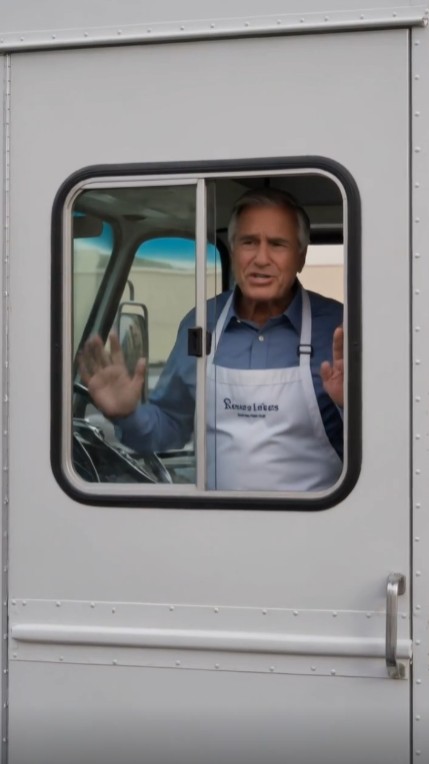
Thirty restaurant owners closed their kitchens for one hour.
Then they all drove to the same tiny food truck.
The owner, seventy-one-year-old Luis, thought something was wrong the moment he saw them.
They arrived one after another.
Chefs in aprons.
Restaurant owners in work shirts.
Some still wearing jackets with their restaurant names embroidered across the chest.
Luis looked out through the service window.
“What happened?”
Nobody answered.
Then the first chef stepped forward.
“One soup, please.”
Luis nodded.
He filled a bowl with the soup he had been serving for decades.
The chef took it to a nearby table.
One bite.
Then he placed the spoon down.
Luis frowned.
“Is something wrong?”
The chef smiled.
“No.”
A second chef stepped forward.
“Same soup.”
Luis served him.
One bite.
Spoon down.
Then another chef.
Then another.
The same thing happened every time.
Luis finally stepped out of the truck.
“Okay.”
He looked around at them.
“Why are you all doing this?”
Nobody answered.
Then the youngest chef in the group stepped forward.
His name was Marco.
He held his bowl carefully in both hands.
“Do you remember giving this soup away?”
Luis laughed.
“I’ve given away thousands of bowls.”
Marco smiled.
“Exactly.”
Then he turned toward the others.
“Everyone who ate here when they couldn’t afford dinner…”
Hands went up.
One.
Five.
Ten.
Twenty.
Twenty-nine hands.
Luis stopped smiling.
He stared at them.
A chef near the back spoke first.
“I was seventeen.”
Another said:
“I was sleeping in my car.”
A woman raised her hand.
“You fed me for three months.”
Someone else said:
“I had just lost my job.”
Another:
“I was trying to keep my first restaurant open.”
Luis looked overwhelmed.
“I didn’t even know your names.”
Marco smiled.
“But we remembered yours.”
For more than forty years, Luis had served food from small kitchens.
Restaurants.
Cafeterias.
Eventually his own food truck.
He had never become wealthy.
He had never opened a famous restaurant.
But everybody in the neighborhood knew one thing about him.
If you were hungry and truly couldn’t pay, Luis rarely asked questions.
Sometimes he wrote the meal down.
Sometimes he pretended the customer had already paid.
Sometimes he simply slid a bowl across the counter and said:
“Next time.”
For many people, there never was a next time.
Luis never chased them.
He never kept a real list.
He didn’t even remember most of their faces.
But they remembered him.
One of the chefs stepped forward.
“My name is Daniel.”
Luis studied him.
Nothing.
Daniel smiled.
“I was nineteen when I came here.”
He had been attending culinary school during the day and washing dishes at night.
Then he lost the dishwashing job.
For almost two weeks, he lived on crackers and whatever food classmates didn’t finish.
One rainy evening, he stopped at Luis’s truck.
He ordered soup.
When it was time to pay, his card declined.
Daniel expected embarrassment.
Instead, Luis looked at the machine and said:
“This thing has been acting up all day.”
Then he pushed the bowl toward him.
Daniel knew the machine was working.
He returned the next evening.
Luis fed him again.
Then again.
For almost three weeks.
Years later, Daniel opened his own restaurant.
Another woman stepped forward.
Her name was Sofia.
She had once been a single mother working two jobs.
Her son was five.
Some evenings, after paying rent and childcare, she had almost nothing left.
Luis used to give them one large bowl of soup and two pieces of bread.
“He always told my son it was the kids’ special.”
Sofia laughed through tears.
“There was no kids’ special.”
Luis looked down.
“I remember him.”
Sofia smiled.
“He owns a bakery now.”
One by one, the stories continued.
A chef who had been homeless.
A dishwasher who became an executive chef.
A restaurant owner who once spent nights sleeping in his kitchen.
A woman who had immigrated with almost nothing and later built a catering company.
Luis listened.
He remembered some faces.
Others only after hearing the stories.
Some he didn’t remember at all.
That seemed to affect him most.
“You’re telling me all of you ate here?”
Marco shook his head.
“Not just here.”
Some had met Luis decades earlier when he worked in a diner.
Others knew him from a small lunch counter he ran before the building was sold.
A few had found his food truck later.
Different places.
Different years.
Same man.
Same soup.
Then a loud engine sounded near the designated parking area beside the lot.
Everyone turned.
A large delivery truck pulled in carefully.
Luis frowned.
“What is that?”
Marco smiled.
The back doors opened.
Inside was brand-new commercial kitchen equipment.
A stainless-steel refrigerator.
A commercial range.
New preparation tables.
Storage units.
A modern ventilation system.
And equipment designed specifically for Luis’s food truck and small prep kitchen.
Luis immediately shook his head.
“No.”
Marco laughed.
“Luis—”
“No.”
Luis raised both hands.
“I cannot accept this.”
The chefs looked at one another.
Then Marco lifted his bowl.
“You already paid for it.”
Luis frowned.
“When?”
Marco smiled.
“One bowl at a time.”
Luis looked away.
For years, his equipment had been failing.
The refrigerator needed constant repairs.
One burner barely worked.
The prep table had been patched so many times that Luis joked it had more repairs than original parts.
Still, he kept working.
Retirement never seemed to interest him.
When Marco and the others learned how bad the equipment had become, they started making calls.
Thirty restaurant owners contributed.
Some donated money.
Some called suppliers.
Others arranged installation.
A few companies reduced their prices after hearing why the equipment was being purchased.
Luis still refused.
“I gave you soup.”
Daniel stepped forward.
“No.”
Luis looked at him.
Daniel continued.
“You gave some of us another day.”
Sofia nodded.
“And you did it without making us feel ashamed.”
That sentence made Luis quiet.
Because that had always mattered to him.
Luis grew up poor.
He remembered standing beside his mother at a grocery store while she quietly removed items from their basket because she didn’t have enough money.
He remembered the embarrassment on her face.
Years later, when Luis started working with food, he made himself one promise.
If he ever helped someone who was hungry, he would never make them explain themselves in front of everybody.
That was why he rarely said:
“You can’t afford it?”
Instead he said:
“I made too much.”
Or:
“This order was cancelled.”
Or:
“Pay me next time.”
Sometimes there really was extra food.
Sometimes there wasn’t.
Marco looked toward the new equipment.
“We know you would never take money from us.”
“So we didn’t bring money.”
Luis shook his head.
“You people are impossible.”
Everyone laughed.
Then Luis noticed something.
Only twenty-nine people had raised their hands earlier.
But thirty restaurant owners were standing there.
He looked at Marco.
“You didn’t raise your hand.”
Marco smiled.
“No.”
“Then what are you doing here?”
Marco looked toward the road.
“I’m part of the reason we chose today.”
Luis frowned.
Before Marco could explain, another car entered the lot.
It stopped beside the food truck.
An elderly man stepped out.
He walked slowly with a cane.
Luis looked at him.
Then froze.
The man smiled.
“Hello, Luis.”
Luis whispered:
“Mr. Alvarez?”
The man nodded.
Nobody else understood.
But Luis did.
Nearly fifty years earlier, before Luis had ever owned a food truck, he had been twenty-two years old and newly married.
Money was tight.
Very tight.
His first daughter had just been born.
Luis worked in a restaurant kitchen six nights a week.
Then the restaurant closed unexpectedly.
He found another job quickly.
But there were two weeks when he had almost nothing.
One evening, Luis entered a tiny café looking for work.
The owner was a man named Roberto Alvarez.
He didn’t have a job available.
But he noticed Luis staring at a pot of soup behind the counter.
Roberto filled a bowl.
Luis immediately said:
“I can’t pay for that.”
Roberto placed it in front of him.
“I didn’t ask you to.”
Luis ate.
The next day, he returned looking for work again.
Roberto still had no opening.
But there was another bowl of soup.
Then another the next day.
For almost two weeks, Roberto fed him.
Eventually, a kitchen position became available.
Roberto gave Luis the job.
Luis worked there for years.
More importantly, he never forgot what Roberto had done.
The bowl of soup Luis later gave away thousands of times was based on Roberto’s recipe.
Luis looked at Marco.
“How did you find him?”
Marco smiled.
“My restaurant bought his old café building three years ago.”
Luis stared.
Marco explained.
During renovations, he discovered an old photograph hanging behind a storage cabinet.
It showed a much younger Roberto standing beside several employees.
One of them was Luis.
Marco recognized him immediately.
He started researching the café’s history.
Eventually, he found Roberto living several states away with his daughter.
Then Marco called him.
Roberto listened to the story of the thirty chefs.
He agreed to come.
Luis walked toward him.
“I thought you were gone.”
Roberto laughed.
“I’m ninety-two, not gone.”
Everyone laughed.
Luis hugged him.
For several seconds, neither man spoke.
Then Roberto looked at the bowl in Marco’s hands.
“You still make my soup?”
Luis wiped his eyes.
“I improved it.”
Roberto raised an eyebrow.
“You ruined it, you mean.”
Luis laughed.
Then Marco finally explained why they had chosen that exact day.
It was fifty years to the day since Roberto had first given Luis a free bowl of soup.
Luis stared at him.
“How do you know that?”
Roberto pulled an old notebook from his coat.
He had kept records from the café.
Not customer debts.
Memories.
On one page was a simple entry:
Young cook came looking for work. No opening. Fed him soup. Told him to come back tomorrow.
The date matched exactly.
Luis read it.
Then looked at the twenty-nine people who had once stood where he had stood.
Hungry.
Embarrassed.
Uncertain about what came next.
He finally understood.
Roberto had given him one bowl.
Luis had carried it forward.
Then the people Luis fed carried it forward again.
Daniel’s restaurant donated meals every week to a local shelter.
Sofia’s family bakery provided free breakfasts to children through a community program.
Another chef trained young people who couldn’t afford culinary school.
The help had never stopped.
It had simply changed kitchens.
Roberto picked up a spoon.
Marco handed him a fresh bowl.
Roberto tasted the soup.
Everyone waited.
He put his spoon down.
Luis laughed.
“Well?”
Roberto pretended to think.
“Needs salt.”
The entire parking lot erupted in laughter.
Later that afternoon, the new equipment was unloaded.
Luis finally agreed to accept it on one condition.
A small metal plaque would be placed inside the truck.
Not with his name.
With Roberto’s.
It read:
THE FIRST BOWL WAS GIVEN TO ME.
The next morning, Luis reopened the food truck.
The new equipment worked perfectly.
Around lunchtime, a young man approached the window.
He ordered soup.
Then quietly searched his pockets.
His face changed.
“I’m sorry.”
He started to walk away.
Luis called after him.
“Hey.”
The young man turned.
Luis placed a bowl on the counter.
“You’re lucky.”
The man looked confused.
“Why?”
Luis smiled.
“Somebody already paid for this one.”
The young man took the soup.
And somewhere behind Luis, surrounded by brand-new equipment and decades of memories, the old tradition continued.
One bowl at a time.