
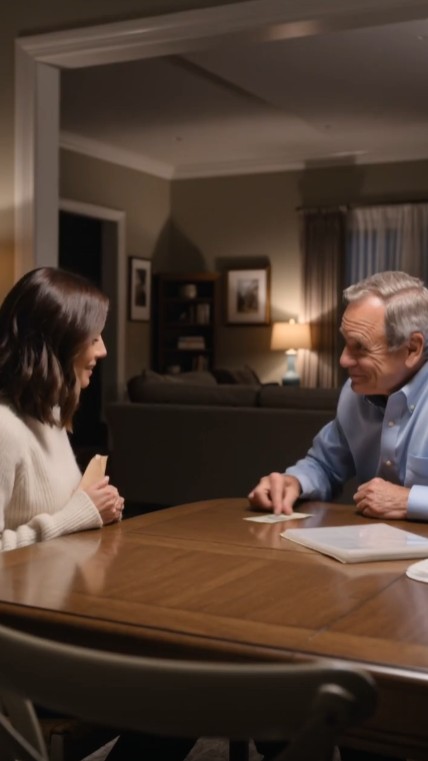
Every birthday, Anna’s father gave her exactly one dollar.
Not one hundred.
Not a gift card.
Not jewelry.
One dollar.
When Anna was eight, she thought it was funny.
At sixteen, she thought it was strange.
By the time she turned thirty, she had stopped trying to understand it.
Her father, Robert, would always hand her a single bill and say the same thing.
“Keep it.”
So she did.
Every year, Anna tucked the dollar away.
Some went into an old jewelry box.
Others into envelopes.
Eventually, she kept them all together inside a small wooden drawer.
Twenty-eight birthdays.
Twenty-eight dollars.
Then came Anna’s thirty-sixth birthday.
She waited for the familiar bill.
Robert handed her nothing.
Anna laughed.
“Did inflation finally get you?”
Her father smiled.
“No.”
He reached into a cabinet and placed a small album on the table.
Inside were twenty-eight transparent pockets.
Anna frowned.
“Dad?”
Robert sat down.
“You’re ready.”
“For what?”
“Go get the dollars.”
Anna brought the old bills.
Robert carefully asked her to place them inside the album in birthday order.
The first bill.
Second.
Third.
Fourth.
Anna didn’t understand why it mattered.
Then she reached bill number seven.
She stopped.
Near the edge was a tiny handwritten mark.
Almost invisible.
A short line and a number.
She checked bill eight.
Another mark.
Then nine.
Another.
Anna looked at her father.
“Dad…”
He said nothing.
“These aren’t random dollars.”
Robert shook his head.
“No.”
Anna continued arranging them.
Each bill carried a tiny mark.
Some had numbers.
Others had letters.
When placed in birthday order, they began forming a sequence.
Anna’s hands started shaking.
She moved the album closer.
The numbers looked like coordinates at first.
Then a street number appeared.
A road name.
A town.
Anna stared.
“Is this an address?”
Robert nodded.
“An old one.”
“Whose?”
Instead of answering, he reached into his pocket.
He placed a key on the table.
Anna stared at him.
“Dad, what did you do?”
Robert smiled.
“Something I started the day you were born.”
Anna looked again at the address.
She recognized the town.
It was almost two hours away.
But she had never heard of the street.
Then Robert handed her one final dollar.
Number twenty-nine.
Anna frowned.
“I thought there were only twenty-eight.”
“There were.”
She examined the bill.
Another mark had been written in one corner.
When she added it to the end of the sequence, it completed the address.
And underneath it was one word.
BLUE.
Anna looked at her father.
“What does blue mean?”
“You’ll know when you get there.”
The next morning, Anna drove to the address.
Robert insisted she go alone.
The road took her through an older neighborhood filled with small houses and enormous trees.
Then she found it.
A narrow blue house stood at the end of the street.
Anna slowed down.
The paint was faded.
The porch leaned slightly.
But it was clearly the place.
She parked.
Then she noticed something strange.
The house looked familiar.
Not because she had been there.
Because she had seen it in photographs.
Old family photographs.
Anna got out.
She walked toward the porch.
The key fit the front door.
Inside, the house was empty.
Almost completely.
No furniture.
No decorations.
Just polished floors and fresh paint.
On the living-room wall hung one framed photograph.
Anna approached it.
The picture showed her father as a young man.
Beside him stood a woman holding a newborn baby.
Anna.
She stared.
That woman was her mother, Sarah.
Anna had only a few memories of her.
Sarah had died when Anna was six.
Robert rarely spoke about the years before her death.
Not because he didn’t love her.
Because talking about her still seemed painful.
Anna touched the frame.
Then she noticed writing underneath.
This was your first home.
She froze.
Anna had always believed the apartment where she grew up was their first family home.
Apparently not.
She walked through the house.
The small kitchen.
The narrow hallway.
One bedroom painted pale yellow.
Inside that room, a single box rested on the floor.
Anna opened it.
There were letters inside.
Dozens.
All written by Robert.
But none had been mailed.
The first envelope said:
For Anna — age 8.
The next:
Age 9.
Age 10.
Every birthday.
Anna sat down.
She opened the first.
Robert had written about the one-dollar gift.
He explained that the dollar itself was never the present.
The bill was a marker.
A breadcrumb.
A piece of a trail.
But Anna wasn’t supposed to follow it until he knew she was ready.
She opened another letter.
Then another.
Each one contained a story about the blue house.
Her parents had rented it when Sarah was pregnant.
They had almost no money.
Robert worked two jobs.
Sarah worked from home when she could.
The house was small.
Drafty.
Cheap.
But they loved it.
This was where Anna took her first steps.
Where she learned to say “Dad.”
Where Sarah once painted stars across the ceiling of the tiny bedroom.
Anna looked up.
The ceiling was plain now.
Then she noticed faint shapes beneath the newer paint.
Stars.
Still visible if the light hit them correctly.
Anna covered her mouth.
She continued reading.
When Sarah became ill, medical bills grew quickly.
Robert and Sarah eventually had to leave the house.
They moved to the apartment Anna remembered.
The blue house was sold.
After Sarah died, Robert made himself a promise.
Someday, if he could, he would buy that house back.
Not for himself.
For Anna.
She stared at the letter.
Then stood and walked through the rooms again.
The house belonged to her?
She found another envelope.
This one was dated five years earlier.
Robert explained that he had finally located the property.
The owner had been planning to sell.
Robert used savings he had quietly built for decades and purchased it.
But he didn’t tell Anna.
He renovated slowly.
One room at a time.
Whenever money allowed.
Anna thought about the yearly dollar.
One dollar.
Twenty-eight years.
She had assumed it was a joke.
But every bill carried another tiny part of the address.
The gifts were not valuable.
They were instructions.
A trail leading back to where her story began.
Then Anna found the final letter.
It was written recently.
She opened it.
Anna,
If you are reading this, then you found the house.
You probably think this was all about property.
It wasn’t.
Your mother and I had almost nothing when we lived here.
But this was the richest time of our lives.
Not because of money.
Because you were here.
Anna stopped.
She wiped her eyes.
The letter continued.
Robert explained that Sarah had started the one-dollar tradition.
On Anna’s first birthday, Sarah had placed a dollar inside a card.
Robert laughed and asked why she was giving a baby money.
Sarah answered:
Because one day she’ll learn that value and price are not the same thing.
Robert never forgot it.
After Sarah died, he continued the tradition.
One dollar.
Every birthday.
At first, it was simply to keep something Sarah had started.
Then Robert began thinking bigger.
He wrote a tiny part of the old house address onto each bill.
He didn’t know whether he would ever be able to buy the property again.
But he liked the idea that Anna was unknowingly carrying pieces of home with her.
Year after year.
When he finally purchased the house, the plan became real.
Anna looked around.
There was one more sentence in the letter.
The key is yours.
The house is yours.
But the memory belongs to all three of us.
Anna cried for a long time.
Then she called her father.
He answered immediately.
“You found it?”
She laughed through tears.
“You’re insane.”
Robert laughed too.
“Probably.”
“Why didn’t you tell me?”
“Because then the dollars would have been boring.”
Anna looked at the album.
“Dad, this house must be worth a lot more than twenty-nine dollars.”
“I told you.”
“What?”
“The dollars weren’t the gift.”
Several days later, Robert came to the house.
Anna was waiting on the porch.
She held the album under one arm.
When he walked up, she handed him a dollar.
Robert frowned.
“What’s this?”
“My turn.”
He smiled.
“What am I supposed to do with it?”
Anna had written something tiny in one corner.
Robert held it closer.
The mark said:
Kitchen.
He laughed.
“What’s in the kitchen?”
“Go look.”
Inside, on the kitchen table, Anna had placed a framed photograph.
Robert and Sarah.
Young.
Standing in front of the same blue house.
Beside it was a second photograph.
Robert and Anna.
Taken that morning.
Same porch.
Same house.
Different decade.
Robert stared at them.
Anna stood beside him.
“You spent twenty-nine years leading me back here.”
Robert looked at her.
“And?”
She smiled.
“I think Mom was right.”
“About what?”
Anna placed the single dollar between the two photographs.
“Value and price aren’t the same thing.”
Years later, Anna kept every birthday dollar inside the album.
She never spent one.
The blue house eventually became the place where family birthdays were celebrated again.
And every year, Robert still gave Anna one dollar.
Not because she needed it.
Not because it was worth much.
But because one tiny gift had carried twenty-nine years of memory inside it.
And sometimes, the smallest present can lead you all the way home.