
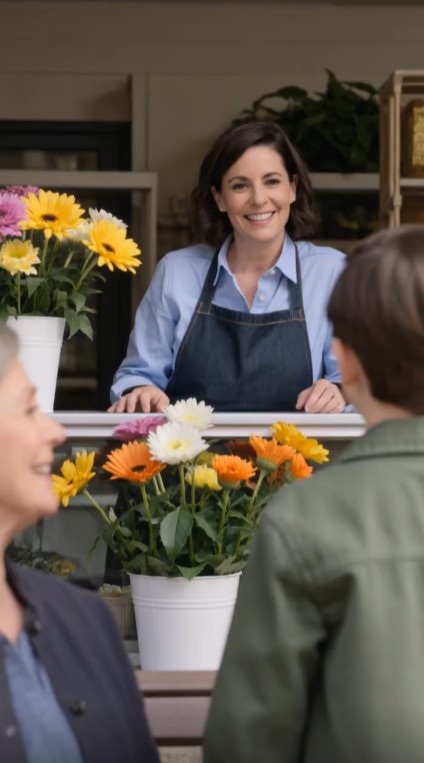
The boy walked into the flower shop and asked for one flower nobody wanted.
The florist smiled.
“What do you mean?”
Ten-year-old Noah pointed toward a bucket in the corner.
Inside were flowers that were slightly bent, uneven, or imperfect.
Not ruined.
Just the ones most customers passed over.
“Those.”
His mother looked at him.
“Noah, you can choose any flower you want.”
He shook his head.
“I need twelve of these.”
The florist raised an eyebrow.
“Why twelve?”
Noah wouldn’t say.
He carefully chose them one by one.
A bent tulip.
Two small roses with uneven petals.
Several daisies.
A lily with a crooked stem.
Nothing matched.
That seemed to be exactly what Noah wanted.
The florist wrapped them loosely in paper.
Noah paid with money from his own pocket.
Then he walked outside with his mother.
The florist, curious now, watched through the window.
Noah crossed the pedestrian plaza.
Then he stopped beside an elderly man sitting alone on a bench.
He handed him one flower.
The man looked surprised.
“For me?”
Noah nodded.
Then he walked to another bench.
Another flower.
Then another.
Twelve elderly people were sitting separately around the plaza.
Noah gave one flower to each of them.
Most smiled.
One laughed.
Another immediately placed hers carefully inside her handbag.
Then Noah reached the final woman.
She accepted the flower.
Looked at it.
Then looked at Noah.
Her expression changed.
She stood.
“Where did you learn to do this?”
Noah pointed toward his mother.
But she shook her head.
“Not from me.”
The elderly woman looked back at Noah.
“Who taught you?”
“My grandfather.”
“What was his name?”
Noah told her.
The woman froze.
Then she looked toward the flower shop.
Without another word, she hurried inside.
The florist looked confused.
“Can I help you?”
The woman held up the flower.
“Do you still have the box these came from?”
“What box?”
“The delivery box.”
The florist glanced toward the back room.
Most flowers had arrived that morning.
The cardboard boxes were still stacked near the sink.
She brought them out.
The elderly woman checked each one.
Then she stopped.
On one box was an old handwritten supplier mark.
A tiny symbol beside a faded number.
The woman touched it.
Then started crying.
Noah’s mother had followed them inside.
“You recognize that?”
The woman nodded.
Then she looked at Noah.
“Your grandfather started this with twelve flowers almost forty years ago.”
Noah stared at her.
“Started what?”
Before she could answer, the shop door opened again.
The other eleven elderly people from the plaza began walking in.
Some were holding Noah’s flowers.
Others looked just as confused.
The woman turned toward them.
“Look.”
She showed them the delivery box.
One man immediately smiled.
Another covered his mouth.
A third whispered:
“That mark.”
Noah looked from face to face.
“You all know Grandpa?”
The elderly woman nodded.
“Most of us did.”
Her name was Evelyn.
She had known Noah’s grandfather, Samuel, when they were young.
Nearly forty years earlier, Samuel worked part-time at a flower market.
His job was simple.
Unload deliveries.
Sweep the floors.
Trim damaged stems.
And throw away flowers that shops wouldn’t buy.
That last part bothered him.
Many of the flowers were still beautiful.
They just weren’t perfect.
A rose bent slightly sideways.
A daisy had a smaller bloom.
A tulip leaned.
Customers wanted straight stems and flawless petals.
Anything else often ended up discarded.
One Friday evening, Samuel gathered twelve flowers from the reject pile.
His manager laughed.
“What are you doing with those?”
Samuel answered:
“Giving them to people who won’t care if they’re crooked.”
He walked to the same plaza.
It looked very different then.
Fewer shops.
Older benches.
But people still sat there alone.
Samuel gave one imperfect flower to twelve strangers.
No speech.
No explanation.
Just:
“This is for you.”
The following Friday, he did it again.
Then again.
Eventually, people began recognizing him.
Some waited for him.
Others started bringing their own extra flowers.
Within months, a small tradition had formed.
Every Friday, twelve imperfect flowers were set aside.
Not sold.
Not thrown away.
Given away.
Noah’s mother stared at Evelyn.
“My father never told us this.”
Evelyn smiled.
“Samuel didn’t like telling people about things he thought were ordinary.”
Noah looked down at the flower still in Evelyn’s hand.
“Why twelve?”
Evelyn laughed softly.
“That part started by accident.”
Samuel’s first reject bucket happened to contain twelve usable flowers.
So he took all twelve.
After that, twelve became the number.
One for each person sitting alone around the plaza.
Over time, the tradition grew.
Workers at nearby restaurants joined.
Shop owners donated extra flowers.
Students helped.
Sometimes there were more than twelve.
Sometimes fewer.
But Samuel always tried to find twelve.
Then something changed.
The flower market closed.
Samuel moved away for work.
The ritual slowly disappeared.
Years later, people still remembered it.
Evelyn pointed toward the handwritten mark on the delivery box.
Samuel had created that symbol.
It was a simple way for workers at the market to identify flowers that were still usable but not suitable for full-price sale.
Instead of throwing them away, they were marked for giveaway.
The supplier had apparently kept using the symbol long after Samuel left.
The florist looked stunned.
“We still use that code.”
Evelyn stared at her.
“You do?”
The florist nodded.
“It means second selection.”
Flowers with cosmetic imperfections.
Still fresh.
Still perfectly usable.
Just not premium display stock.
Noah’s mother looked at him.
“How did you know to choose those?”
Noah shrugged.
“Grandpa told me.”
The room went quiet.
Samuel had died two years earlier.
Noah had been eight.
Before he died, he told Noah dozens of stories.
Most were silly.
Stories about bad haircuts.
Broken bicycles.
Getting lost.
Accidentally wearing two different shoes to work.
But one story stayed with Noah.
Samuel had told him:
“If you ever see something good that people ignore because it isn’t perfect, don’t assume nobody wants it.”
Noah remembered asking:
“Like what?”
Samuel answered:
“Flowers are a good place to start.”
Noah’s mother covered her mouth.
“He said that to you?”
Noah nodded.
“He told me to give twelve away someday.”
Evelyn started crying again.
She looked at the other elderly people.
Several nodded.
They remembered the same line.
Samuel used to say it almost every Friday.
One man stepped forward.
His name was Arthur.
“The first flower your grandfather gave me was a white carnation.”
Noah stared.
“You were here?”
Arthur nodded.
“I was twenty-two.”
At the time, Arthur had recently lost his job.
He spent afternoons sitting alone in the plaza because he didn’t want his family to know how discouraged he had become.
Samuel gave him a crooked carnation.
Arthur remembered laughing.
“Why me?”
Samuel answered:
“You looked like someone who needed something that wasn’t trying too hard.”
Arthur smiled through tears.
“I never forgot that.”
Another woman spoke.
Samuel had given her a flower after her husband died.
Another remembered receiving one while caring for her sick mother.
Another had been a nervous university student studying alone.
Not everyone knew Samuel personally.
But several had carried the tradition forward.
One woman started leaving small flower jars at a nursing home.
Another began giving leftover bakery items to elderly neighbors.
Arthur later ran a repair shop and fixed small things for people who couldn’t afford it.
The flowers had become less about flowers.
More about noticing.
Noah looked around.
“So Grandpa helped all of you?”
Evelyn shook her head.
“Not exactly.”
She smiled.
“He noticed us.”
“That’s different.”
The florist picked up the delivery box.
Then she asked:
“Why did all of you happen to be sitting outside today?”
The group exchanged looks.
Evelyn smiled.
“We come here every year.”
Noah’s mother frowned.
“Why?”
Evelyn pointed toward the calendar hanging beside the register.
That date was the anniversary of Samuel’s first twelve-flower Friday.
For years, some of the people who remembered had quietly returned to the plaza on the same day.
Not every year.
Not everyone.
But enough.
They sat separately on the benches because that was how the original tradition began.
They never expected anything to happen.
They certainly didn’t expect Samuel’s grandson to walk out carrying twelve imperfect flowers.
Noah’s mother sat down.
“You’re telling me he chose today?”
Evelyn looked at Noah.
“Did Grandpa tell you the date?”
Noah shook his head.
“No.”
His mother thought for a moment.
Then remembered.
That morning, Noah had asked if they could visit the flower shop because it was Samuel’s birthday.
That was all.
Evelyn smiled.
“Then maybe we were celebrating two things without knowing it.”
The florist walked toward the back room.
She returned carrying another bucket.
It contained flowers she had been planning to discount later that day.
She placed it on the counter.
“From now on, these don’t get thrown away.”
Noah looked at her.
“What happens to them?”
She smiled.
“Every Friday, twelve go outside.”
The elderly people laughed.
Evelyn looked at Noah.
“You started it again.”
Noah shook his head.
“Grandpa did.”
The florist created a small card for the bucket.
No dramatic story.
No names.
It simply read:
TWELVE FLOWERS
Take one for someone who might need it.
Over the following months, the tradition returned.
Sometimes children handed out the flowers.
Sometimes customers did.
Sometimes someone simply picked one up and gave it to the person sitting beside them.
Noah visited often.
He always chose the bent ones first.
One Friday, the florist asked why.
Noah answered:
“Because everybody picks the perfect ones.”
Then he smiled.
“These are the ones Grandpa said to notice.”
Years later, most people who received a flower never knew Samuel’s name.
They didn’t know about the old market.
The handwritten symbol.
The twelve strangers.
Or the little boy who accidentally restarted a forty-year-old tradition.
They only knew that someone had walked up to them with a flower and said:
“This is for you.”
And sometimes that was enough.