
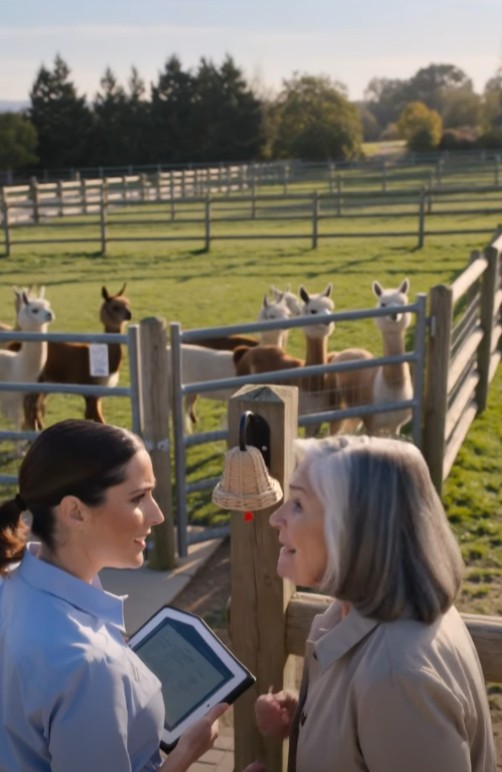
Every afternoon, the sanctuary’s seventeen alpacas did exactly the same thing.
At 4:10, they suddenly left whatever they were doing and moved toward one fence.
Always the same fence.
There was no feeding station there.
No gate.
No visitors.
Nothing the staff could explain.
At first, the workers thought it was coincidence.
Then they started watching the clock.
4:08.
Nothing.
4:09.
The herd would begin looking toward the road.
4:10.
All seventeen moved together.
Some trotted.
Others simply walked quickly.
Then they stood beside the fence for several minutes.
Waiting.
For what, nobody knew.
The sanctuary manager, Emma, started keeping notes.
Weather didn’t matter.
Sunny days.
Cold afternoons.
Light rain.
The pattern stayed almost identical.
One afternoon, just before 4:10, a small white van safely stopped on the road beyond the pasture.
The alpacas noticed immediately.
Heads lifted.
Ears turned forward.
Then an elderly woman stepped out.
Every animal moved toward the fence.
Emma stared.
The woman stood beside the road looking just as surprised.
Emma walked closer.
“You’ve been here before?”
The woman smiled.
“Not for eleven years.”
Her name was Margaret.
She had once volunteered on a small farm that occupied the land before it became a sanctuary.
She looked across the pasture.
Then suddenly froze.
Near the fence, safely mounted on a wooden sanctuary post, hung a small woven bell.
It had been donated with several old pieces of farm equipment.
Margaret pointed.
“I made that.”
Emma looked at the bell.
“You made this?”
Margaret nodded.
“Years ago.”
The bell wasn’t large.
Just a simple metal bell wrapped with faded woven cord.
Margaret had made the braided strap herself.
Then she explained.
Every afternoon on the old farm, she finished her volunteer shift at the same time.
4:10.
Before the animals were guided back toward their sheltered area for the evening, Margaret rang a similar bell.
Not loudly.
Just a few gentle rings.
The animals learned the routine.
Bell.
Walk back.
Fresh water.
Evening hay.
Safe shelter.
Emma smiled.
“That would explain the behavior.”
Then she stopped.
“No, it wouldn’t.”
Margaret frowned.
“What?”
Emma pointed toward the herd.
“None of these alpacas were here eleven years ago.”
Margaret stared at her.
“What do you mean?”
The sanctuary had taken over the property only five years earlier.
Every alpaca currently living there had arrived after that.
As far as Emma knew, the animals came from unrelated rescues and transfers.
So why were they gathering at the same place, at the exact same time, connected to a routine from a farm that no longer existed?
Margaret looked toward the herd.
“Then why are they coming?”
Emma didn’t have an answer.
She went back to the office.
The sanctuary had records for every animal.
Current records were simple.
Name.
Age estimate.
Medical history.
Transfer location.
But older paperwork was more complicated.
Several alpacas had arrived through different rescue organizations.
Some records listed foster farms rather than original owners.
Emma started tracing the transfers backward.
One animal.
Then another.
Then five.
Then nine.
Her expression changed.
She checked again.
“These animals didn’t come from seventeen different places.”
Margaret leaned closer.
“What do you mean?”
Emma pulled up an older transfer record.
All seventeen animals traced back to the same original herd.
The sanctuary had never noticed because they arrived in smaller groups over several years.
Four from one rescue.
Three from another.
Two through a private surrender.
The records looked unrelated until Emma traced them far enough back.
Then she saw the original farm name.
Hollow Creek Farm.
Margaret sat down.
“That was my farm.”
Not literally hers.
But the farm where she had volunteered for nearly sixteen years.
Where she had cared for alpacas every afternoon.
Where she had made the bell.
Emma looked confused.
“But these can’t be the same animals.”
Margaret examined the ages.
Most were too young.
Several had been born years after she left.
Then Emma reached the final line on the old herd record.
It explained everything.
Original herd remained together through breeding line. Evening recall routine maintained by subsequent caretakers using 4:10 bell signal.
Emma read it twice.
Then looked at Margaret.
The animals themselves had not all lived on Hollow Creek Farm when Margaret worked there.
But their herd had.
When the original property closed, the alpacas were transferred together.
The next caretakers kept the same evening routine.
4:10.
Bell.
Return to shelter.
Over the years, older alpacas had offspring.
Younger animals learned by following the herd.
Even after the herd was divided among rescues, parts of that routine remained.
Then, over several years, the sanctuary unintentionally reunited seventeen animals descended from or formerly belonging to that same group.
Margaret stared through the office window.
“So they aren’t remembering me.”
Emma smiled.
“Probably not.”
“They’re remembering a routine.”
That answer somehow made Margaret even more emotional.
The habit had survived longer than the farm.
Longer than the original workers.
Longer than many of the alpacas who first learned it.
At 4:10, younger animals followed older ones.
Then eventually became the older ones themselves.
The routine passed through the herd.
Margaret walked outside again.
The alpacas were still near the fence.
One stood closer than the others.
A gray female named Daisy.
Margaret stared.
“She looks like Willow.”
Emma checked the records.
“Willow?”
“One of our old females.”
Margaret described her.
Gray coat.
Small white patch near the left ear.
Calm temperament.
Emma searched.
Then she smiled.
Daisy’s maternal line traced back to an alpaca named Willow.
Margaret covered her mouth.
“No.”
Emma turned the screen toward her.
There it was.
Willow.
Dam line.
Hollow Creek Farm.
Margaret began crying.
She hadn’t expected to recognize any animal.
She certainly hadn’t expected to find the descendant of one she had cared for more than a decade earlier.
Then Emma asked:
“Do you want to ring the bell?”
Margaret hesitated.
“Would that be okay?”
Emma nodded.
“We’ll do it safely.”
The sanctuary normally used its own established routine for moving the herd, so staff made sure everything was calm and controlled.
Margaret stood beside the post.
She touched the old woven strap.
The braid had faded.
But it was still hers.
She rang the bell gently.
Once.
Twice.
Every alpaca lifted its head.
Then, almost as one group, they turned toward the sheltered side of the pasture.
Margaret laughed through tears.
Emma stared.
“That’s incredible.”
It wasn’t magic.
It didn’t prove the animals remembered Margaret personally.
It showed something quieter.
A learned routine can survive through repetition.
Animals follow one another.
Younger members learn from older members.
A familiar time, place, sound, and movement can become part of herd behavior.
What Margaret had started years earlier had continued through people she never met and animals she never knew.
The next afternoon, Margaret returned.
This time, she brought an old photograph.
It showed Hollow Creek Farm nearly twenty years earlier.
Several alpacas stood near the same fence line.
Margaret was younger.
Standing beside them.
In one hand was the woven bell.
Emma compared the photograph with the current pasture.
The barn had changed.
The fencing had been replaced.
The trees were larger.
But the shape of the land was unmistakable.
Then Margaret pointed toward one alpaca in the photograph.
“That’s Willow.”
Emma looked toward Daisy in the field.
The resemblance was striking.
Margaret smiled.
“Same expression.”
After that, Margaret began visiting the sanctuary once a week.
She did not take over the animals’ routine.
She didn’t need to.
She simply helped.
Brushed animals when appropriate.
Folded blankets.
Cleaned equipment.
Talked with staff.
Sometimes she stood near the fence before 4:10 and watched.
The herd would gradually become alert.
Then move toward the familiar area.
Every time, Margaret smiled.
Months later, Emma created a small display inside the visitor center.
Not a dramatic story.
Just a photograph of the old farm beside a photograph of the current herd.
Between them hung a replica of Margaret’s woven bell strap.
The original remained safely with sanctuary staff.
Underneath were the words:
Some routines are taught once and carried forward for generations.
Visitors often assumed the story was about alpacas remembering one elderly woman for eleven years.
Margaret always corrected them.
“No.”
“They probably don’t remember me.”
Then she would point toward the pasture.
“What matters is that somebody taught the old herd a routine.”
“Somebody else kept it.”
“Then the animals taught each other.”
“And somehow, after all those years, part of it came back here.”
One evening, just before leaving, Margaret stood beside Emma.
The clock approached 4:10.
The alpacas began gathering.
Margaret smiled.
“I used to think when that farm closed, everything we did there disappeared.”
Emma looked toward the herd.
“Apparently not.”
At exactly 4:10, the animals moved toward the fence.
Seventeen alpacas.
Most born long after Margaret left.
Yet all carrying some small piece of a routine that began years before.
The old farm was gone.
The original herd had changed.
The people had moved on.
But every afternoon, at the same time, something remained.