
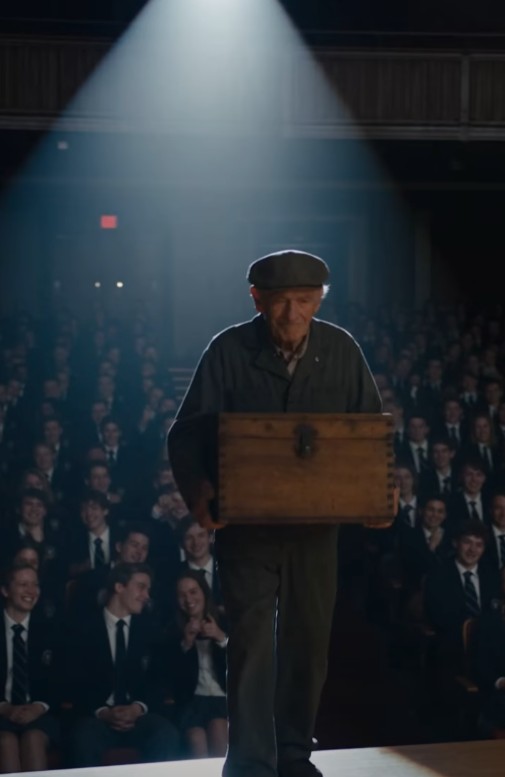
Everyone laughed when the old janitor walked onto the school stage during the award ceremony.
His uniform was dusty.
His hands were rough.
And in his arms, he carried a cracked wooden box.
The principal immediately stepped toward him.
“This is not your moment,” he whispered angrily.
The janitor stopped.
Then looked toward the front row.
A sixteen-year-old student named Andrew was standing there in an expensive suit.
Around his neck hung a medal for bravery.
His father, one of the school’s biggest donors, sat proudly beside the stage.
The janitor’s name was Samuel.
Most students barely noticed him.
He arrived before classes.
Cleaned classrooms.
Fixed broken doors.
Stayed long after everyone went home.
But that afternoon, every person in the auditorium heard him clearly.
“That medal is going to the wrong boy.”
The hall became silent.
Andrew’s father stood.
“How dare you?”
The principal moved closer.
“Samuel, leave the stage.”
Samuel didn’t.
Instead, he placed the wooden box on a table.
Then opened it.
Inside was an old security recording and a small digital backup drive.
The principal’s expression changed.
“Where did you get that?”
Samuel looked at him.
“From the hallway camera you said wasn’t working.”
Parents began whispering.
Several weeks earlier, a small fire had started in a storage room near the science wing.
The school had been evacuated safely.
Three students had needed assistance getting outside.
One student had activated the alarm before staff realized what was happening.
In the confusion afterward, stories spread quickly.
Andrew told teachers he had stayed behind to help students escape.
Several adults believed him.
His father repeated the story publicly.
Soon Andrew was being called a hero.
The school decided to honor him during the annual awards ceremony.
Samuel had said nothing.
Until now.
The principal looked toward the projector operator.
“No.”
Samuel turned toward a teacher standing nearby.
“Please play it.”
The teacher hesitated.
Then looked at the principal.
Finally, another administrator said:
“If this is evidence related to the incident, we should see it.”
The recording began.
The picture was grainy.
But clear enough.
A timestamp appeared in the corner.
Students moved through the hallway between classes.
Then light smoke began drifting from one end of the corridor.
The alarm had not sounded yet.
Andrew appeared on the screen.
Everyone leaned forward.
He looked toward the smoke.
Then turned.
And ran toward the main exit.
He did not stop.
He did not help anyone.
He simply left.
Andrew lowered his head.
His father stared at the screen.
Then another student appeared.
A girl named Maya.
She was fifteen.
Quiet.
A scholarship student who usually sat near the back of every classroom.
Maya noticed the smoke.
She ran toward the nearest alarm station.
She pulled it.
Seconds later, the evacuation alarm began.
Then she moved back toward the hallway.
She shouted toward two younger students who seemed confused about which direction to go.
She pointed them toward the exit.
A teacher appeared and took over.
Maya then started toward the stairs.
But the smoke had grown thicker.
The footage showed her sitting down near the wall while trying to stay low.
The auditorium was completely silent.
Then Samuel appeared on the screen.
The janitor everyone had laughed at minutes earlier.
He came through a side corridor.
He saw Maya.
Helped her toward the exit.
Then turned back after hearing someone calling from another classroom.
The video switched to another camera.
Samuel guided two more students out.
He returned once more with a staff member and helped a third student who had become disoriented near the stairwell.
The footage ended.
Nobody spoke.
Andrew slowly removed the medal.
He placed it on the table.
The principal looked down.
Samuel didn’t reach for it.
Instead, he pointed toward Maya.
She was sitting in the last row.
Exactly where she had sat through most school assemblies.
“She saved everyone first.”
Maya shook her head immediately.
“No.”
Samuel smiled.
“You pulled the alarm.”
“I just saw smoke.”
“That’s exactly why.”
Maya’s eyes filled with tears.
Samuel continued.
“If she had waited for somebody important to notice, we would have lost more time.”
The audience stood.
Not because anyone had told them to.
Parents stood.
Teachers stood.
Students stood.
Maya covered her face.
But Samuel raised one hand.
“Please.”
The applause slowly stopped.
“This isn’t about replacing one story with another story that isn’t true.”
He looked toward Maya.
“She pulled the alarm.”
Then toward the teachers.
“Staff evacuated students.”
“Emergency responders handled the fire.”
“And several people helped each other.”
He pointed at the medal.
“One person should not get credit for everybody.”
That made the room even quieter.
The principal stepped toward the microphone.
His face was pale.
“Samuel…”
Samuel shook his head.
“There’s more.”
The principal froze.
Samuel explained why the footage had almost disappeared.
The school’s old camera system automatically overwrote recordings after several weeks.
After the fire, administrators had checked the main cameras.
One hallway camera was listed as malfunctioning.
So they assumed nothing useful existed.
Samuel knew differently.
He had replaced part of that camera system months earlier.
The camera itself worked.
Only the central connection had failed.
The unit still stored a local copy.
Samuel found it when he went to repair the damaged hallway.
He watched the footage.
Then made a backup.
At first, he planned to take it directly to the principal.
But before he could, the school announced Andrew’s bravery award.
Samuel went to the office.
He asked for a meeting.
The principal was busy.
He returned the following day.
Still no meeting.
Then again.
Eventually, Samuel left a note.
No one responded.
The principal looked increasingly uncomfortable.
One teacher asked:
“You tried to tell us?”
Samuel nodded.
“Three times.”
The principal looked toward the audience.
“I never saw the note.”
Samuel didn’t accuse him of deliberately ignoring it.
He simply answered:
“You probably had more important things on your desk.”
The sentence landed harder than anger would have.
Because Samuel’s job often made him invisible.
People noticed him when something was dirty.
When a light stopped working.
When a door wouldn’t close.
Otherwise, he could walk through an entire hallway without anyone remembering he had been there.
That had nearly happened with the truth too.
Andrew’s father finally spoke.
“My son told us he helped.”
Andrew looked at him.
Then said quietly:
“I lied.”
His father froze.
Andrew’s voice shook.
“When everyone started saying I helped, I didn’t correct them.”
“Then Dad told people I went back inside.”
“And I just…”
He stopped.
“I let everyone believe it.”
The principal asked:
“Why?”
Andrew looked at Maya.
“Because I was embarrassed.”
He admitted that when he saw the smoke, he panicked.
He ran.
Later, he heard that Maya had pulled the alarm and Samuel had helped students outside.
But by then, several classmates had incorrectly assumed Andrew was involved.
Instead of correcting them, he stayed silent.
Then the story grew.
His father repeated it.
A local newspaper mentioned it.
And suddenly Andrew felt trapped inside a lie he had helped create.
Maya looked at him.
“You could have said something.”
“I know.”
Andrew began crying.
“I’m sorry.”
Samuel stepped toward him.
For a moment, everyone expected anger.
Instead, Samuel said:
“Running from danger doesn’t make you a bad person.”
Andrew looked up.
“Lying about what happened afterward is what you need to fix.”
The medal remained on the table.
The principal picked it up.
Then looked toward Maya.
“We owe you an apology.”
Maya shook her head.
“I don’t want his medal.”
Samuel smiled.
“Good.”
People laughed softly.
It broke the tension.
Maya explained that she didn’t pull the alarm because she wanted recognition.
She had simply remembered the emergency training teachers reviewed every year.
See danger.
Alert others.
Leave safely.
She followed the instructions.
That was all.
Samuel looked proud.
“That’s why training matters.”
The school canceled the planned presentation.
Instead, the principal asked everyone to remain seated while staff reviewed what had happened.
A week later, the school held another assembly.
This one was different.
No single student received the original medal.
The school officially recognized Maya for acting quickly and responsibly.
Several staff members were recognized for managing the evacuation.
Emergency responders were thanked.
And Samuel was asked to come onto the stage again.
This time, nobody laughed.
The principal handed him a plaque.
Samuel looked at it.
Then at the audience.
“I don’t need this.”
The principal smiled awkwardly.
“I thought you might say that.”
Samuel handed the plaque back.
Then asked for something else.
“What?”
“Replace the alarm system near the old science hallway.”
Several people laughed.
Samuel didn’t.
“And fix the emergency lighting.”
The principal nodded.
“Done.”
Samuel continued.
“And every student should know where the nearest alarm is.”
The following month, the school updated its emergency procedures.
Students practiced evacuations.
Older camera equipment was replaced.
Maintenance staff were included in safety meetings for the first time.
And the principal created a direct reporting process so custodial and support employees could raise urgent concerns without waiting days for appointments.
Maya’s life changed too.
Not because she became famous.
She didn’t want that.
But teachers began seeing her differently.
She had always been quiet.
People had mistaken that for being unsure of herself.
Now they understood that when something mattered, Maya acted.
Andrew also changed.
He publicly corrected the story.
He apologized to Maya.
He apologized to Samuel.
His father offered to make a large donation to the school in Samuel’s honor.
Samuel refused to have anything named after him.
Instead, the money went toward safety improvements and scholarships for students who wanted to study emergency services, nursing, or public safety.
Months later, Maya found Samuel repairing a locker.
She stood beside him.
“You embarrassed the principal pretty badly.”
Samuel laughed.
“I wasn’t trying to.”
“You walked onto the stage during the biggest ceremony of the year.”
“I tried knocking on his office door first.”
Maya smiled.
Then asked:
“Why did you keep the recording?”
Samuel stopped working.
He thought for a moment.
“Because everybody deserves the truth.”
Then he added:
“Especially when the wrong person is getting blamed or praised.”
Maya looked toward the old wooden box sitting on his cart.
“Are you keeping that too?”
Samuel nodded.
“It held my tools for thirty years.”
“I’m not throwing it away because people laughed at it once.”
Years later, students still told the story of the award ceremony.
Some versions became exaggerated.
They said Samuel stormed the stage.
He hadn’t.
They said the entire fire was caught perfectly on video.
It wasn’t.
They said one person saved the school.
That wasn’t true either.
The real story was simpler.
A girl noticed danger and pulled an alarm.
Staff followed their training.
A janitor helped students reach safety.
And a frightened boy made a mistake, then allowed people to believe something that wasn’t true.
But the part students remembered most happened weeks later.
An elderly janitor walked onto a stage carrying a cracked wooden box.
People laughed because they thought he didn’t belong there.
Then he opened it.
And suddenly, the person everyone had ignored was holding the one thing the entire room needed.
The truth.