
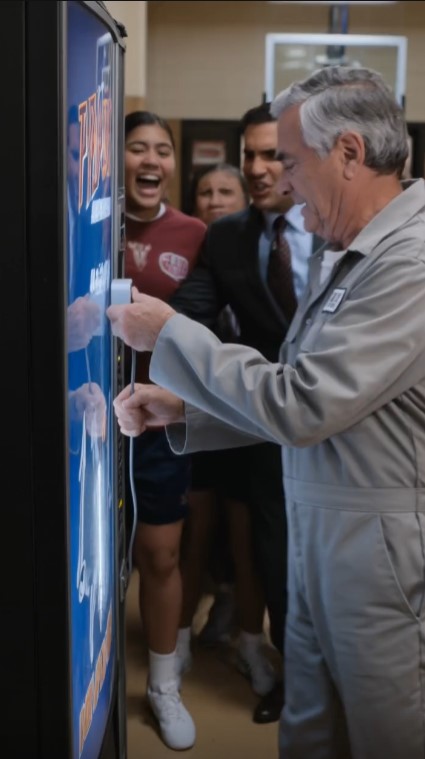
Everyone yelled when the janitor unplugged the vending machine.
The school gym was packed that Friday night. Students filled the bleachers, parents cheered from the sidelines, and the basketball game was close enough that nobody wanted to miss a single second.
Near the back wall, beside the gym entrance, the vending machine glowed brightly. Kids hurried over during timeouts, pushing coins into the slot, laughing, and rushing back to their seats with candy and drinks in their hands.
Then Mr. Lewis, the old janitor, walked toward it.
At first, no one paid attention.
He moved slowly, the way he always did, with a ring of keys clipped to his belt and a tired look on his face. Most students barely noticed him unless there was a spill to clean or a trash can to empty.
But then he reached behind the vending machine and pulled the plug from the wall.
The machine went dark.
Immediately, students started booing.
“Hey! What are you doing?”
“I paid for that!”
“Plug it back in!”
The coach turned from the court and shouted, “Mr. Lewis, not now!”
The principal hurried over, embarrassed and frustrated.
“Mr. Lewis,” she said sharply, “this is not the time. The game is still going.”
But the janitor did not answer.
He was not looking at the snacks.
He was staring at the floor beneath the machine.
Something small and red was caught near the bottom edge.
A bracelet.
Mr. Lewis bent down slowly.
The principal sighed. “Please, move away from the machine.”
But then the old janitor raised one hand.
“Quiet,” he said.
The gym was too loud for anyone to understand at first. Sneakers squeaked on the court. The scoreboard buzzed. Students kept whispering and complaining.
Then Mr. Lewis pressed his ear closer to the wall behind the vending machine.
His face changed.
The principal stopped speaking.
“What is it?” she asked.
Mr. Lewis looked up, pale.
“I heard a voice.”
The coach stepped closer.
“A voice?”
Everyone nearby went silent.
For a few seconds, there was nothing.
Then it came again.
Small.
Weak.
Terrified.
“Please…”
The sound was so faint that it seemed to come from inside the wall.
A mother in the crowd covered her mouth.
The principal turned toward the students. “Everyone move back. Now.”
Mr. Lewis pointed to the vending machine.
“Pull it away from the wall.”
Two coaches and a parent grabbed the sides of the heavy machine. It scraped against the gym floor as they slowly dragged it forward.
The red bracelet slipped free.
Then everyone froze.
Behind the vending machine, trapped in the narrow gap between the metal frame and the wall, was a little girl.
She was curled sideways, her face pale, her breathing shallow. One arm was pinned awkwardly near her chest, and her small fingers were still reaching toward the bracelet that had fallen from her wrist.
For one terrible moment, nobody moved.
Then the principal whispered, “Oh my God.”
The girl’s name was Sophie.
She had been at the game with her older brother. During the rush at halftime, when students crowded near the vending machine, she had dropped her bracelet. She bent down to reach for it, slipped behind the machine, and became trapped in the narrow space.
The crowd noise had swallowed her cries.
The game had gone on.
Students had walked past her.
Parents had stood only a few feet away.
Nobody noticed.
Except Mr. Lewis.
The coach dropped to his knees.
“Sophie, sweetheart, can you hear me?”
Her lips trembled.
“I couldn’t breathe,” she whispered.
A teacher called 911 while another brought a blanket. Mr. Lewis stayed beside Sophie, speaking softly so she would not panic.
“You’re safe now,” he told her. “We found you.”
But Sophie shook her head weakly.
“You found me,” she whispered.
The gym was silent.
The same students who had booed now stared at the floor, ashamed. The coach who had shouted at Mr. Lewis stepped back with tears in his eyes. The principal looked at the unplugged machine, then at the janitor, and seemed unable to speak.
Minutes later, paramedics arrived and carefully lifted Sophie out. She was scared, shaken, and struggling to catch her breath, but she was alive.
Her mother rushed into the gym after getting the call. When she saw Sophie wrapped in a blanket, she broke down and pulled her daughter into her arms.
“I thought she was with her brother,” she sobbed. “I thought she was safe.”
Sophie lifted one trembling hand and pointed at Mr. Lewis.
“He heard me,” she said.
The old janitor stood near the wall, still holding the red bracelet in his palm.
He looked uncomfortable with everyone staring at him.
“I just saw this under the machine,” he said quietly. “Then I listened.”
That sentence stayed with everyone.
Because no one else had listened.
They had heard the scoreboard.
They had heard the crowd.
They had heard the game.
But Mr. Lewis had heard the one sound that mattered.
The next Monday, the principal called a school assembly.
Mr. Lewis stood at the front of the gym, wearing the same faded work shirt and holding his keys in one hand. Sophie sat with her mother in the front row, her red bracelet back on her wrist.
The principal’s voice broke as she spoke.
“Last Friday, I told Mr. Lewis to stop,” she said. “I thought he was interrupting the game. But he was paying attention when the rest of us were distracted.”
The students stood and applauded.
This time, nobody laughed.
Nobody booed.
Mr. Lewis looked down, then smiled softly at Sophie.
Later, the vending machine was moved to a safer spot, and the school added a new rule: no machines or storage units could sit close enough to a wall for a child to slip behind them.
But the biggest change was quieter.
Students began saying hello to Mr. Lewis in the hallway.
Teachers thanked him more often.
Parents remembered his name.
And Sophie never walked past him without waving.
Sometimes the person everyone ignores is the one who sees what others miss.
Sometimes a hero does not need a whistle, a badge, or a spotlight.
Sometimes he is the quiet man with a mop, a keyring, and enough patience to stop, look down, and listen when the whole world is making noise.