
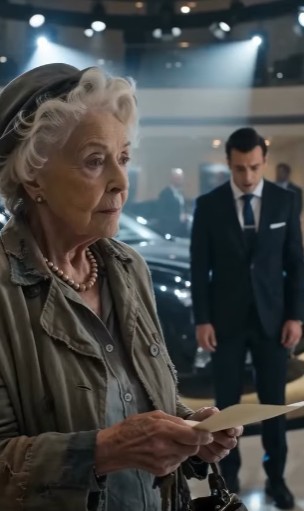
Everyone laughed when the old woman walked into the luxury car showroom holding a rusty key.
Her coat was patched.
Her shoes were muddy.
And she carried an old leather bag that looked older than some of the cars in the building.
A salesman stepped in front of her.
“The used cars are across town.”
The woman looked past him.
At the center of the showroom sat the newest black sports car.
She pointed.
“That one is mine.”
Several customers laughed.
The salesman smiled awkwardly.
“Madam, that vehicle costs more than—”
“I know what it costs.”
Her voice was calm.
The laughter grew louder.
Then the showroom owner walked out of his office.
His name was Daniel Whitmore.
He had inherited the business from his father.
He was used to wealthy clients.
Collectors.
Executives.
Professional athletes.
The elderly woman did not look like any of them.
But then he saw the key in her hand.
His expression changed instantly.
“Where did you get that?”
The room became quieter.
The woman opened her palm.
Attached to the rusty key was a faded metal tag.
The engraving was barely visible.
WHITMORE & HALE MOTOR WORKS.
Daniel stared.
That name had not appeared on the building in more than forty years.
The company had been called Whitmore Motors for as long as he could remember.
He stepped closer.
“Who are you?”
The woman looked directly at him.
“My name is Eleanor Hale.”
Daniel froze.
The surname meant something.
He had seen it once.
On an old photograph in his father’s office.
Two young men standing outside a small garage.
One was Daniel’s father, Charles Whitmore.
The other was a man named Thomas Hale.
Daniel had always been told Thomas was an early employee.
Nothing more.
Eleanor reached into her bag.
“My husband built this place.”
The salesman stopped smiling.
Daniel frowned.
“My father founded this company.”
Eleanor shook her head.
“No.”
“Your father and my husband founded it together.”
Then she added:
“And after Thomas disappeared, your father made sure everyone forgot the second name.”
Daniel stared at the metal tag again.
“That’s not true.”
Eleanor did not argue.
She simply opened her bag.
Inside was an old document folder.
She removed one yellowed sheet and placed it on the hood of a display car.
Daniel looked down.
It was a property deed.
Original.
Signed more than four decades earlier.
Two names appeared at the bottom.
Charles Whitmore.
Thomas Hale.
Fifty percent ownership each.
Daniel’s hands began to shake.
The showroom fell silent.
The old woman had not come to buy a car.
She had come to prove that her family had once owned half the land beneath it.
Daniel looked up.
“Where did you get this?”
“From the bank box your father never found.”
The salesman stepped away.
Eleanor continued.
Thomas and Charles had been best friends.
They began with a small repair garage.
Two lifts.
One office.
No showroom.
Thomas was the mechanic.
Charles handled sales.
Together, they bought the property.
The business slowly grew.
Then Thomas vanished.
At least, that was the story everyone heard.
Daniel’s father later claimed Thomas had abandoned the company.
According to Charles, Thomas left debts behind and disappeared overseas.
Years later, the business was renamed.
Whitmore & Hale became Whitmore Motors.
Eleanor said almost nobody questioned it.
Her husband was gone.
She had little money.
And Charles controlled the company records.
Daniel shook his head.
“My father said Thomas left voluntarily.”
Eleanor looked at him.
“Your father said many things.”
Then she pulled out another document.
A letter.
Written by Thomas.
Addressed to Eleanor.
The date was from the week before he disappeared.
It read:
Charles wants me to sign my half over.
I refused.
He says the business needs one owner.
I told him that owner will not be him.
If anything happens, the deed is in the bank box.
Daniel read the lines twice.
“That proves they argued.”
“It doesn’t prove my father stole anything.”
Eleanor nodded.
“You’re right.”
Daniel looked surprised.
She wasn’t there to accuse anyone without evidence.
So she took out more papers.
Bank statements.
Tax records.
Copies of correspondence.
A partnership agreement.
Then one final document.
A transfer of ownership.
Thomas’s signature appeared at the bottom.
Daniel exhaled.
“There.”
“He signed.”
Eleanor looked at him.
“No.”
She placed Thomas’s real signature beside the transfer.
The difference was obvious.
The transfer signature leaned differently.
The middle initial was formed incorrectly.
Thomas had always written the final letter of his surname with a long upward stroke.
The transfer did not.
Daniel stared.
Eleanor continued.
“My lawyer noticed it first.”
Now Daniel looked alarmed.
“You have a lawyer?”
“Yes.”
“Then why are you here?”
Eleanor looked around the showroom.
“Because I wanted to see the place before they called you.”
Daniel’s phone rang.
He looked at the screen.
His attorney.
He did not answer.
The phone rang again.
Then his office manager hurried toward him.
“Daniel…”
“What?”
“There are people outside.”
“Who?”
“Lawyers.”
The room became completely still.
Eleanor had already begun the legal process.
She had not come hoping a rusty key would magically give her a company.
The deed mattered.
The forged transfer mattered.
But everything would have to be examined properly.
Courts.
Records.
Signatures.
Company history.
No one would simply hand over a showroom because of an old story.
Eleanor understood that.
She had spent three years preparing.
Daniel looked at her.
“Why now?”
Eleanor’s expression softened.
“Because I only found the box three years ago.”
After Thomas disappeared, Eleanor had spent years searching for him.
Police reports went nowhere.
There was no clear evidence of where he went.
Eventually, she was left with two children and almost nothing.
Charles told her Thomas had emptied accounts and left.
She believed him at first.
What else could she do?
She sold their house.
Moved away.
Worked.
Raised her children.
Decades passed.
Then, after Eleanor’s older sister died, the family discovered an unopened bank envelope among her belongings.
Inside was a key.
A safe-deposit box key.
The rusty one Eleanor now carried.
The bank had changed ownership several times, but records still existed.
The box had been transferred into long-term storage.
Inside were the original deed.
Partnership papers.
Thomas’s letters.
And documents showing Charles had repeatedly tried to buy Thomas’s share.
Eleanor hired an attorney.
Then a forensic document examiner.
Then an accountant.
The more they investigated, the stranger the company history became.
Thomas’s supposed transfer was filed after his disappearance.
Several witnesses listed on it could not be verified.
One had died months earlier.
Another name belonged to a person who denied ever seeing the document.
Daniel sat down.
His father had died ten years earlier.
For most of Daniel’s life, Charles Whitmore had been celebrated as a self-made businessman.
A man who supposedly built the company from nothing after being abandoned by an unreliable partner.
Daniel had believed every word.
“Why didn’t you contact me?”
Eleanor answered:
“I did.”
Daniel looked confused.
She had written twice.
Both letters went to company legal counsel.
Both received formal replies denying her claim.
Daniel had never seen them.
The company’s attorneys treated it as an inheritance dispute.
Then Eleanor’s lawyer found the original deed.
That changed everything.
Daniel finally answered his phone.
His attorney told him not to discuss ownership publicly.
The company would need to review the documents.
Eleanor nodded.
“That’s exactly what you should do.”
Daniel looked at her.
“You don’t seem very angry.”
She smiled sadly.
“I was angry for forty years.”
“I’m tired now.”
Then he glanced toward the black sports car.
“Why did you say that car was yours?”
For the first time, Eleanor laughed.
“It isn’t.”
The salesman looked confused.
Eleanor pointed toward the floor beneath it.
“But if those papers are real, half the ground it’s sitting on should have belonged to my husband.”
A few customers laughed softly.
This time not at her.
Daniel almost smiled.
Then Eleanor looked at the salesman who had told her the used cars were across town.
“You should be careful judging people by their coats.”
He lowered his eyes.
“I’m sorry.”
Eleanor nodded.
“That’s enough.”
The legal dispute lasted months.
The documents were examined.
The signatures compared.
Historical records reopened.
Eventually, investigators concluded that Thomas’s ownership transfer was not reliable.
The original partnership agreement remained valid longer than the company had claimed.
Because Thomas had disappeared without a confirmed legal transfer, his interest should have been handled through his estate.
It never was.
The outcome was complicated.
Forty years of business growth could not simply be divided as though nothing had happened.
There had been investments.
Loans.
New buildings.
Different shareholders.
Legal restructuring.
Eleanor did not receive “half of everything.”
But the court recognized that Thomas Hale’s ownership interest had been improperly removed from the company’s history.
His estate was entitled to substantial compensation.
Daniel could have fought for years.
Instead, after reviewing the evidence himself, he chose settlement.
His lawyers advised him that continuing would be expensive and uncertain.
But Daniel said there was another reason.
“My father built part of this company.”
“So did hers.”
The agreement restored the Hale family’s financial interest and formally corrected the company’s founding records.
Then Daniel did something Eleanor did not expect.
He invited her back to the showroom.
This time, nobody laughed.
The salesman opened the door for her.
Inside, the large silver sign above the entrance had been covered.
Daniel stood beside it.
Eleanor frowned.
“What is this?”
He removed the covering.
The new sign read:
WHITMORE & HALE MOTOR COMPANY
Eleanor stopped.
Her eyes filled.
“You didn’t have to do that.”
“Yes.”
Daniel looked at the old metal tag in her hand.
“I did.”
Then he led her toward a wall near the showroom entrance.
Two photographs hung there.
Charles Whitmore.
Thomas Hale.
The original founders.
Under Thomas’s photograph was a short description.
Mechanic. Builder. Co-founder.
Not employee.
Not former worker.
Co-founder.
Eleanor touched the frame.
For several seconds, she said nothing.
Then Daniel handed her a small box.
She opened it.
Inside was a restored version of the old rusty key.
The original had been cleaned but not polished completely.
The faded tag remained attached.
Eleanor smiled.
“This doesn’t open anything anymore.”
Daniel nodded.
“No.”
“But it opened enough.”
Months later, Daniel asked Eleanor if she wanted one of the company’s cars as part of the settlement.
She refused.
He offered again.
She laughed.
“I took the bus here for forty years.”
“I’ll survive.”
Then she looked toward the black sports car she had pointed at on her first visit.
“That one uses too much fuel anyway.”
Daniel laughed.
Eleanor eventually chose something much simpler.
A small comfortable car.
Nothing flashy.
When the salesman handed her the keys, he smiled.
“New or used?”
Eleanor gave him a look.
He laughed.
“Sorry. I deserved that.”
Before driving away, Eleanor placed the rusty original key inside her bag.
She never sold it.
Never framed it.
Never locked it away.
She kept it exactly where she had carried it into the showroom that first day.
Because the old key had stopped opening doors decades earlier.
But it had still carried one thing no one in that building expected.
Proof.
And the woman everyone laughed at had not walked in to buy something she could not afford.
She had come to reclaim the part of her family’s story that money had erased.