
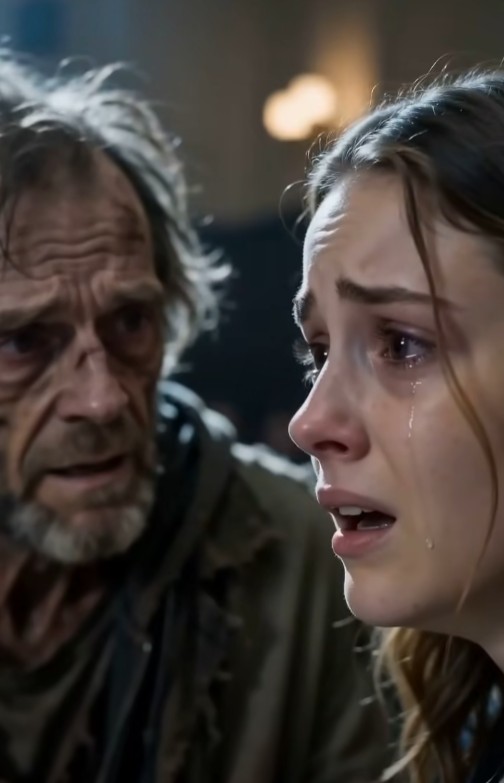
The judge was about to rule on the house when the courtroom doors opened.
Everyone turned.
A homeless man stood in the doorway.
His coat was torn.
His beard was gray.
His shoes were covered in mud.
A guard immediately stepped toward him.
“Sir, you can’t come in here.”
The man raised one hand.
In it was an old envelope.
“I was told to bring this today.”
The courtroom went quiet.
At the plaintiff’s table, a young woman named Emily froze.
Six months earlier, her father, Robert, had died after a long illness.
Since then, Emily had been fighting her stepmother, Diane, over the family home.
Diane claimed Robert had signed everything over to her shortly before he died.
Emily insisted that made no sense.
The house had belonged to Robert long before the second marriage.
It was the home where Emily grew up.
The place her mother had lived before she died.
The place Robert had repeatedly told Emily would one day be hers.
But Diane had documents.
Signed papers.
Witness statements.
And an attorney who argued that Robert had simply changed his mind.
That afternoon, the judge was preparing to rule.
Then the homeless man arrived.
The judge looked toward him.
“Who gave you that envelope?”
The man looked directly at Emily.
“Your father did.”
Emily stopped breathing.
Diane stood immediately.
“That man is lying.”
The judge raised a hand.
“Sit down.”
Diane’s attorney whispered something to her.
The homeless man remained near the door.
The judge asked:
“What is your name?”
“Samuel Carter.”
Emily frowned.
She had never heard the name.
The judge looked at the envelope.
“And why were you instructed to bring it today?”
Samuel answered:
“Robert told me only to deliver it if Emily was about to lose the house.”
The room became completely still.
The judge ordered the envelope brought forward.
It was sealed.
Across the front, in Robert’s handwriting, were the words:
For the court — only if my daughter is about to lose everything.
Emily’s eyes filled.
“That’s his handwriting.”
The judge did not immediately treat the envelope as proof.
Instead, it was carefully documented.
Both attorneys were allowed to inspect the exterior.
Then the judge opened it.
Inside was a handwritten letter.
A small video drive.
And several photocopied documents.
The judge read the note first.
Then looked toward the clerk.
“We need to view the recording.”
Diane shifted in her seat.
Her lawyer leaned toward her.
“Stay calm.”
A court computer was brought forward.
The drive was inserted.
One video file appeared.
The screen came on.
Robert was sitting in a hospital bed.
He looked weak.
But alert.
Emily covered her mouth.
“Dad…”
Robert looked directly into the camera.
“If this video is being played, then something has gone very wrong.”
No one moved.
Robert continued.
“My daughter Emily is supposed to receive the house.”
Diane’s face changed.
Robert held up a document.
“My wife Diane brought me transfer papers while I was in the hospital.”
“I did not knowingly sign away the house to her.”
Emily stared at the screen.
Then Robert said the words that changed the entire hearing.
“The documents she is using were altered.”
Diane whispered:
“No.”
Her attorney immediately objected to conclusions being drawn from the video alone.
The judge agreed.
The recording would need authentication.
The documents would need examination.
Nothing would be decided from one video without verification.
But Robert kept speaking.
“I became suspicious when Diane asked me to sign several pages without letting Emily or my attorney see them.”
“So I called the only person I still trusted.”
Robert paused.
“Samuel.”
Everyone looked toward the homeless man.
Emily stared.
Robert continued.
“Samuel is my younger brother.”
Emily’s head snapped toward him.
“My uncle?”
Samuel lowered his eyes.
Emily had always been told her father had no surviving siblings.
Robert explained why.
Samuel had struggled for years.
Bad decisions.
Debt.
Periods without stable housing.
The brothers had a painful falling-out almost two decades earlier.
Robert stopped speaking to him.
Emily grew up believing Samuel was gone.
Then, during Robert’s final year, the brothers quietly reconciled.
Nobody knew.
Not even Emily.
Robert looked into the camera.
“I was ashamed of how long I let pride keep us apart.”
“Samuel came when I called.”
“And when I told him I was afraid the papers around me were being changed, he believed me.”
The video showed Robert holding up several documents.
He explained that before signing anything further, he had asked a hospital social worker to witness a new written statement.
He also contacted his longtime attorney.
But before those papers could be finalized, Robert’s health worsened.
So he created a second safeguard.
The envelope.
He gave it to Samuel.
The instruction was simple.
Do not interfere unless Emily was in real danger of losing the house.
Then bring everything.
Emily looked toward Samuel.
“You had this for six months?”
Samuel nodded.
“Your father made me promise.”
“Why didn’t you come sooner?”
“Because he told me not to.”
Emily looked confused.
Samuel explained.
Robert feared that if Samuel appeared immediately after his death carrying accusations, people would dismiss him.
A homeless man with a criminally messy past.
Estranged brother.
No money.
No polished lawyer.
Robert knew exactly how it would look.
So he told Samuel to wait.
Let the ordinary legal process happen.
Only step forward if the disputed documents were actually about to defeat Emily’s claim.
Today was that day.
The judge paused the video.
Then looked at Samuel.
“Do you have anything else?”
Samuel pointed toward the envelope.
“The papers.”
The judge examined them.
One was a copy of an earlier deed showing Robert as sole owner.
Another was a letter from Robert’s attorney stating that his longstanding estate plan left the property to Emily.
There was also a signed hospital statement expressing concern about documents being presented while Robert was seriously ill.
None of those papers alone automatically settled the case.
But together, they raised serious questions.
Then the judge compared Robert’s older signatures with the disputed transfer.
The difference was noticeable even without expertise.
But the court would need an independent examiner.
The ruling was postponed.
Diane looked furious.
“You can’t do this because some man wandered in off the street.”
The judge looked directly at her.
“This court is not ruling based on his appearance.”
“We are delaying because new evidence has been presented.”
That ended the argument.
The case reopened.
Over the following weeks, investigators examined the transfer documents.
A handwriting expert found inconsistencies.
One signature had likely been copied from an older record.
Another page had been substituted after signing.
Metadata from a scanned version showed edits after the date Diane claimed the document had been completed.
Then one of the supposed witnesses admitted she had not actually seen Robert sign the final transfer.
She had signed only a different hospital form.
The case changed completely.
Diane’s attorney withdrew several claims.
The court later found that the transfer could not be relied upon as a valid expression of Robert’s wishes.
Emily retained the house under Robert’s earlier estate plan.
But for Emily, the property became almost secondary.
She wanted to understand Samuel.
The uncle she never knew existed.
After the hearing, she found him sitting outside the courthouse.
He still wore the same torn coat.
Emily approached slowly.
“Why didn’t Dad tell me about you?”
Samuel stared at the pavement.
“Because I made his life difficult.”
“That’s not an answer.”
He smiled faintly.
“It’s part of one.”
Years earlier, Samuel had struggled with addiction and unstable work.
Robert helped repeatedly.
Money.
Housing.
Jobs.
Eventually Samuel lied to him.
Sold something Robert had trusted him with.
The brothers stopped speaking.
Samuel drifted from one temporary place to another.
Years passed.
Then Robert became ill.
One afternoon, Samuel received a message through an old mutual friend.
Robert wanted to see him.
Samuel almost refused.
He was ashamed.
But he went.
Robert looked at him and said:
“We wasted enough time.”
They reconciled quietly.
Samuel began visiting.
He brought coffee.
Sat in the hospital room.
Sometimes they spoke.
Sometimes they didn’t.
Then Robert asked him for one final favor.
Protect Emily if the legal papers become a problem.
Samuel laughed at first.
“Why me?”
Robert answered:
“Because everybody else can be bought, pressured, or talked around.”
“You’ve already lost everything.”
“What could they offer you?”
Samuel smiled bitterly when he repeated the line.
“Your father had a strange way of complimenting people.”
Emily laughed through tears.
Then she asked:
“Why are you still homeless?”
Samuel became quiet.
Robert had offered him money.
Samuel refused.
He wanted to prove their reconciliation wasn’t about inheritance.
So Robert gave him something else.
A key.
Emily frowned.
“What key?”
Samuel reached into his pocket.
He pulled out a small brass key.
“I was supposed to give you this too.”
Emily stared.
“Another surprise?”
Samuel nodded.
The key opened Robert’s old garage workshop behind the house.
Emily had assumed it was empty.
After the court case ended, she and Samuel went there together.
Inside was a workbench.
Boxes.
Old tools.
And one sealed plastic container.
On top was another note.
Emily opened it.
Robert had written:
Emily, if Samuel got this far, it means he kept his promise.
Please give him the back room.
Both of them froze.
Samuel shook his head immediately.
“No.”
Emily continued reading.
The workshop had a small finished room in the rear with its own entrance and bathroom.
Robert wanted Samuel to use it if he still needed somewhere safe.
Not as charity.
Not as payment.
As family.
Samuel started crying.
“I told him I didn’t want anything.”
Emily looked at him.
“He knew.”
Samuel refused at first.
Emily insisted.
Eventually, he agreed to stay temporarily.
Temporary became months.
He repaired the workshop.
Fixed the leaking roof.
Restored Robert’s old furniture.
Then found part-time work nearby.
For the first time in years, Samuel had a stable address.
Emily began learning who her uncle was beyond the torn coat he wore into court.
He was funny.
Stubborn.
Excellent with wood.
Terrible at cooking.
He knew dozens of stories about Robert as a teenager.
Stories Emily had never heard.
One evening, she asked:
“Did Dad really think Diane forged everything?”
Samuel nodded.
“He was terrified no one would believe him once he got weaker.”
“Why not just tell me?”
“He didn’t want your last months with him to become a legal war.”
Emily looked away.
That sounded exactly like her father.
Trying to protect her.
Even by keeping too much from her.
Months later, Emily hung Robert’s handwritten note inside the workshop.
Not the part about the house.
The last line.
If Samuel delivers this, believe that he came because he kept his word.
Samuel saw it.
“You framed that?”
“Yes.”
“It makes me sound reliable.”
“You were.”
He laughed.
“Don’t spread that around.”
Years later, people still remembered the courthouse story differently.
Some said a homeless stranger walked in and overturned a case.
That wasn’t exactly true.
Evidence did.
Records did.
Verification did.
Samuel simply made sure the evidence reached the right place at the right time.
And the house was not the only thing returned that day.
Emily recovered the home her father intended for her.
Samuel recovered the brother he had almost lost before death gave them one final chance.
And a young woman who walked into court believing her only family had been buried six months earlier walked out knowing she still had an uncle.
The man everyone judged by his torn coat had not come asking for money.
He had come carrying a promise.
And after years of having almost nothing, it turned out to be the one thing he had never lost.