
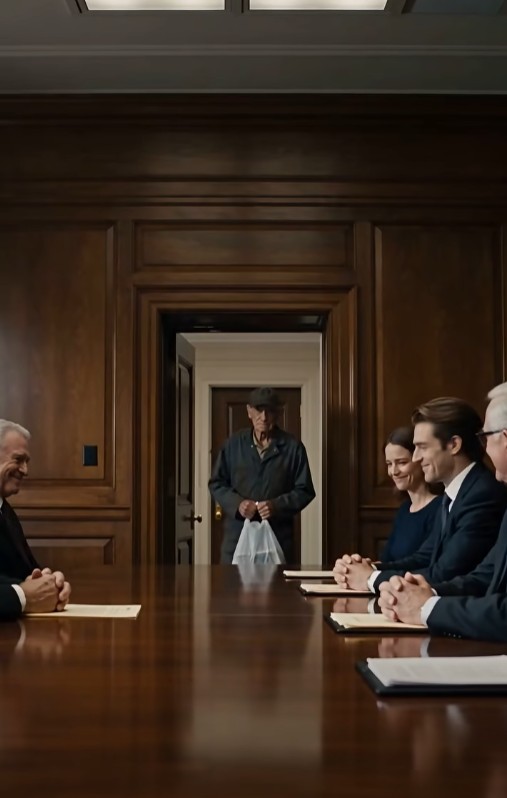
Everyone laughed when the old cleaner walked into the courtroom carrying a plastic grocery bag.
His uniform was faded.
His shoes were worn.
And he looked completely out of place among the lawyers, polished shoes, and expensive suits.
At the front of the room, a young woman named Emma sat silently beside her attorney.
She had spent six months fighting to keep the house where she had grown up.
Across from her sat her older stepbrother, Adrian.
He had money.
A powerful legal team.
And documents claiming their father had transferred the entire mansion to him shortly before he died.
Emma had almost nothing.
Her father, Jonathan, had always told her the house would remain hers.
But there was no recent will anyone could find.
No signed letter.
Nothing strong enough to defeat Adrian’s paperwork.
That afternoon, the judge was preparing to rule.
Then the cleaner walked in.
A guard immediately moved toward him.
“Sir, you can’t interrupt these proceedings.”
The man raised one hand.
“Your Honor.”
The judge looked up.
“Yes?”
The cleaner stepped forward.
“Jonathan Hale told me to bring this if they ever tried to erase his daughter.”
Emma’s head snapped toward him.
Adrian immediately stood.
“That man is a janitor.”
His voice filled the courtroom.
“Remove him.”
The cleaner looked at Adrian.
Then calmly placed the grocery bag on a table.
The judge raised a hand.
“Sit down, Mr. Hale.”
Adrian reluctantly did.
The judge turned toward the cleaner.
“What is your name?”
“Samuel Price.”
“And how did you know Jonathan Hale?”
Samuel looked toward Emma.
“That’s complicated.”
Then he opened the grocery bag.
Inside was a dusty envelope.
And an old video tape.
Emma stared.
The tape had her father’s handwriting on the label.
FOR EMMA — ONLY IF NECESSARY.
Her eyes filled immediately.
“That’s Dad’s.”
The judge did not immediately accept the contents as proof.
Instead, the items were documented.
Both attorneys were allowed to inspect them.
The court took a short recess while staff found equipment capable of playing the old tape.
When everyone returned, the courtroom was completely silent.
The recording began.
Jonathan appeared on the screen.
He was sitting in the study of the mansion.
He looked tired.
Much thinner than Emma remembered him before his illness.
But his voice was clear.
“If this tape is being played, then Adrian has tried to use the papers I discovered.”
Adrian went pale.
Jonathan continued.
“My son forged the documents transferring this house.”
A murmur spread through the courtroom.
Adrian’s attorney stood.
“We object to any assumption that this recording proves—”
The judge nodded.
“It does not prove anything by itself. Sit down. We will determine authenticity properly.”
The video continued.
Jonathan held several papers toward the camera.
“I found these after Adrian asked me to sign financial documents while I was ill.”
“I did not knowingly transfer the house.”
“My daughter Emma is to receive it.”
Emma covered her mouth.
Then Jonathan said something nobody expected.
“And the man delivering this is not my cleaner.”
Everyone turned toward Samuel.
Jonathan looked directly into the camera.
“Samuel Price is my oldest friend.”
Emma stared at him.
Samuel lowered his eyes.
Jonathan continued.
“He is also the only person I trusted to hold this without using it for himself.”
The video ended.
Nobody moved.
Emma looked at Samuel.
“You knew my father?”
Samuel nodded.
“For fifty-one years.”
She had never heard his name.
Not once.
Adrian leaned toward his attorney.
His face was white.
The judge opened the dusty envelope.
Inside were copies of older estate documents.
Letters.
Bank records.
And a handwritten note signed by Jonathan.
The note said:
If Emma is about to lose the house, Samuel will know what to do.
The court postponed the ruling.
The new evidence had to be verified.
Emma should have felt relieved.
Instead, she felt confused.
She followed Samuel into the hallway after the hearing.
“Why have I never met you?”
Samuel stopped.
“You have.”
Emma frowned.
“When?”
“You were five.”
She stared.
Samuel smiled.
“You probably don’t remember.”
He explained.
Jonathan and Samuel grew up together.
They came from completely different worlds.
Jonathan’s family owned property.
Samuel’s father worked maintenance jobs.
But as boys, none of that mattered.
They went to school together.
Played football together.
Got into trouble together.
When Jonathan inherited the mansion from his parents, Samuel helped him restore it.
He repaired floors.
Fixed old windows.
Rebuilt part of the garden wall.
For years, Samuel came and went like family.
Then life changed.
Samuel’s wife became ill.
Bills piled up.
He lost his business.
Then his home.
He started taking cleaning and maintenance work wherever he could find it.
Jonathan offered him money.
Samuel refused.
Their friendship became strained.
Emma asked:
“Why?”
Samuel looked embarrassed.
“Pride.”
He stopped visiting.
Years passed.
Jonathan married again.
Adrian, his wife’s son from an earlier marriage, became part of the household.
Emma grew up.
Samuel faded out of the family story.
Then, about a year before Jonathan died, the two men saw each other again by accident.
Samuel had taken a nighttime cleaning job in an office building.
Jonathan walked in for a meeting.
They recognized each other instantly.
Jonathan said:
“We’ve wasted enough years.”
Samuel laughed.
“Your father could be very direct.”
The friendship returned.
Quietly.
Jonathan began meeting Samuel for coffee.
Sometimes Samuel helped him with small repairs at the mansion.
But he always came through the service entrance.
Not because Jonathan was ashamed.
Because Samuel didn’t want anyone treating him differently.
Then Jonathan became seriously ill.
That was when he discovered the property documents.
He became suspicious.
Adrian had been helping manage parts of the household finances.
He brought Jonathan several papers to sign.
Jonathan initially trusted him.
Later, he realized one of the documents appeared to transfer ownership of the mansion.
He never remembered agreeing to that.
So he asked questions.
Adrian dismissed his concerns.
Said the paperwork was only for tax planning.
Jonathan became more suspicious.
He contacted his longtime attorney.
Then discovered something worse.
A deed bearing his signature had already been prepared.
Jonathan compared it with documents he knew he had signed.
Something looked wrong.
He called Samuel.
“Why him?” Emma asked.
Samuel sighed.
“Because your father knew nobody took me seriously.”
Emma looked confused.
Samuel explained.
Adrian knew Jonathan’s lawyers.
His advisers.
His relatives.
His staff.
But Samuel was invisible to him.
A cleaner.
A man in an old uniform.
Someone Adrian barely acknowledged.
Jonathan realized that made Samuel the safest person to hold evidence.
He created the video.
Copied the paperwork.
Placed everything into the grocery bag.
Then told Samuel:
“Do nothing unless Emma is truly about to lose the house.”
Samuel obeyed.
For six months.
Emma stared at him.
“You watched this case happening and said nothing?”
“I hated every day of it.”
“Then why wait?”
“Because your father was afraid that if I appeared too early, Adrian would find a way to discredit me or make the evidence disappear.”
Emma looked back toward the courtroom.
“He thought of everything.”
Samuel smiled sadly.
“He tried.”
The investigation lasted several weeks.
A forensic document examiner compared Jonathan’s known signatures with the disputed deed.
Several differences were significant.
More troubling, the document contained formatting associated with a later template than the date printed on it.
Computer records showed part of the file had been edited after Jonathan’s death.
Then another piece of evidence appeared.
One supposed witness admitted he had signed a different document.
He had never witnessed Jonathan transferring the mansion.
Adrian’s legal position began collapsing.
His attorney eventually withdrew several arguments.
The court ruled that the disputed transfer was invalid.
Jonathan’s earlier estate plan remained controlling.
The mansion passed to Emma.
When the judge announced the decision, Emma cried.
But not because of the size of the house.
She cried because for months she had begun wondering whether her father had really changed his mind about her.
Whether he had quietly chosen Adrian.
Whether everything Jonathan told her while she was growing up had meant nothing.
Now she knew.
He had tried to protect her until the very end.
Outside the courthouse, reporters gathered.
Emma ignored them.
She looked for Samuel.
He was sitting alone on a bench.
Still holding the empty grocery bag.
She walked toward him.
“You’re coming home with me.”
Samuel laughed.
“I don’t think so.”
“That wasn’t a question.”
He shook his head.
“Emma, that house belongs to you.”
“I know.”
“That doesn’t mean I belong there.”
Emma sat beside him.
“My father trusted you more than almost anyone.”
Samuel looked away.
“He trusted me with one bag.”
“For six months.”
“You could have opened it.”
“I didn’t.”
“You could have sold the story.”
“I didn’t.”
“You could have asked Dad for money.”
“I didn’t.”
Samuel smiled.
“You sound exactly like him when you argue.”
Emma laughed.
Then she asked:
“Where are you staying?”
He didn’t answer.
That told her enough.
Samuel had been sleeping in temporary shelters and occasionally in a room provided by the cleaning company.
Emma immediately offered him a room at the mansion.
Samuel refused.
She offered money.
He refused again.
Then Emma remembered the note.
There was one more line beneath Jonathan’s instructions.
She had almost missed it.
If Samuel keeps his promise, remind him that the workshop is still his.
Emma looked at him.
“What workshop?”
Samuel froze.
Behind the mansion was a small brick building.
Emma had always thought of it as her father’s storage room.
Samuel knew it differently.
He and Jonathan had built much of it together when they were twenty-two.
It had been Samuel’s workspace for years.
He repaired furniture there.
Built cabinets.
Taught Jonathan how to use half the tools hanging on the wall.
When their friendship ended, Samuel stopped going.
Jonathan never changed the room.
Emma unlocked it the next morning.
Dust covered everything.
But Samuel’s old wooden toolbox still sat beneath the bench.
His initials were carved into the handle.
S.P.
Samuel stood in the doorway.
“You kept this?”
Emma smiled.
“Dad did.”
On the wall was a photograph.
Two young men.
Jonathan in a clean shirt.
Samuel covered in sawdust.
Both laughing.
Emma had never seen her father look that young.
Samuel touched the frame.
“He kept this too.”
Then Emma discovered another envelope beneath the toolbox.
Samuel’s name was written on it.
He opened it.
Jonathan had written:
You spent half your life refusing help because you thought accepting it made you less of a man.
You were wrong.
If Emma gives you the key, take it.
Consider this the last argument I intend to win.
Samuel laughed so loudly Emma started laughing too.
Then he cried.
He moved into the workshop apartment several weeks later.
Not the mansion.
He insisted on that distinction.
He restored the building.
Started repairing furniture again.
Eventually, people from the neighborhood began bringing him chairs, tables, cabinets, and old wooden boxes.
He earned enough to live independently.
Emma never charged him rent.
Samuel never stopped complaining about that.
The mansion changed too.
Emma decided she did not want to live alone in a huge house filled only with family history.
She converted part of the property into a community arts and training space.
Samuel helped build the workshops.
Young people learned woodworking.
Furniture repair.
Basic maintenance.
Skills Samuel had learned over a lifetime.
One afternoon, a teenager asked him:
“Were you really just a cleaner when you saved this place?”
Samuel smiled.
“I didn’t save the place.”
“The evidence did.”
“But you brought it.”
“I carried a grocery bag.”
The teenager laughed.
“That’s the same thing.”
Samuel shook his head.
“No.”
Then he pointed toward the mansion.
“Never confuse the person carrying the truth with the truth itself.”
Years later, the plastic grocery bag still existed.
Emma had wanted to preserve it in a display case.
Samuel refused.
“It’s a bag.”
Instead, he used it for groceries until one handle finally broke.
Emma was horrified.
“That was part of the court case!”
Samuel shrugged.
“It did its job.”
But she kept the wooden box from his workshop.
Inside were copies of Jonathan’s note and the old photograph of the two friends.
Underneath, Emma added one sentence:
The person everyone ignored was the person my father trusted most.
People in the courtroom had laughed when Samuel walked in.
They saw worn shoes.
A faded cleaner’s uniform.
A plastic grocery bag.
Adrian saw someone beneath him.
The judge saw an interruption.
Emma saw a stranger.
None of them knew that the old man was carrying fifty-one years of friendship into that room.
He had not come for money.
He had not come for the mansion.
He had not even come to prove that he mattered.
He came because a dying friend had made him promise one thing.
If they ever try to erase my daughter, bring her the truth.
And when the moment finally came, Samuel kept his word.