
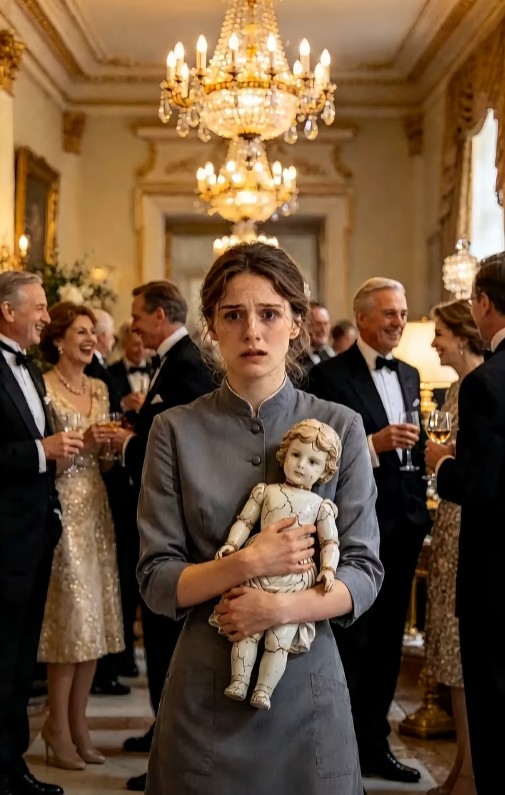
Everyone laughed when the young waitress walked into the auction hall carrying a cracked porcelain doll.
Her name was Emma.
Her coat was inexpensive.
Her shoes were still damp from the rain.
And tucked carefully beneath one arm was a doll so old that part of its painted face had begun to fade.
Around her sat some of the wealthiest property buyers in the city.
They had come for one reason.
Hawthorne House.
A century-old mansion on nearly twenty acres of valuable land.
At the front of the hall, businessman Richard Cole was preparing to make what everyone expected would be the winning bid.
Emma stepped farther inside.
The auctioneer frowned.
“Miss, this is a private sale.”
Several people laughed.
Emma swallowed.
“I know.”
“Then you need to leave.”
She raised the doll.
“My mother told me to bring this before the house was sold.”
The laughter faded slightly.
Richard turned toward her.
His assistant walked over.
“Whatever this is, we can deal with it outside.”
He reached toward the doll.
Emma pulled it back.
“Don’t.”
The movement loosened an already cracked panel along the doll’s back.
It opened.
Something fell onto the polished floor.
A small yellowed envelope.
Everyone went quiet.
The auctioneer bent down and picked it up.
On the front was written:
If Rose’s daughter ever brings this home.
Emma stared.
Rose was her mother’s name.
The auctioneer slowly opened the envelope.
Inside was a handwritten letter.
He read the first lines silently.
Then his face changed.
Richard stood.
“What does it say?”
The auctioneer looked toward Emma.
Then read aloud:
If this doll returns to Hawthorne House, the girl carrying it is my granddaughter.
The auction hall fell completely silent.
Emma stared at him.
“My what?”
The auctioneer continued reading.
Her mother, Rose, is my daughter.
The house was never intended to leave her family line.
Before any sale proceeds, contact my solicitor and examine the family trust documents.
Richard immediately stepped forward.
“That proves nothing.”
The auctioneer lowered the letter.
Richard was right about one thing.
An old handwritten note could not simply transfer a mansion to whoever walked in carrying a doll.
But it could create a serious legal problem.
And the name signed at the bottom certainly did.
Eleanor Hawthorne.
The mansion’s former owner.
Emma had heard the name before.
Everyone in the city had.
Eleanor Hawthorne had belonged to one of the region’s oldest families.
She had lived in the mansion for most of her life.
When she died, newspapers reported that she had no direct descendants.
The property passed into an estate structure and, after years of legal administration, was finally being sold.
At least, that was the story everyone knew.
Emma looked at the letter again.
“My mother never told me any of this.”
Richard’s assistant shook his head.
“This is absurd.”
The auctioneer raised a hand.
“The sale is suspended.”
Richard stared at him.
“You cannot stop a multimillion-euro auction because a waitress brought in a toy.”
“I can stop it because an apparent document from the former owner has raised a question about title.”
Richard’s face tightened.
His attorney was already on the phone.
Emma simply stood there holding the cracked doll.
She had walked in expecting embarrassment.
Now an entire room of wealthy buyers was waiting because of something her mother had hidden for decades.
The auction was postponed.
Emma was taken into a private office.
An estate attorney named Daniel Mercer arrived less than an hour later.
He examined the letter but made no promises.
“Do you have identification?”
Emma nodded.
“Your mother’s full name?”
“Rose Martin.”
“Was Martin her birth name?”
“I think so.”
Daniel looked at the doll.
“Where did this come from?”
Emma sat down.
“My mother gave it to me before she died.”
Rose had spent most of her life working modest jobs.
Housekeeping.
Laundry.
Kitchen work.
For several years, she had even worked at Hawthorne House when it was used for private events.
Emma had sometimes gone with her as a child.
She remembered enormous staircases.
A glass conservatory.
A long hallway she had been told never to enter.
But Rose never said the house belonged to their family.
Not once.
Before Rose died, she gave Emma the doll.
It had belonged to her since childhood.
She told her:
“Never sell this.”
Then, almost as an afterthought:
“If Hawthorne House is ever sold, take the doll there first.”
Emma thought grief medication had made her mother confused.
She promised anyway.
Three years passed.
Then Emma saw the auction announcement online.
She almost ignored it.
She worked double shifts at a restaurant.
She had rent due.
The mansion had nothing to do with her life.
But she remembered the promise.
So she took the morning off.
Put the doll inside her bag.
And went to the auction.
Daniel looked at her.
“Did your mother leave any documents?”
“Boxes.”
“What kind?”
“I don’t know.”
“Find them.”
The next day, Emma brought everything from her mother’s old storage cupboard.
Most of it seemed worthless.
Receipts.
Birthday cards.
Old employment records.
Photographs.
Then Daniel found a picture.
Three women stood outside Hawthorne House.
The oldest was Eleanor Hawthorne.
Beside her stood a younger woman Emma didn’t recognize.
And beside that woman stood Rose.
A teenager.
Emma turned the photograph over.
Three generations.
Eleanor.
Margaret.
Rose.
Emma stared.
“Margaret?”
Daniel asked.
“Do you know that name?”
Emma nodded slowly.
“My mother sometimes said her mother was named Margaret.”
She had always assumed Margaret died when Rose was young.
The next discovery came from an old birth certificate.
Rose Martin had not been born Rose Martin.
Her original name was Rose Hawthorne.
Emma sat down.
“No.”
Daniel kept reading.
Rose’s mother was Margaret Hawthorne.
Eleanor’s only daughter.
The supposedly childless Eleanor Hawthorne had, in fact, had a daughter.
And a granddaughter.
Then why did the official estate history say otherwise?
The answer took months to uncover.
Margaret had fallen in love with a man Eleanor’s husband strongly disapproved of.
The family argument became bitter.
Margaret left Hawthorne House.
She later married and used her husband’s surname, Martin.
After he died young, Margaret raised Rose with very little money.
Eleanor privately tried to reconnect.
But the relationship remained complicated.
Then Margaret died unexpectedly.
Rose was only seventeen.
According to letters found in the boxes, Eleanor offered to bring Rose back to Hawthorne House.
Rose refused.
She believed the family had rejected her mother.
She wanted nothing from them.
Years later, Eleanor tried again.
That was apparently when she gave Rose the porcelain doll.
The doll had belonged to Margaret as a child.
Emma looked at it differently now.
It wasn’t simply an antique toy.
It had passed from Eleanor to Margaret.
Margaret to Rose.
Rose to Emma.
But none of that automatically meant Emma owned the mansion.
Daniel reminded her of that constantly.
“We still need the trust.”
“What trust?”
“The letter in the doll mentions one.”
They searched old court archives.
Probate filings.
Bank records.
Solicitors’ records.
Then Daniel discovered that Eleanor had created a family property trust years before she died.
Its terms were unusual.
Hawthorne House was to remain available to Eleanor during her lifetime.
After her death, it would pass first to Margaret, if living.
If Margaret had died, then to Margaret’s descendants.
Only if no direct descendants could be located could the trustees sell the property and distribute the proceeds under a secondary charitable provision.
Emma stared at him.
“So why are they selling it?”
“Because the estate records said no descendants could be located.”
“But Mom was alive.”
“Yes.”
“Why didn’t anyone find her?”
That became the central question.
Rose had changed addresses repeatedly.
She had used the surname Martin.
She had never claimed any connection to the Hawthorne estate.
And when lawyers attempted to trace Margaret’s line decades earlier, one critical record incorrectly listed Rose as having died as a child.
Daniel discovered the mistake in an old handwritten registry.
Two girls named Rose Martin had been born in the same district within months of each other.
One had died young.
The records had been confused during an earlier estate search.
The trustees concluded Eleanor’s line had ended.
It hadn’t.
Emma looked at the cracked doll.
“My mother could have had this house?”
“Possibly.”
“And she never knew?”
Daniel wasn’t sure.
Then they found one final letter.
It was written by Rose.
Never mailed.
Addressed to Eleanor.
Emma read it.
Grandmother,
I don’t want the house.
I don’t want the money.
But I want you to know I kept the doll.
Maybe one day my daughter will understand it better than I did.
Emma stopped.
“My mother knew.”
Daniel nodded.
At least partly.
Rose had apparently learned enough to know she was connected to the Hawthorne family.
But she never pursued the estate.
Perhaps she didn’t know the trust still existed.
Perhaps she knew and deliberately chose not to claim it.
The letter never said.
Emma cried that evening.
Not because her mother had failed to make them rich.
Because she suddenly understood why Rose sometimes became quiet whenever they passed the mansion.
Why she knew which garden path led to the old greenhouse.
Why she once stood in the kitchen doorway and whispered:
“I used to know this place.”
Emma had thought she meant she had worked there.
Now she knew she meant something else.
Months after the interrupted auction, the court reviewed the evidence.
Birth records confirmed Rose was Margaret’s daughter.
DNA testing with a distant Hawthorne relative supported the documented family connection.
The trust remained legally significant.
And because Emma was Rose’s only surviving child, the proposed sale could not proceed as planned.
But the ending was not as simple as the auction hall rumor made it sound.
Emma did not walk into court one morning and instantly receive a mansion.
There were taxes.
Maintenance obligations.
Trust issues.
Years of expenses.
Legal disputes.
The property was enormous.
Keeping it would cost more every year than Emma had ever earned.
Richard Cole’s company offered to purchase it from her once her claim was formally established.
For a moment, Emma considered it.
Then she returned to Hawthorne House alone.
She carried the cracked doll with her.
She walked through rooms she remembered from childhood.
The old kitchen.
The conservatory.
The staircase.
Then she entered a bedroom on the second floor.
A faded shelf stood beside the window.
There, painted directly onto the wood, were four tiny names.
Eleanor.
Margaret.
Rose.
Then an unfinished line beneath them.
Emma touched it.
Her mother had brought her into that room once when she was six.
Emma barely remembered.
Rose had told her:
“This used to be a little girl’s room.”
Now Emma understood.
It had been Margaret’s.
Then Rose’s.
And perhaps, for a very short time, hers too.
She made a decision.
Emma did not turn the entire mansion into her private home.
Instead, she sold a portion of the surrounding land under legal advice.
That provided enough money to repair the main house and stabilize the property.
She converted much of Hawthorne House into a community foundation.
Part became an event space that helped fund maintenance.
Another part offered training and temporary accommodation for young women leaving unstable circumstances.
Emma kept a modest apartment in one wing.
She also kept her restaurant job for several months.
Her coworkers could not understand why.
Emma laughed.
“I’ve spent my entire life serving tables.”
“I don’t become another person because somebody found my grandmother’s paperwork.”
Eventually, she left the restaurant to manage the foundation full-time.
The porcelain doll was restored carefully.
Not completely.
Emma insisted the crack remain visible.
She placed it inside a glass case near the entrance.
Beside it was Eleanor’s letter.
Not the original.
That stayed protected with the legal records.
A copy.
Underneath, Emma placed a small plaque:
Never lose what carries your story.
Years later, visitors would hear exaggerated versions of the auction.
They said Emma walked in poor and walked out a millionaire.
That the businessman was thrown from the room.
That one letter instantly gave her the mansion.
The truth was less magical.
And more meaningful.
A cracked doll led to a letter.
The letter led to records.
The records led to a forgotten family line.
And a young woman who had spent her life believing her mother was simply a housekeeper discovered that Rose had once walked through Hawthorne House not merely as an employee.
She had walked through it as the granddaughter of the woman who owned it.
The wealthy collectors had laughed when Emma entered the auction hall.
They saw a waitress holding a broken toy.
They did not know the doll had survived three generations of women.
They did not know a letter was hidden inside.
And they certainly did not know that the person who appeared least likely to belong in the mansion was the one person whose family had belonged there all along.