
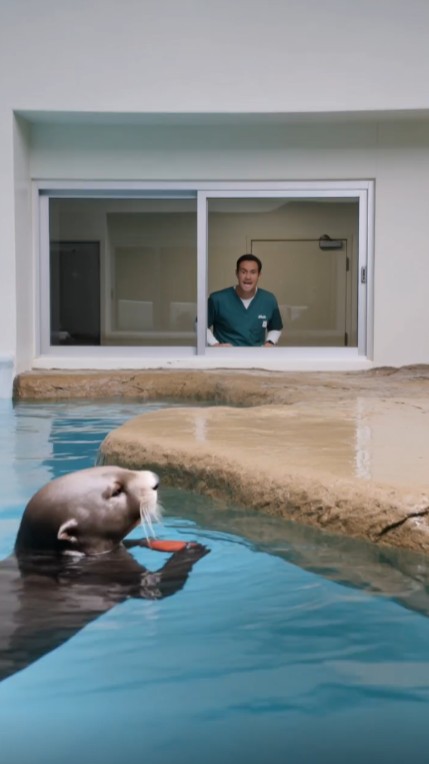
Every morning, the rescued sea otter carried the same red stone to the edge of his pool.
His name was Milo.
He was six years old.
And among all the enrichment objects in his habitat, the red stone was the one he returned to again and again.
He had floating toys.
Shells.
Safe puzzle feeders.
Different textured objects introduced by the sanctuary team.
But Milo always came back to the stone.
He would pick it up.
Carry it carefully.
Place it on a flat rock beside the water.
Then swim away.
A few minutes later, he would return.
Touch it.
Move it slightly.
Sometimes hold it against his chest.
The caretakers thought it was simply his favorite object.
Sea otters often manipulate stones and other objects.
Some individuals show clear preferences.
So nobody thought much of it.
Until Dr. Eleanor Hayes visited the sanctuary.
Eleanor was seventy-four.
She had spent most of her career working with marine mammals along the coast.
She had retired years earlier, but still visited rehabilitation centers and spoke with younger staff about animal care.
That morning, a caretaker named Daniel was showing her Milo’s habitat.
“Milo was rescued after being found weak near the harbor,” Daniel explained.
“He recovered well, but this is the object he seems most attached to.”
Eleanor looked toward the pool.
Milo surfaced.
In his paws was the red stone.
Eleanor stopped walking.
“Where did he get that?”
Daniel shrugged.
“It came with him.”
“What do you mean?”
“When he was transferred here, it was listed among the safe enrichment objects that arrived with his records.”
Eleanor stepped closer to the glass.
“Can I see it?”
Daniel looked surprised.
“The stone?”
“Yes.”
During a scheduled supervised enrichment session later that morning, staff safely retrieved the object while Milo was occupied elsewhere.
Daniel handed it to Eleanor.
The stone was smooth.
Deep red.
About the size of a small plum.
Eleanor turned it over.
Then froze.
On the underside were three tiny white dots.
Not naturally occurring marks.
Paint.
Her hands started trembling.
“I painted these.”
Daniel stared.
“You painted this stone?”
Eleanor nodded.
“When?”
She looked at him.
“Thirty-one years ago.”
Daniel glanced toward Milo.
“But Milo is only six.”
“I know.”
Eleanor sat down.
Years earlier, she had worked at a coastal wildlife rehabilitation center called Harbor Point.
The center was small then.
Few staff.
Limited equipment.
Workers improvised many of their enrichment activities from safe materials they could inspect and clean.
Eleanor had once created a set of smooth painted stones for supervised use.
Each stone had a different color.
Red.
Blue.
Green.
Yellow.
She marked the bottom of every one with small white dots so staff could identify which set it belonged to.
Daniel held the red stone.
“So this came from Harbor Point?”
“It looks like it.”
“But how did Milo get it?”
Eleanor shook her head.
“That’s what I don’t understand.”
Then she smiled faintly.
“This particular one was special.”
“Why?”
Eleanor remembered exactly which animal had first received it.
A female sea otter named Pearl.
Pearl had arrived at Harbor Point as a young adult after being found injured and exhausted.
During recovery, she was unusually cautious with unfamiliar objects.
She ignored most enrichment items.
But she repeatedly picked up the red stone.
Eleanor began placing it near different areas of the pool.
Pearl always found it.
Eventually, the staff jokingly called it “Pearl’s ruby.”
Eleanor had not thought about that animal in decades.
Daniel immediately opened the sanctuary’s historical database.
“Let’s see if any of the old Harbor Point records were imported.”
He searched.
Sea otter.
Pearl.
Red enrichment stone.
Old transfer notes.
Then stopped scrolling.
“Ma’am…”
Eleanor looked over.
“I found something.”
An old scanned photograph appeared.
It showed a sea otter floating on her back.
In her paws was a red stone.
Eleanor leaned closer.
Her eyes filled with tears.
Then suddenly she frowned.
“That isn’t Pearl.”
Daniel looked confused.
“The record says Pearl.”
“No.”
“I knew Pearl.”
Eleanor pointed toward the animal’s face.
“Pearl had a pale patch above her left eye.”
“This otter doesn’t.”
Daniel zoomed in.
She was right.
The photograph had been mislabeled.
Eleanor kept looking.
Then noticed another detail.
The animal was wearing a temporary rehabilitation tag used by another facility.
Not Harbor Point.
The code started with CBR.
Eleanor whispered:
“Cape Bay Rescue.”
Daniel turned toward her.
“You know it?”
“Yes.”
Harbor Point sometimes transferred animals to Cape Bay when one facility became overcrowded.
Eleanor remembered one particular transfer.
Pearl had never been permanently released.
After a period of recovery, she was moved to Cape Bay for longer-term care.
The red stone went with her.
Staff believed familiar objects could sometimes reduce stress during a transfer, so a few of Pearl’s known enrichment items accompanied her.
Daniel searched the Cape Bay archives.
Most records had been digitized years earlier.
Eventually, he found another photograph.
Pearl.
This time Eleanor recognized her immediately.
Same pale patch.
Same eyes.
And the same red stone.
But the story didn’t end there.
A note in the record said Pearl was later housed near a younger female otter named Marina.
The animals were not kept together constantly, but they participated in adjacent supervised enrichment sessions.
At some point, the red stone began appearing in Marina’s enrichment bin.
Nobody documented exactly when it moved.
It may simply have been mixed with other sanitized objects during routine care.
Years passed.
Pearl died at an old age.
Marina remained in human care for several more years.
Then Marina was transferred again.
This time to a larger coastal sanctuary.
The red stone apparently traveled with her belongings.
Daniel stared at the screen.
“So it kept moving.”
Eleanor nodded.
“Through the facilities.”
They continued searching.
The stone appeared in photographs several more times.
Sometimes clearly.
Sometimes barely visible in a corner.
A red shape near a pool ledge.
Three white dots visible in one close-up.
Then Daniel found the record that changed everything.
Marina had lived alongside another rescued female called Nessa.
Nessa later gave birth while under long-term managed care after rehabilitation was no longer considered appropriate for release.
Her offspring remained within the accredited care system.
One of Nessa’s descendants eventually ended up at the facility where Milo was first treated.
Daniel looked toward Milo.
“You don’t think—”
Eleanor shook her head.
“We shouldn’t assume the stone passed from one animal to another intentionally.”
That mattered.
The animals were not handing down an heirloom.
There was no evidence of that.
The likely explanation was much simpler.
The stone remained in circulation because staff considered it a safe reusable enrichment object.
It moved with care equipment.
Transfer crates.
Inventory.
Animal records.
And over decades, it happened to stay connected to the same broad network of facilities.
But then Daniel found one final note.
When Milo arrived at the first rehabilitation center, staff recorded that he repeatedly selected a red stone from a mixed enrichment tray.
When he was later transferred to the sanctuary, caretakers included several familiar items to help maintain continuity.
One was the red stone.
Eleanor smiled.
“So Milo chose it himself.”
“Apparently.”
Daniel looked toward the pool.
“That’s strange.”
“Not necessarily.”
“Why?”
“Animals can have preferences.”
Eleanor took the stone again.
“Texture. Weight. Shape. Smell. Familiarity.”
She smiled.
“The remarkable part isn’t that he likes it.”
“It’s that nobody threw it away for thirty-one years.”
That was the real story.
Not an object being consciously passed through generations of otters.
A small enrichment stone surviving decades of animal care.
Pearl used it.
Then other animals encountered it.
Staff moved it from place to place.
Facilities closed.
Records were transferred.
Animals were relocated.
Yet somehow the same red stone remained in use.
Eleanor asked whether she could see Pearl’s full file.
Daniel printed several photographs.
One showed Eleanor herself.
Thirty-one years younger.
Standing beside Pearl’s rehabilitation pool.
The red stone sat on the ledge.
Eleanor stared at the photograph for a long time.
“I had forgotten this day.”
“What happened?”
“She finally started interacting with enrichment again.”
Eleanor smiled.
“She had ignored almost everything for weeks.”
“The stone was the first thing she picked up.”
Daniel looked toward Milo.
“And now he picks it up every morning.”
“Yes.”
There was something comforting about that.
Even if the connection was accidental.
Especially because it was accidental.
It meant good care could leave traces long after the people providing it retired.
Eleanor returned the stone to staff.
Daniel placed it back in Milo’s enrichment area.
Milo surfaced.
Swam toward it.
Picked it up.
And carried it to the flat rock.
Eleanor laughed.
“He still does exactly the same thing?”
“Every morning.”
Milo adjusted the stone.
Then slid back into the water.
Eleanor stood quietly.
For a moment, she was no longer seventy-four.
She was a young marine biologist at Harbor Point.
Watching Pearl explore a red stone for the first time.
Daniel noticed she was crying.
“Are you okay?”
“Yes.”
She wiped her eyes.
“I’m just remembering how temporary everything felt back then.”
“What do you mean?”
“We always thought we were doing small things.”
“One animal.”
“One meal.”
“One safe object.”
“One day.”
She looked toward Milo.
“You rarely get to see where those small things end up.”
The sanctuary decided not to remove the stone permanently.
After inspection confirmed it was still safe for supervised use, it remained part of Milo’s enrichment rotation.
But staff documented its history properly.
Not as a magical family object.
As a piece of rehabilitation history.
A photograph of Pearl was added to the sanctuary archive.
Beside it was one of Milo.
Both holding the same red stone.
Underneath, Daniel wrote:
Same object. Different animal. Thirty-one years of care between them.
Eleanor visited again several months later.
This time she brought something.
A small photograph album.
Inside were pictures from Harbor Point.
Young staff.
Old pools.
Animals Eleanor had helped rehabilitate.
On one page was Pearl.
Holding the red stone.
Eleanor gave the album to the sanctuary.
“For the archive.”
Daniel looked through it.
“You sure?”
“I don’t need to keep everything.”
Then she looked toward Milo.
“Some things survive better when they keep moving.”
The phrase stayed with him.
Years later, younger caretakers still heard the story.
They would watch Milo carry the stone to the same flat rock and ask:
“Is that really thirty years old?”
Daniel would correct them.
“Older now.”
Then he would explain.
No mystery inheritance.
No proof that Milo somehow knew Pearl.
No secret message between animals.
Just one simple object moving through a long chain of human care.
And one retired marine biologist who recognized three tiny white dots she painted when she was young.
That was enough.
Because the red stone had traveled farther than anyone intended.
From one rehabilitation center to another.
From one enrichment bin to the next.
Through changing staff.
Changing records.
Changing animals.
Until one morning, thirty-one years later, Eleanor saw it again in Milo’s paws.
She had spent her career wondering whether the small things she did mattered.
Then an otter carried one of those small things to the edge of his pool.
And answered the question without knowing it.